Sololearn's Series B deck is a masterclass in demonstrating product-led growth and community moats. By 2021, the company had achieved 21 million profiles with zero marketing spend, a metric that serves as the deck's primary anchor. The presentation shifts away from traditional curriculum-heavy EdTech pitches, instead focusing on a 'whole-self' learning experience that combines instruction, practice, and social peer support. With a freemium model introduced just months before the raise, the deck successfully argues that their engaged 'student' base is 5x more likely to monetize than casual use…
Key takeaways
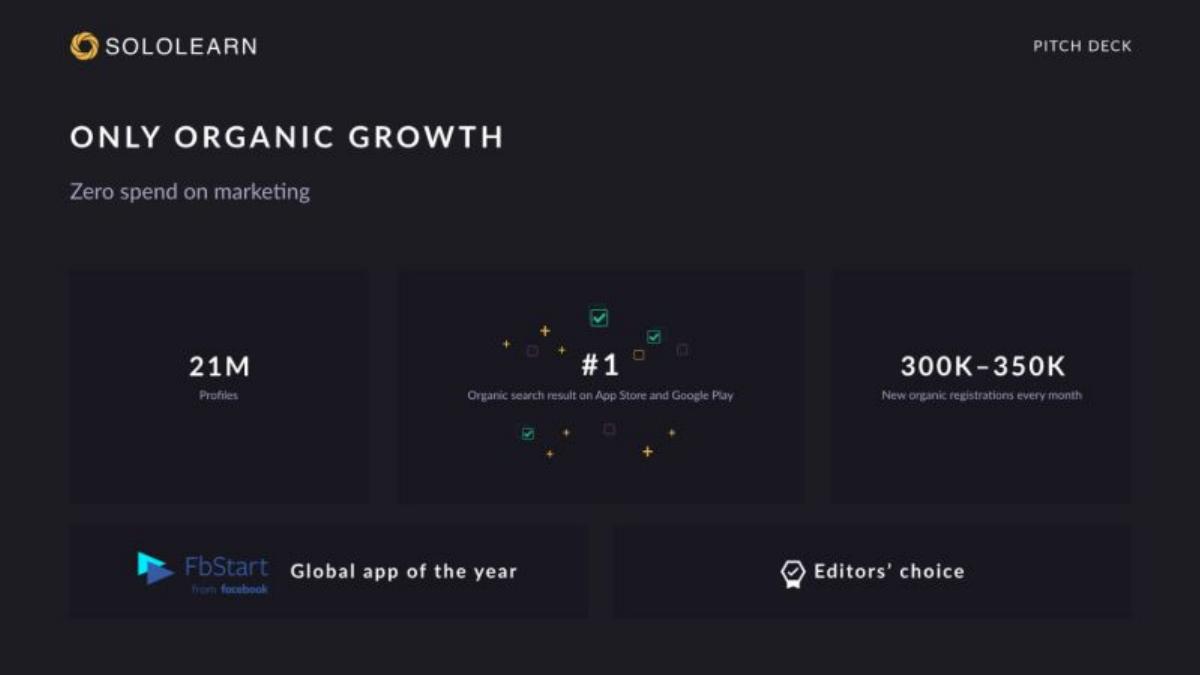
- The company achieved 21 million profiles and 300k-350k monthly registrations with zero spend on marketing (Slide 4).
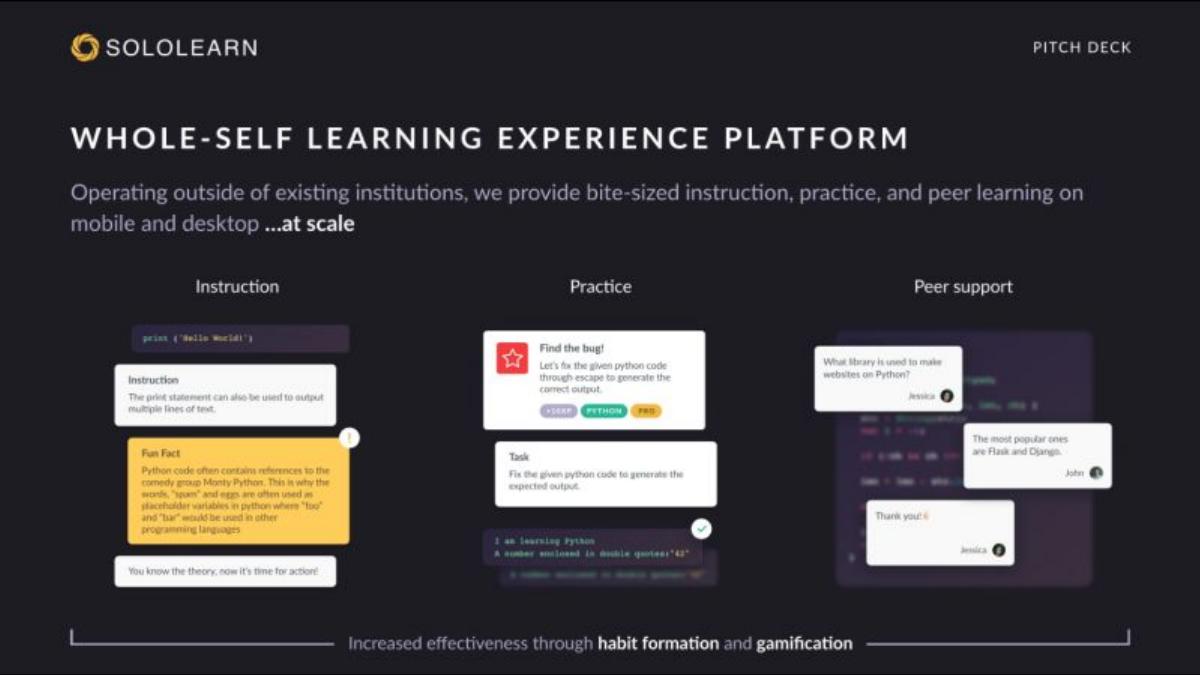
- Sololearn defines its competitive edge as a 'whole-self' learning experience that integrates instruction, practice, and peer support (Slide 3).
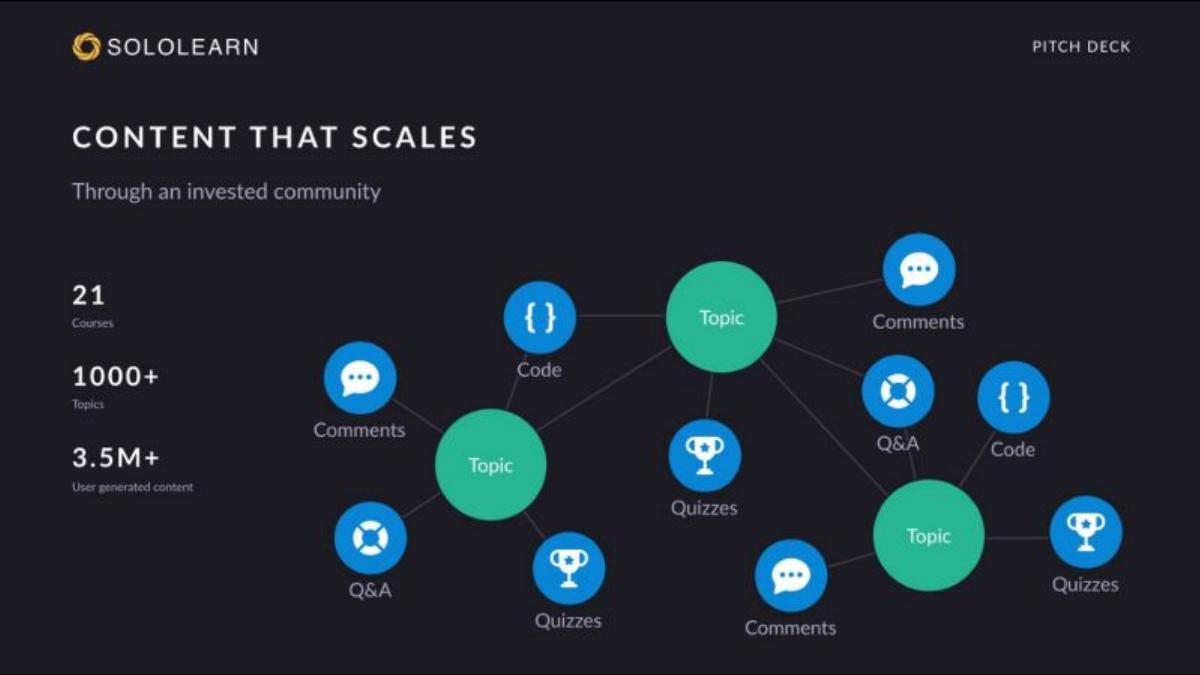
- User-generated content is a massive scale driver, with over 3.5 million pieces of UGC across 21 courses (Slide 5).
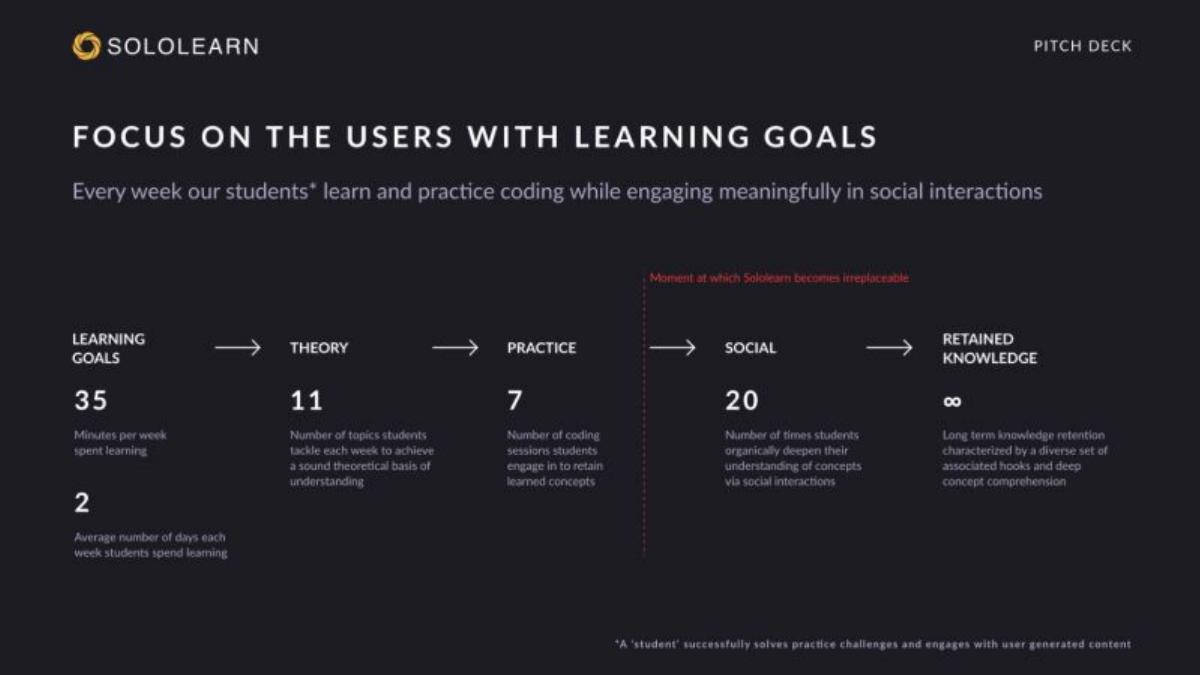
- Engagement metrics are specific: active students spend 35 minutes per week learning across an average of 2 days (Slide 6).
- The 'student' segment is 5x more likely to monetize than the general user base, validating the Q3 2020 freemium pivot (Slide 7).
- 95% of search traffic in the coding education market is for beginners, where Sololearn's SEO strategy is positioned (Slide 10).
- The deck completely omits a team slide, financial projections, and a specific 'ask' or use of funds (Slides 1-23).
- Social interaction is identified as the 'moment at which Sololearn becomes irreplaceable' (Slide 6).
The Macro Problem and the 'Whole-Self' Solution
Slides 1-3: Setting the Stage
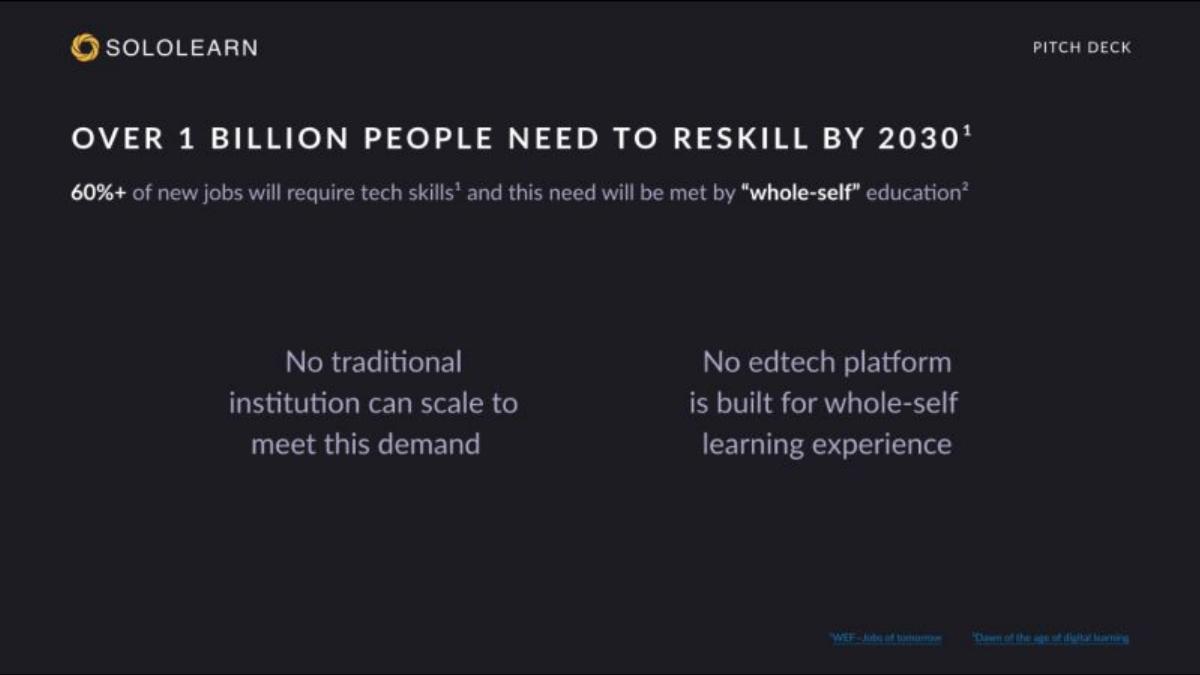
The deck opens with a high-level vision: "Bridge the skills gap to future careers" (Slide 1). This is immediately backed by a massive TAM (Total Addressable Market) claim on Slide 2, stating that "Over 1 billion people need to reskill by 2030." The slide identifies two critical gaps: traditional institutions cannot scale to meet this demand, and existing EdTech platforms are not built for a "whole-self learning experience."
Slide 3 defines this 'whole-self' experience. It isn't just about watching videos; it is a tripartite model of Instruction (bite-sized), Practice (interactive tasks), and Peer Support (community Q&A). By framing the product as a scaleable alternative to institutions, Sololearn positions itself as a infrastructure play rather than just another content library.
The Power of Organic Scale
Slides 4-5: Traction and Content Moats
Slide 4 is the 'mic drop' of the deck. Titled "ONLY ORGANIC GROWTH," it claims "Zero spend on marketing" while boasting 21M Profiles and 300K-350K new organic registrations every month. It also notes being the #1 organic search result on the App Store and Google Play. For a Series B investor, zero CAC (Customer Acquisition Cost) at this scale is an incredibly attractive metric.
Slide 5 explains how they maintain this scale: Content that Scales. With 21 courses and 1000+ topics, the real engine is the 3.5M+ pieces of user-generated content. This community-led model suggests that the platform grows more valuable (and cheaper to run) as more users join, creating a classic network effect moat.
Engagement and the Path to Revenue
Slides 6-9: The Student Lifecycle and Flywheel
Sololearn differentiates between a 'user' and a 'student.' Slide 6 defines a student as someone who successfully solves practice challenges and engages with UGC. These students spend 35 minutes per week learning. Crucially, the slide identifies the "Social" phase as the "Moment at which Sololearn becomes irreplaceable."
Slide 7 provides the financial justification for this focus: "Students are 5x more likely to monetize." Since the freemium model was only introduced in Q3 2020, the charts show a sharp upward trajectory in 'PRO' conversions. Slide 8 further details the premium experience, projecting 4x conversion growth by moving users from basic theory to 'Effective Learning' (real-life problems and personalization).
Slide 9 summarizes the business logic with an "Experience at Scale Flywheel." Improved product leads to more engagement, which leads to more premium offerings, higher conversion rates, and ultimately, more revenue to reinvest in the product. It is a standard but effective visualization of their growth engine.
Market Positioning and Future Vision
Slides 10-11: SEO and 'New Education'
Slide 10 dives into the 'Growth Potential' through marketing and product. It notes that 95% of search in the online coding education market is in beginner search. Sololearn's strategy is to capture this top-of-funnel traffic through SEO and then use 'increased virality' (peer-to-peer reviews) to retain them. Slide 11 serves as a transition, promising to perfect and scale "New Education" where learning is a "daily dose" customized to the individual.
The Experience Demo: A Deep Dive into Product
Slides 12-22: Walking Through the User Journey
The second half of the deck is an extended 'Experience Demo.' It starts by contrasting their vision with the current state of online learning— "Passive content digestion and unidirectional exercises" (Slide 12). From Slide 13 to Slide 20, the deck walks through a hypothetical user journey for someone who says, "I wanna learn Python!"
Slide 14 (Lessons): Shows simple, easy-to-follow instructions. · Slide 15 (Try Code): Demonstrates quizzes and a 'Code Playground' baked into the lessons. · Slide 16 (More Learning): Highlights how helpful comments from the community clarify misconceptions. · Slide 17 (Real-Life Practice): Shows relatable projects like building a 'Thermometer' function. · Slide 18-19 (Get Answers/Peer Help): Focuses on the emotional side of learning, showing how the community supports users when they feel 'lost' or want to 'give up.' · Slide 20-22 (Share the Excitement): Displays the social reward of coding. Users share projects (Slide 20), leave 5-star reviews (Slide 21), and create complex programs like 'Clash of Tanks' or 'CSS Cubes' (Slide 22).
This section is highly visual and serves to prove that the 'whole-self' experience described in Slide 3 is a functional reality, not just a theoretical concept.
What Sololearn's Deck Does Well
The 'Zero Marketing' Hook: Leading with 21 million users acquired for $0 is the strongest possible opening for a Series B deck. It proves product-market fit and suggests that any capital injected will go toward product and scaling, not just feeding a high-CAC machine.
Defining the 'Student': By creating a specific definition for a high-value user (the 'student'), Sololearn shows they understand their data. The 5x monetization multiplier for this segment is a compelling reason for investors to believe in their revenue projections.
Community as a Feature: Most EdTech decks treat community as a 'nice-to-have' forum. Sololearn treats it as a core product feature that drives content creation (3.5M UGC pieces) and retention (the 'irreplaceable' moment).
What is Missing from the Sololearn Deck
No Team Slide: This is the most glaring omission. Investors at the Series B stage are betting heavily on the leadership's ability to scale. There is no mention of the founders, their backgrounds, or the engineering talent behind the platform.
No Competition: The deck mentions that "no edtech platform is built for whole-self learning," but it fails to name or analyze competitors like Codecademy, Duolingo (for coding), or Coursera. A competitive matrix would have helped define their market position more clearly.
No Financials or Ask: While the deck shows growth trends, it lacks a slide on burn rate, LTV/CAC ratios (beyond the 'zero spend' claim), or a specific funding request. We know from external facts they raised $24M, but the deck doesn't explain how that specific number was reached or how it will be allocated.
What Founders Should Copy
The Flywheel Visualization: Slide 9 is an excellent example of how to show investors that your business is a self-reinforcing system rather than a series of disconnected efforts.
The User Journey Demo: Instead of static screenshots, Slides 13-20 tell a story. They address the user's emotional state ("I'm lost," "Should I just give up?") and show how the product provides the solution. This makes the product feel 'human' and essential.
Metric-Driven Moats: Don't just say you have a community; say you have 3.5 million pieces of user-generated content. Don't just say you're growing; say you're getting 300k+ organic signups a month. Specificity builds credibility.
Final Thoughts
The Sololearn Series B deck is a product-first presentation. It relies on the sheer weight of its organic traction and the elegance of its community-driven content model to do the heavy lifting. While the lack of a team or financial slide is unconventional for a $24M raise, the strength of the 21M-user 'zero marketing' claim likely made those details secondary in the initial pitch. It is a powerful example of how a dominant North Star metric can carry a deck.
Frequently asked questions
- How much did Sololearn raise with this deck?
- According to the catalogue facts, Sololearn raised $24 million in a Series B round in 2021. The deck itself focuses on the growth metrics and product philosophy that justified this valuation, though it does not explicitly state the dollar amount requested on any slide.
- What is Sololearn's primary growth strategy?
- Sololearn relies almost entirely on organic growth. Slide 4 highlights 'Zero spend on marketing' while achieving 21 million profiles. This is supported by an SEO strategy targeting the beginner market (Slide 10) and a community flywheel where user-generated content and peer interactions drive retention and new registrations.
- What is the 'whole-self' learning experience mentioned in the deck?
- Slide 3 defines this as a platform operating outside existing institutions that provides bite-sized instruction, practice, and peer learning on mobile and desktop. It aims to move beyond 'passive content digestion' (Slide 12) to a responsive, personalized method involving community, testing, and real-life projects.
- How does Sololearn monetize its users?
- The company uses a freemium business model introduced in Q3 2020. Slide 8 explains that while 'Basic Learning' (theory, peer support) is free, 'Effective Learning' (real-life problems, 1-on-1 help, personalization) is part of the premium 'PRO' offering, which has seen 4x conversion growth.
- What are the most notable omissions in this pitch deck?
- The deck is missing several standard components: there is no team slide introducing the founders or key staff, no competition slide, no detailed financial breakdown or P&L, and no 'Ask' slide detailing how the $24M would be spent.