Someone Somewhere presents a visually compelling case for a lifestyle brand that bridges the gap between traditional craftsmanship and modern consumer demand. The deck focuses heavily on the 'socially conscious millennial' demographic, citing a $35B market opportunity in North America. By positioning themselves alongside successful D2C unicorns like Allbirds and Warby Parker, the company establishes a clear category for their growth. However, the deck is notably light on financial performance data, unit economics, and specific team biographies. It relies on the strength of its supply chain—wh…
Key takeaways
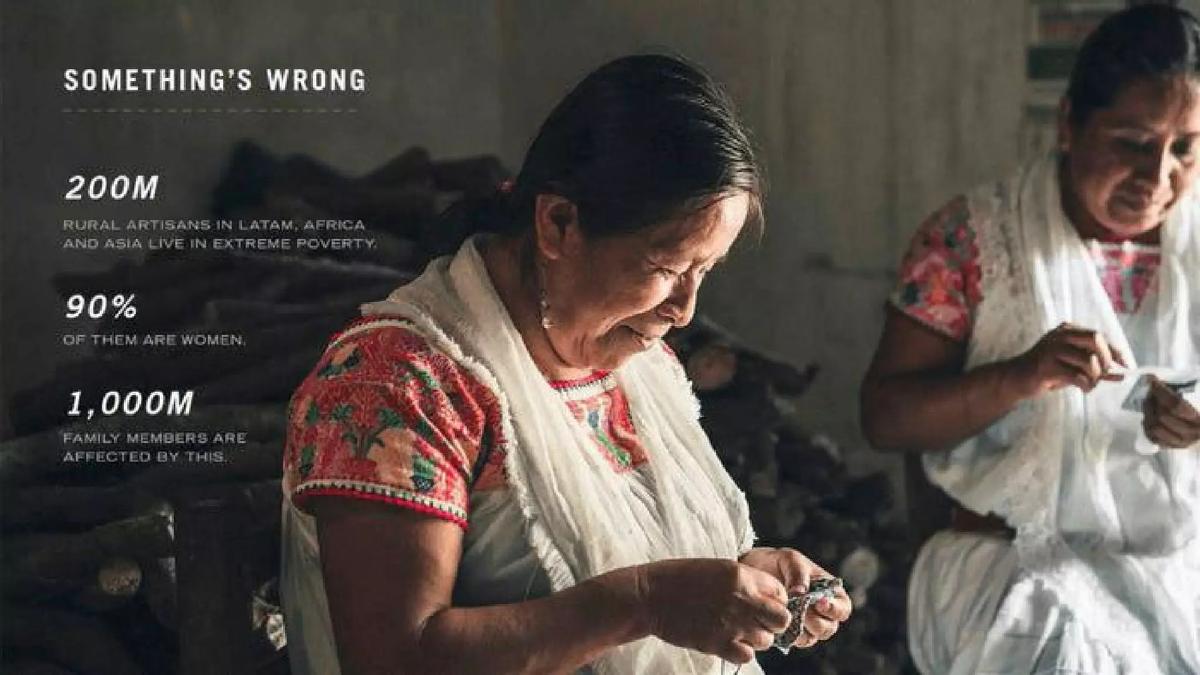
- The deck identifies a massive social problem: 200M rural artisans living in extreme poverty, 90% of whom are women (Slide 2).
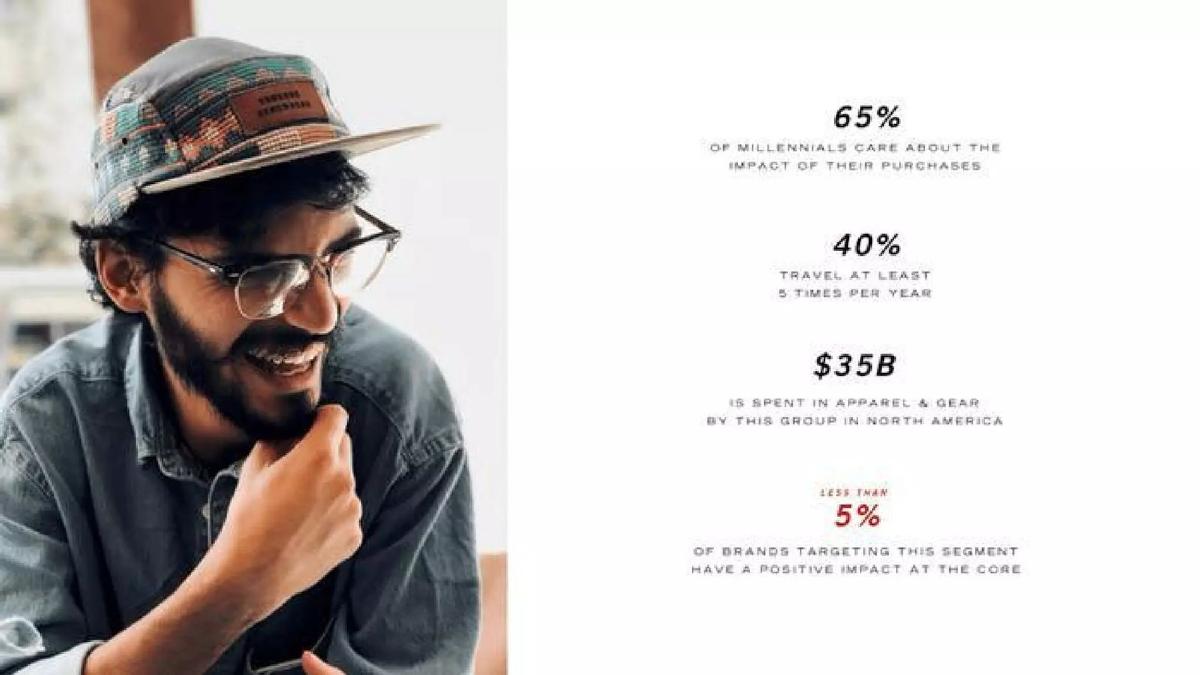
- The target market is defined as millennials, with 65% caring about purchase impact and a $35B spend in apparel and gear (Slide 3).
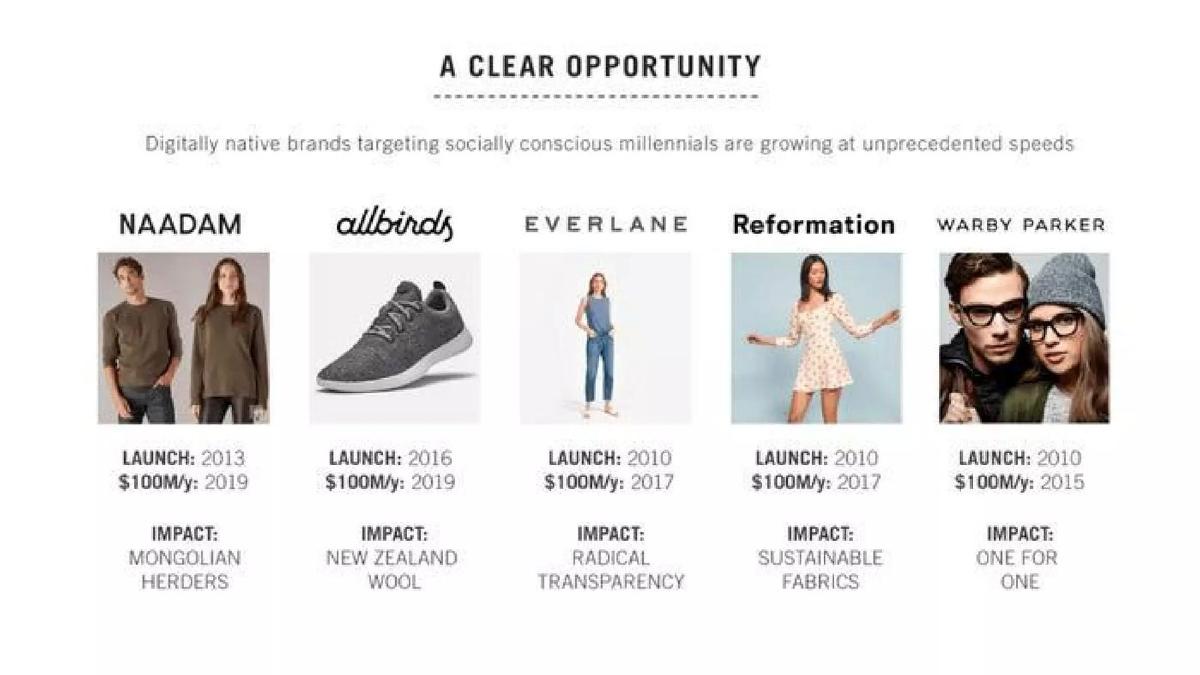
- The company uses a 'Clear Opportunity' slide to benchmark itself against successful D2C brands like Naadam, Allbirds, and Everlane (Slide 4).
- The brand identity is built on transparency, with labels that name the specific artisan and community behind each product (Slide 7).
- The supply chain claims to increase monthly income for artisans by up to 300% through a three-step design and assembly process (Slide 9).
- The business model is omnichannel, showcasing both a 'Digitally Native' online presence and physical retail stores in Mexico (Slides 10, 11).
- The $1.7M funding ask is precisely allocated: 47% for US Launch, 34% for Strategic Hires, and 19% for MX Consolidation (Slide 12).
- The deck lacks a dedicated team slide, omitting the specific backgrounds and expertise of the founders and leadership.
The Narrative of Impact: Someone Somewhere Teardown
Someone Somewhere is a lifestyle brand that operates at the intersection of e-commerce and social impact. Their pitch deck is a masterclass in visual storytelling, focusing on the human element of their supply chain while attempting to ride the wave of successful Direct-to-Consumer (D2C) brands that have defined the last decade. Founded in 2012, the company seeks to scale its model from Mexico to the broader North American market.
The Problem and Market Opportunity (Slides 1-3)
Slide 1: Title. The deck opens with a minimalist black slide featuring only the company name. It sets a premium, brand-focused tone immediately.
Slide 2: Something's Wrong. The problem slide uses high-quality photography of artisans to ground the statistics. It cites that 200M rural artisans in LATAM, Africa, and Asia live in extreme poverty, 90% of whom are women. It further notes that 1,000M family members are affected by this. This is a classic 'Big Problem' slide, though it frames the problem globally while the company's current operations are localized to Mexico.
Slide 3: The Millennial Consumer. This slide shifts from the 'supply' problem to the 'demand' opportunity. It claims 65% of millennials care about purchase impact and that 40% travel at least 5 times per year. Most importantly, it identifies a $35B spend in apparel and gear by this group in North America, while noting that less than 5% of brands targeting this segment have a 'positive impact at the core.' This identifies a clear gap in the market: high demand for ethical products but low supply of authentic brands.
Benchmarking Success (Slide 4)
Slide 4: A Clear Opportunity. This is one of the most strategic slides in the deck. Instead of a traditional competitor matrix, Someone Somewhere lists five D2C 'unicorns': Naadam, Allbirds, Everlane, Reformation, and Warby Parker. For each, they list the launch year and the year they hit $100M/year in revenue. For example, it notes Allbirds launched in 2016 and hit $100M/y by 2019. By highlighting the 'Impact' of each (e.g., 'Mongolian Herders' for Naadam), they place themselves in an established lineage of high-growth, mission-driven companies. This reduces perceived risk by showing that the 'socially conscious millennial' model is proven and scalable.
The Solution and Brand Identity (Slides 5-7)
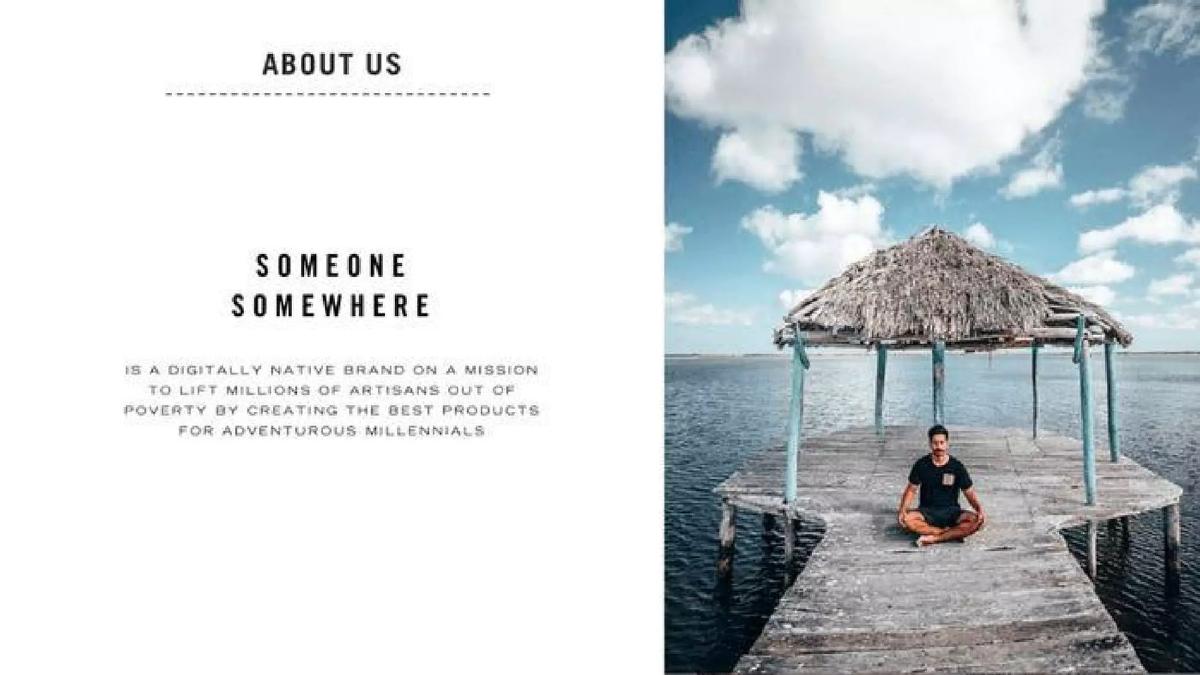
Slide 5: About Us. This slide defines the company as a 'digitally native brand on a mission to lift millions of artisans out of poverty.' It is a concise mission statement that bridges the social goal with the business model.
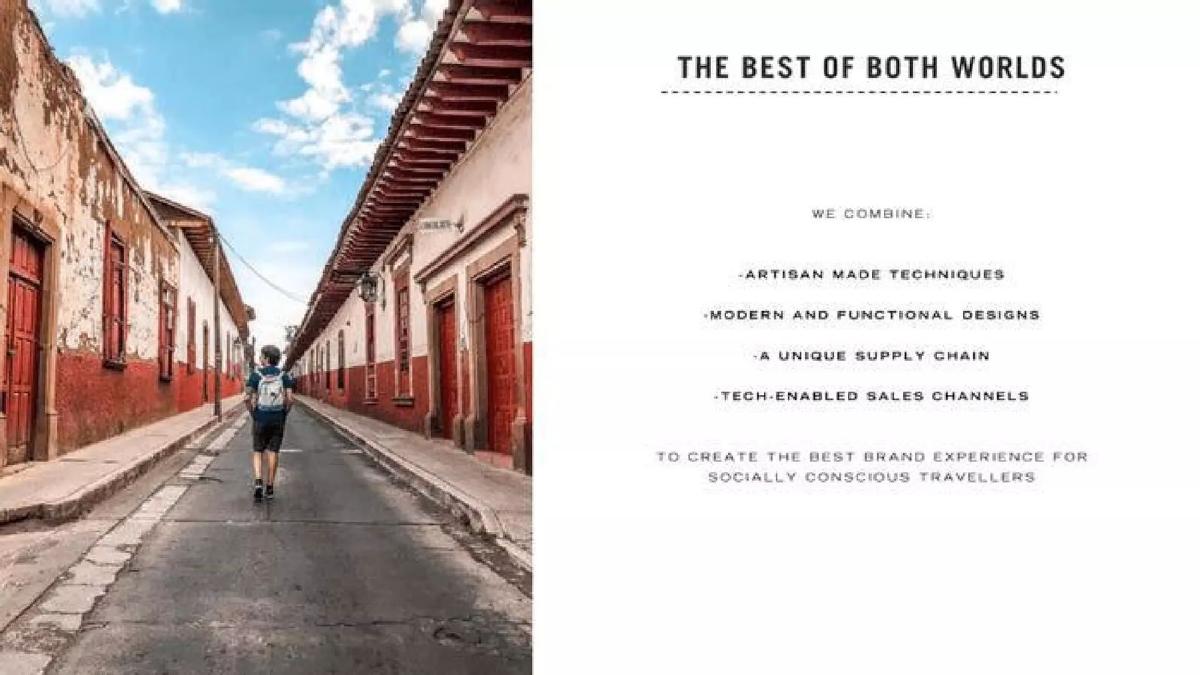
Slide 6: The Best of Both Worlds. This slide breaks down the 'how.' They combine artisan techniques, modern designs, a unique supply chain, and tech-enabled sales. This is the first mention of their 'Tech-Enabled' nature, though the deck doesn't elaborate on the specific technology used.
Slide 7: Our Label. This slide highlights a key product feature: the label. The label includes the name of the 'Someone' (the artisan) and the 'Somewhere' (the community). This is a powerful tool for consumer connection and radical transparency, similar to the Everlane model mentioned earlier.
Operational Strategy and Supply Chain (Slides 8-9)
Slide 8: Why Now? The 'Why Now' slide is a bit vague, citing an 'Innovative Supply Chain,' 'D2C Distribution,' and being 'All Driven by Data.' The data claim is illustrated with questions like 'Which products should we make?' but lacks evidence of how they currently use data to drive these decisions.
Slide 9: The Heart of Our Supply Chain. This slide provides a three-step overview of their production: in-house design, artisan creation of handmade elements, and specialized workshops for final assembly. The headline claim is significant: artisans can increase their monthly income by up to 300% without changing their lifestyle. This suggests a decentralized production model that respects local culture while meeting industrial standards.
Omnichannel Presence (Slides 10-11)
Slide 10: Online World. This slide shows the e-commerce interface on a laptop and mobile device. It emphasizes the 'Digitally Native' aspect of the brand, though it provides no metrics on web traffic, conversion rates, or online sales growth.
Slide 11: Offline World. This slide displays their physical retail presence. It shows a storefront and interior shots of a well-designed, modern retail space. This demonstrates that the brand is already 'real' and has successfully translated its aesthetic into a physical environment, which is a key part of their US expansion plan.
The Ask and Future Roadmap (Slides 12-13)
Slide 12: Opportunity / Use of Funds. The company is raising $1.7M USD. The allocation is clear: 47% for the US Launch (online + 2 physical stores), 34% for Strategic Hires, and 19% for MX Consolidation. They also set a clear milestone: reaching the break-even point and raising a $5-7M Series A in 18-24 months. This is a very standard and professional 'ask' slide.
Slide 13: Let's Talk. The deck ends with a high-energy photo of laughing artisans, reinforcing the human impact of the investment.
What Works in This Deck
Visual Cohesion: The deck uses high-quality, consistent photography that makes the brand feel premium and established. · Market Benchmarking: Comparing themselves to Allbirds and Warby Parker (Slide 4) is a smart way to signal the potential 'exit' or 'scale' size to investors without having to invent their own market category. · Clear Mission: The 'Someone' and 'Somewhere' naming convention is intuitive and effectively communicated through the label slide (Slide 7). · Specific Ask: The use of funds (Slide 12) is granular and tied to specific business outcomes (US launch, break-even).
What is Missing
The Team: This is the most glaring omission. There is no slide detailing who the founders are, their previous experience in retail or e-commerce, or the 'Strategic Hires' they already have on board. · Financial Traction: There are zero revenue numbers. For a company founded in 2012 (per catalogue facts) and raising a 'Later' stage round, investors would expect to see year-over-year growth, current revenue, and gross margins. · Unit Economics: There is no mention of Customer Acquisition Cost (CAC) or Lifetime Value (LTV). In the crowded D2C space, these metrics are vital to prove the business can grow profitably. · Competition: While they list 'aspirational' peers, they don't address direct competitors in the ethical fashion or artisan-made goods space.
What a Founder Should Copy
The 'Clear Opportunity' Slide: If you are in a new or niche category, find 4-5 companies that have successfully scaled a similar business model in adjacent categories. It proves the 'math' of your business works even if your specific product is different. · The Use of Funds Pie Chart: Don't just say you need money for 'marketing.' Break it down into percentages and tie it to a 18-24 month milestone like Someone Somewhere does on Slide 12. · Product-as-Story: The way they use the clothing label to tell the company's story (Slide 7) is a perfect example of how to bake your marketing and mission directly into your product.
Frequently asked questions
- What is the primary value proposition of Someone Somewhere?
- The primary value proposition is the combination of traditional artisan embroidery with modern, functional product design for the millennial market. According to Slide 6, they combine 'Artisan Made Techniques' with 'Tech-Enabled Sales Channels' to create a unique supply chain. This allows them to offer high-quality, socially impactful products that appeal to the 65% of millennials who care about the social impact of their purchases.
- How does the company measure its social impact?
- The company measures impact primarily through artisan income and employment. Slide 9 states that their supply chain allows artisans to increase their monthly income by up to 300% without changing their lifestyle. Additionally, Slide 12 notes that a goal of the $1.7M raise is to 'Increase 6x our impact,' though it does not specify if this refers to the number of artisans employed or total wages paid.
- Who are the main competitors mentioned in the deck?
- The deck does not list direct competitors in a traditional 'grid' format. Instead, Slide 4 lists 'Digitally Native' brands that have successfully targeted socially conscious millennials, including Naadam, Allbirds, Everlane, Reformation, and Warby Parker. By showing these brands reaching $100M/year in revenue within 5-9 years of launch, Someone Somewhere positions itself as the next logical winner in this category.
- What is the specific plan for the $1.7M investment?
- As detailed on Slide 12, the $1.7M USD will be used for three main pillars: 47% for a US Launch (including online and 2 physical stores), 34% for Strategic Hires to strengthen the team, and 19% for consolidating their existing operations in Mexico. The stated financial goal of this raise is to reach the break-even point and prepare for a $5-7M Series A in 18-24 months.
- What critical information is missing from this pitch deck?
- The deck is missing three critical components: a team slide, financial traction, and unit economics. There are no bios for the founders, no mention of current monthly recurring revenue (MRR) or annual run rate (ARR), and no data on margins or customer acquisition costs. While the brand and mission are clear, the lack of financial proof points makes it a high-conviction 'story' deck rather than a 'data' deck.