SoLo Funds raised a $10M Series A in 2023, led by ACME Capital and Impact America, to address the scarcity of small-dollar emergency loans. The 15-slide deck focuses on a peer-to-peer marketplace where borrowers set their own terms and lenders provide capital for loans under $1,000. A central pillar of the pitch is the 'SoLo Score,' a proprietary social credit algorithm designed to assess borrowing potential beyond traditional credit scores. The deck successfully highlights a massive underserved market—citing that 78% of American workers live paycheck-to-paycheck—while positioning financial l…
Key takeaways
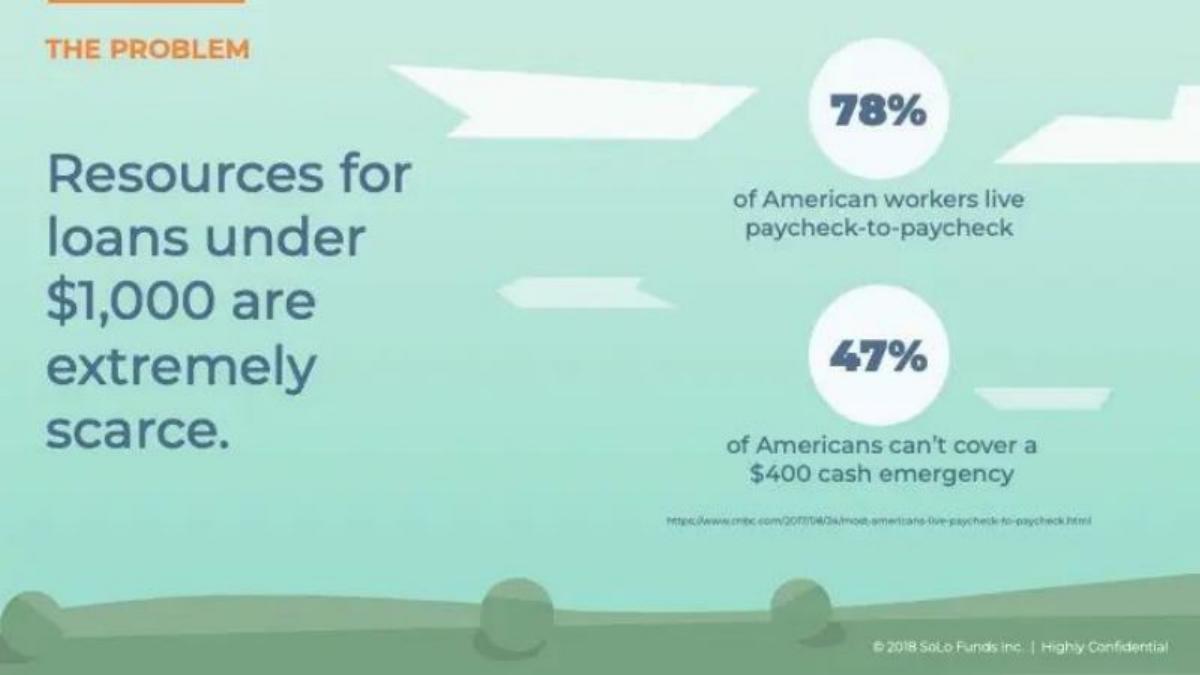
- The problem slide identifies a specific gap in the market: loans under $1,000 are extremely scarce for the 78% of Americans living paycheck-to-paycheck (Slide 2).
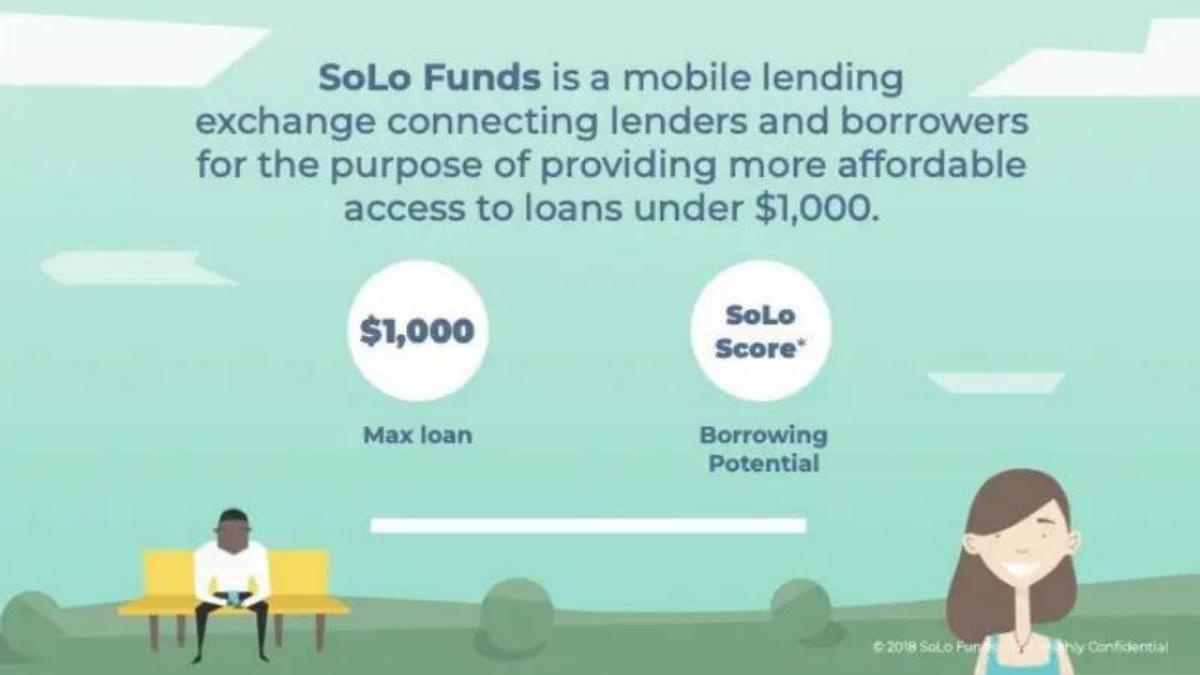
- SoLo Funds positions itself as a mobile lending exchange rather than a traditional bank, connecting lenders and borrowers directly (Slide 3).
- The 'SoLo Score' is introduced as a proprietary alternative to traditional credit scoring to determine borrowing potential (Slide 3).
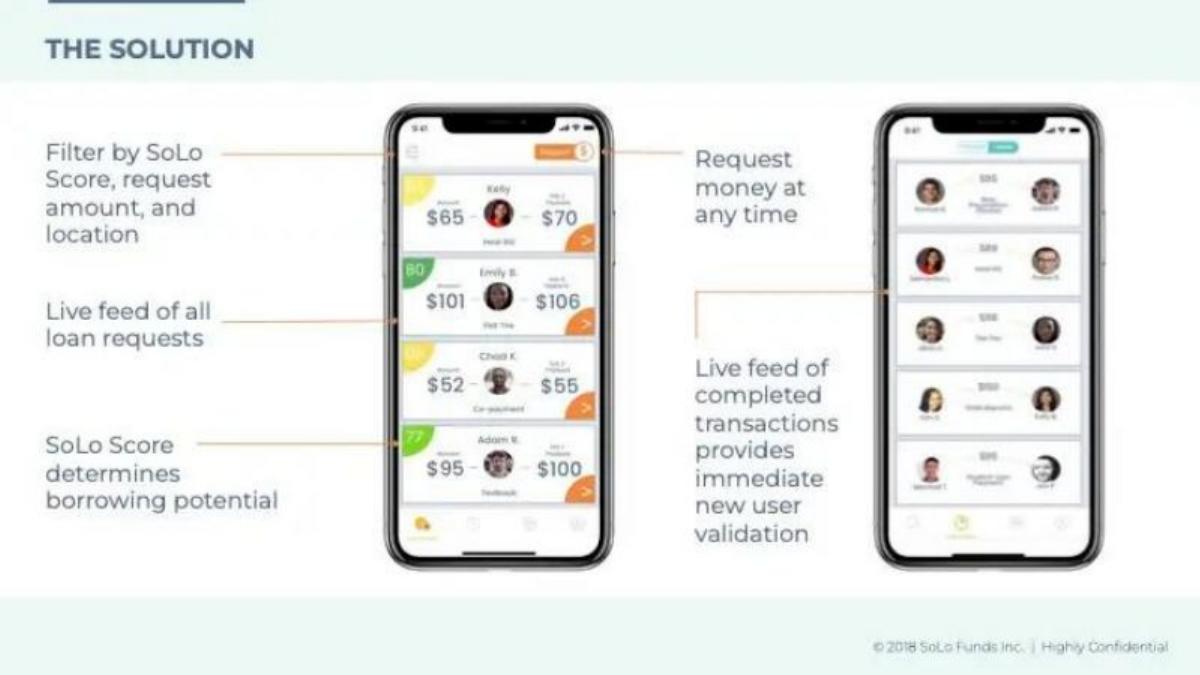
- The product interface allows borrowers to request money at any time and provides a live feed of completed transactions for social validation (Slide 4).
- Financial literacy is integrated into the platform via a white-labeled curriculum that is free for all users (Slide 7).
- The competitive landscape slide claims SoLo is the only player offering the combination of low loans, mobile/web access, P2P lending, and financial literacy (Slide 8).
- Traction is demonstrated through a $1.2M Seed round, participation in Techstars, and a published patent for their social credit algorithm (Slide 10).
- The team slide highlights founders with backgrounds at Northwestern Mutual, P&G, and Roc Nation, alongside a deep bench of developers and designers (Slide 12).
SoLo Funds: Disrupting the Micro-Lending Market
SoLo Funds entered the fintech space with a clear mission: to solve the liquidity crisis for the average American worker. Their Series A deck, which helped secure $10M in 2023, focuses heavily on the social impact and the mechanical simplicity of their peer-to-peer marketplace. By targeting loans under $1,000, they carved out a niche that traditional banks and larger P2P lenders often ignore due to high overhead and low margins.
Slide 1: Title Slide
The deck opens with a minimalist title slide featuring the SoLo logo—two overlapping circles in yellow and orange. There is no tagline or mission statement here, relying entirely on the brand identity. The background uses a soft teal color palette with stylized white clouds, establishing a friendly, non-institutional aesthetic that carries through the rest of the presentation.
Slide 2: The Problem
Slide 2 establishes the market urgency. It states that "Resources for loans under $1,000 are extremely scarce." To back this up, the slide cites two critical statistics: 78% of American workers live paycheck-to-paycheck and 47% of Americans can't cover a $400 cash emergency . By citing a 2017 CNBC report, the founders ground their pitch in a well-documented macroeconomic reality, positioning their solution as a necessity rather than a luxury.
Slide 3: The Mission and Product Definition
This slide defines SoLo Funds as a "mobile lending exchange connecting lenders and borrowers for the purpose of providing more affordable access to loans under $1,000." It introduces two key product pillars: the $1,000 Max loan and the SoLo Score . The asterisk next to SoLo Score hints at the proprietary nature of their borrowing potential metric, which is the engine of their marketplace.
Slide 4: The Solution (UI/UX)
Slide 4 showcases the mobile interface. It highlights features such as the ability to "Filter by SoLo Score, request amount, and location" and a "Live feed of all loan requests." Interestingly, it also mentions a "Live feed of completed transactions" which they claim provides "immediate new user validation." This social proof mechanism is a common tactic in P2P marketplaces to build trust between anonymous participants.
Slide 5: How It Works - Sign-up
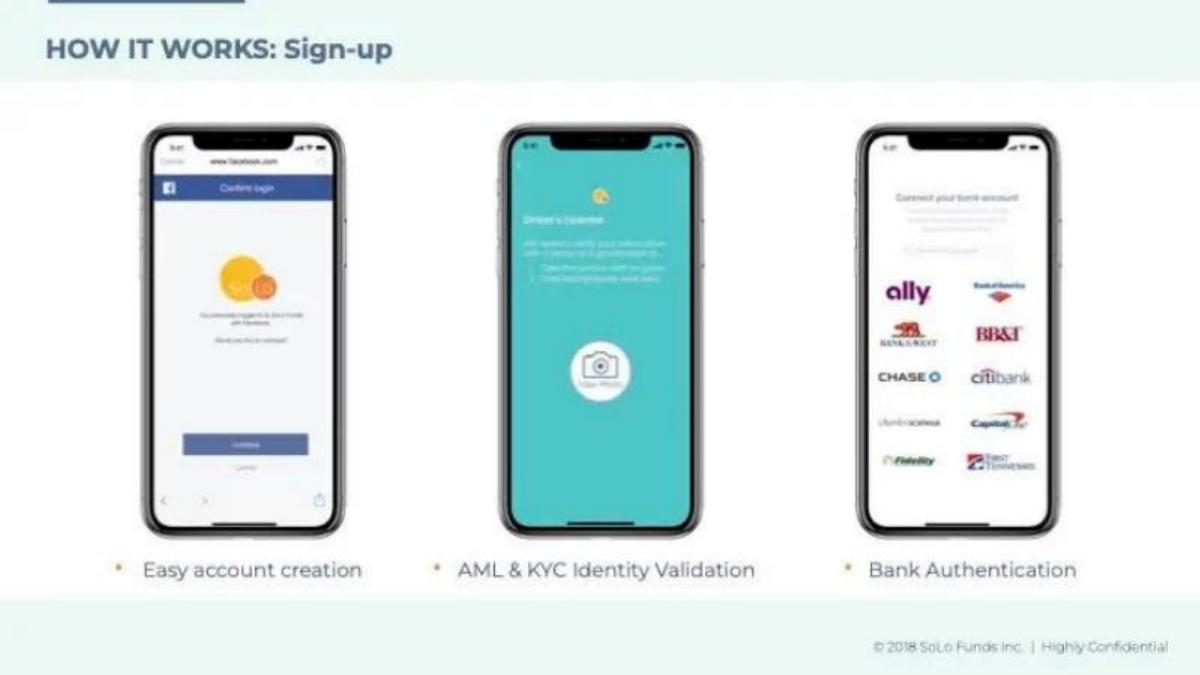
The sign-up flow is presented as a three-step process: Easy account creation (via Facebook login), AML & KYC Identity Validation (via driver's license photo), and Bank Authentication . The slide displays logos of major banks like Ally, Chase, and Bank of America, signaling that the platform integrates with the existing financial ecosystem to facilitate secure transfers.
Slide 6: How It Works - Borrower Request
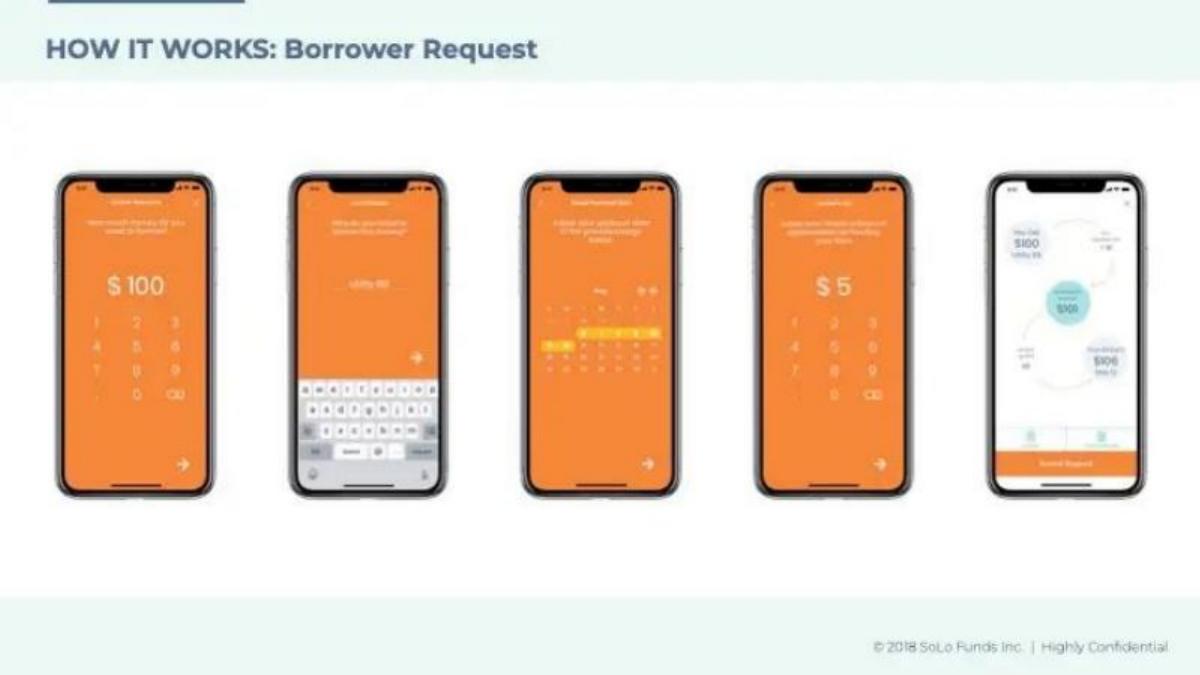
This slide illustrates the borrower's journey. A user selects a loan amount (e.g., $100), states the reason (e.g., "Utility Bill"), sets a repayment date, and offers a "tip" or fee (e.g., $5). The final screen shows a summary where a $100 loan results in a $106 total repayment. This transparency is central to their pitch of being an "affordable" alternative to payday lenders.
Slide 7: Financial Literacy
SoLo emphasizes its social mission by dedicating a slide to financial literacy. They offer a "White-labeled curriculum" that is "Free for all users." The courses range from "Building Emergency Savings" to "Credit Scores and Reports." By including this, SoLo positions itself as a tool for long-term financial health, which likely appealed to the impact-focused investors (Impact America) in their Series A round.
Slide 8: Competitive Landscape
The competition grid compares SoLo to LendingClub, LendingTree, Prosper, Puddle, and LendUp. SoLo claims to be the only provider that hits all five criteria: Low Loan, Mobile, Web, Peer to Peer, and Financial Literacy. Notably, they mark competitors like LendingClub and Prosper as P2P, but indicate that for those platforms, the "institution dictates borrower" terms, whereas SoLo allows the marketplace to set them.
Slide 9: Product Roadmap
The roadmap covers May '18 through Fall '18. Key milestones include the Go-to-Market Launch (Android) in May, Referral Incentives in June, Introducing a Banking Partner in August, and Private Group Lending and White-Label Banking Solutions in the Fall. This slide demonstrates a clear path from a simple lending app to a broader financial services platform.
Slide 10: Traction
The traction slide is a collection of logos and high-level achievements. It notes they "Raised $1.2M (Seed)" and have a "Proprietary Social Credit Algorithm." They list accelerators like Techstars and Patriot Boot Camp , and partnerships with EverFi and TrueAccord . While visually impressive, the slide lacks the specific growth metrics (MoM revenue, active lenders vs. borrowers) usually expected at the Series A stage.
Slide 11: Why Now?
This slide uses a simple checklist: Massive Underserved Market, Right Message, and Validated. The accompanying illustration of a person signing a document reinforces the idea that the market is ready and the legal/regulatory groundwork is being laid.
Slide 12: Founders and Team
The team slide is split between "Founders" and "Team." CEO Travis Holoway is highlighted with a background at Northwestern Mutual . Advisor Rodney Williams brings experience from Procter & Gamble and LISNR . The broader team includes roles like Data Scientist, iOS Developer, and Backend Developer , showing a balanced focus on technology and design.
Slide 13: Advisors
The advisor slide adds further credibility with Jenny Fielding (Techstars), Seth Metcalf (Former Deputy Treasurer of Ohio), and Richelieu Dennis (Sundial Brands). The inclusion of a former government official (Metcalf) is a strategic move for a fintech company operating in a highly regulated space like lending.
Slide 14: Conclusion
The deck ends with a simple "Thank you" slide containing the CEO's contact information. It maintains the clean, airy design of the opening slide.
What SoLo Funds Does Well
The deck excels at identifying a massive, relatable problem and presenting a simple, elegant solution. By focusing on the "under $1,000" niche, they avoid direct competition with the giants of P2P lending who have moved toward larger personal loans. The emphasis on the "SoLo Score" suggests a technological moat—a proprietary way to price risk where others cannot. Furthermore, the integration of financial literacy transforms the app from a simple utility into a mission-driven platform, which is a powerful narrative for modern VCs.
What is Missing from the Deck
For a $10M Series A, the deck is surprisingly light on data. There are no slides covering:
Unit Economics: What is the average take rate per loan? What is the CAC? · Default Rates: In P2P lending, the biggest risk is the default rate. The deck does not disclose how their "SoLo Score" has performed in the real world. · Revenue Growth: There is no mention of historical revenue or projected financials. · The Ask: The deck does not specify how much they are raising (though we know from catalogue facts it was $10M) or how they intend to use the funds.
Founder Takeaways
Founders should study how SoLo Funds uses social proof and mission-alignment to build a compelling narrative. The use of a competitive matrix (Slide 8) that highlights a specific, unaddressed niche (Low Loans + Mobile) is a textbook example of how to position a startup against entrenched incumbents. However, founders should be prepared to provide the missing data—specifically default rates and unit economics—in a supplemental data room, as these are the first questions any Series A investor will ask in a fintech deal.
Frequently asked questions
- What is the core business model of SoLo Funds?
- SoLo Funds operates as a peer-to-peer (P2P) mobile lending exchange. Unlike traditional lenders that use their own balance sheets, SoLo provides a marketplace where individual lenders fund the emergency needs of borrowers for loans under $1,000. They utilize a proprietary 'SoLo Score' to facilitate these transactions, moving away from institutional dictation of terms.
- How does SoLo Funds differentiate itself from competitors like LendingClub or Prosper?
- According to Slide 8, SoLo differentiates itself by focusing specifically on 'Low Loans' (under $1,000) and providing a mobile-first experience. While competitors like LendingClub and Prosper offer peer-to-peer lending, SoLo claims they do not focus on the micro-loan segment or integrate free financial literacy courses directly into the user experience.
- What metrics are used to prove traction in this deck?
- The deck is relatively light on hard financial metrics. Slide 10 lists 'Traction' as having raised a $1.2M Seed round, publishing a patent, and securing partnerships with entities like EverFi and TrueAccord. It also mentions press coverage from Black Enterprise and Blavity, but does not disclose active user counts, loan volume, or default rates.
- What is the significance of the SoLo Score?
- The SoLo Score is presented as the platform's proprietary social credit algorithm. It is used to determine a user's 'borrowing potential' (Slide 3). By creating their own scoring system, SoLo aims to provide credit access to the 47% of Americans who cannot cover a $400 emergency, many of whom may be underserved by traditional FICO-based systems.
- What is missing from the SoLo Funds Series A deck?
- The deck lacks a clear 'Ask' slide, which is standard for a Series A pitch to explain how the $10M will be spent. It also omits detailed unit economics, such as the cost of customer acquisition (CAC), lifetime value (LTV), and most importantly, the historical performance/default rates of the loans facilitated on the platform.