Galatica Smart Energy Infrastructure presents one of the most disjointed narratives in the startup ecosystem, attempting to pitch two entirely unrelated business units under one banner. The first half of the deck focuses on VeriComm, a software solution aimed at the $22-25B global scam crisis (Slide 03). The second half abruptly shifts to energy infrastructure, proposing the acquisition of second-hand oil tankers for $8-15M each to generate $30-40M in revenue per trip (Slide 11). While the team slide (Slide 13) features individuals with relevant backgrounds in engineering and finance, the dec…
Key takeaways
- The deck identifies a massive global scam crisis costing consumers over $22B annually, specifically citing $12.5B in losses in the USA (Slide 03).
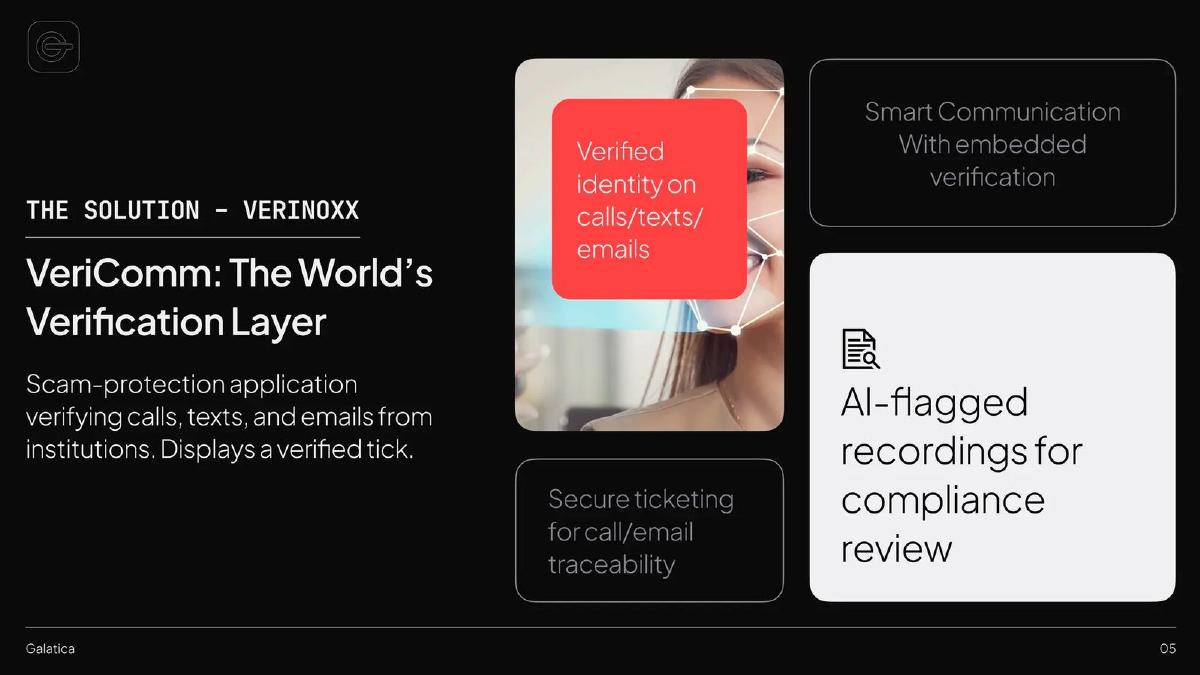
- The proposed software solution, VeriComm, aims to be a 'Verification Layer' for calls, texts, and emails from institutions (Slide 05).
- Galatica outlines a 'Multi-Angle Pressure Campaign' that involves using PR and regulators to force big tech and telecom companies into adoption (Slide 09).
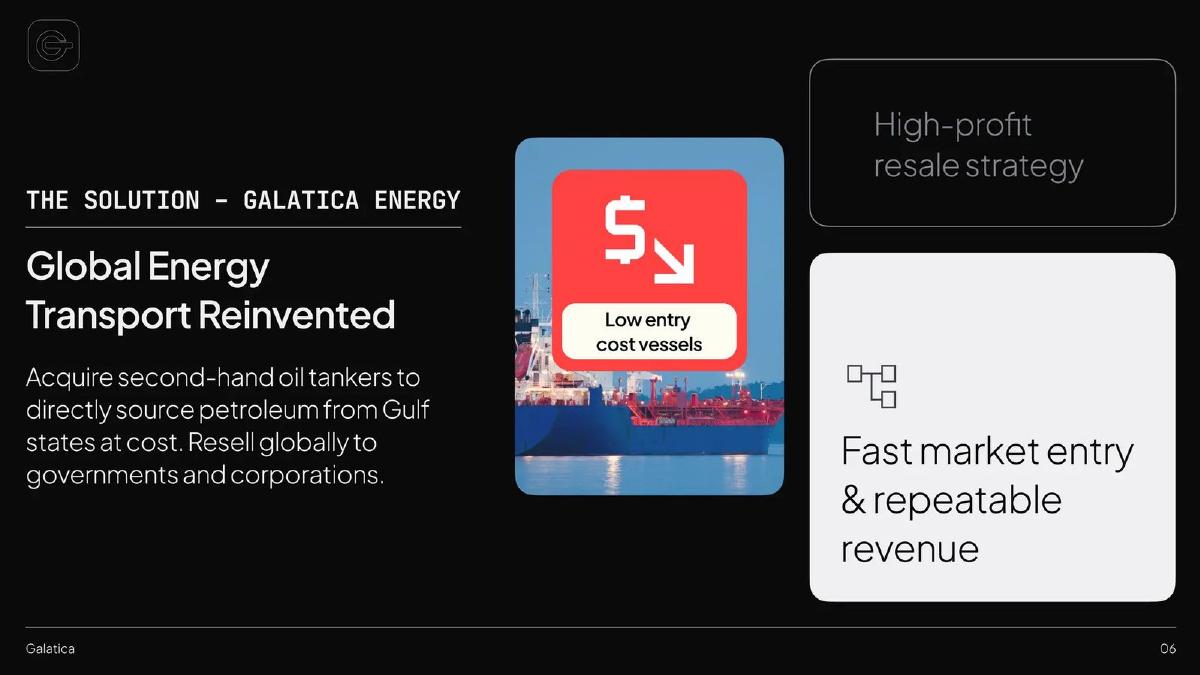
- The business model shifts entirely to energy, proposing the purchase of tankers with 1-2M barrel capacity to arbitrage oil prices (Slide 11).
- The energy model relies on a $30-40 per barrel spread between source price and resale price (Slide 11).
- The team includes a CEO with 6+ years in brand building and a CTO with 25+ years in engineering and telecom (Slide 13).
- There is no slide detailing the total amount of capital being raised or how it will be allocated between software and tankers.
- The deck lacks any mention of existing customers, pilot programs, or letters of intent for either the software or energy divisions.
Slide-by-Slide Analysis
Slide 01: Title Slide
The deck opens with a minimalist black background featuring the Galatica logo—a stylized 'G' that resembles a power button or a toggle switch. The tagline is 'Power. Protection. Progress.' and the year '2025' is displayed at the bottom. This slide establishes a corporate, infrastructure-focused aesthetic but provides no immediate indication of the company's industry.
Slide 03: The Problem - Verinoxx
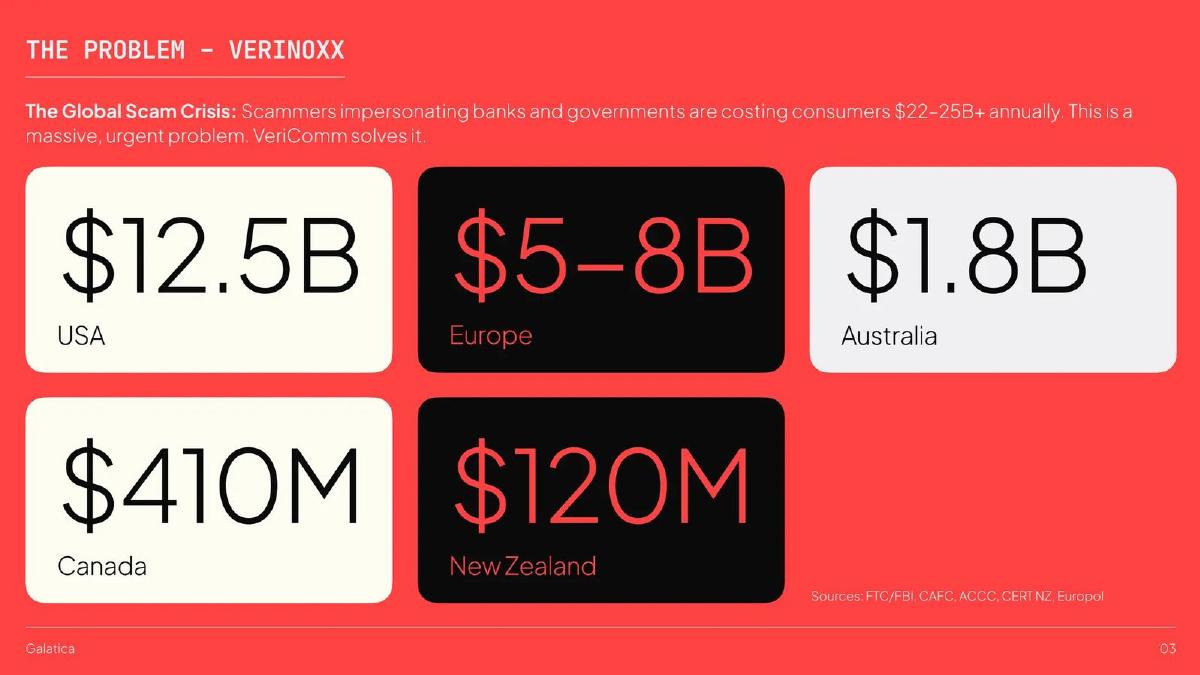
This slide introduces 'The Global Scam Crisis' under the sub-brand Verinoxx. It claims scammers impersonating banks and governments cost consumers $22-25B+ annually. The slide uses large, bold typography to break down losses by region: $12.5B in the USA, $5-8B in Europe, $1.8B in Australia, $410M in Canada, and $120M in New Zealand. Sources cited include the FTC/FBI, CAFC, ACCC, CERT NZ, and Europol. This is a standard 'hair on fire' problem slide, though it focuses exclusively on the software side of the business.
Slide 05: The Solution - Verinoxx
Galatica introduces 'VeriComm,' described as 'The World’s Verification Layer.' The product is a scam-protection application that verifies calls, texts, and emails from institutions, displaying a 'verified tick' to the user. Features listed include smart communication with embedded verification, secure ticketing for traceability, and AI-flagged recordings for compliance review. The visual shows a woman's face with a facial recognition overlay, suggesting biometric components, though the text does not explicitly detail how the verification is performed.
Slide 07: Market Opportunity - Verinoxx
The strategy for market entry involves three pillars: building the product and partnering with telecoms, securing government backing, and leveraging that support to onboard 'Big Tech' (Apple and Google). The slide suggests that by aligning with regulatory mandates, Galatica can earn formal endorsements. It also mentions offering Apple and Google a 'stake or revenue share' to increase buy-in potential. This slide transitions from a product pitch to a high-level distribution strategy.
Slide 09: The Multi-Angle Pressure Campaign
This is perhaps the most unconventional slide in the deck. It outlines a 'Breadwinning Formula' based on 'strategic pressure.' The flow involves pitching a company, then informing government agencies of the approach, engaging shareholder groups to ask if their investment is protected, and running PR campaigns featuring scam victims tied to companies that haven't adopted VeriComm. The goal is to use 'public and executive pressure' to force adoption. This 'hostile' sales strategy is a significant departure from traditional B2B SaaS go-to-market motions.
Slide 11: Business Model - Galatica
The deck takes a sharp turn here, moving away from Verinoxx/VeriComm and into 'Galatica' energy infrastructure. The plan is to acquire second-hand oil tankers with 1-2M barrel capacity for $8-15M each. The revenue model is based on commodity arbitrage: buying oil at $30-40 per barrel and reselling it at $70-80 per barrel. The slide claims a 'Trip Yield' of $30-40M in revenue per tanker trip. There is no explanation of how the company will secure oil at roughly 50% of the resale price or how this relates to the scam-protection software.
Slide 13: Meet Our Team
The team slide presents four individuals. Sahal Hassan (CEO) is described as a marketing-driven founder with 6+ years in brand building. Eric Stone (CTO) is a 25-year engineering leader and ex-telecom executive. Collin Nieman (CFO) is a Wall Street-trained strategist. Ahmed Mohamed (Energy Ops) is a Middle East-based operations engineer. While the individuals appear qualified, the team is split between software expertise (CEO, CTO) and energy expertise (CFO, Energy Ops), mirroring the split nature of the deck.
Slide 15: Vision Statement
The final slide provided shows an industrial energy facility at dusk. The text claims Galatica is building the 'next global titan' where 'security meets energy.' It mentions a 'dual-market strategy' and 'proven leadership' to deliver sustainable value. It functions as a summary slide but lacks a concrete call to action or contact information.
What Galatica Does Well
Visual Clarity: The deck uses a consistent, high-contrast color palette (black, white, and red) that feels professional and authoritative. The use of large typography for key metrics on Slide 03 makes the scale of the problem immediately apparent.
Problem Quantification: The 'Global Scam Crisis' is well-documented with specific figures and reputable sources. By breaking the losses down by country, the founders demonstrate a global perspective on the market opportunity.
Team Composition: On paper, the team has the necessary components for a complex project. Having a CTO with 25 years of experience and a Middle East-based Energy Ops lead provides a level of credibility that the ambitious business model requires.
What is Missing from the Deck
Strategic Cohesion: The biggest flaw is the lack of a 'bridge' between scam-protection software and oil tankers. The deck presents them as a 'dual-market strategy,' but there is no operational, technical, or financial synergy explained. Investors typically look for focus; pitching a SaaS app and a shipping fleet simultaneously is highly irregular.
The Ask: There is no mention of how much capital is being raised. Given that a single tanker costs up to $15M and software development for a 'global verification layer' is equally expensive, the capital requirements are likely massive, yet the deck remains silent on the funding round details.
Traction and Proof of Concept: There are no case studies, pilot results, or revenue figures for the software. Similarly, there is no evidence that the company has access to the oil supply chains required to achieve the $30-40/barrel margins claimed on Slide 11.
Regulatory and Operational Risks: Operating a fleet of oil tankers involves immense regulatory, environmental, and geopolitical risk. Likewise, a 'pressure campaign' to force Big Tech adoption could lead to significant legal pushback. Neither of these risk profiles is addressed.
Founder Takeaways: What to Copy and What to Avoid
Copy the Problem Framing: Slide 03 is an excellent example of how to present a macro problem. It uses 'big numbers' effectively and cites credible sources to validate the urgency of the solution.
Avoid the 'Everything Store' Approach: Founders should avoid pitching two unrelated businesses in one deck. It dilutes the value proposition and makes the team look unfocused. If Galatica is an energy company that uses proprietary security software, that needs to be the narrative. If they are two separate companies, they need two separate decks.
Be Wary of 'Pressure' Strategies: While 'creating urgency' is a standard sales tactic, explicitly documenting a plan to use regulators and PR to 'pressure' potential clients into buying (Slide 09) can be perceived as aggressive or litigious by investors. It is generally better to focus on the value provided rather than the consequences of not buying.
Include a Clear Ask: Never leave an investor guessing about what you need. A pitch deck is a fundraising tool; if it doesn't state the amount being raised and the milestones that capital will achieve, it has failed its primary purpose.
Frequently asked questions
- What is the primary product Galatica is pitching?
- The deck is split between two products. The first is VeriComm, a software application designed to verify communications from banks and governments to prevent scams. The second is an energy infrastructure play involving the acquisition and operation of second-hand oil tankers for commodity trading. The deck does not clarify which is the primary focus or how they are integrated.
- How does Galatica plan to acquire customers for its software?
- Slide 09 details a 'Multi-Angle Pressure Campaign.' This involves pitching companies directly, then informing government agencies if they don't adopt, engaging shareholder groups to question protection levels, and running PR campaigns highlighting victims of scams at non-client companies to force executive leadership into adoption.
- What are the unit economics of the energy business?
- According to Slide 11, Galatica plans to buy tankers for $8-15M. They estimate a source price of $30-40 per barrel and a resale price of $70-80 per barrel. With a tanker capacity of 1-2M barrels, they project a 'Trip Yield' of $30-40M in revenue per tanker trip.
- Who are the key members of the leadership team?
- The team (Slide 13) consists of Sahal Hassan (CEO), a brand builder; Eric Stone (CTO), a 25-year engineering veteran; Collin Nieman (CFO), a Wall Street-trained strategist; and Ahmed Mohamed (Energy Ops), an operations engineer based in the Middle East with an oil and gas network.
- Is there a clear investment ask in the deck?
- No. The 16-slide deck (of which 8 are provided) contains no information regarding the amount of money being raised, the valuation, or the specific use of proceeds. It concludes with a high-level vision statement on Slide 15 without a call to action for investors.