The Game Face Gaming pitch deck introduces a 'Reality Gaming Social Network' initially focused on poker, aiming to replicate the 'poker face' experience online. The company seeks $3M to execute its business plan and states it is OTCBB fully reporting. The deck highlights a market surge in gaming deals in 2010 and presents a team with finance and technology backgrounds. It outlines a competitive analysis against PurePlay, detailing features like interactive video and audio, cash tournaments, and a social network community. Marketing strategies include Twitter-based outreach. The deck provides…
Key takeaways
- The company, Game Face Gaming, aims to create a 'Reality Gaming Social Network' (Slide 1).
- The initial focus is on poker, with other games to follow, addressing the frustration of lacking visual and auditory cues in online play (Slide 2).
- The deck cites a 36% surge in the worldwide gaming market in 2010 and a nearly 300% increase in funding deals in the social network gaming segment in 2010 (Slide 3).
- Game Face Gaming is seeking $3M to execute its business plan and states it is OTCBB fully reporting, with filings available on SEC.gov (Slide 5).
- The team includes Alex Lemburg (Co-Founder), Felix Elinson (Co-Founder), and S. Leo Chief Technology Officer, with backgrounds in finance, markets, and technology (Slide 6).
- A beta launch is stated to kick off 'Next Month', and the company plans to leverage celebrity poker players (Slide 7).
- Competitive analysis against PurePlay highlights Game Face Gaming's $19.95 / Month Membership, interactive video & audio, and cross-promotion with real casinos (Slide 8).
- Marketing plans include using hashtags, weekly tweets, advanced search to target gamers, and Tweetvite for local events (Slide 9).
Game Face Gaming Pitch Deck Teardown
This teardown analyzes the pitch deck for Game Face Gaming, a company aiming to establish a 'Reality Gaming Social Network.' The deck, titled 'Game Face Gaming Introduction' on SlideShare, consists of 26 slides in total, with nine provided for this analysis. The published year is not stated in the source listing. The company's core proposition revolves around enhancing the online gaming experience, particularly for poker, by integrating real-time interactive elements. The analysis will proceed slide-by-slide, detailing the content presented, identifying strengths, and pointing out omissions critical for a comprehensive investor pitch.
Slide 1: Title Slide - Game Face Gaming
The first slide serves as the title slide, prominently displaying 'GAME FACE GAMING' and the tagline 'Reality Gaming Social Network.' A logo for 'FACE UP GAMING' is positioned in the bottom left corner. The visual features several white, stylized human figures standing on interconnected grey puzzle pieces, with one red figure standing on a red puzzle piece at the center, suggesting a central or unique role. The overall aesthetic uses a clean, grid-like background. This slide effectively introduces the company name and its primary value proposition, setting the stage for a social gaming platform.
Slide 2: Who We Are
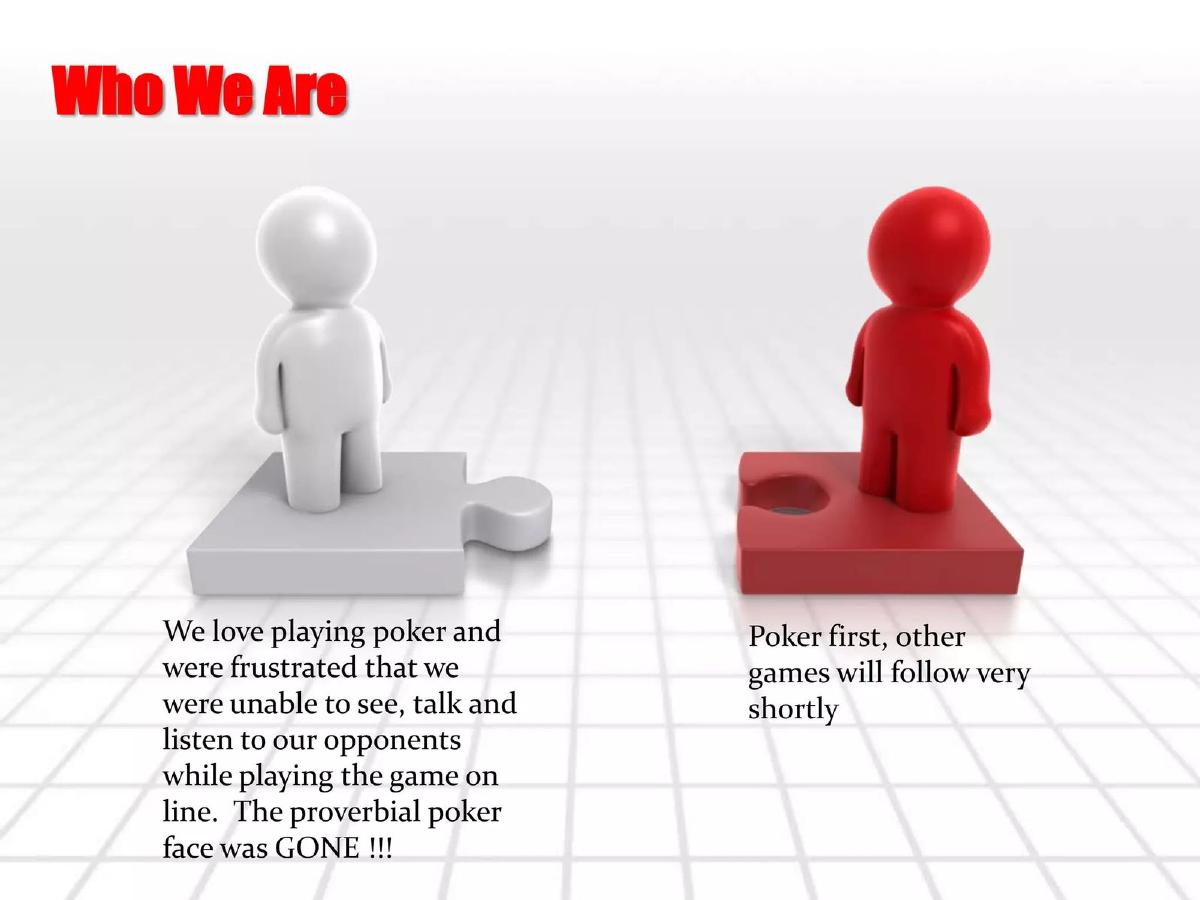
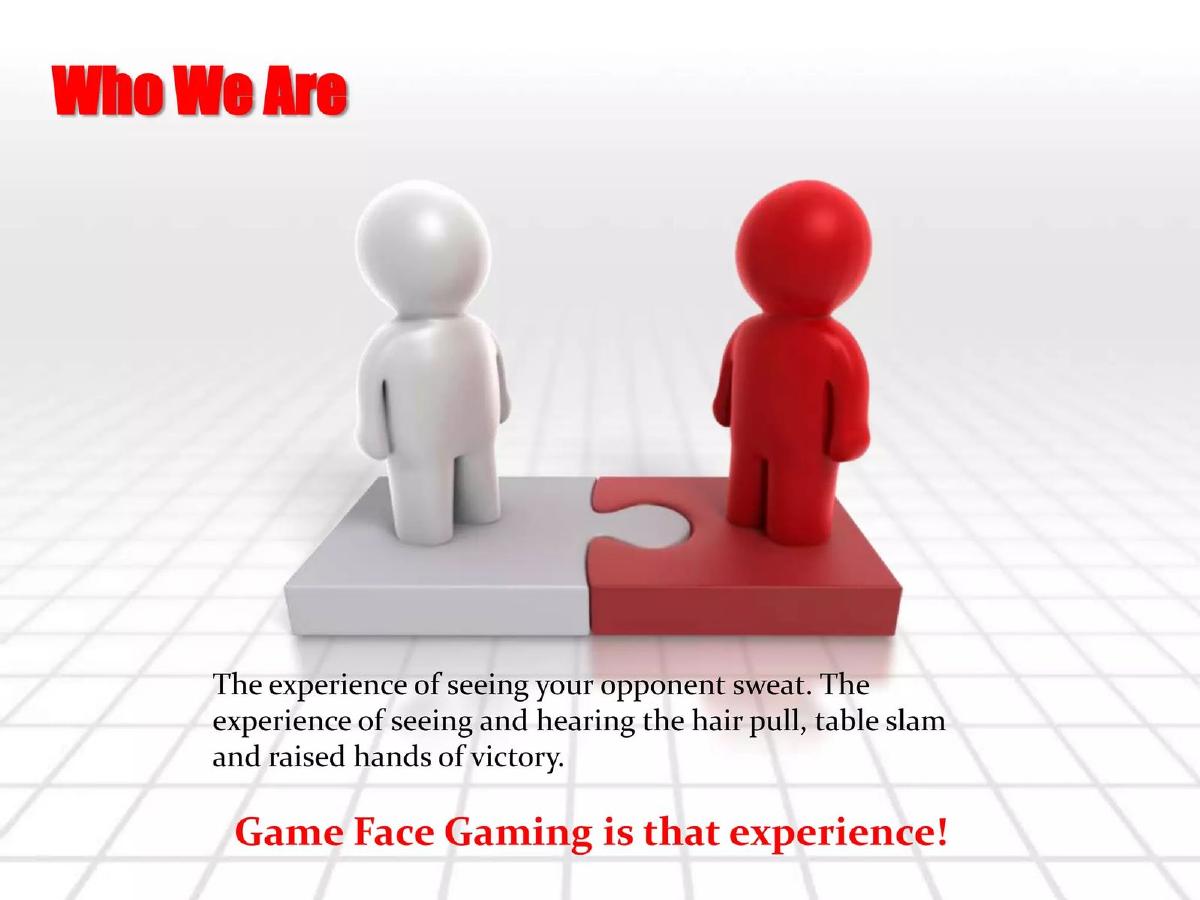
Titled 'Who We Are,' this slide elaborates on the company's motivation. It features two stylized human figures: one white figure on a grey puzzle piece and one red figure on a red puzzle piece, separated. The text on the left states, "We love playing poker and were frustrated that we were unable to see, talk and listen to our opponents while playing the game on line. The proverbial poker face was GONE !!!" On the right, it reads, "Poker first, other games will follow very shortly." This slide clearly articulates the founders' personal pain point and the initial focus of their solution, emphasizing the restoration of the 'poker face' element to online play. It functions as a problem statement, albeit framed from the founders' personal experience.
Slide 3: Gaming Deals Surge
This slide, titled 'Gaming Deals Surge,' presents market data to support the company's venture. The visual is similar to the title slide, showing three stylized figures (two white, one red in the center) on interconnected puzzle pieces. The text states: "Driven by advancements in online and social gaming, funding and acquisition deals for the worldwide gaming market surged 36% in 2010 , according to new IHS Screen Digest research." It continues: "The total declared value of funding deals in the social network gaming segment increased by nearly 300 percent in 2010 . This data comes from a new report entitled: Games Market Monitor: Acquisitions and Funding in 2010." This slide aims to demonstrate a growing and active market, providing external validation for the timing and opportunity of Game Face Gaming.
Slide 4: Home
Titled 'Home,' this slide provides a visual mock-up of the platform's user interface. It displays a screenshot of what appears to be the 'Face Up Gaming' website. Key elements visible include login fields, navigation tabs (Tournaments, Community, Memberships, Promotions, Win Cash, Leagues), and game options (Chess, Poker, Backgammon). The central graphic depicts a globe surrounded by screens, suggesting a global network. Below this, text reads: "CONNECT > SHARE > PLAY" followed by bullet points: "Live video and audio chat," "Free play, Win real cash," and "No download." A 'PLAY NOW' button is prominent. This slide offers a tangible glimpse into the product, highlighting its core features and user experience, particularly the interactive video and audio chat.
Slide 5: Company Overview
This slide is titled 'Company Overview' at the bottom, but the main content is presented within a large white rectangle against a blurred background image of a stylized figure writing. The text within the rectangle is sparse and uses varying colors: "OTCBB fully reporting, IKCC" in blue, "The company's 8k-10k and other filings can all be found online at WWW.sec.gov" in green, "Seeking $3M to execute our business plan" in red, "Awaiting DTC eligibility - stock will open for trading shortly thereafter" in yellow, and "First Reality Gaming Social Network" in green. This slide functions as a brief summary of the company's status and its funding request, along with a claim of being the 'First Reality Gaming Social Network.' The information about SEC filings and OTCBB status suggests the company is publicly traded or has plans to be.
Slide 6: Founders
The 'Founders' slide introduces three key individuals with their names and brief biographies, each positioned below a stylized figure. Alex Lemburg is listed as Co-Founder, with experience as a Business Analyst at Merrill Lynch, Morgan Stanley, Barclays Capital, CIBC, and Credit Suisse, and involvement in MMORPG games and an Internet Gaming café. Felix Elinson is also a Co-Founder, described as having played poker for over 20 years, an entrepreneur, and a licensed Commodity Broker with experience in futures, forex, and commodity markets, and real estate. S. Leo is listed as Chief Technology Officer, with a background on Wall Street in technology for bulge bracket firms, specializing in Low Latency, Algo and Electronic Trading, and currently leading a technology team at Deutsche Bank's North American Algo group. This slide establishes the credibility and experience of the core team, covering business, finance, and technology aspects relevant to the venture.
Slide 7: Going Live - Soon
Titled 'Going Live - Soon' with the subtitle 'Come Along,' this slide uses a visual of four stylized figures interacting, with speech bubbles containing key messages. The speech bubbles state: "Beta Kicks off Next Month," "GFG is poised to change the way people play on-line games," "Celebrity poker players previously under contract to Poker Stars and others such brand names- are now eager and ready to sign up with GFG," and "GFG's business lends itself to constant news releases." This slide focuses on the imminent launch and marketing momentum, highlighting the potential for disruption and the attraction of celebrity endorsements.
Slide 8: Competitive Analysis
This slide, titled 'Competitive Analysis,' presents a direct comparison between 'GFG' (Game Face Gaming) and 'PurePlay' using a two-column format on a whiteboard graphic. Both companies are listed as having 'Membership Based' and 'Tournament and Private Tables' features. PurePlay offers a 'Play for fun Feature (No Monthly Fee)' and 'Daily / Weekly / Monthly Cash Tournaments,' with a '$25 / Month Membership.' Game Face Gaming also offers 'Play for fun Feature (No Monthly Fee)' and 'Daily / Weekly / Monthly Cash Tournaments,' but differentiates with a '$19.95 / Month Membership,' 'Interactive Video & Audio (No Download),' 'Social Network Community,' 'Year Long Event ending in an Off-Shore Tournament,' 'Ability to play against industry pros,' and 'Cross-Promote with Real Casinos.' This slide clearly outlines Game Face Gaming's competitive advantages, particularly its lower membership fee and unique interactive and community features.
Slide 9: Marketing Twitter
The final provided slide is titled 'Marketing Twitter' and illustrates a flowchart of Twitter-based marketing strategies. A stylized figure is shown writing on a surface, with arrows connecting various steps: "Use hash-tags" leads to "Weekly tweets," which leads to "Advanced search to target gamers and poker players." This then leads to "Use Tweetvite to create and find Tweetups (events) in your area; for launch of product/service." This slide details a specific digital marketing approach, focusing on leveraging Twitter for community engagement and targeted outreach.
What Works Well
The Game Face Gaming pitch deck effectively communicates the core concept of a 'Reality Gaming Social Network' by addressing a clear pain point experienced by online poker players: the absence of visual and auditory cues (Slide 2). The mock-up of the home screen (Slide 4) provides a tangible vision of the product, showcasing key features like live video and audio chat, which directly addresses the stated problem. The competitive analysis (Slide 8) is well-structured and clearly highlights Game Face Gaming's differentiators, such as a lower membership fee and unique interactive features, against a named competitor. Furthermore, the inclusion of market data on 'Gaming Deals Surge' (Slide 3) provides a strong macro-level justification for the venture, indicating a growing and active market. The team slide (Slide 6) presents founders with relevant experience in finance, markets, and technology, lending credibility to the project. The 'Going Live - Soon' slide (Slide 7) generates excitement by mentioning an imminent beta launch and the potential for celebrity endorsements.
What is Missing
Despite its strengths, the Game Face Gaming pitch deck has several notable omissions. A detailed problem statement beyond the founders' personal frustration is not explicitly articulated; while the 'poker face' issue is clear, a broader market problem or unmet need is not fully explored. There is no dedicated slide for the solution, although elements of it are shown on the home screen mock-up. The business model is only partially revealed through the mention of a '$19.95 / Month Membership' (Slide 8); details on other revenue streams, pricing tiers, or unit economics are absent. The deck lacks any financial projections, such as revenue forecasts, user acquisition costs, or profitability timelines. A comprehensive go-to-market strategy is not present; while 'Marketing Twitter' (Slide 9) outlines one channel, a broader strategy encompassing other acquisition channels, partnerships, and launch plans is missing. The target market is implied to be online poker players and gamers, but a detailed market size, segmentation, or user persona analysis is not included. Furthermore, the deck does not include a clear 'Ask' slide beyond the mention of "Seeking $3M to execute our business plan" on the 'Company Overview' slide (Slide 5), nor does it specify how these funds will be allocated. There is no mention of an advisory board, current traction, or key milestones achieved thus far. The legal and regulatory implications of online gaming, especially involving cash, are not addressed, which can be significant in this sector.
What a Founder Should Copy
Founders can learn several valuable lessons from the Game Face Gaming deck. Firstly, clearly articulating the core problem from a personal, relatable experience (Slide 2) can be very effective in engaging investors, provided it is then backed by broader market validation. Secondly, presenting a visual mock-up of the product (Slide 4) is crucial for making the solution tangible and understandable, especially for a platform-based business. Thirdly, a well-structured competitive analysis (Slide 8) that directly compares features and pricing against a known competitor helps investors quickly grasp the unique value proposition. Fourthly, leveraging market trend data (Slide 3) to establish the timeliness and opportunity of the venture is a strong practice. Lastly, showcasing the team's relevant experience (Slide 6) across different domains pertinent to the business builds confidence in their ability to execute. While the deck has omissions, these elements provide a solid foundation for communicating the essence of a new venture.
Frequently asked questions
- What is Game Face Gaming's core offering?
- Game Face Gaming aims to be a 'Reality Gaming Social Network' that initially focuses on online poker. The core idea is to integrate interactive video and audio to allow players to see, talk, and listen to opponents, replicating the 'poker face' experience online. Other games are planned to follow the poker launch.
- What is the company's funding ask?
- Game Face Gaming is seeking $3M to execute its business plan, as stated on Slide 5. The deck also mentions that the company is OTCBB fully reporting and awaiting DTC eligibility, with stock expected to open for trading shortly thereafter.
- What market trends does the deck highlight?
- The deck highlights a 'Gaming Deals Surge,' noting that the worldwide gaming market surged 36% in 2010. It also states that the total declared value of funding deals in the social network gaming segment increased by nearly 300% in 2010, citing IHS Screen Digest research and a 'Games Market Monitor' report.
- Who are the key team members presented?
- The deck introduces Alex Lemburg (Co-Founder), Felix Elinson (Co-Founder), and S. Leo Chief Technology Officer. Their bios highlight experience in business analysis, financial markets, commodity brokerage, and leading technology teams at bulge bracket firms.
- How does Game Face Gaming differentiate itself from competitors?
- In its competitive analysis against PurePlay, Game Face Gaming highlights features such as a $19.95 / Month Membership (compared to PurePlay's $25), interactive video & audio, a social network community, a year-long event ending in an off-shore tournament, and the ability to cross-promote with real casinos.