The Gaming Arts Motivator: Riverside (GAMR) deck is a brief, 6-slide presentation that appears to be the output of a university-affiliated incubator program, specifically the UCR Office of Technology Partnerships and the NSF Innovation Corps. Dated December 2019, the deck focuses heavily on customer discovery metrics, citing 12 total interviews to validate a hypothesis about 18-24-year-old aspiring developers. While it provides a clear definition of its target market—specifically Unity developers—and a basic unit price of $30, it lacks essential startup pitch components such as a business mod…
Key takeaways
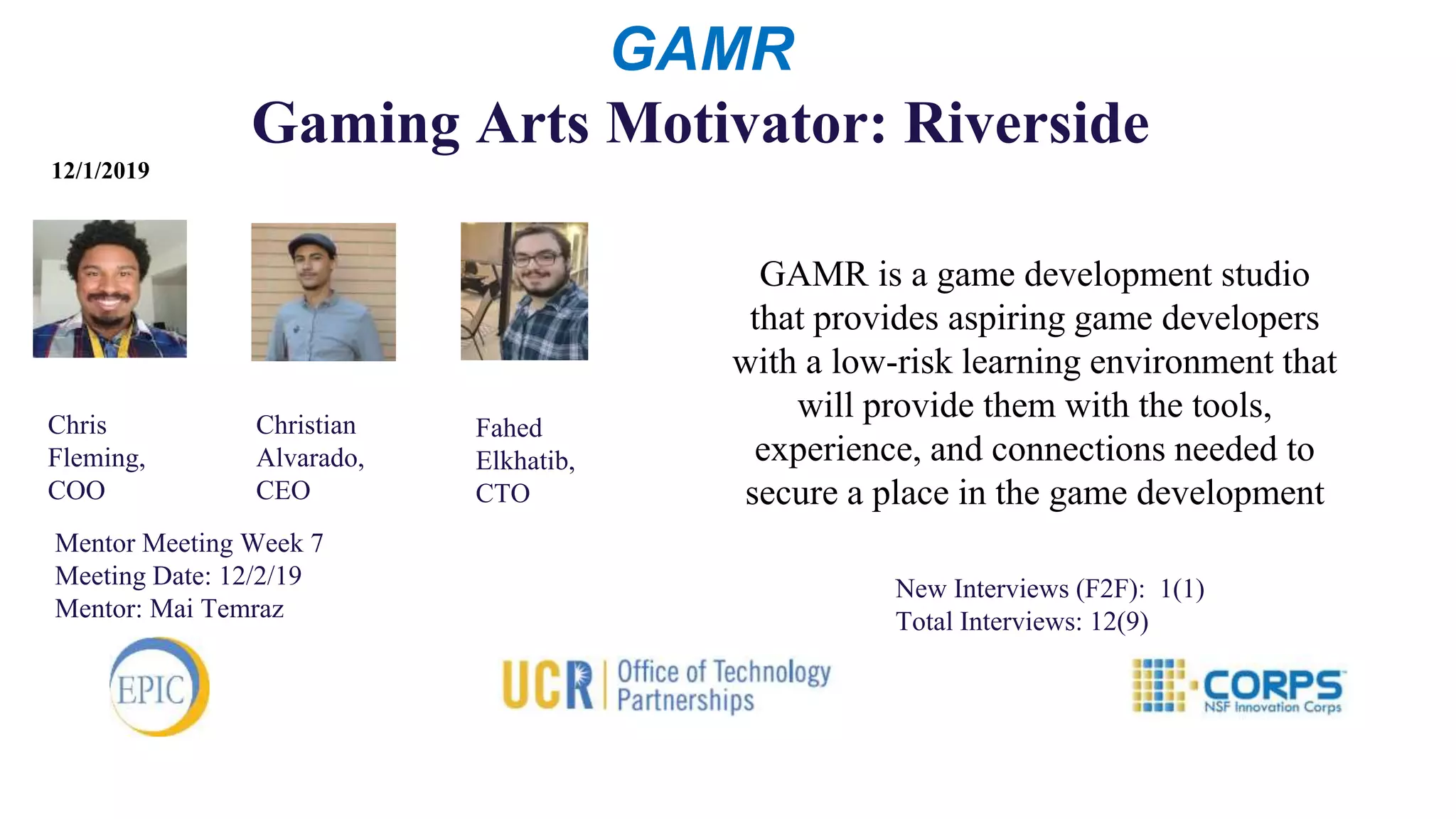
- The company defines itself as a game development studio providing a low-risk learning environment for aspiring developers (Slide 1).
- The deck tracks customer discovery progress, noting 12 total interviews and a specific mentor meeting with Mai Temraz on 12/2/19 (Slide 1).
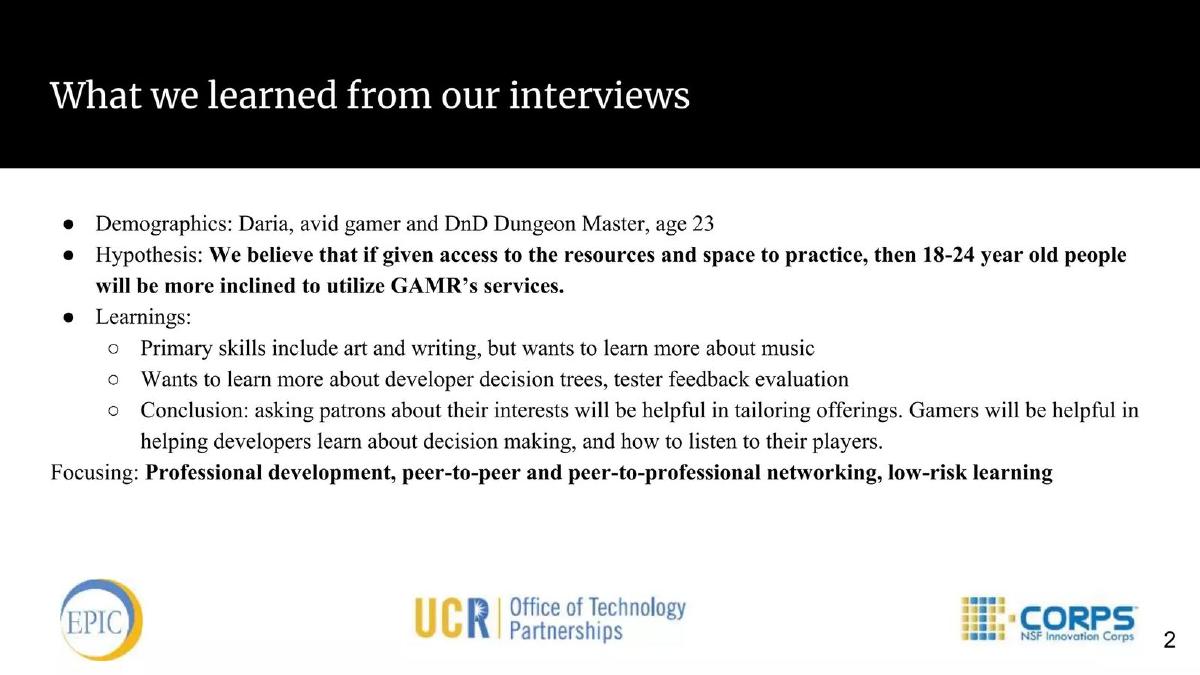
- A core hypothesis targets 18-24-year-olds, validated by a persona named Daria, a 23-year-old Dungeon Master (Slide 2).
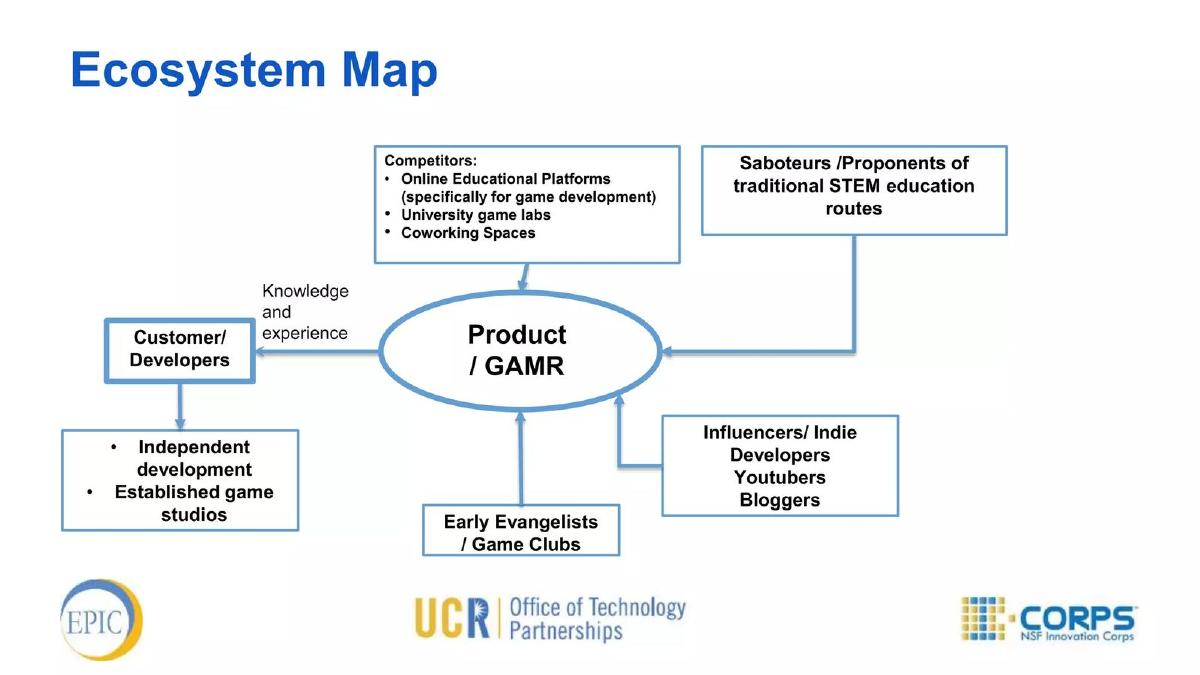
- The ecosystem map identifies 'traditional STEM education routes' as potential saboteurs or proponents (Slide 3).
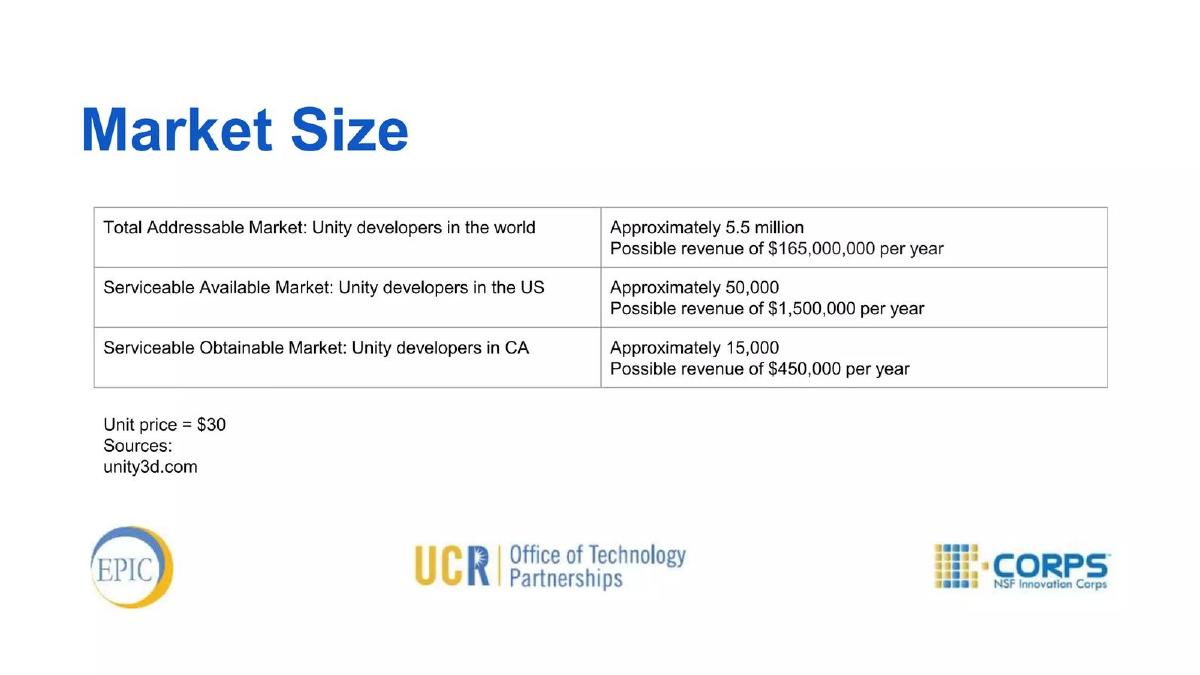
- Market sizing is calculated based on Unity developers, with a Serviceable Obtainable Market (SOM) of 15,000 people in California (Slide 4).
- Revenue potential is modeled at a unit price of $30, projecting $450,000 per year for the California market (Slide 4).
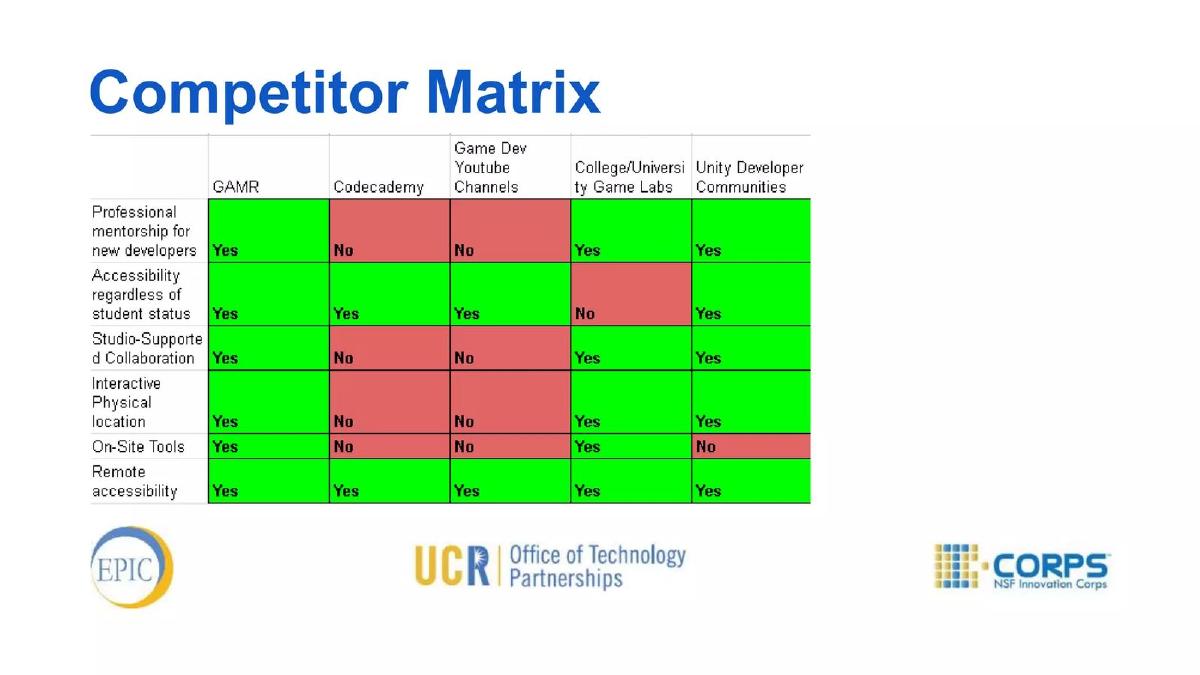
- The competitor matrix claims GAMR is the only entity offering the combination of professional mentorship, physical location, and on-site tools (Slide 5).
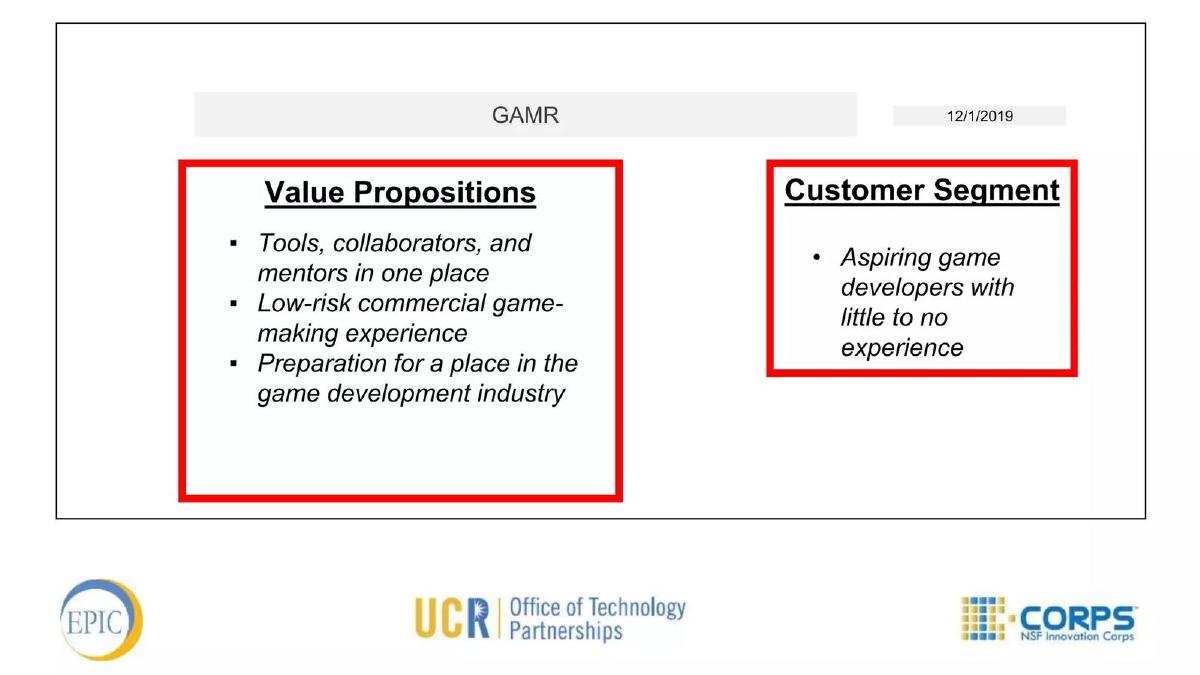
- The deck concludes with a value proposition focused on providing tools, collaborators, and mentors in one place (Slide 6).
Gaming Arts Motivator: Riverside — A Customer Discovery Snapshot
The Gaming Arts Motivator: Riverside (GAMR) pitch deck is a 6-slide document dated December 1, 2019. It is clearly a product of a structured entrepreneurship program, as evidenced by the logos for the UCR (University of California, Riverside) Office of Technology Partnerships, EPIC, and the NSF Innovation Corps (I-Corps). The deck is less of a traditional fundraising tool and more of a summary of the 'Customer Discovery' phase of a startup's lifecycle. It focuses on validating a problem-solution fit rather than demonstrating a scalable business with financial traction.
Slide 1: Title and Team
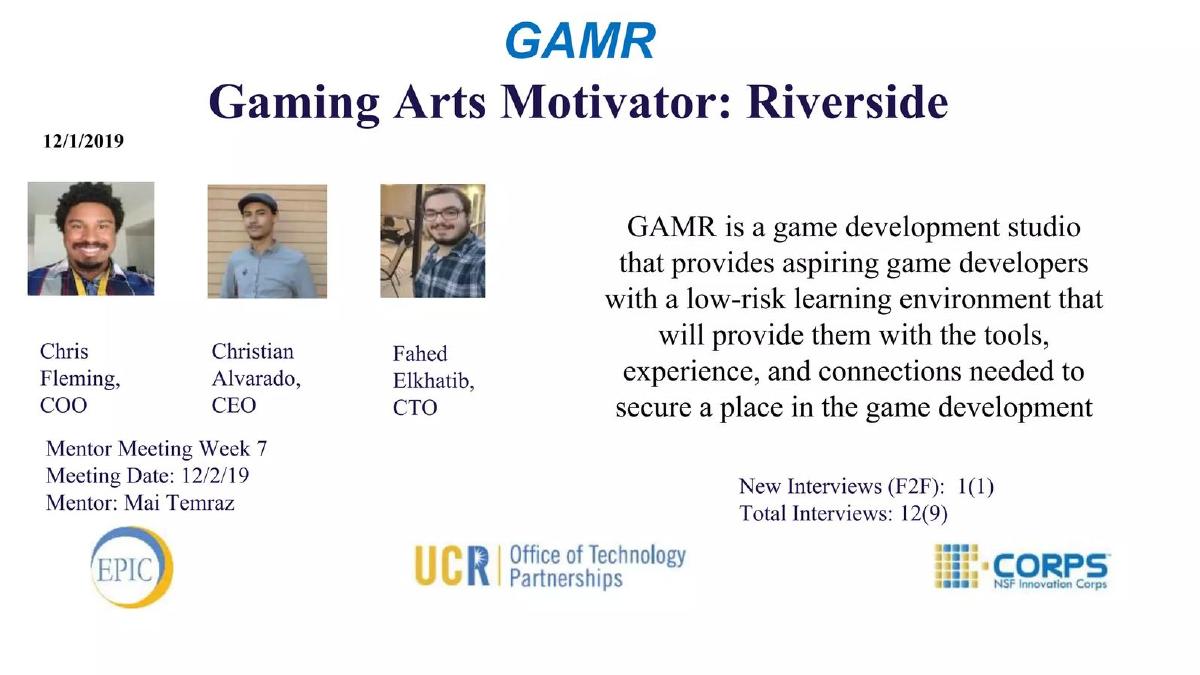
The opening slide introduces the company as 'GAMR' and 'Gaming Arts Motivator: Riverside.' It lists the core team: Christian Alvarado (CEO), Chris Fleming (COO), and Fahed Elkhatib (CTO). The slide also includes administrative details typical of an incubator program, such as the 'Mentor Meeting Week 7' date and the name of their mentor, Mai Temraz. A brief mission statement describes the company as a game development studio providing a 'low-risk learning environment' to help aspiring developers secure a place in the industry. Notably, it tracks 'Total Interviews: 12(9),' a metric specific to the I-Corps methodology where founders must conduct dozens of interviews to validate their business assumptions.
Slide 2: Customer Interview Learnings
Slide 2, titled 'What we learned from our interviews,' moves into the qualitative data gathered during the discovery phase. It highlights a specific persona: 'Daria, avid gamer and DnD Dungeon Master, age 23.' The founders state their hypothesis: that 18-24-year-olds will use GAMR's services if given access to resources and space. The 'Learnings' section notes that potential users want to learn about music, developer decision trees, and tester feedback. The slide concludes that the focus should be on professional development and peer-to-peer networking. This slide is effective for an academic presentation but lacks the 'pain point' urgency usually found in a commercial pitch.
Slide 3: Ecosystem Map
The 'Ecosystem Map' on Slide 3 visualizes the relationship between the product and various stakeholders. It places 'Product / GAMR' at the center, with arrows connecting it to Customers (Developers), Early Evangelists (Game Clubs), and Influencers (Indie Developers, Youtubers, Bloggers). Interestingly, it includes a box for 'Saboteurs / Proponents of traditional STEM education routes,' acknowledging that traditional universities might view a low-cost, low-risk alternative as a threat. This shows a sophisticated understanding of the market landscape, even if the visual execution is basic.
Slide 4: Market Size
Slide 4 provides a quantitative breakdown of the market using the TAM/SAM/SOM framework, specifically citing unity3d.com as the source. The Total Addressable Market (TAM) is listed as 5.5 million Unity developers worldwide, with a theoretical revenue of $165,000,000. The Serviceable Available Market (SAM) focuses on 50,000 Unity developers in the US ($1,500,000 revenue). The Serviceable Obtainable Market (SOM) is narrowed down to 15,000 Unity developers in California, with a projected revenue of $450,000 per year. The slide specifies a 'Unit price = $30,' though it does not explain if this is a monthly fee, a class fee, or a daily rate.
Slide 5: Competitor Matrix
The Competitor Matrix compares GAMR against Codecademy, Game Dev YouTube Channels, College/University Game Labs, and Unity Developer Communities. The criteria include professional mentorship, accessibility regardless of student status, studio-supported collaboration, interactive physical location, on-site tools, and remote accessibility. GAMR is the only entity marked 'Yes' for every category. The matrix highlights that while online platforms like Codecademy have remote accessibility, they lack the 'Interactive Physical location' and 'On-Site Tools' that GAMR intends to provide. This slide confirms that GAMR is envisioned as a brick-and-mortar facility.
Slide 6: Value Propositions and Customer Segment
The final slide summarizes the core offering. The 'Value Propositions' are listed as tools, collaborators, and mentors in one place; a low-risk commercial game-making experience; and preparation for the industry. The 'Customer Segment' is defined as 'Aspiring game developers with little to no experience.' The slide is dated 12/1/2019, matching the first slide. There is no concluding 'Ask' slide, no contact information beyond the names on slide one, and no roadmap for future development.
What GAMR Does Well
The GAMR deck excels at showing the 'work' of early-stage validation. By including specific interview counts and a named persona (Daria), the founders demonstrate that they are not building in a vacuum. They have identified a specific niche—Unity developers in California—and have researched the competitive landscape to find a gap (the lack of physical, accessible spaces for non-students). The inclusion of an 'Ecosystem Map' that identifies 'Saboteurs' shows a level of strategic thinking often missing from early-stage decks, which usually only focus on the 'Happy Path' of growth.
What is Missing from the GAMR Deck
As a fundraising document, the deck is incomplete. The most glaring omission is the Business Model . While a '$30 unit price' is mentioned, there is no explanation of the cost structure. Running a physical location with 'On-Site Tools' (likely high-end PCs and software licenses) involves significant overhead, including rent, utilities, and equipment maintenance. The deck does not address how a $30 price point covers these costs or leads to profitability. Furthermore, there is no Financial Projection , no Marketing/Acquisition Strategy , and no Product Roadmap . Most importantly, there is no Ask ; the deck never specifies how much money the team needs or what they will do with it.
What a Founder Should Copy
Founders should emulate the Customer Discovery transparency shown here. Investors appreciate seeing that a team has actually spoken to potential customers and adjusted their hypothesis based on those conversations. The Competitor Matrix is also a good model; it uses specific, functional criteria (like 'On-Site Tools' and 'Student Status') rather than vague marketing terms like 'Better' or 'Faster.' Finally, the narrow SOM (Serviceable Obtainable Market) is a positive example of realistic planning. Instead of claiming they will capture the global gaming market, they focused on a specific geography (California) and a specific platform (Unity), which makes their initial revenue projections feel grounded in reality.
Final Analysis
The GAMR pitch deck is a clear artifact of a university-led innovation program. It follows the lean startup methodology of hypothesis testing and customer validation. While it serves as an excellent summary of a student project or an incubator milestone, it lacks the financial depth and operational detail required to secure venture capital. To move from a 'project' to a 'startup,' the founders would need to bridge the gap between their $30 unit price and the high costs of maintaining a physical game development studio in Riverside, California.
Frequently asked questions
- What is the primary business model of GAMR?
- The deck does not explicitly detail a business model, such as whether it is a subscription, a one-time tuition fee, or a revenue-share agreement. However, Slide 4 mentions a 'Unit price = $30.' Given the focus on a physical location and tools, this could represent a daily drop-in fee or a per-session cost, but the deck leaves the frequency and nature of this charge undefined.
- Who are the founders and what is their background?
- Slide 1 lists Christian Alvarado as CEO, Chris Fleming as COO, and Fahed Elkhatib as CTO. While their names and titles are provided alongside photos, the deck omits any biographical information, past professional experience, or specific technical credentials that would qualify them to run a game development studio or educational program.
- How does GAMR differentiate itself from competitors?
- According to the Competitor Matrix on Slide 5, GAMR differentiates itself through a combination of 'Interactive Physical location' and 'On-Site Tools.' It claims that while University Game Labs have physical locations, they lack accessibility for non-students, and while Unity Developer Communities have tools, they lack a physical presence. GAMR positions itself as the only provider offering all six listed criteria.
- What is the intended use of the funds being raised?
- The deck does not include a 'The Ask' slide. There is no mention of a funding goal, valuation, or how capital would be deployed. This suggests the deck was created for an academic or incubator showcase—specifically for the NSF Innovation Corps (I-Corps) program—rather than for a formal seed or Series A investment round.
- What is the specific target market for this service?
- The deck identifies its Serviceable Obtainable Market (SOM) as the 15,000 Unity developers located in California (Slide 4). The customer segment is further refined on Slide 6 as 'Aspiring game developers with little to no experience,' with a specific focus on the 18-24 age demographic identified during their interview phase.