Gendo’s pre-seed deck is a masterclass in industry-specific positioning. Rather than pitching a generic image generator, the company aligns its AI tools with the professional lifecycle of an architect, specifically citing the Royal Institute of British Architects (RIBA) Stages of Work. The deck identifies a clear pain point: architects spend only 30% of their time designing, while 70% is consumed by visualization and documentation. By presenting a three-phase product roadmap—moving from CGI production to generative design and finally technical documentation—Gendo demonstrates a deep understan…
Key takeaways
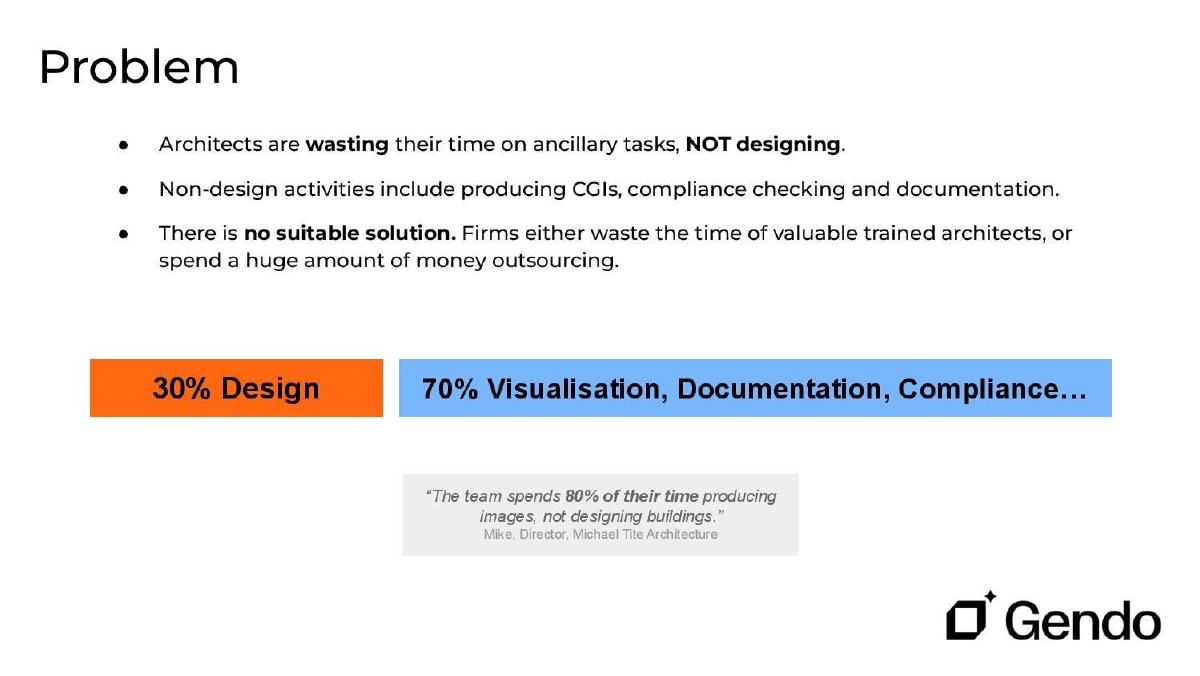
- The deck identifies that architects spend 70% of their time on non-design tasks like CGI, compliance, and documentation (Slide 3).
- Gendo positions itself as a browser-based platform with specialized AI tools, rather than a single-prompt generator (Slide 6).
- The product roadmap is structured into three distinct phases: CGI Production, Generative Design, and Technical Documents (Slide 6).
- Traction is evidenced by a waiting list of 90 global architecture and visualization firms (Slide 8).
- The company reports over 2,000 'cutout' generations to date, indicating early feature testing (Slide 8).
- The deck uses the RIBA Stages of Work (0-7) as a framework to show where their AI intervenes in the professional workflow (Slide 4).
- A quote from a director at Michael Tite Architecture validates the problem, stating the team spends 80% of their time producing images (Slide 3).
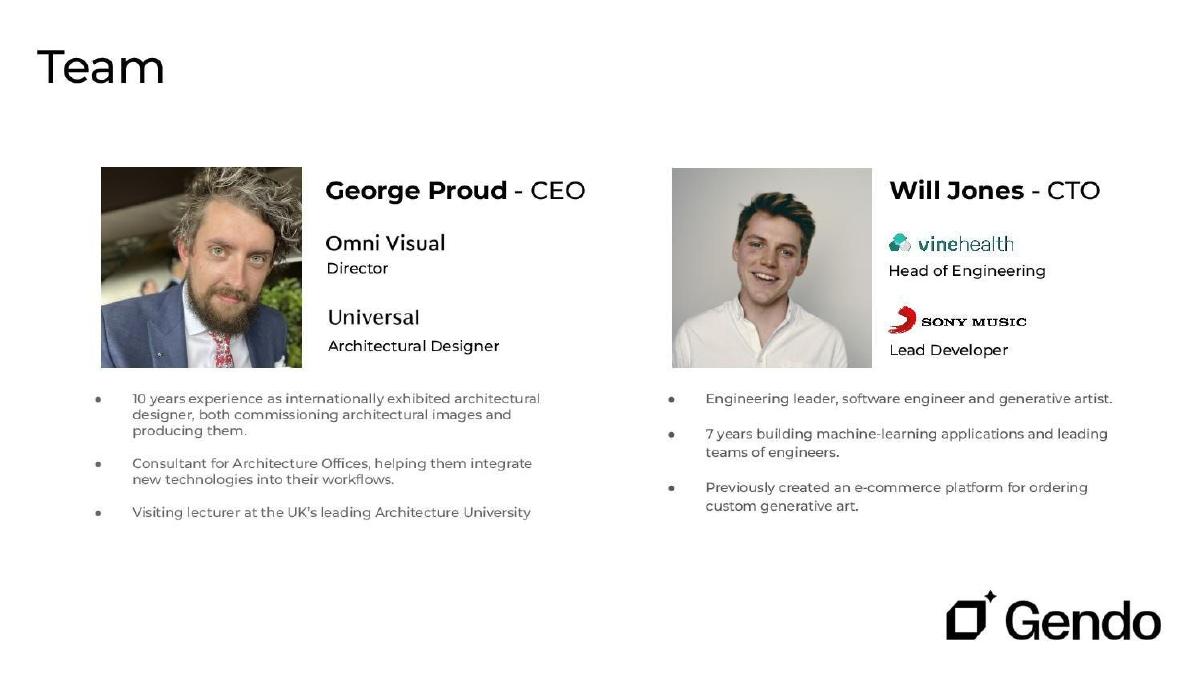
- The deck omits a team slide, financial projections, and a specific 'ask' or valuation in the provided 16-slide sequence.
The Hook: Visual Proof and Workflow Reality
Slides 1-2: The Aesthetic Entry
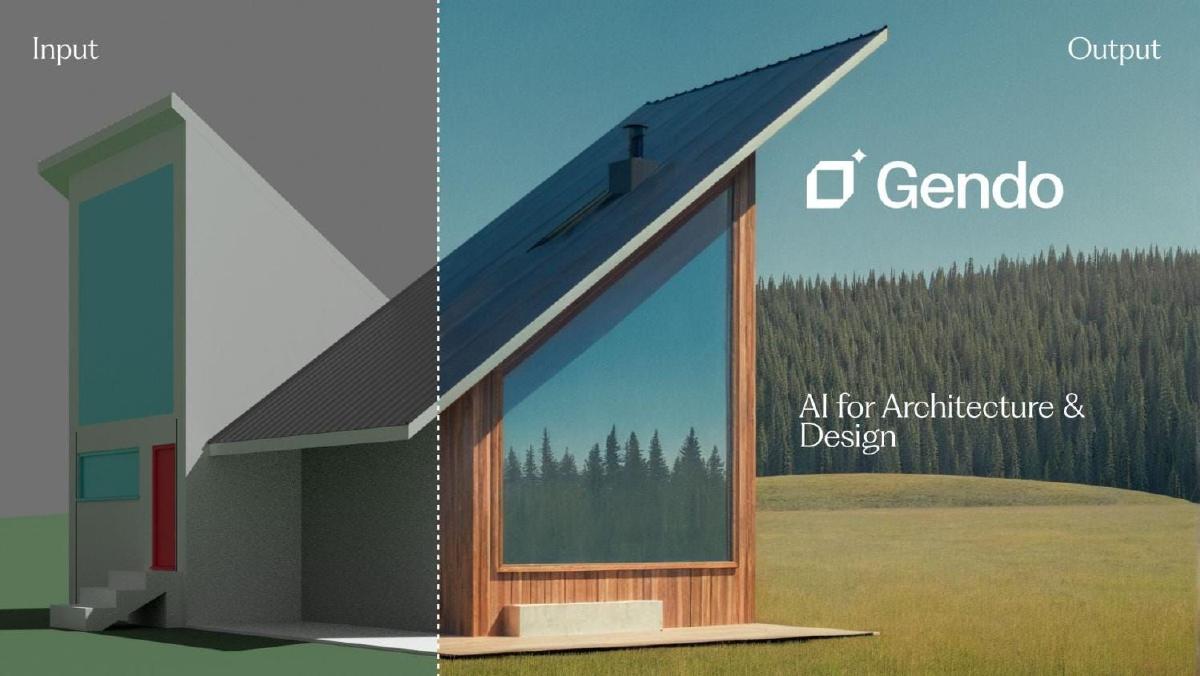
Slide 1 is a minimalist title slide, followed immediately by Slide 2, which serves as the 'aha' moment. Slide 2 displays a split-screen 'Input' vs 'Output.' The input is a basic, low-fidelity 3D massing model—the kind architects produce in minutes. The output is a photorealistic architectural visualization of a modern cabin in a forest. This slide establishes the core value proposition: Gendo takes the 'grunt work' of rendering and turns it into an instantaneous AI process. The tagline 'AI for Architecture & Design' is clear and avoids unnecessary jargon.
Slide 3: The 70% Problem
Slide 3 defines the pain point with statistical clarity. It claims architects are 'wasting their time on ancillary tasks, NOT designing.' The slide breaks down the time allocation: 30% Design vs. 70% Visualisation, Documentation, and Compliance. To add weight to this claim, Gendo includes a testimonial from Mike, a Director at Michael Tite Architecture, who states his team spends 80% of their time producing images. This is a classic 'hair on fire' problem for a high-cost professional service industry.
Strategic Alignment with Industry Standards
Slide 4: The RIBA Framework
One of the strongest slides in the deck is Slide 4, titled 'Start to Finish.' Instead of creating a proprietary workflow, Gendo maps its utility onto the Royal Institute of British Architects (RIBA) Stages of Work. By highlighting stages 0 through 7 (Strategic Definition to In Use), Gendo shows exactly where CGI Production and Technical Documents sit in the professional lifecycle. This signals to investors that the founders understand their target market's regulatory and professional constraints.
Slide 5: The Short-term Vision
Slide 5 illustrates the 'Short-term Vision' using a workflow diagram. It shows a jagged line oscillating between 'Architects' and 'Gendo' (and occasionally a 'Contractor'). This diagram visualizes the collaborative nature of the tool, suggesting that Gendo isn't replacing the architect but acting as a high-frequency assistant that handles the technical heavy lifting while the architect maintains creative control.
Product Architecture and Roadmap
Slide 6: The Three-Phase Evolution
Slide 6 is the 'Product' slide, and it is remarkably dense with information. It describes Gendo as a 'browser-based platform' and outlines a three-phase rollout. Phase 1 (CGI Production) is the current focus, covering concept images and marketing renders. Phase 2 (Generative Design) moves into design compliance and technical design. Phase 3 (Technical Documents) is the most ambitious, aiming to automate planning applications and construction documentation. Below this, a UI mockup shows specific tools like 'Cutouts,' 'Materials,' and 'Planning Application.' This roadmap is crucial because it moves Gendo from a 'nice-to-have' visualization tool to a 'must-have' technical infrastructure tool.
Slide 7: Feature Deep Dive
Slide 7 focuses on the 'CGI product concept video' and lists three key attributes: 'Series of discrete tools,' 'Pick & Mix for ease of use,' and 'Based on existing workflows.' The UI mockup shows a grid of specialized modules: Lighting, Materials, Props, Furniture, Landscaping, and Cutouts. This modular approach is smart; it allows architects to use AI for specific pain points (like adding realistic trees or people) without having to surrender their entire design to a 'black box' generator.
Validation and Market Pull
Slide 8: Traction and Social Proof
The 'Traction' slide (Slide 8) provides the necessary evidence that this isn't just a cool demo. It lists 'Over 2,000 cutout generations to date' as a usage metric. More importantly, it notes 90 global firms on the waiting list, including 'the UK’s largest Architecture firm.' The slide also mentions that large firms are seeking 'paid access after Beta,' which addresses the question of monetization. A quote from an artist at Foster & Partners—one of the most prestigious architecture firms in the world—serves as a high-signal endorsement.
What Works in the Gendo Deck
Workflow Integration: The most impressive aspect of this deck is the use of the RIBA Stages of Work. Most AI startups pitch 'magic,' but Gendo pitches 'efficiency within a regulated framework.' This makes the product feel grounded and ready for enterprise adoption.
Modular Product Design: By breaking the AI down into 'discrete tools' (Slide 7), Gendo avoids the 'uncanny valley' problem of AI architecture where the whole building looks slightly wrong. Instead, they let architects use AI to fix specific, tedious parts of the image, like furniture and landscaping.
Clear Roadmap: The transition from Phase 1 (visuals) to Phase 3 (technical documents) shows a clear path to increasing the 'stickiness' and LTV (Lifetime Value) of the customer. Visuals are a commodity; planning applications are a mission-critical pain point.
What is Missing from the Gendo Deck
The Team: In the 16-slide sequence provided, there is no team slide. For a pre-seed round, the pedigree of the founders is often the most important factor. Investors need to know if the founders have architectural backgrounds or deep AI expertise.
Business Model: While the deck mentions firms seeking 'paid access,' it does not detail the pricing strategy. Is it a per-seat SaaS model, a per-render credit system, or an enterprise license? This is a significant omission for a $1.1M raise.
Competition: The deck does not mention competitors like Midjourney, DALL-E, or industry-specific tools like LookX AI or Hypar. Addressing why a general-purpose image generator isn't sufficient for a professional architect would have strengthened the 'Problem' section.
The Ask: There is no slide detailing how much capital is being raised or how it will be spent. While we know from external reports that they raised $1.1M, the deck itself should ideally communicate the milestones that this capital will unlock.
Founder's Playbook: What to Copy
Use Industry Standards: If you are building for a specific vertical (Law, Medicine, Architecture), don't just show a UI. Show how your tool maps to the standard operating procedures of that industry. Gendo’s use of the RIBA stages is the gold standard for this.
Quantify the 'Waste': Slide 3’s breakdown of 30% design vs 70% ancillary tasks is a powerful way to frame the ROI. If you can prove your tool shifts that ratio, the software pays for itself in billable hours saved.
High-Signal Quotes: Don't just get quotes from 'users.' Get quotes from the most recognizable names in the industry. The Foster & Partners mention on Slide 8 likely did more to close the round than any other single bullet point.
Visual 'Before and After': Slide 2 is the perfect opening for a generative AI company. It shows the low-effort input and the high-value output side-by-side. It requires zero reading to understand the value proposition.
Frequently asked questions
- What is the primary problem Gendo is solving?
- Gendo addresses the inefficiency in the architectural workflow. According to Slide 3, architects spend only 30% of their time on actual design, while the remaining 70% is wasted on 'ancillary tasks' such as producing CGIs, compliance checking, and documentation. The deck argues that current solutions either waste the time of trained architects or require expensive outsourcing.
- How does Gendo integrate with existing architectural standards?
- The deck explicitly maps its product onto the 'Royal Institute of British Architects (RIBA) Stages of Work' (Slide 4). By aligning with these industry-standard stages (0-7), Gendo demonstrates that its AI tools are designed to fit into the professional reality of how buildings are actually planned and built, rather than being a standalone toy.
- What does the product roadmap look like?
- As shown on Slide 6, the roadmap is divided into three phases. Phase 1 focuses on CGI Production (concept images, materials, cutouts). Phase 2 moves into Generative Design (concept and technical design, compliance). Phase 3 targets Technical Documents (planning applications and construction documentation). This shows a progression from aesthetic tools to functional, high-stakes technical tools.
- What early traction did Gendo demonstrate?
- Slide 8 highlights 'High Demand' with 90 global architecture and visualization firms on the waiting list, including the UK’s largest firm. They also report 'High Usage' with over 2,000 cutout generations and 'High Interest' through invitations to present at global firms and AI symposiums.
- Is there a team slide or financial ask in the deck?
- No. Based on the 16 slides provided, the deck omits a team slide, unit economics, a competitive landscape, and a specific funding ask. While the publisher reports a $1.1M raise, these specific details are not present in the visual presentation analyzed here.