Yoona.ai presents a compelling case for the digitization of the fashion industry, a sector notorious for inefficiency and environmental impact. The deck highlights that 30% of goods go unsold and the industry is responsible for 8-10% of global CO2 emissions. Yoona's solution is a generative AI platform that claims to make design 80% faster and 90% more efficient. With a clear B2B SaaS model and a target market of 160,000 fashion companies in Europe alone, the startup demonstrates strong early traction through pilots with major brands like Gerry Weber and Vaude. While the deck is heavy on envi…
Key takeaways
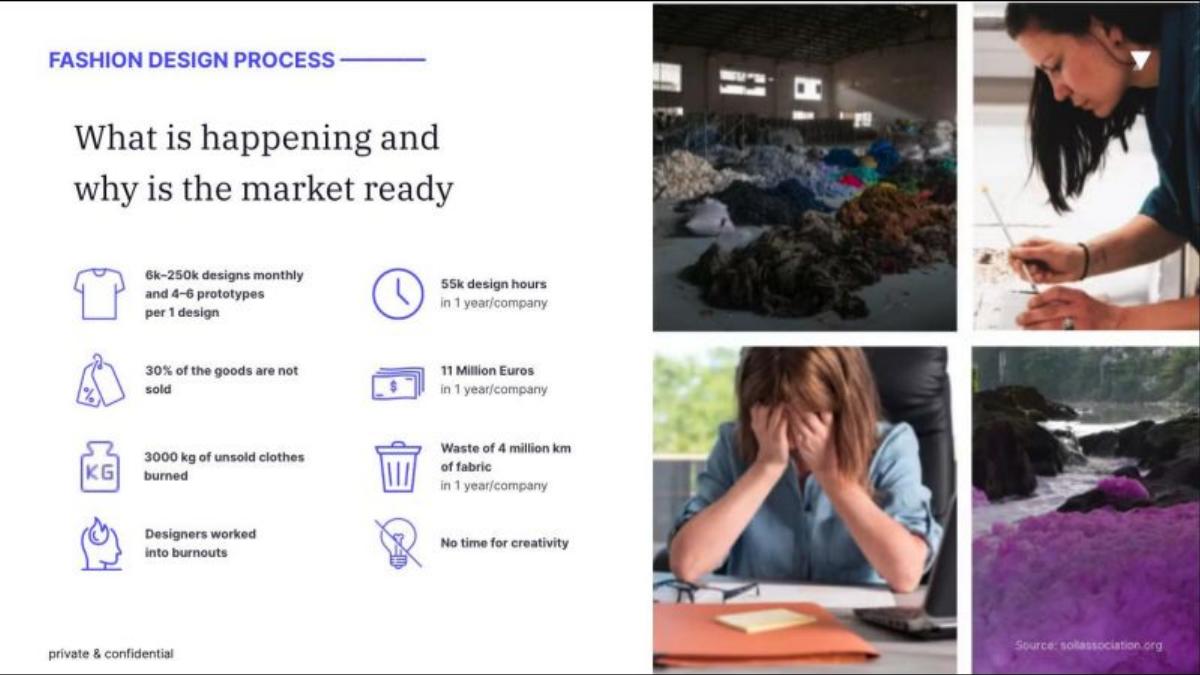
- The fashion industry currently faces massive waste, with 3000 kg of unsold clothes burned per company annually (Slide 4).
- Yoona.ai claims to reduce daily design work by 4 hours, moving from a manual process to a one-click digital platform (Slide 11).
- The platform offers significant environmental benefits, projecting a 99.8% reduction in energy and CO2 savings compared to traditional prototype production (Slide 12).
- The business model is a B2B SaaS subscription, with pricing scaling based on the number of designs and specific AI assistants used (Slide 15).
- Yoona.ai has established a strong pipeline with 10 customers in 2022 and a goal of 1,650 customers by 2026 (Slide 16).
- The startup has secured pilot projects or interest from major industry players including Adidas, H&M, and Desigual (Slide 16).
- The total addressable market for fashion design processes in Europe is estimated at €115 billion by 2024 (Slide 8).
- The team is led by a 'Digital Female Leader '19' with 20 years of industry experience and a CTO with 17 years of tech leadership (Slide 3).
Executive Summary
Yoona.ai is positioning itself as the 'global leader for design digitization.' The deck, produced in 2022, outlines a vision for a B2B SaaS platform that leverages generative AI to transform the fashion industry from a manual, wasteful cycle into a streamlined, data-driven operation. With a focus on both efficiency and sustainability, Yoona.ai targets a massive market opportunity while addressing the critical environmental failures of modern apparel production.
Slide 1: Title Slide
The opening slide establishes Yoona.ai as a 'SaaS / B2B Software Solution' that is 'made by designers for designers.' It features a clean, professional aesthetic with logos of high-profile partners and supporters at the bottom, including Microsoft, Techstars, and Puma, immediately establishing credibility.
Slide 2: The Hook
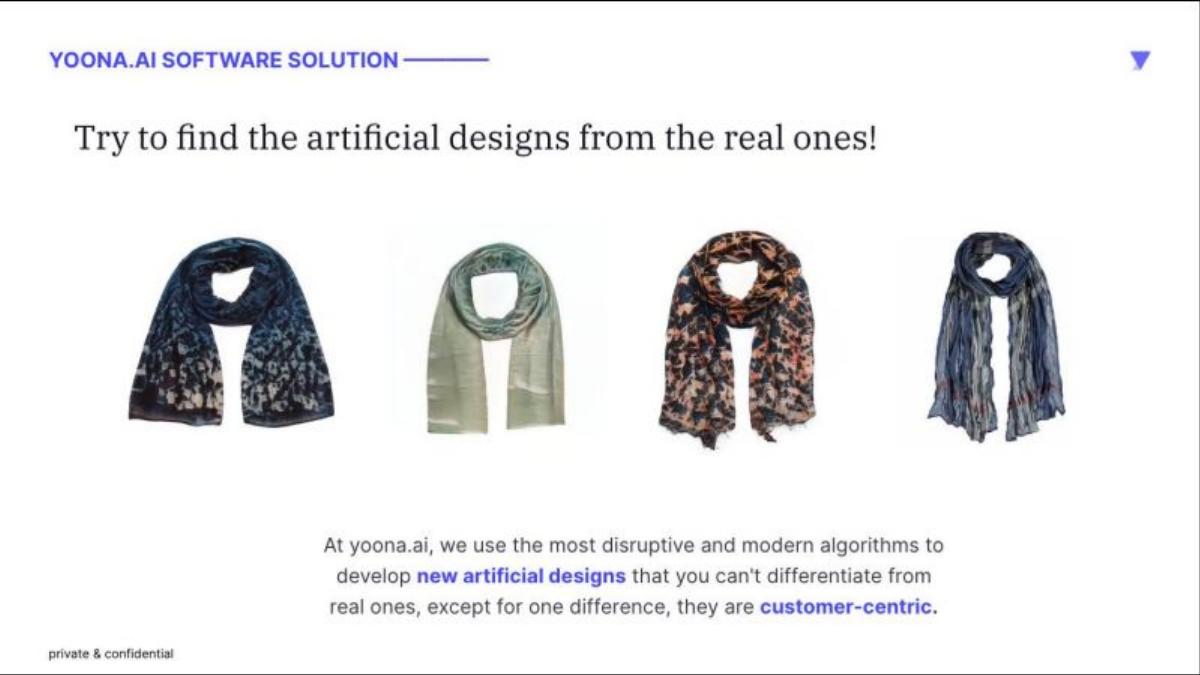
This slide challenges the viewer to differentiate between 'artificial designs' and 'real ones' using images of four scarves. It introduces the core value proposition: using 'disruptive and modern algorithms' to create 'customer-centric' designs that are indistinguishable from human-made ones.
Slide 3: The Team
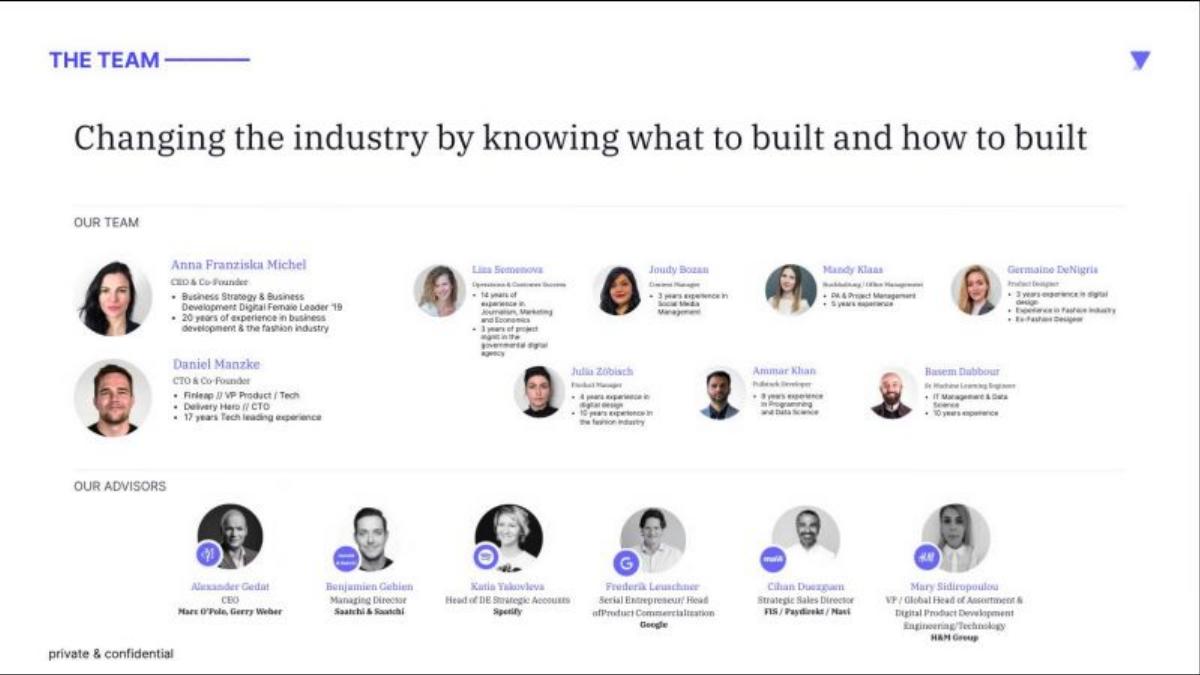
The team slide highlights the founders' deep expertise. CEO Anna Franziska Michel is noted as a 'Digital Female Leader ’19' with 20 years of experience in business development and fashion. CTO Daniel Manzke brings 17 years of tech leadership from companies like Delivery Hero and Finleap. The slide also lists a robust group of advisors from companies like Spotify, Google, and H&M Group.
Slide 4: The Problem - Fashion Design Process
This slide uses stark statistics to illustrate the industry's inefficiency. It notes that companies produce 6k–250k designs monthly with 4–6 prototypes per design, leading to 55,000 design hours per year. Critically, it states that 30% of goods are not sold and 3,000 kg of unsold clothes are burned per company annually.
Slide 5: Manual vs. Data-Driven Process
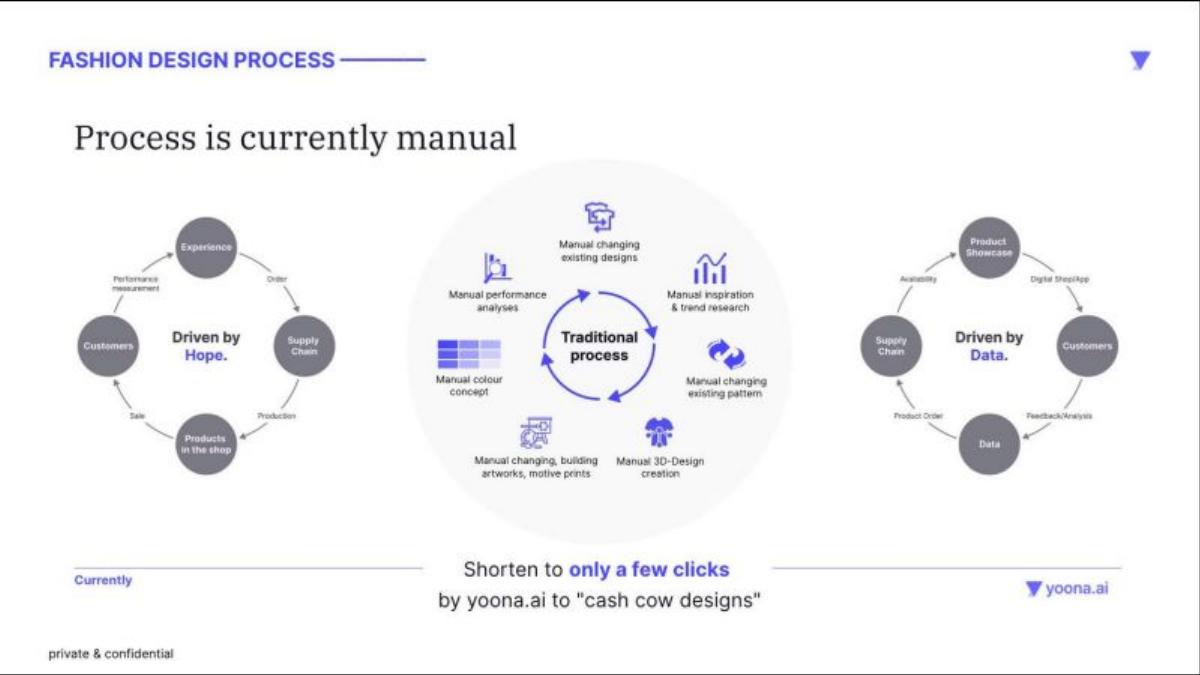
Yoona.ai contrasts the 'Traditional process'—which it describes as 'Driven by Hope'—with its own 'Driven by Data' approach. The current manual cycle involves performance analysis, trend research, and 3D creation, which Yoona.ai claims to shorten to 'only a few clicks' to produce 'cash cow designs.'
Slide 6: Industry Example
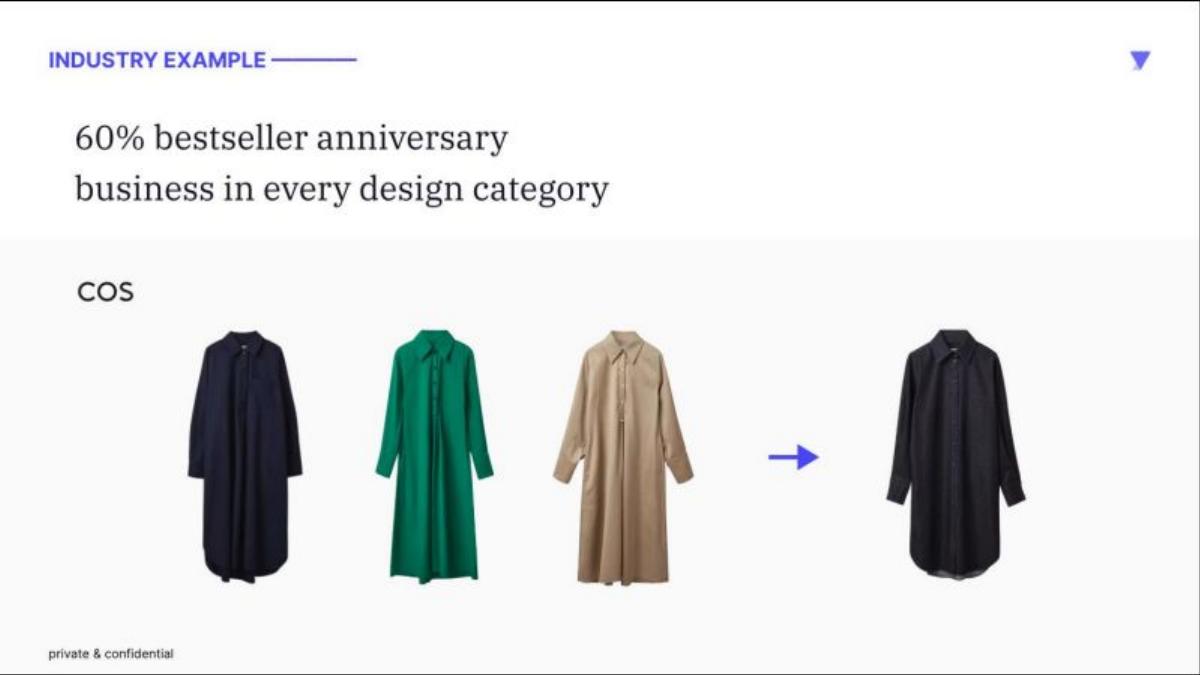
Using the brand COS as an example, this slide illustrates how 60% of 'bestseller anniversary business' exists in every design category. This suggests that AI can easily replicate and iterate on proven successful designs to ensure commercial viability.
Slide 7: Sustainability Impact
This slide focuses on the environmental cost of fashion, stating the industry is responsible for 8-10% of global CO2 emissions. It highlights the financial impact of unsold goods in France (€630 million) and Germany (€7 billion), and mentions upcoming CO2 taxes as a driver for change.
Slide 8: Market Size
Yoona.ai estimates the global textile volume at €3 trillion. It breaks down the Total Addressable Market (TAM) for design processes, projecting a European TAM of €115 billion by 2024 with an advanced offer of features. The slide notes a 10% annual growth rate in the sector.
Slide 9 & 10: How Yoona.ai Works
These slides provide a high-level overview of the platform's workflow. It takes 'Design Data Input,' performs 'Data Analysis,' and generates 'Design Data Output.' The company claims the platform is 80% faster, 100% easier, 90% more efficient, and 100% customer-centric.
Slide 11: Benefits
This slide quantifies the time savings, claiming to 'reduce 4 hours of daily design work.' It compares the traditional 55k design hours and €11 million annual cost to the Yoona.ai platform's 1 design hour for a whole collection and €700k annual cost.
Slide 12: Energy & CO2 Savings
Yoona.ai provides a detailed breakdown of energy and CO2 savings. By replacing physical prototypes with digital designs, they claim a 99.8% reduction in both power consumption and CO2 emissions for the design phase.
Slide 13 & 14: Product Examples
These slides showcase the platform's output across various categories, including footwear, knitwear, and accessories. Slide 14 specifically demonstrates the progression from 'Data of any kind' to 'AI Design,' then '3D Designs,' and finally 'AR' (Augmented Reality) visualization for a dress.
Slide 15: Business Model
The business model is a standard B2B SaaS subscription. Pricing scales based on the number of designs (citing examples like Adidas needing 30,000 monthly) and the specific AI assistants used (print, silhouette, shirt, 3D, AR).
Slide 16: Roadmap and Traction
This slide shows an ambitious growth trajectory, from 10 customers and €160k ARR in 2022 to 1,650 customers and €61m ARR by 2026. It lists impressive pilot clients and POC planning with brands like Adidas, H&M, and Balenciaga.
Slide 17: Recognitions and Awards
A 'social proof' slide featuring logos from Techstars, Startupbootcamp, the European Union, and various German government and industry awards.
Slide 18: Global Design Database Scalability
Yoona.ai argues that their technology is not limited to fashion. They identify the advertising, furniture, automotive, and FMCG industries as future markets where their design digitization can be applied.
Slide 19: The Ask - What We Are Looking For
The company presents three potential hiring cases (Most Likely, Minimum, and Hyper Growth) to expand their team. It notes that €1.3 million is 'already committed' but does not explicitly state the total amount being raised in this specific round, though catalogue facts indicate a $50k pre-seed raise from Expert Dojo.
Slide 20: Executive Summary
A recap of the key points: the manual nature of the current process, Yoona.ai's revolutionary AI platform, the $3 trillion market opportunity, and their expert team supported by the industry.
Slide 21: Contact Slide
The final slide provides contact information for the founders and a call to action to 'drive impact together.'
What Works Well in This Deck
Strong Problem/Solution Fit: The deck does an excellent job of quantifying the pain points of the fashion industry—specifically waste and inefficiency—and showing exactly how AI solves them. · Credibility through Association: The frequent use of major brand logos (Adidas, H&M, Puma) and prestigious accelerator logos (Techstars) builds immediate trust for an early-stage startup. · Sustainability as a Business Driver: Instead of treating sustainability as a 'nice-to-have,' the deck links it directly to cost savings and upcoming regulatory pressures (CO2 taxes), making it a compelling financial argument. · Clear Product Visualization: Slides 13 and 14 show the actual output of the AI, which is crucial for a creative-focused tool. The AR example on slide 14 is particularly effective at showing the tech's sophistication.
What Is Missing or Could Be Improved
Specific Financial Ask: While slide 19 mentions hiring cases and committed funds, it doesn't clearly state the total funding goal for the current round or the valuation. · Unit Economics: The deck lacks detail on Customer Acquisition Cost (CAC) or Lifetime Value (LTV). While it's a pre-seed deck, some projections on these metrics would strengthen the business case. · Competitive Landscape: There is no slide addressing competitors. In the rapidly evolving generative AI space, investors would want to know how Yoona.ai differentiates itself from other AI design tools or traditional CAD software. · Technical Depth: The 'How it Works' slides are very high-level. A brief explanation of the underlying AI architecture (e.g., GANs or Diffusion models) would be beneficial for technical due diligence.
Founder Takeaways: What to Copy
Quantify the Inefficiency: Follow Yoona's lead by breaking down exactly how many hours and how much money your target customers are currently wasting. The '55,000 design hours' vs. '1 design hour' comparison is a powerful visual. · Use 'Social Proof' Early and Often: If you have pilots or even just conversations with major brands, put those logos on your slides. It signals that the industry takes you seriously. · Show the Future, but Sell the Present: Slide 18 shows how the tech can scale to other industries, which demonstrates long-term vision, but the rest of the deck stays laser-focused on the immediate fashion market. · Link Impact to ROI: If your startup has an ESG (Environmental, Social, and Governance) component, always tie it back to the bottom line. Yoona.ai doesn't just say 'save the planet'; they say 'save €10 million in wasted prototypes.'
Frequently asked questions
- What problem is Yoona.ai solving?
- Yoona.ai addresses the manual, time-consuming, and wasteful nature of the traditional fashion design process. According to slide 4, companies spend 55,000 design hours per year and produce 4-6 prototypes per design, yet 30% of goods remain unsold. This leads to massive environmental waste and designer burnout. Yoona.ai replaces this 'manual process driven by hope' with a 'data-driven process' that uses AI to generate customer-centric designs quickly.
- How does the technology actually work?
- The platform functions as an end-to-end design digitization tool. As shown on slide 9, it takes 'Design Data Input' and performs 'Data Analysis' using a global design database. The output is a collection of digital designs that can be converted into 3D models and even Augmented Reality (AR) visualizations (Slide 14). This allows brands to visualize and test collections before physical production, significantly reducing the need for physical prototypes.
- What is the business model and pricing?
- Yoona.ai operates on a B2B SaaS subscription model. Slide 8 mentions a subscription of €3,500 per month, which they equate to the average designer's salary. Slide 15 further clarifies that the subscription scales based on the volume of designs (e.g., 5,000 to 30,000 monthly) and the specific AI assistants utilized, such as print, silhouette, shirt, 3D, or AR assistants.
- What kind of traction does the company have?
- The company shows significant early-stage traction. Slide 16 lists 10 customers for 2022 with an ARR of €160k. They have active pilots or POC planning with major brands like Gerry Weber, Vaude, Adidas, and H&M. Additionally, they have been recognized by programs like Techstars and Startupbootcamp FashionTech, and have received awards such as the Deep Tech Award 2020 (Slide 17).
- What are the company's growth plans?
- Yoona.ai has aggressive growth targets, aiming to reach €61m in ARR and 1,650 customers by 2026 (Slide 16). Beyond fashion, they plan to scale their global design database to other industries including advertising, furniture, automotive, and FMCG, which represent a combined market turnover in the trillions (Slide 18). They are currently seeking funding to expand their product, sales, and marketing teams (Slide 19).