Youth+ Africa’s pitch deck addresses the critical issue of youth unemployment in Kenya, citing that 11.42 million youth are unemployed and 800,000 enter the job market annually. The company proposes a service-oriented solution comprising identification, training, mentorship, networking, and monitoring of high-potential entrepreneurs. Unlike typical tech startups, Youth+ Africa relies on a diversified revenue model where 42% of income is projected from product sales (conferences and masterclasses), 40% from sponsorship and advertising, and 18% from consultancy. The deck maps out an ambitious g…
Key takeaways
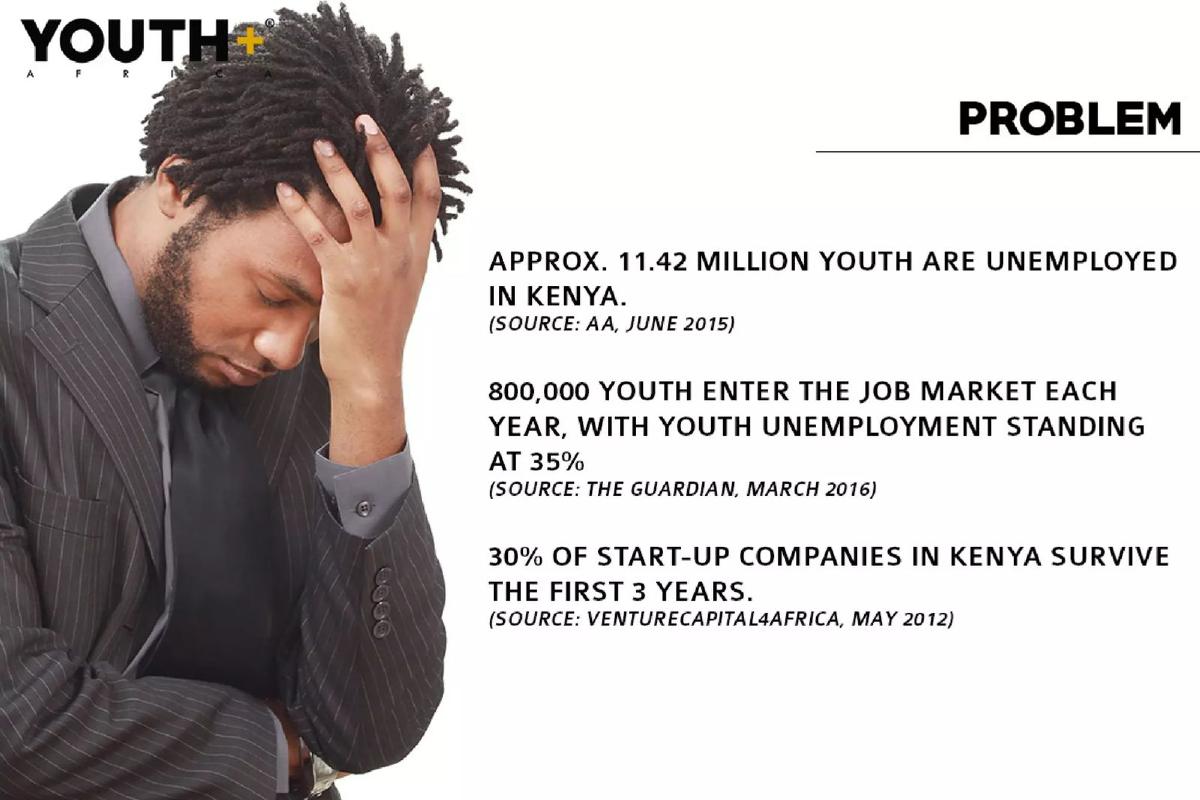
- The problem slide identifies a 35% youth unemployment rate in Kenya using data from The Guardian (Slide 2).
- The solution is defined as a 5-step approach: Identify, Train, Mentor, Network, and Monitor & Evaluate (Slide 3).
- Revenue is split into three primary buckets: Product Sales (42%), Sponsorship & Advertising (40%), and Consultancy (18%) (Slide 4).
- Conferences and Masterclasses are the largest individual product revenue drivers at 15% and 13% respectively (Slide 4).
- The growth timeline targets expansion from 3 markets in 2017 to 10 markets by 2021, including Nigeria and South Africa (Slide 5).
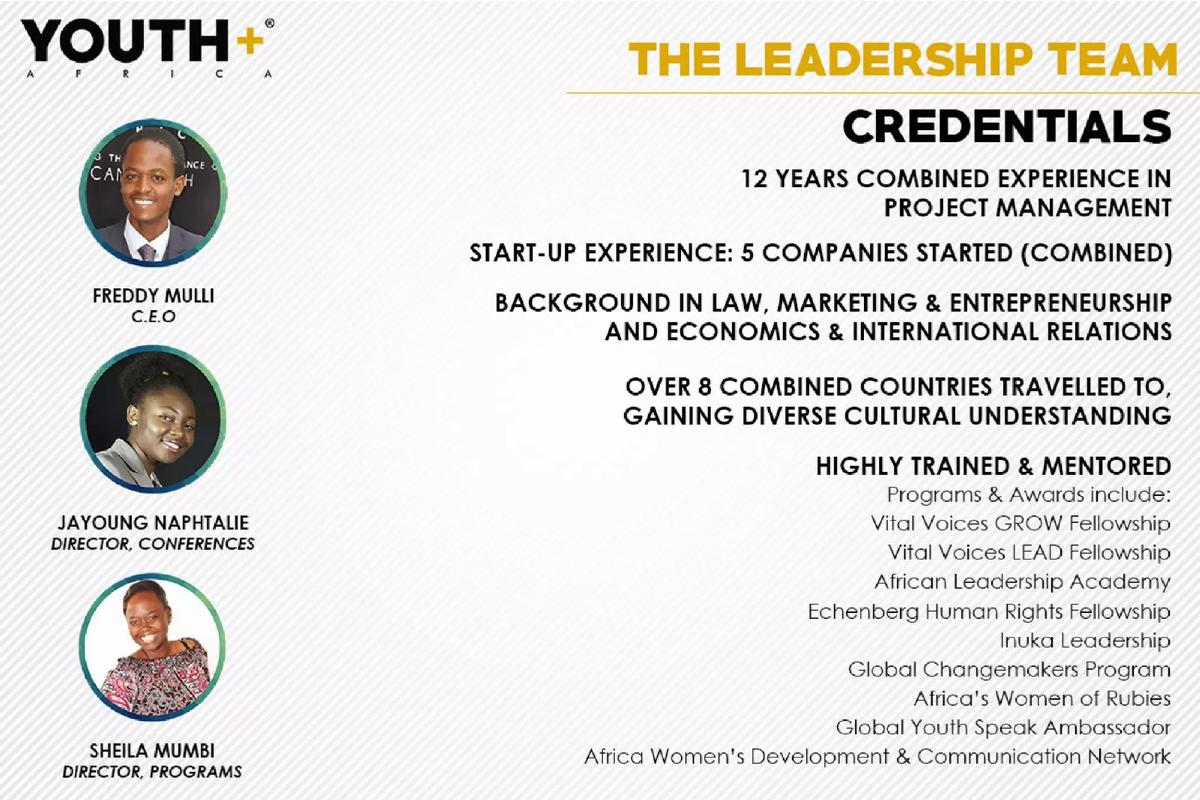
- The deck omits a team slide, though the contact slide lists three email addresses for Freddy Mulli, Jayoung Naphtalie, and Sheila Mumbi (Slide 6).
- There is no specific funding ask or valuation mentioned in the provided slides.
- The business operates under the Redd Dot Consulting Group Limited entity based in Nairobi, Kenya (Slide 6).
Executive Summary: A Mission-Driven Training Model
Youth+ Africa presents a pitch deck that is deeply rooted in social impact and professional development. The company, operating under Redd Dot Consulting Group Limited, focuses on the Kenyan entrepreneurial ecosystem. The deck is structured to highlight a massive social problem—youth unemployment—and offers a structured, 5-step service-based solution to mitigate it. While the visual design is clean and professional, the business model leans heavily on events and consultancy rather than scalable software, which places it in the category of a professional services or non-profit/social enterprise hybrid.
Slide 1: Title Slide
The opening slide features the Youth+ Africa logo against a dark background with a stylized, illuminated globe centered on the African continent. The branding is minimalist, using a bold sans-serif font with a yellow '+' symbol. This slide establishes the company's focus on the entire continent, despite the subsequent slides focusing primarily on Kenya. There is no tagline or mission statement present on this cover, leaving the viewer to wait for the next slide to understand the industry.
Slide 2: The Problem
Slide 2 uses a high-contrast image of a distressed professional to underscore the gravity of the unemployment crisis. The slide provides three specific data points to validate the market need: 11.42 million youth are unemployed in Kenya (Source: AA, June 2015), 800,000 youth enter the job market each year with a 35% unemployment rate (Source: The Guardian, March 2016), and a 30% survival rate for startups over three years (Source: VentureCapital4Africa, May 2012). By citing reputable sources, the deck builds immediate credibility. It successfully connects the macro problem (unemployment) with a specific business failure point (low startup survival), setting the stage for an intervention that supports entrepreneurs.
Slide 3: The Solution
The solution is presented as a "5-step approach to meeting the needs established." The steps are: Identify (high-potential entrepreneurs), Train (management, growth, innovation), Mentor (sustainable growth), Network (collaboration on social businesses), and Monitor & Evaluate (sustainability). This is a classic accelerator or incubator model. The language used—specifically "high-potential" and "social businesses"—suggests that Youth+ Africa is looking for a specific type of founder rather than providing mass-market vocational training. However, the slide does not explain how these steps are delivered (e.g., via an app, in-person workshops, or a digital platform).
Slide 4: Revenue Streams
This is the most detailed slide in the deck, providing a percentage breakdown of how the company intends to make money. It identifies three pillars: Product Sales (42%) , Sponsorship & Advertising (40%) , and Consultancy (18%) . Under Product Sales, the largest contributors are Conferences (15%) and Masterclasses (13%). Sponsorship is split nearly evenly between general Sponsorship (21%) and Advertising (19%). Consultancy is split 9% each between private and public institutions. This diversified model reduces risk but also highlights the labor-intensive nature of the business; conferences and consultancy require significant human capital to execute, which may concern investors looking for high-margin, automated scalability.
Slide 5: Growth Timeline
The growth timeline outlines a five-year expansion plan from 2017 to 2021. It shows a logical progression: starting in the East African Community (Kenya, Uganda, Rwanda) in 2017, expanding to Ethiopia and Tanzania in 2018, and then moving into West Africa (Ghana, Nigeria) by 2019. The final phases include Zambia (2020) and Malawi/South Africa (2021). While the map provides a clear vision of scale, there is no mention of the infrastructure or capital required to manage operations across ten different countries with varying regulatory and economic environments.
Slide 6: Contact Information
The final slide provides the physical address for Redd Dot Consulting Group Limited in Nairobi, Kenya, along with a phone number and website. Crucially, it lists three email addresses, which provides the only hint at the team involved: Freddy Mulli , Jayoung Naphtalie , and Sheila Mumbi . The inclusion of a registered trademark symbol on the logo and the formal company name suggests a level of legal and operational readiness.
What Works in This Deck
The deck excels at problem validation . By using specific, sourced statistics, the founders make the case that the status quo is untenable. An investor reading Slide 2 understands exactly why a solution is needed. Furthermore, the revenue transparency on Slide 4 is refreshing. Many early-stage decks are vague about how they will generate income; Youth+ Africa clearly delineates its various income streams, which allows for a more grounded discussion about unit economics and market size.
The visual consistency is also a strength. The use of a consistent color palette (yellow, orange, teal, and grey) and professional stock photography gives the impression of a mature brand. The 5-step solution is easy to remember and communicate, which is vital for a service-based business where the "product" is intangible.
What Is Missing from This Deck
The most glaring omission is a Team Slide . In a service-based business like consultancy and mentorship, the pedigree and experience of the founders are the primary assets. Without knowing the backgrounds of Freddy Mulli, Jayoung Naphtalie, or Sheila Mumbi, an investor cannot assess the company's ability to deliver high-level training or secure government consultancy contracts.
Secondly, there is no Traction Slide . The deck is forward-looking (referencing dates up to 2021), but it does not state what has been achieved to date. Have they already held a conference? How many entrepreneurs have they trained? Without proof of concept, the revenue percentages on Slide 4 are merely hypotheses rather than projections based on data.
Finally, the Investment Ask is absent. A pitch deck's primary purpose is to facilitate a transaction. This deck fails to state how much capital is being raised, what equity is being offered, or how the funds will be allocated to achieve the expansion goals shown on the timeline.
Founder Takeaways: What to Copy and What to Avoid
Copy the Sourced Problem Slide: Don't just say a problem exists; prove it with data from recognized publications or organizations as seen on Slide 2. · Copy the Revenue Breakdown: If you have multiple revenue streams, use a visual hierarchy (like the circles on Slide 4) to show which ones are the primary drivers. · Avoid Omitting the Team: Especially in Africa's emerging tech and service scenes, the "who" is often more important than the "what." Always include a slide detailing the founders' relevant experience. · Avoid the "Map Expansion" Trap: Showing a map with pins in ten countries (Slide 5) looks impressive but often signals a lack of focus. Investors usually prefer to see deep penetration in one market before a multi-country rollout. · Include a Clear Call to Action: The final slide should do more than provide an email; it should reiterate the opportunity and the specific next steps for an interested investor.
Frequently asked questions
- What is the core business model of Youth+ Africa?
- Youth+ Africa operates as an entrepreneurial accelerator and consultancy. It generates revenue by selling access to conferences, masterclasses, and fellowships to entrepreneurs, while simultaneously selling sponsorship and advertising to brands. Additionally, it offers consultancy services to both private and public institutions, creating a hybrid model of B2C training and B2B professional services.
- How does the company justify the market need?
- The deck uses macro-economic data to establish urgency. It notes that only 30% of startups in Kenya survive the first three years and highlights the massive influx of 800,000 new job seekers annually. By positioning itself as a filter and support system for 'high-potential' entrepreneurs, it aims to improve these survival rates and reduce unemployment.
- What are the specific revenue components under 'Product Sales'?
- Product Sales account for 42% of the total revenue mix. This is further broken down into Youth+ Conferences (15%), Masterclasses (13%), Entrepreneurs' Retreats (6%), Youth+ Fellowships (5%), and Youth+ Outreach (3%). This suggests a heavy reliance on event-based income and tuition-style fees for their training programs.
- What is the geographic expansion strategy?
- The company planned a phased rollout across Africa. Starting in 2017 with Kenya, Uganda, and Rwanda, it intended to add Tanzania and Ethiopia in 2018, Ghana and Nigeria in 2019, Zambia in 2020, and finally Malawi and South Africa by 2021. This represents a strategy of securing East Africa before moving into the larger West and South African markets.
- What critical investor information is missing from this deck?
- The deck is missing several standard components required for a professional fundraise: a team slide with biographies, a clear 'Ask' (how much money is needed), a use of funds breakdown, competitive analysis, and any historical traction or financial performance data. It functions more as a high-level program overview than a comprehensive investment pitch.