The Young Journey Youth & Family Programs pitch deck, dated 2018, functions primarily as a non-profit solicitation tool rather than a traditional venture capital deck. It outlines a mission to provide youth with safe, positive opportunities through media production and humanitarian efforts. The organization identifies significant socio-economic gaps, noting that incarceration rates for their target population tripled between 1968 and 2017. While the deck successfully communicates its social impact and geographic footprint—spanning NYC, Austin, and Montgomery—it lacks the financial rigor typic…
Key takeaways
- The organization focuses on youth aged 11 through 25, addressing a 2.5x higher likelihood of poverty in their target demographic (Slide 3).
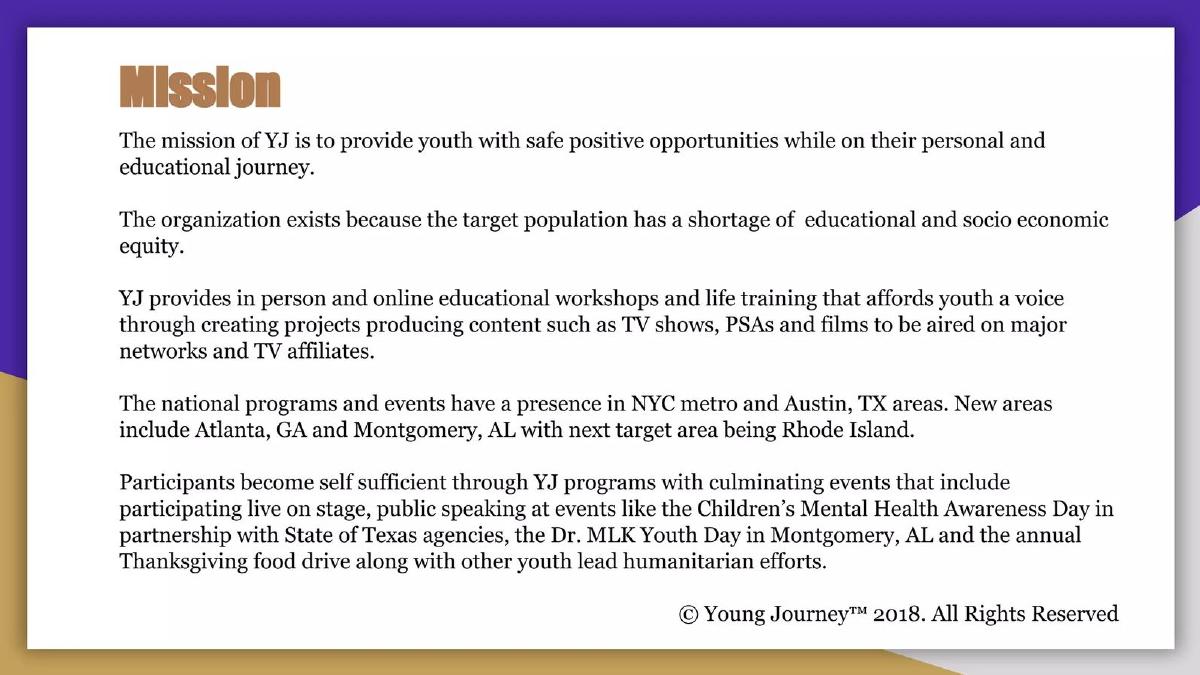
- Media production is a core pillar, with workshops designed to create content for major networks and TV affiliates (Slide 2).
- The program has a multi-state presence, operating in NYC and Austin, with expansions into Atlanta and Montgomery (Slide 2).
- The deck identifies a specific lack of financial literacy in underfunded public schools as a core problem (Slide 3).
- Humanitarian efforts include 'Clothes for Tots' and environmental learning projects (Slide 4).
- The 'Ask' is broad, requesting everything from office space and video editing to building materials from Home Depot or Lowes (Slide 5).
- The deck omits a formal team slide, providing only the name of the Executive Director, Jaha Wilder (Slide 6).
- There are no specific financial metrics, unit economics, or quantitative impact data regarding the number of youth served (Slides 1-6).
Young Journey: A Mission-Driven Community Deck
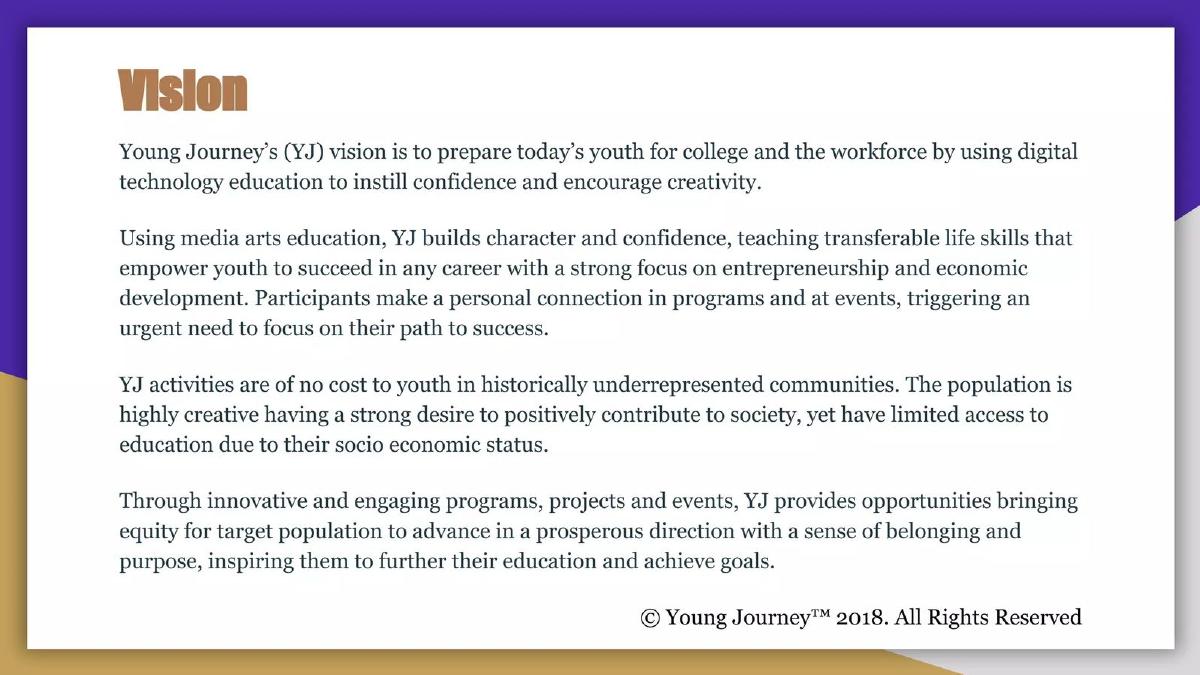
The Young Journey Youth & Family Programs pitch deck is a 2018 document that leans heavily into social impact and community development. Unlike a tech startup deck that focuses on scale, user acquisition, and exit strategies, this deck is designed to solicit support for a non-profit model. It emphasizes the creation of media content as a vehicle for youth empowerment and addresses systemic socio-economic issues.
Slide 1: Title Slide
The title slide is minimalist, featuring the 'Young Journey' logo which incorporates a film clapperboard icon. This immediately signals that media production is a central component of their identity. The subtitle 'Youth Programs' clarifies the sector. There is no tagline or specific value proposition on this slide, which is a missed opportunity to immediately define what makes their approach to youth programs unique.
Slide 2: Mission
Slide 2 outlines the organization's purpose. It states the mission is to 'provide youth with safe positive opportunities' during their educational journey. The slide identifies a 'shortage of educational and socio economic equity' as the reason for their existence. Crucially, it defines their primary activity: 'online educational workshops and life training' that result in TV shows, PSAs, and films for major networks. The slide also lists their geographic footprint, mentioning NYC, Austin, Atlanta, and Montgomery, with Rhode Island as a future target. It mentions partnerships with State of Texas agencies and the Dr. MLK Youth Day in Montgomery, providing some evidence of existing community integration.
Slide 3: The Problem
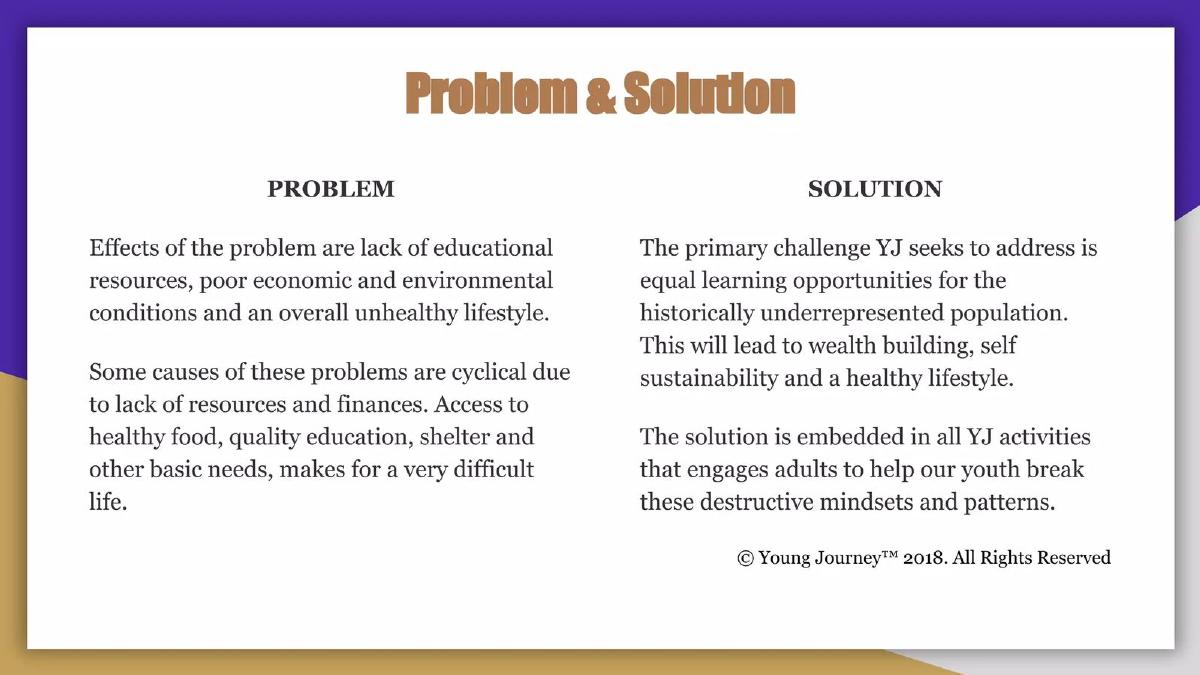
This slide attempts to quantify the social issues the organization addresses. It defines the target demographic as 'underrepresented boys and girls between the ages eleven through twenty five.' The slide cites a specific statistic: 'The rate of incarceration tripled from 1968 to 2017.' It also notes that the target population is '2.5 times more likely to be in poverty.' A significant portion of the slide is dedicated to the lack of financial literacy in public schools, referencing a MarketWatch article from March 2018. By linking idle time to discouragement and lack of basic needs, the slide sets the stage for their intervention, though it remains broad in its scope.
Slide 4: Identifying An Opportunity
Slide 4 transitions from the problem to the solution. It introduces 'Clothes for Tots' as a program providing basic needs to improve confidence. It claims that YJ workshops shape youth into 'productive citizens' and 'pipe line' them into employment and entrepreneurship. The slide makes a 'why now' argument, suggesting that society is 'regressing to unequitable resources' such as school resegregation and supermarket deserts. While the sentiment is strong, the slide lacks data on how many youth have actually been employed or how many 'tax dollars' have been saved through their incarceration prevention efforts.
Slide 5: How You Can Support
This is the 'Ask' slide, and it is exceptionally broad. It categorizes support into Sponsorship, Partnership, In-Kind, Share/Recommend, and Monetary Donation. The In-Kind section is particularly detailed, requesting everything from 'Building Materials (Home Depot/Lowes)' to 'Pro Audio/Visual Equipment' and 'Grant Writing.' The slide provides a mailing address in Round Rock, Texas, and mentions CashApp handles ($YoungJourney, $ClothesForTots). The lack of a specific fundraising target (e.g., 'We are raising $50,000 for a new media lab') makes the request feel more like a general donation appeal than a strategic capital ask.
Slide 6: Contact
The final slide provides contact information for Jaha Wilder, the Executive Director. It lists two phone numbers (718 and 512 area codes, corresponding to their NYC and Austin presence) and two websites: YoungJourney.org and ClothesForTots.org. The inclusion of a physical mailing address for donations reinforces the non-profit nature of the deck.
What the Deck Omissions Reveal
The most striking omission in the Young Journey deck is the lack of a Team Slide . While Jaha Wilder is mentioned as the Executive Director, there is no information about their background, nor is there any mention of a Board of Directors or staff. In the non-profit and startup worlds alike, the 'who' is often as important as the 'what,' especially when claiming to produce content for 'major networks.'
Furthermore, the deck lacks Traction Metrics . While it mentions having a presence in several cities, it does not state how many youth have participated in the programs, how many films have been produced, or which 'major networks' have actually aired their content. Without these figures, the 'Opportunity' slide remains theoretical.
Finally, there is no Financial Overview . A professional pitch deck usually includes a slide on how funds are allocated or a summary of the previous year's budget. The 'How You Can Support' slide asks for a vast array of items, but without a budget, a potential donor or partner cannot understand the organization's scale or fiscal responsibility.
What Founders Can Learn
Founders can learn from the way Young Journey anchors their problem in external research . By citing a MarketWatch article and specific incarceration statistics, they provide a factual basis for their mission. This is a strong tactic for establishing urgency.
However, the deck serves as a cautionary tale regarding the 'Ask.' When a deck asks for everything—from office space to building materials to CashApp donations—it can appear unfocused. A more effective approach is to have a primary, high-level ask for the main deck, with a secondary 'needs list' available upon request. This ensures the core message of the pitch isn't diluted by a long list of miscellaneous supplies.
Conclusion
The Young Journey 2018 deck is a community-centric document that successfully communicates a passion for youth advocacy and media education. Its strength lies in its clear identification of the socio-economic hurdles facing its target demographic. Its primary weaknesses are the lack of quantitative traction data, the absence of a professional team overview, and an overly broad request for support. For a non-profit seeking local community donations, this deck provides a sufficient overview; for an organization seeking significant institutional grants or corporate partnerships, a more data-driven and team-focused revision would be necessary.
Frequently asked questions
- What is the primary product or service of Young Journey?
- Young Journey provides in-person and online educational workshops that teach youth how to produce media content, including TV shows, PSAs, and films. These projects are intended for broadcast on major networks. Additionally, the organization manages humanitarian programs like 'Clothes for Tots' and hosts community events such as Thanksgiving food drives and public speaking engagements.
- What specific problem is the organization trying to solve?
- The organization targets the 'conditioned mindset of lack' and socio-economic inequity facing underrepresented youth. Specifically, they cite a tripling of incarceration rates from 1968 to 2017 and a lack of financial literacy courses in schools. They aim to prevent youth from becoming 'physically and mentally idle' by providing productive pathways to employment and entrepreneurship.
- Where does Young Journey operate?
- According to slide 2, the organization has a presence in the New York City metro area and Austin, Texas. They have recently expanded into Atlanta, Georgia, and Montgomery, Alabama. The deck also identifies Rhode Island as the next target area for expansion, indicating a national growth strategy.
- What kind of support is the organization seeking?
- The deck lists a wide range of needs on slide 5. This includes monetary donations via CashApp or check, corporate sponsorships, and in-kind donations. Specifically, they request office/storage space, video editing services, Mac/PC computers, building materials, and professional services like grant writing and curriculum development.
- Who is leading the organization according to the deck?
- The only individual named in the deck is Jaha Wilder, who is listed as the Executive Director on slide 6. The deck does not provide a board of directors, a list of staff members, or any biographical information regarding the leadership's background in media production or non-profit management.