You Impact Us is a volunteer-matching platform designed to bridge the gap between the 60 million Americans who volunteer and the 70% who do not. The deck, created for an LA Startup Weekend event, positions the product as a 'Match.com for volunteers and charities.' Its core thesis relies on social psychology: non-volunteers are more likely to serve if a 'trusted friend' asks them. The product workflow emphasizes speed, claiming a user can RSVP and donate food in just 90 seconds. While the deck is light on financial specifics and competitive analysis, it provides a clear roadmap for technical i…
Key takeaways
- The platform targets the 70% of Americans who currently do not volunteer, citing social influence as the primary lever for conversion (Slide 2).
- The value of volunteer service in the US was estimated at $162 billion in 2008, providing a massive macro-economic backdrop for the solution (Slide 2).
- The core product hook is a 'Match.com' style interface for pairing individuals with specific charitable causes (Slide 3).
- The user experience is designed for extreme efficiency, allowing a volunteer to RSVP and donate in 90 seconds (Slide 5).
- Social proof is baked into the product via automated Facebook status updates that broadcast a user's impact to their network (Slide 5).
- The roadmap includes heavy reliance on third-party integrations such as the AllforGood API and PayPal for transaction handling (Slide 10).
- Mobile and location-based search are identified as critical 'next steps' to drive local engagement (Slide 10).
- The deck utilizes a conversational, question-based transition style to move between product, business model, and roadmap sections (Slides 4, 6, 7, 8, 9).
The Pitch Deck Breakdown
The You Impact Us deck is a product of a Startup Weekend, which typically means it was built in a high-pressure, 54-hour window. This context is visible in the deck's structure: it is designed for a live presentation with high-impact visuals and minimal text, using 'segue' slides to keep the audience engaged. The company attempts to solve the friction and lack of social motivation in the non-profit sector by applying the mechanics of dating sites and social networks to volunteering.
Slide 1: Title and Branding
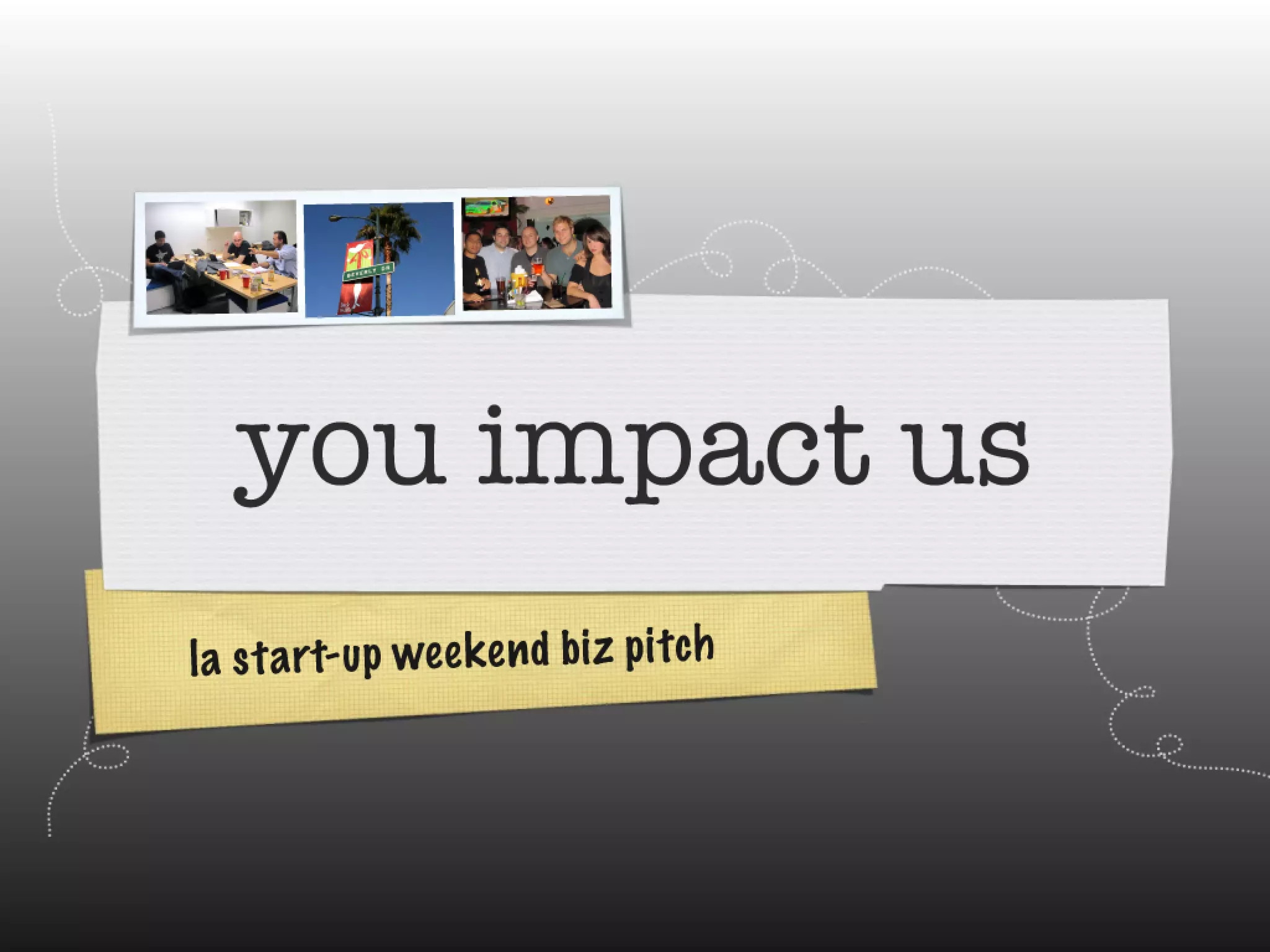
The title slide establishes the company name, 'you impact us,' and the context of the presentation: 'la start-up weekend biz pitch.' The imagery includes photos of the team at work and social settings, which reinforces the 'social' aspect of the brand. The aesthetic is informal, utilizing a typewriter font and a scrapbook-style layout that suggests a grassroots, community-focused mission.
Slide 2: The Situation
This slide serves as the 'Problem' or 'Market Opportunity' slide. It uses 2008 data to establish a massive scale: 60 million volunteers contributing 8 billion hours worth $162 billion . However, it points out a significant inefficiency: 70% of Americans don't volunteer . The most critical insight on this slide is the psychological trigger: non-volunteers are more likely to serve if a trusted friend asks them. This sets the stage for a social-referral based solution.
Slide 3: The Solution
The solution is presented as a simple analogy: 'match.com for volunteers and charities.' By using a well-known consumer brand as a reference point, the founders immediately communicate the core functionality—matching two sides of a marketplace based on compatibility. The subtitle, 'matching the right people with the right causes,' emphasizes the curation aspect of the platform.
Slide 4: Transition - How it Works
This is a pure transition slide. In a live pitch, this allows the speaker to pause and reset the audience's attention before diving into the product demo or workflow. It uses a simple, clean design consistent with the rest of the deck.
Slide 5: Product Workflow - The Volunteer Experience
Slide 5 details the user journey through the lens of a persona named Chelsea. The process is designed for speed, claiming a user can RSVP and donate food in 90 seconds . The slide also introduces the 'viral loop' of the product: the platform pings authenticated social accounts to post a status update. The example shown is a Facebook post stating, 'Chelsea McGee helped the NYC Food Bank meet their goal... You can get involved too.' This directly addresses the 'trusted friend' insight from Slide 2.
Slide 6: Transition - Show it to me
Another transition slide, likely intended to precede a live demo of the website or a series of screenshots showing the interface. It maintains the conversational tone of the presentation.
Slide 7: Transition - Monetization
This slide asks the question, 'but how do you make that cheddar?!' This is the 'Business Model' transition. While the specific answer is not in the provided slides, the question acknowledges the necessity of a sustainable revenue model even for a social impact startup.
Slide 8: Transition - Retention
The question 'so how do you keep ‘em comin back?' addresses the 'Retention' or 'Engagement' strategy. In a marketplace, keeping users active after their first 'match' is a common hurdle. This slide sets up the discussion for gamification or recurring volunteer opportunities.
Slide 9: Transition - The Future
The final transition, 'so what’s next?!' , leads into the roadmap and execution plan. It signals the end of the 'current state' of the product and the beginning of the 'vision' section.
Slide 10: Next Steps and Roadmap
The final slide in this set outlines the technical and strategic roadmap. Key items include:
Integrate AllforGood API: To populate the platform with existing volunteer opportunities. · Facebook and mobile apps: To meet users where they already spend time. · PayPal integration: To handle the financial aspect of donations mentioned in Slide 5. · Location-based volunteer search: Demonstrated by a mockup of an iPhone showing pins on a map of Los Angeles.
The slide ends with the ambitious goal to 'change the world' and a plan to 'meet in San Francisco,' suggesting a desire to move from a weekend project to a venture-backed startup.
What You Impact Us Does Well
The deck excels at identifying a specific psychological lever—social proof—and building the entire product story around it. By citing that 70% of people don't volunteer but would if asked by a friend, they create a clear 'why now' and 'why this' for their social integration features. The '90-second' claim is also a strong value proposition, as it addresses the common barrier of time commitment in the non-profit space.
The use of a persona (Chelsea) to walk through the product flow makes the abstract concept of a 'matching engine' feel tangible and easy to understand. Furthermore, the analogy of 'Match.com' provides an instant mental model for the audience, reducing the cognitive load required to understand the business.
What is Missing from the Deck
As this is a partial set of slides from a Startup Weekend, several critical components for a professional fundraising round are absent: 1. Business Model Details: While Slide 7 asks how they will make money, the provided slides do not show the answer. Investors would need to see if this is a SaaS model for charities, a transaction fee model for donations, or an ad-based model. 2. Competitive Landscape: The deck does not mention existing players like VolunteerMatch or Idealist. Identifying how You Impact Us differs from these incumbents is essential. 3. Unit Economics: There is no mention of Customer Acquisition Cost (CAC) or the Lifetime Value (LTV) of a volunteer, which are vital for a marketplace business. 4. Team Slide: Although the title slide has photos, there is no slide detailing the specific expertise of the founders (e.g., engineering, non-profit management, or growth marketing). 5. The Ask: The deck ends with 'next steps' but does not include a specific funding request or a breakdown of how capital would be deployed.
Founder's Guide: What to Copy
Use the 'X for Y' Analogy: If your product is a marketplace, using a well-known comparison like 'Match.com for volunteers' is an incredibly effective way to explain your business in five seconds. It allows you to spend the rest of your time on your unique differentiators rather than explaining the basic concept.
Focus on a Single Insight: The most powerful part of this deck is the statistic about 'trusted friends' on Slide 2. Every subsequent slide supports this insight. Founders should find the one data point that proves their solution is necessary and make it the heartbeat of the deck.
Design for the Medium: Because this was a live pitch, the founders used large fonts and transition slides. If you are pitching on a stage, copy this 'less is more' approach. Save the text-heavy slides for the version of the deck you email to investors for review.
Show the Viral Loop: If your product relies on social growth, show exactly what the social post looks like (as seen on Slide 5). Seeing the actual Facebook status update makes the growth strategy feel real rather than theoretical.
Frequently asked questions
- What is the primary problem You Impact Us aims to solve?
- The company addresses the 'participation gap' in American volunteering. According to Slide 2, while 60 million Americans volunteer, 70% of the population does not. The deck argues that these non-volunteers are not inherently unwilling but rather lack the right social prompt, as they are significantly more likely to serve if asked by a trusted friend.
- How does the platform utilize social media?
- Social media is the engine for growth and retention. Slide 5 shows that once a user (in this case, 'Chelsea') completes an action, the platform pings their authenticated social accounts. This generates a Facebook status update that publicizes the good deed, encouraging friends to 'Become a fan' and get involved themselves.
- What is the stated business model for the company?
- The provided slides do not explicitly detail the revenue streams. Slide 7 asks 'but how do you make that cheddar?!' as a transition, but the subsequent slide in the provided sequence (Slide 8) is another transition question regarding retention. The specific monetization mechanics—whether through corporate partnerships, transaction fees, or premium listings—are missing from this selection.
- What technical integrations are planned for the product?
- As outlined on Slide 10, the technical roadmap includes integrating the AllforGood API to aggregate volunteer opportunities, building dedicated Facebook and mobile apps, and implementing PayPal for seamless financial donations. They also highlight location-based search as a key feature for the mobile experience.
- Who is the target audience for this pitch?
- The deck was specifically designed for an 'LA start-up weekend biz pitch' (Slide 1). This context explains the informal tone, the use of transition slides to guide a live audience, and the focus on 'next steps' like meeting in San Francisco to scale the idea beyond the hackathon environment.