Arize AI’s Series B deck is a highly professional, narrative-driven presentation that successfully argues for the necessity of a new software category: Machine Learning (ML) Observability. By framing the problem as a 'mission to the moon' where companies are currently 'running AI blindly,' the deck creates a sense of urgency. It effectively uses a competitive landscape quadrant to distance itself from legacy monitoring tools, positioning Arize as a 'Full Stack Observability' solution that doesn't just surface issues but resolves and improves them. The inclusion of high-profile enterprise logo…
Key takeaways
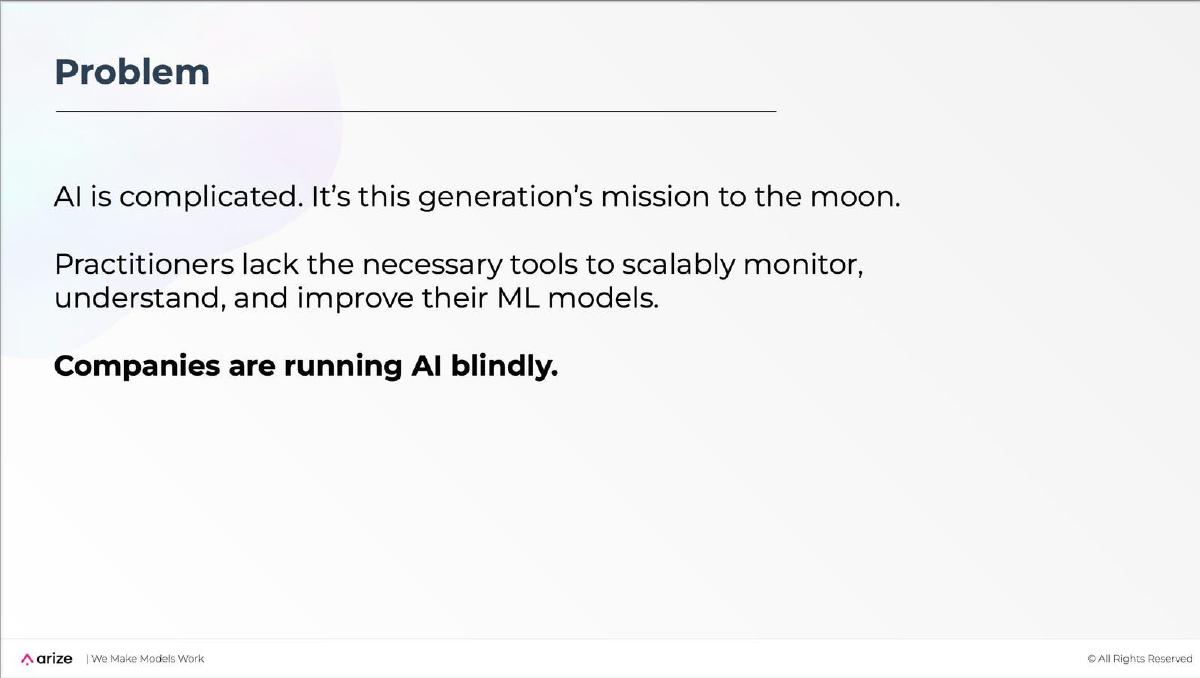
- The deck positions AI development as a high-stakes 'mission to the moon' to elevate the importance of the problem (Slide 2).
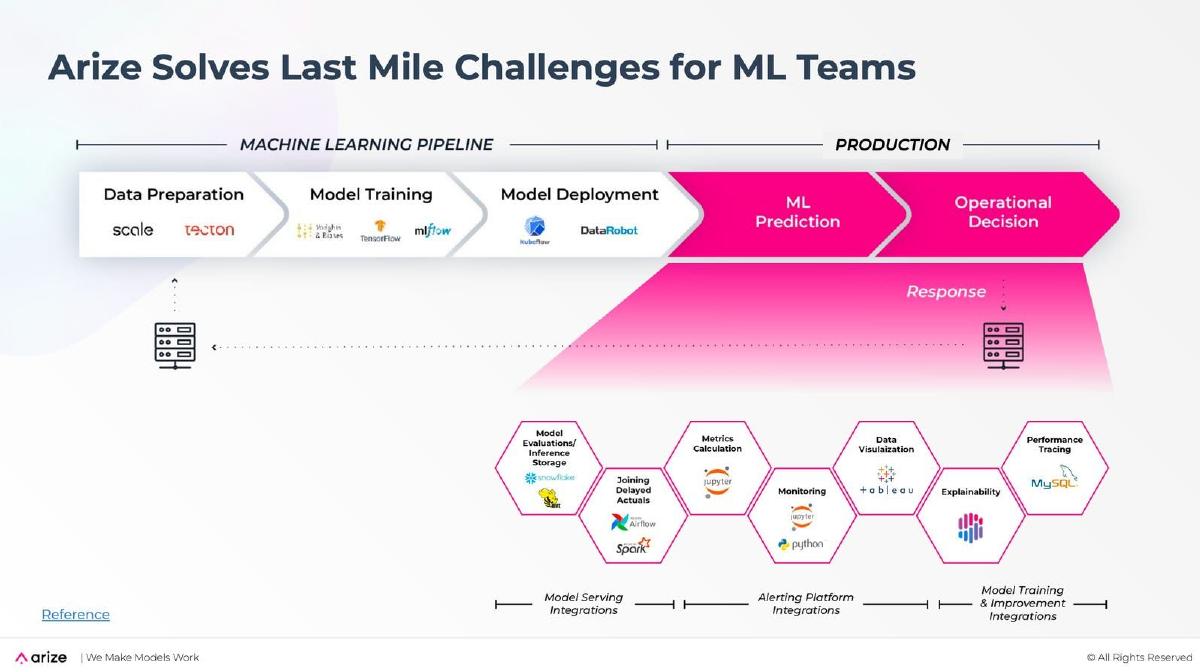
- Arize identifies a specific gap in the market: the 'Last Mile' of the ML pipeline where production decisions happen (Slide 4).
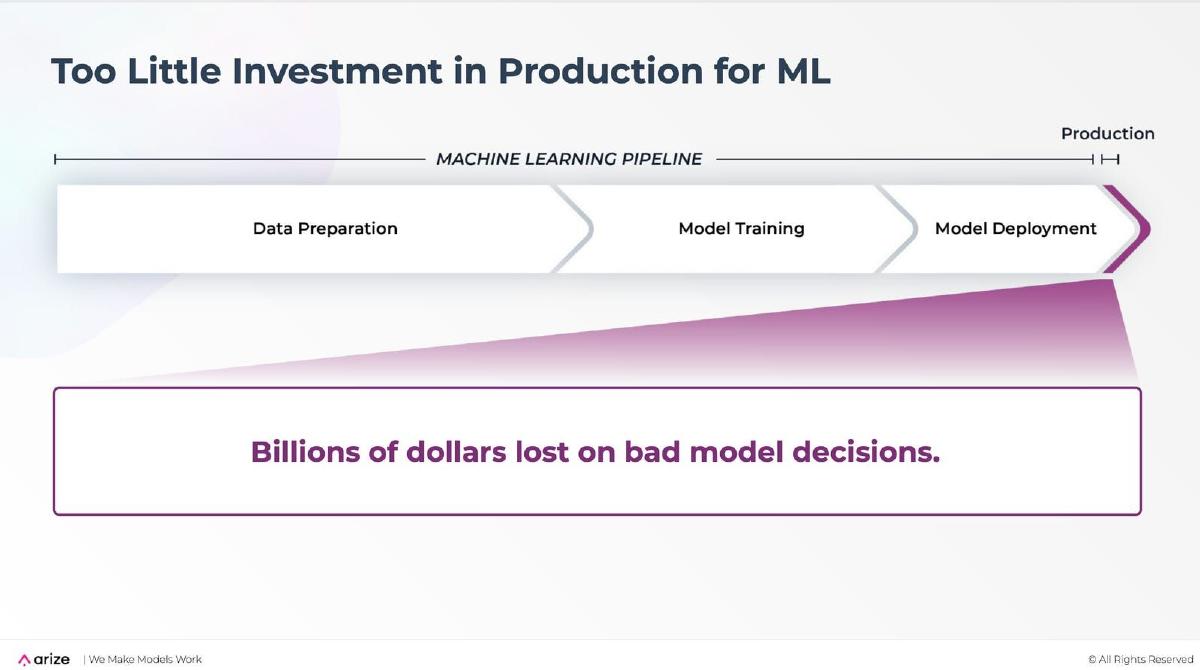
- The company claims that 'billions of dollars' are lost due to bad model decisions, providing a clear ROI narrative (Slide 3).
- A competitive quadrant is used to differentiate Arize from 'Metrics Monitoring' by focusing on 'Full Stack Observability' (Slide 7).
- The deck highlights a 40.2% CAGR for AI Hardware & Software, projecting a $350B market by 2028 (Slide 6).
- Arize benchmarks its category against the $70B+ Infrastructure Observability market, citing companies like Datadog and Splunk (Slide 6).
- The solution is simplified into three clear pillars: Surface, Resolve, and Improve (Slide 5).
- Social proof is demonstrated through a timeline of 'Notable New Customers' including P&G, Instacart, and Uber (Slide 8).
Arize AI: Defining the ML Observability Category
Arize AI’s Series B deck, used to raise $38 million in 2023 as reported by Business Insider, is a masterclass in category positioning. In a crowded AI landscape, Arize avoids the trap of being 'just another AI tool' by focusing on the infrastructure required to make AI work reliably in production. The deck is clean, visually consistent, and follows a logical narrative arc from problem to market opportunity to proof of traction.
Slide 1: Title and Ethos
The cover slide sets a professional tone with a minimalist design. The subtitle, "Built by Practitioners, for Practitioners," is a deliberate attempt to establish immediate credibility. In the developer tools and MLOps space, being 'built by practitioners' suggests that the founders have felt the pain points they are solving, which is a key signal for technical investors.
Slide 2: The High-Stakes Problem
Slide 2 uses a bold analogy: "AI is complicated. It’s this generation’s mission to the moon." By framing AI deployment as a moonshot, Arize elevates the importance of their solution. The core problem stated is that practitioners lack the tools to scalably monitor and improve ML models, leading to the punchline: "Companies are running AI blindly." This creates a sense of systemic risk that requires a specialized solution.
Slide 3: The Financial Impact
Slide 3 visualizes the Machine Learning Pipeline, divided into Data Preparation, Model Training, and Model Deployment. It highlights a massive gap at the end of the funnel. The text "Billions of dollars lost on bad model decisions" provides the 'why now' and the economic justification for the round. It suggests that without observability, the previous investments in data and training are at risk of being wasted.
Slide 4: Solving the 'Last Mile'
This slide expands on the pipeline by introducing the 'Production' phase, which includes ML Prediction and Operational Decisions. Arize positions itself as the layer that sits underneath these final stages. By showing logos like Scale, Tecton, Weights & Biases, and DataRobot in the earlier stages, Arize acknowledges the existing ecosystem while clearly marking its own territory in the 'Last Mile.' This is a sophisticated way to show how they integrate with, rather than compete against, other popular MLOps tools.
Slide 5: The Three-Pillar Solution
Slide 5 simplifies the product offering into three digestible actions: Surface, Resolve, and Improve. This framework tells the investor exactly what the software does: it finds issues automatically, explains why they happened, and helps engineers iterate. It moves the conversation from abstract 'observability' to concrete utility.
Slide 6: Market Size and Acceleration
The market slide is particularly aggressive. It compares the AI market to the Cloud Computing market, suggesting that AI will eventually be larger. Citing Grand View Research and Fortune Business Insights , the slide shows a 40.2% CAGR for AI Hardware & Software, reaching $350B by 2028. Crucially, it benchmarks the opportunity against the $70B+ Infrastructure Observability market , listing companies like Datadog, Splunk, and New Relic. This tells investors: 'We are building the Datadog for AI.'
Slide 7: The Competitive Landscape
Arize uses a standard 2x2 matrix to define the competitive landscape. The Y-axis ranges from Compliance to ML Engineering, and the X-axis ranges from Metrics Monitoring to Full Stack Observability. Arize places itself in the top-right corner. By labeling the left side as just 'Surface' and their own side as 'Surface, Resolve, Improve,' they visually reinforce the product pillars from Slide 5 and dismiss competitors as incomplete solutions.
Slide 8: Traction and Social Proof
The final slide in this sequence is a 'Notable New Customers' timeline for 2022. The logos are impressive: Uber, Spotify, P&G, eBay, and Instacart. For a Series B, investors look for enterprise validation. Showing that world-class engineering teams at Uber and Spotify trust Arize is a powerful signal that the product is 'enterprise-ready' and solves problems at scale.
What Arize AI Does Well
The deck excels at category framing. Instead of competing for a slice of the 'AI' pie, Arize argues that the pie cannot be eaten without their specific tools. They successfully draw parallels to the established DevOps/Observability market, which makes the business model easy for VCs to understand: it’s a 'picks and shovels' play for the AI gold rush.
The visual storytelling is also top-tier. The use of the pipeline diagram (Slides 3 and 4) helps non-technical investors visualize where Arize fits in a complex software stack. By placing well-known logos in the 'Data Prep' and 'Training' phases, they provide context for their own position in the 'Production' phase.
What is Missing from the Deck
As is common with public versions of Series B decks, this version omits detailed financials and unit economics. There is no mention of Annual Recurring Revenue (ARR), Net Revenue Retention (NRR), or Customer Acquisition Cost (CAC). While the logos on Slide 8 imply growth, the actual velocity of that growth is not quantified in the slides provided.
Furthermore, there is no Team Slide in this 8-slide selection. For a company emphasizing 'Built by Practitioners,' seeing the specific backgrounds of the founders and the engineering leadership would be critical to the narrative. The deck also lacks a clear 'Ask' slide , though we know from external reports that the goal was a $38M Series B.
Lessons for Founders
Use Analogies to Simplify: The 'mission to the moon' analogy helps ground a complex technical product in a relatable concept of risk and reward. · Position Against the Ecosystem: Don't just list competitors; show where you sit in the workflow relative to other tools the customer already uses. · Benchmark Against Established Categories: If you are creating a new category (ML Observability), compare its potential to a mature, multi-billion dollar category (Infrastructure Observability) to help investors size the opportunity. · Show, Don't Just Tell, Traction: A timeline of logos is more effective than a simple list because it shows momentum and the speed of market adoption.
Frequently asked questions
- What is the primary problem Arize AI is solving?
- Arize AI addresses the 'last mile' challenge in machine learning. According to Slide 3 and 4, while companies invest heavily in data preparation and model training, they lack the tools to monitor models once they are in production. This leads to 'running AI blindly' and results in billions of dollars lost due to poor model decisions.
- How does Arize AI differentiate itself from competitors?
- On Slide 7, Arize uses a 2x2 matrix to position itself in the top-right quadrant. It differentiates by moving beyond simple 'Metrics Monitoring' (which only surfaces issues) to 'Full Stack Observability.' This approach allows engineers to not only surface issues but also resolve them and continuously improve models.
- What market size does Arize AI target?
- Slide 6 projects the AI Hardware & Software market to reach $350B by 2028 with a 40.2% CAGR. It also compares the potential of ML observability to the existing Infrastructure Observability market, which had a market cap of over $70B in 2020, featuring giants like Datadog and Splunk.
- Which major companies are using Arize AI?
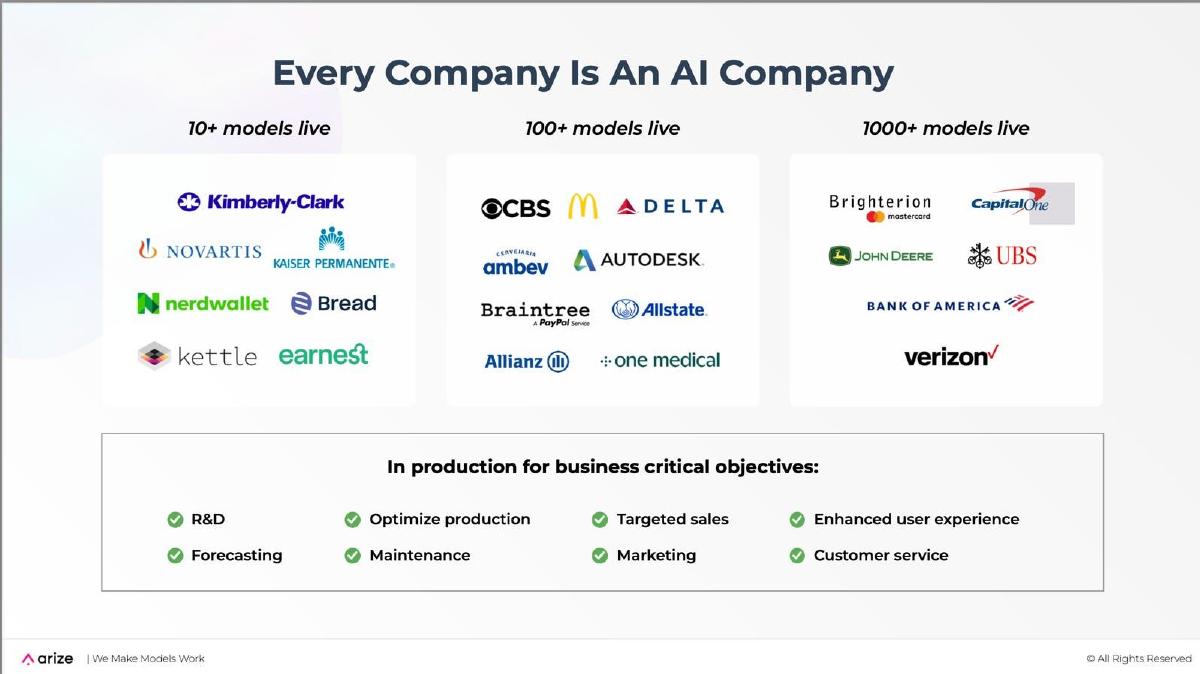
- Slide 8 lists several high-profile enterprise customers acquired in the first half of 2022, including Uber, Spotify, eBay, Instacart, P&G, Nextdoor, and Stitch Fix. This demonstrates significant traction across diverse industries like tech, retail, and consumer goods.
- What are the three core functions of the Arize platform?
- As detailed on Slide 5, the platform is designed to: 1) Surface issues automatically, 2) Resolve issues by helping engineers understand the 'why' behind them, and 3) Improve models continuously through ongoing monitoring and feedback loops.