The Arcus pitch deck is a narrative-driven presentation that positions the company as the essential infrastructure layer for modern banking. By categorizing the industry's evolution into three consumer-led trends—centralization, on-demand access, and personalization—Arcus makes a compelling case for why traditional, fragmented banking rails are no longer sufficient. The deck introduces a proprietary ecosystem of three products (xData, xChange, and xPay) that allow financial institutions to interact directly with merchants, bypassing traditional networks to offer real-time data and payment cap…
Key takeaways
- Arcus defines the 'Bank of the Future' through three pillars: Centralization, On-demand services, and Personalization.
- The company offers three distinct modular products: xData (data pulling), xChange (instruction pushing), and xPay (payment processing).
- The infrastructure is designed to bypass traditional networks by creating a direct two-way link between FSPs and merchants.
- Arcus emphasizes 'recurring payments' as the core of the consumer financial experience.
- The deck lists major enterprise partners like Santander and 7Eleven, proving the technology is capable of handling scale.
- The company operates with a dual-HQ strategy in New York and Mexico City, targeting the LatAm fintech boom.
What this deck actually is
The Arcus pitch deck is a product-centric vision document aimed at establishing the company as the foundational "connective tissue" between financial institutions and merchants. It classifies itself as "the new infrastructure for recurring payments," positioning the company as a modern, API-first alternative to archaic banking rails. The primary objective of the deck is to demonstrate how Arcus enables the "Bank of the Future" through three core functionalities: data pulling (xData), instruction pushing (xChange), and payment processing (xPay).
The single most important finding in this deck is its heavy reliance on industry trends and conceptual workflows rather than traction metrics or financial performance. While the deck lists high-profile logos like Santander, 7Eleven, and Marqeta as "powering many solutions," it does not disclose revenue, transaction volume, growth rates, or the specific stage of the fundraise. It is a narrative-driven deck that focuses on the "why" and the "how" of the technology, assuming the investor is already sold on the "who" or will find that information in a data room.
Slide-by-slide walkthrough
Slide 1: Title Slide
The deck opens with a clear, bold value proposition: "arcus the new infrastructure for recurring payments." The subtitle expands this by defining the company as a "direct infrastructure between financial services and merchants" that is "powering the bank of the future." The visual identity is established with an orange gradient and a stylized "M" logo.
From an investor's perspective, this slide immediately answers the question of "what do you do?" and "who do you do it for?" By using the word "infrastructure," Arcus signals a B2B play with high switching costs and potential for scale. The phrasing "direct infrastructure" suggests the removal of intermediaries, which is a common value driver in fintech.
To make this slide even stronger, Arcus could have included a high-level "anchor metric"—for example, "Powering $X billion in transactions for 50+ global banks." This would immediately ground the visionary statement in reality before the reader moves to the problem/solution slides.
Slide 2: The Current Banking Evolution
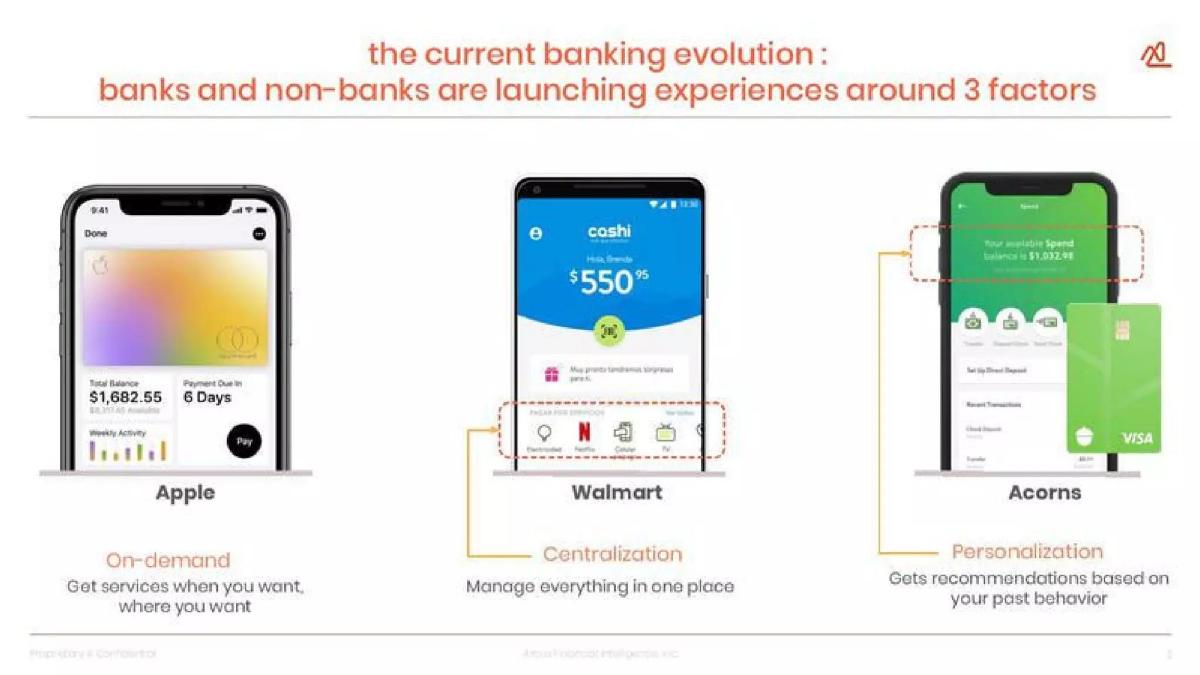
This slide contextualizes the product within a shifting market landscape. It identifies three "factors" driving the bank of the future: On-demand (Apple), Centralization (Walmart/Cashi), and Personalization (Acorns). It uses mobile mockups to show how these themes manifest in real-world user interfaces, such as the ability to "Pay Payment Due In 6 Days" or get recommendations based on "past behavior."
An investor reads this as a "market thesis" slide. The founders are demonstrating that they understand the consumer expectations being set by massive incumbents and successful startups. The inclusion of the "Cashi" app from Walmart is particularly notable, as it hints at the company's focus on the Latin American market (where Cashi is prevalent), though the slide doesn't explicitly state this geography yet.
The strongest version of this slide would link these trends more directly to the pain point Arcus solves. While it shows what consumers want , it doesn't yet explain why existing banks can't provide it. Adding a "The Gap" section would bridge the transition to the infrastructure problem.
Slide 3: Centralization Trend
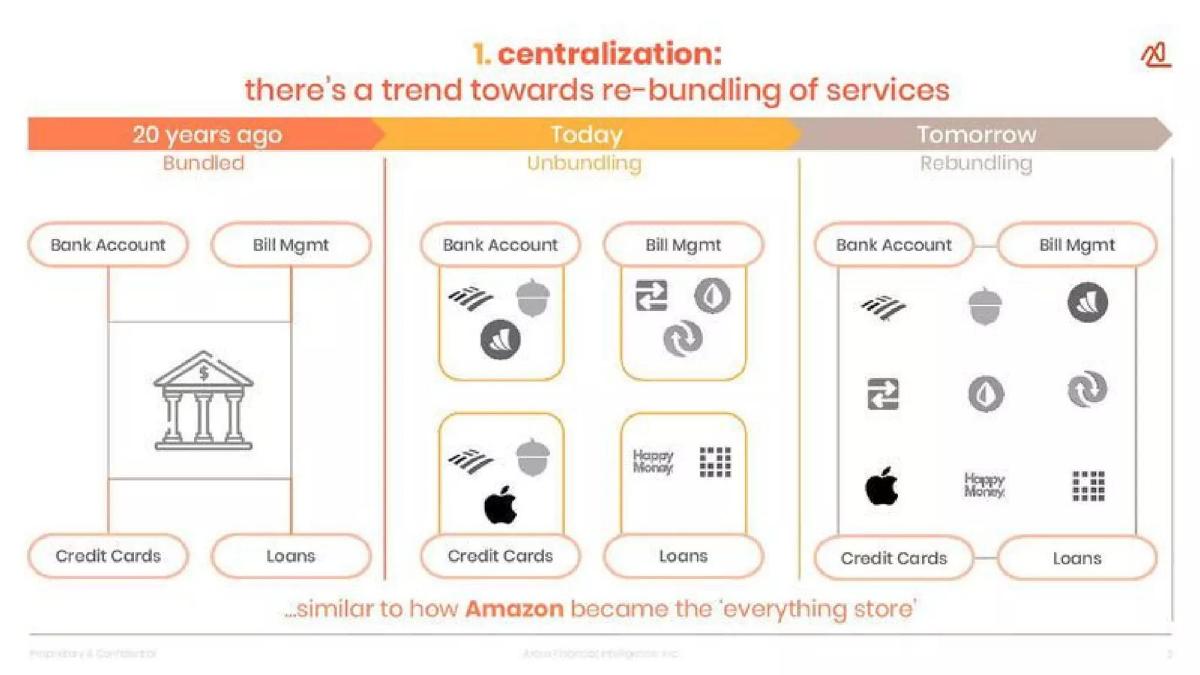
Arcus dives deeper into its first factor: Centralization. It presents a timeline showing a 20-year shift from "Bundled" services to "Unbundling" (the current state) and finally to "Rebundling" (the future). It draws a parallel to Amazon becoming the "everything store," suggesting that financial services will follow a similar path where bank accounts, bill management, and credit cards are managed in one place.
This slide is designed to build a sense of inevitability. Investors look for "macro tailwinds," and the rebundling of fintech is a significant one. By showing the "Happy Money" and generic "Bank Account" icons, the deck suggests that the winners of the next era will be those who can integrate multiple disparate services into a single interface.
The slide is visually clean but abstract. It would be stronger if it explicitly named the technical hurdle to rebundling—namely, that data is siloed. This would set the stage for why "infrastructure" (Arcus) is the necessary catalyst for this trend to materialize.
Slide 4: On-Demand Financial Products
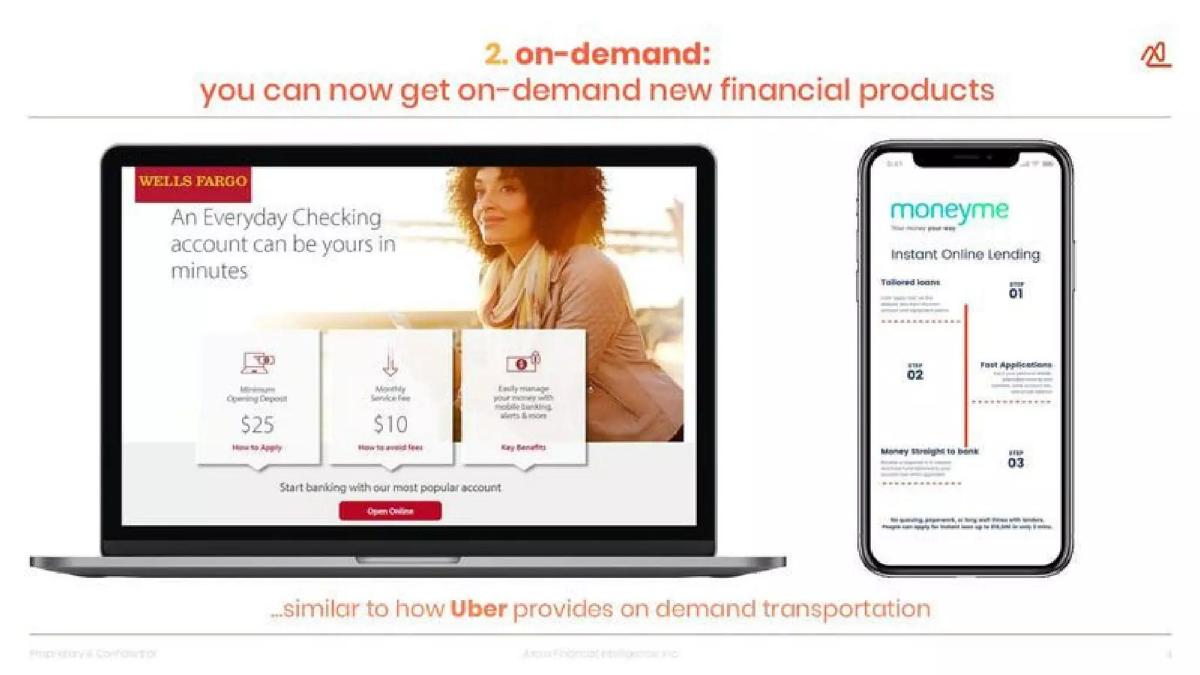
The focus shifts to the "on-demand" nature of modern banking. It contrasts a Wells Fargo "Everyday Checking" account (open in minutes) with a "MoneyMe" instant online lending interface. The comparison to Uber is made explicitly at the bottom: "...similar to how Uber provides on demand transportation." The slide emphasizes "fast applications" and "money straight to bank."
For an investor, this slide highlights the speed at which financial transactions must now occur. The implication is that "instant" requires real-time back-end connectivity. If a bank wants to offer a loan in 60 seconds, they need instant access to the user's financial history and a way to push funds immediately—capabilities Arcus presumably provides.
The slide contains a fair amount of small text from the screenshots that may be difficult to read in a presentation. Replacing the detailed screenshots with simplified, high-contrast UI elements that highlight the "60 seconds" and "Instant Online" claims would make the point more forcefully.
Slide 5: Personalization and Consumer Expectations
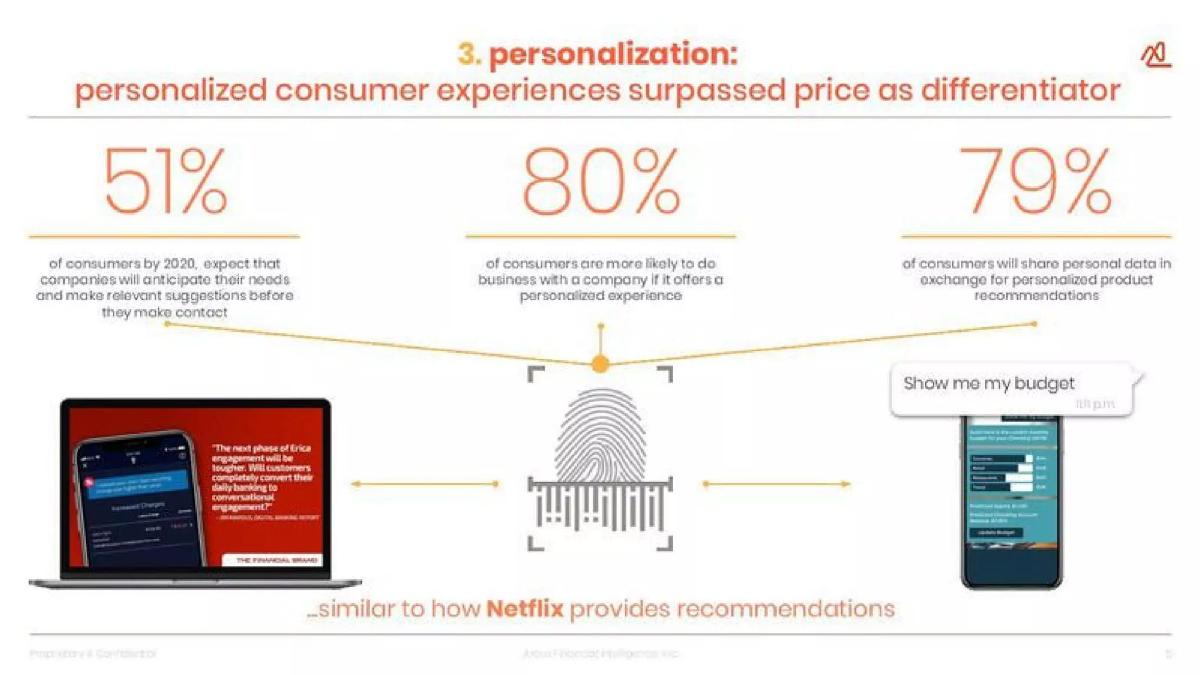
This slide provides quantitative backing for the "Personalization" factor. It cites statistics: 51% of consumers expect companies to anticipate needs, 80% are more likely to do business with personalized experiences, and 79% will share data for recommendations. It also includes a quote from Jim Marous regarding conversational engagement and "Erica" (Bank of America's AI).
Investors see this as the "demand" side of the equation. Consumers are willing to trade data for value, but banks need the infrastructure to "pull" that data and "push" relevant offers. The quote adds industry authority to the claim that the next phase of banking will be about engagement rather than just transactions.
The slide feels a bit "busy" compared to the others. The three statistics are powerful, but the quote and the two different device mockups (a laptop and a phone) compete for attention. The slide would be more effective if it focused purely on the trade-off: "Consumers give data (xData) to get better offers (xChange)."
Slide 6: E-commerce Comparison (The "Now")
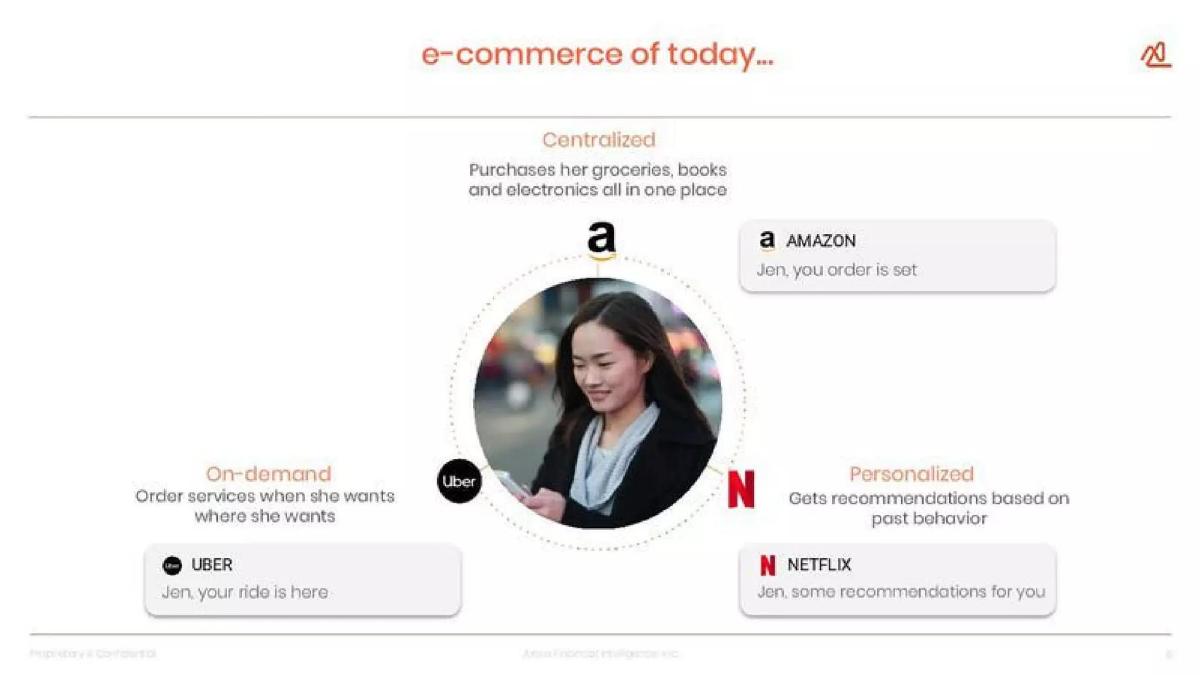
This slide uses a persona ("Jen") to illustrate how e-commerce is already centralized (Amazon), on-demand (Uber), and personalized (Netflix). It uses a hub-and-spoke visual to show how Jen interacts with these services seamlessly. The logos are recognizable and the value proposition for the consumer is clear.
This is a "parallel industry" argument. Investors love these because they suggest that the transformation of one industry (retail) is a blueprint for another (banking). By showing that Jen's expectations are already being met by Uber and Netflix, the deck makes the case that she will soon demand the same from her bank.
While the slide is effective at setting the stage, it is largely "fluff" in terms of new information. It repeats the three themes from Slide 2. A more efficient deck might combine Slide 6 and Slide 7 to show the "Today vs. Tomorrow" contrast on a single page.
Slide 7: The Bank of Tomorrow (The "Future")
Mirroring the previous slide, this shows "Jen" interacting with a hypothetical "MY APP." The icons now represent banking actions: tracking bills, toggling autopay, and getting credit card recommendations based on payment history. The slide explicitly states: "...what ties it all together is recurring payments."
This is the "Vision" slide. It defines Arcus's target use cases. The mention of "recurring payments" is critical; it narrows the broad "infrastructure" claim to a specific, high-value niche. Investors recognize that recurring payments (utilities, subscriptions, credit cards) are the stickiest part of a consumer's financial life.
The slide uses generic "MY APP ICON" placeholders. While this shows that Arcus is white-labeled infrastructure, it lacks the punch of seeing a real partner's logo. If Arcus has a flagship customer, showing that customer's app here would make the vision feel realized rather than theoretical.
Slide 8: The Broken Infrastructure
This is the "Problem" slide. Arcus identifies three issues: 1) Archaic systems (pre-internet era, not designed for mobile/subscriptions), 2) One-way communication (FSPs and merchants cannot push/pull data directly), and 3) Fragmented landscape (each product or country requires individual integration).
This slide is highly effective because it speaks the language of a technical investor. It identifies the specific bottlenecks—latency, lack of two-way data flow, and geographic silos—that prevent the "Bank of Tomorrow" from existing. It justifies why a new layer (Arcus) is necessary.
The slide is text-heavy but categorized well. To strengthen it, the company could have included a "Cost of Inaction" metric. For example, "Current integrations take 6–9 months and cost $X." This would quantify the "Fragmented" pain point.
Slide 9: Arcus Solution
The "Solution" slide directly mirrors the "Problem" slide, showing how Arcus addresses each point. It offers: 1) Mobile banking focus (real-time data/notifications), 2) Two-way network (push/pull data directly without traditional networks), and 3) Centralized API (one integration for multiple products and regions).
The most provocative claim here is "without going thru the networks." For an investor, this suggests Arcus is building a proprietary bypass to traditional, expensive payment rails. This implies higher margins and a stronger competitive moat. The "One API" promise is the standard B2B SaaS value prop: simplicity and speed to market.
The "Two-way network" claim is the strongest part of this slide, but it’s also the most complex. The slide would benefit from a small diagram showing the "Old Way" (indirect) vs. the "Arcus Way" (direct) to visualize this efficiency gain.
Slide 10: The Three Pillars: xData, xChange, xPay
This slide introduces the product architecture. A central gear (Arcus) sits between FSPs and Merchants. Three satellite circles define the product names: xData (Pulls financial data), xChange (Pushes instructions), and xPay (Pushes payments). It frames this as the "secured infrastructure for the bank of the future."
This is a classic "Middleman" architecture slide. It clarifies that Arcus isn't just a payment processor; it’s a data and instruction layer. By naming the products with the "x" prefix, the company is attempting to create a branded ecosystem of tools that investors can easily refer to.
The slide is a bit abstract. While the gear metaphor is clear, it doesn't explain the relationship between the three products. Do you need xData to use xPay? Are they sold separately? Clarifying the product modularity would help an investor understand the sales motion.
Slide 11: xChange Deep Dive
This slide explains the "xChange" product: pushing instructions to merchants. It shows a flow from User → App → Arcus API → Merchants. The merchant list includes utilities (PG&E), cell phones (Verizon), credit cards (Chase), loans (Navient), subscriptions (Netflix), and retail (Amazon, Walmart, United, Delta).
The value here is the breadth of the merchant network. For a bank, the ability to "push" a customer's new card details to all these merchants simultaneously is a massive retention feature. It "locks" the card into the merchant's ecosystem, making it the "top of wallet" card.
The "Users' e-commerce" category is very broad. Including logos like United and Delta suggests a travel/retail reach that goes beyond simple monthly bills. The deck should specify if these integrations are live or "target" merchants, as the distinction is vital for valuation.
Slide 12: xPay Deep Dive
This slide is visually identical to Slide 11, but the title and focus change to "xPay: pushes payments to merchants." The flow remains the same, highlighting that the same network used for instructions is used for the actual movement of funds to the same set of merchants (Utilities, Cell phones, Netflix, etc.).
Investors look for "multi-product" strategies. By showing that xPay uses the same connection as xChange, Arcus demonstrates how it can increase its "Average Revenue Per User" (ARPU) by layering payments on top of instructions. It reinforces the "infrastructure" narrative—once the API is integrated, turning on additional features is easy.
Because the layout is identical to Slide 11, there is a risk that a reader might skim past it, missing the shift from "instructions" to "payments." A different color scheme for each product (xData, xChange, xPay) would help differentiate these slides during a quick flip-through.
Slide 13: xData Deep Dive
The final product slide covers "xData," which "pulls data from merchants." The arrows are reversed, showing data flowing from the merchants back to the User/App. The merchant list is slightly truncated compared to the previous two slides, focusing on Utilities, Cell, Credit Cards, Loans, and Subscriptions.
Data is the most valuable asset in fintech. If a bank can see a user's Netflix subscription or PG&E bill balance in real-time through xData, they can offer better loans or financial management advice. This completes the "Personalization" loop mentioned in Slide 5. It shows that Arcus provides the "insight" that drives the "action" (xChange/xPay).
The slide doesn't mention the type of data being pulled. Is it just the balance due, or is it full transaction history? Being specific about the data fields (e.g., "Statement date, balance due, payment history") would give an investor a clearer picture of the product's depth.
Slide 14: Partner Solutions and Traction
This is the "Proof" slide. It shows seven real-world applications of Arcus products with partner logos: Element Credit Union (Card update/xChange), Santander (Autopay/xData/xPay), Marqeta (Bill pay/xData/xPay), 7Eleven (Walk-in bill pay/xPay), QPagos (Prepaid/xPay), Happy Money (Debt payoff/xPay), and Pangea (Cross-border/xPay).
This is arguably the most important slide in the deck. It moves from theory to practice. Seeing Santander and 7Eleven confirms that Arcus has enterprise-grade security and reliability. The variety of use cases—from "Debt payoff" to "Cross-border bill pay"—proves that the "One API" infrastructure is versatile across different financial sectors.
While the logos are impressive, the slide is missing the results of these partnerships. "Jen pay any bill" is a user story, not a business metric. Adding "Processing $XM/month for Santander" or "Reduced churn by X% for Element CU" would turn this from a gallery of logos into a compelling traction slide.
Slide 15: Contact and Headquarters
The final slide provides contact information and lists two headquarters: New York (Global) and Mexico City (LatAm). The background image shows a large, diverse team, which suggests the company has significant headcount and a physical presence in its key markets.
The inclusion of a Mexico City HQ is a vital piece of information that should have been introduced earlier. It explains why logos like 7Eleven and Santander (which has a huge LatAm presence) are featured prominently. It signals to the investor that Arcus is a bridge between the US and the emerging LatAm fintech market.
The slide is standard, but the "Thank You" text is placed over a photo that makes it a bit hard to read. A more professional approach would be to include the founders' names, titles, and direct contact info (email/LinkedIn) rather than just the general company website and physical addresses.
Concrete fixes in priority order
Add a Traction/Metrics Slide: The deck is entirely qualitative. It needs a slide showing transaction volume (TPV), number of active users, revenue growth (MoM or YoY), and the number of live integrations versus those in the pipeline. · Clarify Geography Early: The LatAm focus is a massive competitive advantage but isn't explicitly mentioned until the final slide. Move the "Global HQ / LatAm HQ" context to Slide 1 or 2 to frame the market opportunity. · Quantify the "Broken" Infrastructure: Slide 8 describes problems but doesn't quantify them. Stating the average time/cost for a bank to build these connections manually would highlight the ROI of the Arcus API. · Differentiate Product Slides Visually: Slides 11, 12, and 13 look nearly identical at a glance. Using distinct color coding (e.g., Blue for xData, Green for xPay, Orange for xChange) would make the product ecosystem easier to navigate. · Include an "Ask" and Use of Funds: The deck does not state how much money is being raised or what the capital will be used for (e.g., "Expanding merchant network in Brazil" or "Scaling engineering team"). This is essential for any fundraising deck. · Provide Partner Case Studies: Instead of just listing what "Jen" can do on Slide 14, provide one or two specific success metrics for the high-profile partners like Santander or Marqeta.
Frequently asked questions
- What is the core technology Arcus offers?
- Arcus provides a centralized API that allows financial service providers (FSPs) to pull financial data (xData), push merchant instructions (xChange), and facilitate recurring payments (xPay) directly to a network of merchants.
- What specific problems does Arcus solve for banks?
- The deck identifies "Archaic" pre-internet systems, "One-way" communication where data cannot be pushed/pulled directly, and "Fragmented" integrations that are often country-specific.
- Who are Arcus's current partners or customers?
- The deck features several high-profile partners including Santander, 7Eleven, Marqeta, Element Credit Union, Happy Money, QPagos, and Pangea.
- What types of payments does the Arcus infrastructure handle?
- Arcus targets recurring payments, including utilities (PG&E), cell phones (Verizon), credit cards (Chase), loans (Navient), and subscriptions (Netflix), as well as general e-commerce (Amazon, Walmart).
- What geographic markets does Arcus operate in?
- While not stated in the early slides, the final slide reveals headquarters in both New York and Mexico City, and partner logos like Santander and QPagos suggest a strong focus on the Latin American market.