Archimedes’ Offspring (Aos) attempts to democratize early-stage invention funding by creating a structured ecosystem of 'Families' of funds, each organized as a C-Corp. The deck argues that the traditional VC model has failed ordinary Americans by keeping companies private longer and focusing on unsustainable business models. Aos proposes a solution where retail investors can access vetted inventions through specific offerings like the 'Da Vinci' or 'Henry' families. While the deck provides specific exit scenarios—such as licensing royalties averaging $130k-$150k annually per invention—it lac…
Key takeaways
- The company identifies a market of 50 million U.S. households that are retail investors, citing a 2017 Federal Reserve survey (Slide 4).
- Aos uses a complex structure consisting of a Management LLC with two divisions: Inventor-Facing and Investor-Facing (Slide 6).
- The investment model is organized into 'Families' of funds, including the Da Vinci, Henry, Volta, Pasteur, Babbage, and Donovan families (Slide 6).
- One projected exit strategy involves licensing royalties at 5% of wholesale price, estimated at $130k to $150k per invention annually (Slide 7).
- A secondary exit option includes an inventor buyback of partial ownership at no less than 2x the investment (Slide 8).
- The deck uses a full-page Wikipedia screenshot of 'Intellectual Ventures' as its primary market validation (Slide 3).
- Competitors listed include Lexit, Kadasa Intellectual Property, Dynamic IP Deals LLC, Quirky, and Invention Thrives Here (Slide 9).
- The deck identifies recent IPO failures like Uber, Lyft, Slack, and WeWork as evidence of a broken VC-funded startup model (Slide 2).
Executive Summary: The Democratization of Invention Funding
Archimedes’ Offspring (Aos) positions itself as a disruptive force in the intellectual property and venture capital space. The deck focuses heavily on the systemic exclusion of retail investors from high-growth early-stage opportunities. By creating a structured 'Family of Funds,' Aos intends to bridge the gap between independent inventors who need capital and retail investors seeking diversified portfolios. However, the deck leans heavily on philosophical arguments against the current VC landscape and lacks the granular traction data typically required for a late-seed or Series A round.
Slide 1: Title and Mission
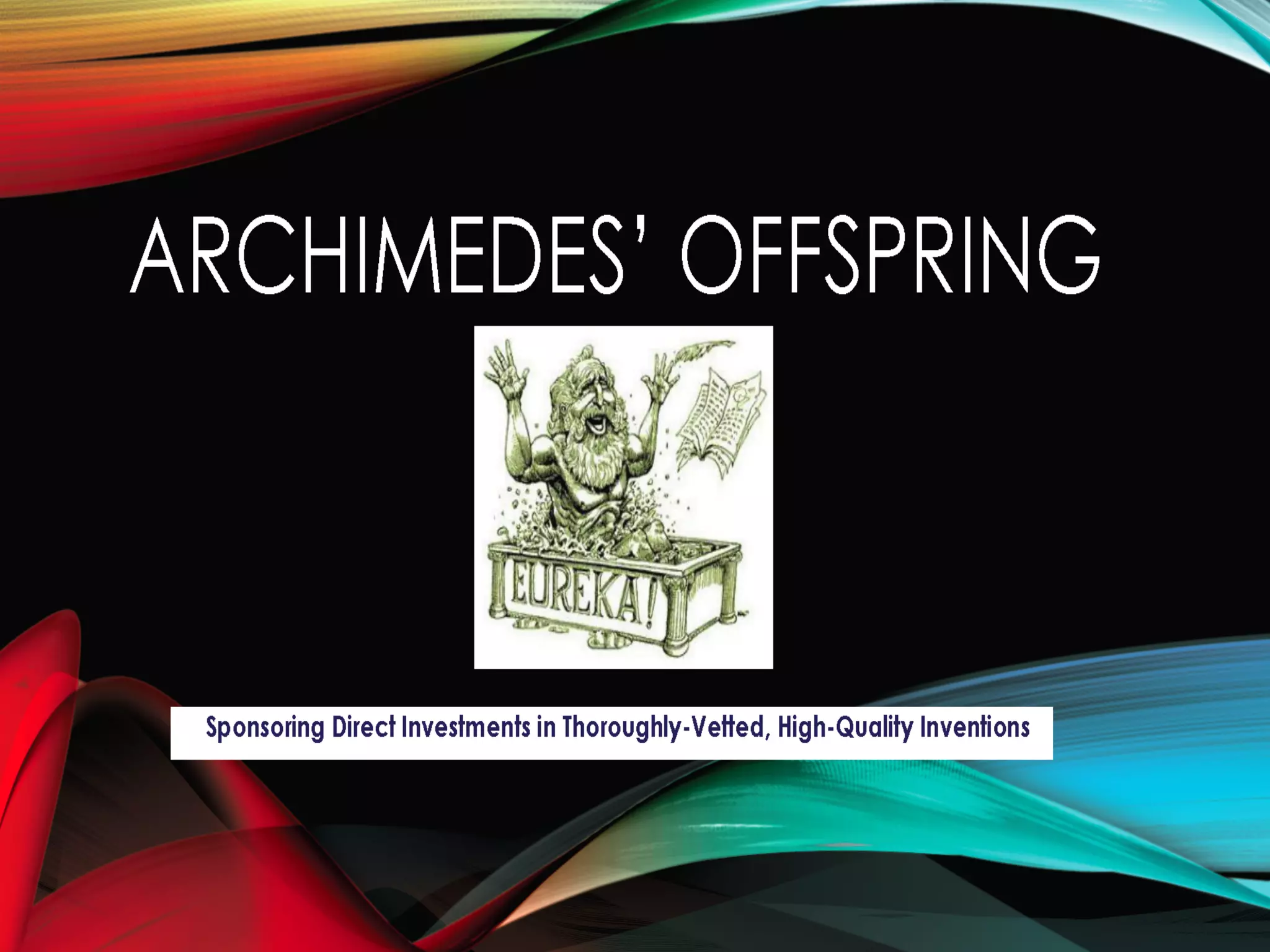
The cover slide introduces the brand name 'Archimedes’ Offspring' accompanied by a classical illustration of Archimedes in a bathtub shouting 'Eureka!' The subtitle defines the business as 'Sponsoring Direct Investments in Thoroughly-Vetted, High-Quality Inventions.' This immediately establishes the company as a gatekeeper or intermediary in the IP space rather than a direct product manufacturer.
Slide 2: The Problem Statement
Slide 2, titled 'Problem 2,' takes a macro-economic stance. It claims the 'VC-Funded Startup Model' has 'Impoverished Ordinary Americans.' The slide lists four specific grievances: exclusion due to securities laws, companies staying private longer, the disappearance of small companies through acquisition, and the failure of recent high-profile IPOs like Uber, Lyft, and WeWork. The stated outcome is 'vast quantities of cash wasted on mediocre or failing businesses.' This is a bold, narrative-driven slide that seeks to align the investor with a populist sentiment regarding the 'democratization' of finance.
Slide 3: Market Validation via Wikipedia
In a highly unusual move for a professional pitch deck, Slide 3 uses a screenshot of the Wikipedia page for 'Intellectual Ventures' as its primary market validation. It highlights Intellectual Ventures as a top-five owner of U.S. patents that has raised over $5.5 billion. While this proves that patent aggregation is a viable multi-billion dollar business, it does not provide validation for Aos specifically. Using a third-party encyclopedia entry instead of proprietary market research or internal case studies may signal a lack of established history for the company.
Slide 4: Defining the Retail Investment Market
Slide 4 quantifies the target investor demographic. It cites a 2017 Federal Reserve survey stating that 54% of U.S. households owned stocks. It notes that over 50 million households are retail investors. The slide argues that retail traders are more likely to invest in small-cap stocks due to lower price points and a desire for diversification. This slide effectively establishes the 'Total Addressable Market' for the fundraising side of the Aos platform, though it does not address the supply side (the inventors).
Slide 5 and 6: The Business Model and Structure
Slide 5 is a transition slide asking, 'What is Archimedes’ Offspring??' Slide 6 provides the answer through a complex organizational chart. The entity is managed by 'AOS Management LLC,' which is split into an 'Inventor-Facing Division' (led by Rita Z. Crompton) and an 'Investor-Facing Division' (led by R.P. Burrasca). The actual investment vehicles are 'Families of Funds,' each structured as a 'C' Corp. The slide lists six initial families: Da Vinci, Henry, Volta, Pasteur, Babbage, and Donovan. This structure suggests a heavy administrative and legal overhead, as each 'Family' and 'Individual Offering' represents a distinct corporate or securities layer.
Slide 7 and 8: Exit Strategies and Returns
These slides provide the 'how' of investor returns. Slide 7 outlines 'Option One,' which is based on royalties. It projects a 5% royalty on the wholesale price of an invention, estimating an average annual return of $130,000 to $150,000 per invention. Slide 8 outlines 'Option Four,' a buyback scenario where the inventor repurchases partial ownership. The slide explicitly states there will be 'No resale at less than 2 X Investment.' These figures are specific, but the deck does not provide the underlying data or the 'Option Two' and 'Option Three' mentioned by implication.
Slide 9: The Competitive Landscape
The final slide in this set displays logos of competitors. These include Lexit (an IP marketplace), Kadasa Intellectual Property, Dynamic IP Deals LLC, Quirky (a well-known consumer product crowdsourcing site that famously struggled with its business model), and Invention Thrives Here. The slide lacks a comparison matrix, leaving the viewer to guess how Aos differentiates itself from these varied entities.
What Archimedes’ Offspring Does Well
The deck is successful in identifying a clear emotional and economic pain point: the 'retail investor gap.' By framing the problem as a systemic failure of the VC model, they create a 'hero' narrative for their platform. The naming convention for the funds (Da Vinci, Pasteur, etc.) is clever branding that evokes a sense of prestige and historical significance in the field of innovation. Furthermore, providing specific (if hypothetical) exit numbers like the 5% royalty or the 2x buyback gives investors a concrete framework for how they might eventually see a return, which is often missing in early-stage IP decks.
Omissions and Weaknesses
The most glaring omission is the lack of a specific financial 'Ask.' There is no slide indicating how much money AOS Management LLC is seeking to raise for its own operations, nor is there a breakdown of the management fees they intend to charge the sub-funds. The reliance on a Wikipedia screenshot for market validation is a significant weakness; it suggests the founders may not have access to primary industry reports or their own proprietary data. Additionally, the deck does not explain the 'Vetting' process mentioned on the cover. For an investment fund, the 'secret sauce' is the selection criteria, yet the 'External Vetting Committees' are only mentioned as a bullet point on Slide 6 without further detail. Finally, the mention of 'Quirky' as a competitor without addressing that company's high-profile bankruptcy could be a red flag for savvy investors who know the history of the invention-crowdsourcing space.
Founder Takeaways: What to Copy and What to Avoid
Copy the Branding: The use of 'Families' named after famous inventors is an excellent way to categorize different sectors of a fund (e.g., medical, mechanical, digital) without using dry, technical language. It makes a complex financial product feel accessible and prestigious.
Avoid Third-Party Screenshots: Never use a Wikipedia page as a slide. It undermines the authority of the founders. Instead, extract the relevant data points and present them in a custom chart that aligns with your deck's visual style, citing the original source (e.g., 'Source: USPTO' or 'Source: Federal Reserve').
Clarify the Legal Overhead: If your business model involves multiple C-Corps and an LLC management layer, you must address the cost of maintaining that structure. Investors will be concerned about how much of their capital is being eaten by legal, accounting, and compliance fees before it ever reaches an inventor.
Include the 'Ask': A pitch deck without a clear request for capital is a presentation, not a pitch. Always include a slide detailing the amount you are raising, the terms (if public), and the specific milestones that capital will help you achieve.
Slide 2: Identifies the 'broken' VC model as a primary market opportunity. · Slide 4: Targets 50M U.S. households as the potential investor base. · Slide 6: Reveals a complex management structure with two distinct divisions. · Slide 7: Projects $130k-$150k in annual royalties per invention. · Slide 9: Lists Quirky and Lexit as competitors but lacks a comparison.
Frequently asked questions
- What is the core problem Archimedes’ Offspring is trying to solve?
- According to Slide 2, the company believes the 'VC-Funded Startup Model' has impoverished ordinary Americans. They argue that securities laws and the trend of companies staying private longer exclude retail investors from early-stage innovation. They also critique recent high-profile IPOs for having unsustainable business models, leading to wasted cash on mediocre businesses.
- How is the Archimedes’ Offspring fund structured?
- Slide 6 details a multi-layered structure. At the top is AOS Management LLC, which oversees two divisions. Below this are 'Families' of funds, each registered as a 'C' Corp. These families (named after famous inventors like Da Vinci and Pasteur) contain individual offerings that retail investors can participate in directly.
- What kind of returns are projected for investors?
- The deck offers two specific exit examples. Slide 7 suggests a royalty-based exit where inventions are licensed for 5% of the wholesale price, yielding an average of $130,000 to $150,000 per year. Slide 8 describes a buyback option where the inventor can repurchase partial ownership at a minimum of 2x the original investment.
- Who are the key people mentioned in the deck?
- Slide 6 lists Rita Z. Crompton as President and CEO of the Inventor-Facing Division. R.P. Burrasca is listed as the Executive VP and COO of the Investor-Facing Division. The staff includes roles for legal counsel, finance/CFO, and marketing, though specific names for these roles are not provided on the slide.
- What is missing from this pitch deck?
- The deck is missing a clear 'Ask' slide detailing how much capital AOS Management LLC is raising and how those funds will be used. It also lacks a roadmap, historical performance data of previously vetted inventions, and detailed unit economics for the management company itself versus the individual funds.