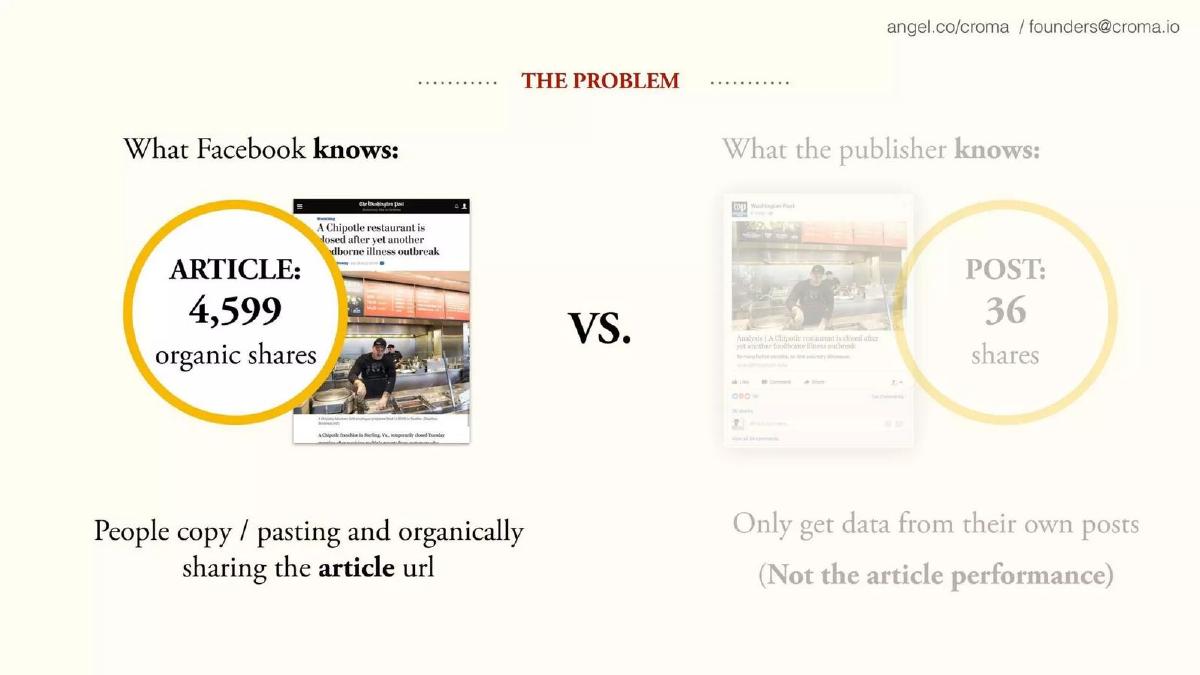
Croma's pre-seed deck is a masterclass in identifying a specific, painful data gap for a niche industry. By highlighting the discrepancy between what Facebook knows (4,599 organic shares) and what a publisher sees (36 shares), the deck makes an immediate case for its analytics platform. The founders lead with their 'Second Time Founders' status and a successful 2014 exit, providing instant credibility. Despite a modest $150,000 raise, the deck showcases impressive early traction with seven full-paying customers and a pipeline of 1,200 U.S. publications. While it lacks detailed financial proje…
Key takeaways
- The deck emphasizes founder experience by highlighting a successful exit in 2014 on slide 2.
- A three-slide visual sequence (slides 6-8) effectively illustrates the 'dark social' problem where publishers miss 99% of organic share data.
- Croma identifies a $168 billion global revenue industry for news on slide 10.
- The platform had 7 full-paying customers and 12 in trial at the time of the deck (slide 11).
- The team targets a potential market of 35,000 news publications worldwide (slide 11).
- High-authority social proof is established through a direct quote from the Global Social Media Editor at HuffPost (slide 12).
- The deck omits a specific funding ask, valuation, or use of funds slide.
- The solution is technically defined as connecting publisher websites with social network APIs to surface trending articles (slide 9).
Introduction
Croma's 2016 pitch deck is a lean, 14-slide presentation designed to solve a very specific problem for a very specific audience: news publishers. In an era where social media algorithms were beginning to dictate the survival of digital journalism, Croma positioned itself as the essential lens through which editors could see their true reach. The deck focuses heavily on the 'Founders' and 'Traction' to compensate for the lack of detailed financial modeling.
The Hook and the Team
Slide 1: Title The deck opens with a high-contrast image of a protest, immediately signaling that the product is built for the 'hard news' environment. The tagline is functional: 'A content distribution analytics platform for news publishers.' It also highlights their status as a 'Startups for News Finalist 2017,' providing early third-party validation.
Slide 2: Second Time Founders Croma makes a strategic choice to put the team slide second. They emphasize their history by showcasing 'Comenta.TV' and a 'Successful Exit in 2014.' By listing Juan Melano (CEO), Juan Schwindt (CTO), Nacho Harriague (Sales), and Julian Ganzabal (Engineering), they present a complete functional unit. The inclusion of Tiffany Labanca as an advisor adds further industry weight. This slide is designed to de-risk the investment by showing the team has 'done it before.'
The Narrative of News Evolution
Slide 3: The Past A full-bleed black and white image of a newspaper delivery boy. This serves as a silent transition slide, grounding the viewer in the traditional roots of the industry before pivoting to the digital chaos of the present.
Slide 4: The Present (Facebook) A close-up of the Facebook logo on a smartphone. This establishes the dominant platform where news is now consumed, setting the stage for the conflict.
Slide 5: The Content A screenshot of a Washington Post article about a Chipotle illness outbreak. This is a clever choice of example—a high-velocity, breaking news story that would naturally generate significant organic sharing.
The Problem: The Visibility Gap
Slide 6: The Problem (Part 1) This is the most critical slide in the deck. It contrasts 'What Facebook knows' against 'What the publisher knows.' It shows that while an article has 4,599 organic shares (people copy-pasting the URL), the publisher only sees data for their own post, which has a mere 36 shares. This 100x discrepancy is the 'aha' moment for the investor.
Slide 7: The Problem (Part 2) A repetition of the previous slide, emphasizing that publishers 'Only get data from their own posts (Not the article performance).'
Slide 8: The Problem (Part 3) The final beat of the problem sequence adds a large red 'NO ACCESS' stamp over the organic share data. It visualizes the frustration of a social media editor who is flying blind.
The Solution and Market Opportunity
Slide 9: The Solution Croma introduces its interface. The text explains: 'We connect the news publisher website with social networks API’s to surface their trending web articles.' The screenshot shows a dashboard with BBC News stories, displaying scores and specific share counts for Facebook, Twitter, and LinkedIn. It promises a way to 'Compare Publications' and view 'All Trending Stories.'
Slide 10: The Market Croma cites Pew Research Center (2016) to state that '60% of US adults learn about news on social media.' They pair this with a '$168B Global Revenue for the industry' figure. While the $168B is a massive top-down number, the 60% figure is the more relevant metric for their specific tool's utility.
Traction and Social Proof
Slide 11: Traction and Partners This slide provides the 'hard' evidence. They report 7 full-paying customers and 12 in trial. The 'Pipeline' of 1,200 US publications and 'Potential Market' of 35,000 worldwide shows room for growth. The most impressive part of this slide is the 'Top Partners' section, featuring logos for The Wall Street Journal, HuffPost, BBC News, and The Washington Post. For a pre-seed company, this is elite-level traction.
Slide 12: Testimonial A full-slide quote from Ethan Kapler, Global Social Media Editor at HuffPost: 'Croma is the best solution to surface our internally trending articles for social distribution.' Direct praise from a target user at a major publication is often more persuasive than a revenue chart at this stage.
Closing
Slide 13: The Impact of News A collage of powerful photojournalism images. This reinforces the 'mission' aspect of the startup—that helping news organizations survive and thrive in the digital age has societal value.
Slide 14: Contact The final slide repeats the logo and the partner logos, providing a clear email address (founders@croma.io). It lacks a specific call to action regarding the fundraise, which is a missed opportunity to create urgency.
What Works in This Deck
The Problem Sequence: Slides 6-8 are incredibly effective. They don't just tell the investor there is a problem; they show the data gap using a real-world example. Any investor who understands digital media will immediately grasp the value proposition. · Founder Pedigree: Leading with a successful exit is the strongest way to build trust in a pre-seed round. It suggests that the team knows how to build, scale, and sell a product. · High-Signal Logos: Landing the BBC and The Wall Street Journal as early partners/customers is a massive signal of product quality. It suggests the 'barrier to entry' for their sales process is manageable even for a small team.
What Is Missing
The Ask: The deck never mentions how much money they are looking for or what they plan to do with it. While this information is often shared in the email body or a follow-up, its absence in the deck makes the presentation feel like a sales deck rather than a fundraising deck. · Business Model: There is no mention of how Croma makes money. Is it a SaaS subscription? Is it per-user or per-publication? Without this, it's hard to evaluate the $168B market claim. · Competition: The deck ignores competitors like NewsWhip or CrowdTangle (which Facebook acquired in 2016). Investors will inevitably ask how Croma differs from these established players, and the deck offers no preemptive answer. · Unit Economics: While they have 7 paying customers, the deck doesn't disclose the ACV (Annual Contract Value) or the cost to acquire these customers.
Founder Takeaways: What to Copy
Use the 'Comparison' Slide: If your product surfaces hidden data, use the 'What [Industry Giant] knows vs. What the User knows' format. It is the fastest way to explain a complex technical advantage. · Leverage Your Exit: If you have had a previous exit, no matter the size, put it on the second slide. It changes the tone of the entire meeting from 'Can they do it?' to 'How big can they make this one?' · Focus on a Niche: Croma didn't try to be 'analytics for everyone.' They were 'analytics for news publishers.' This allowed them to land world-class logos early because their product was tailored to the specific workflow of a newsroom. · Visual Proof of Product: Slide 9 shows the actual dashboard. For software startups, showing the UI early helps investors visualize the product as a reality rather than a concept.
Frequently asked questions
- What is the core problem Croma solves?
- Croma addresses the 'data gap' in social media distribution for news publishers. As shown on slides 6 through 8, publishers typically only see data from their own official social posts (e.g., 36 shares). However, they lack visibility into 'dark social' or organic shares where users copy and paste the article URL directly (e.g., 4,599 shares). Croma surfaces this hidden trending data.
- How does the team establish credibility?
- The team leads with their track record on slide 2, explicitly labeling themselves as 'Second Time Founders' and noting a 'Successful Exit in 2014' with Comenta.TV. This is supported by a list of high-tier 'Top Partners' on slide 11, including The Wall Street Journal, BBC News, and The Washington Post, which validates their enterprise readiness.
- What are the key metrics mentioned in the deck?
- On slide 11, Croma reports 7 full-paying customers and 12 organizations in a trial period. They also identify a pipeline of 1,200 news publications in the US and a total addressable market of 35,000 publications globally. Market-wide, they cite that 60% of US adults learn about news on social media (slide 10).
- Is there a clear business model or 'Ask' in the deck?
- No. The deck is notably missing a business model slide explaining their pricing tiers or unit economics. It also lacks a final 'Ask' slide detailing how much capital they are raising, the terms of the round, or how the $150,000 (noted in catalogue facts) would be allocated toward specific milestones.
- How does the product actually work?
- Slide 9 explains that Croma connects news publisher websites with social network APIs. The platform then surfaces trending web articles in a dashboard that allows editors to compare publications, view total engagements across Facebook, Twitter, and LinkedIn, and see specific distribution times and URLs for their content.