Crew’s pitch deck (presented under their former name, ooomf) is a masterclass in narrative-driven marketplace fundraising. By contrasting the 'race to the bottom' of existing platforms like oDesk and Elance with their own premium, curated model, the founders successfully argued for a higher-margin, higher-quality alternative. The deck relies heavily on early traction—specifically $950,000 in projects booked within six months—to prove that high-end talent and high-budget clients were underserved. While the deck lacks a traditional 'Ask' slide or detailed unit economics, its focus on a 30% mont…
Key takeaways
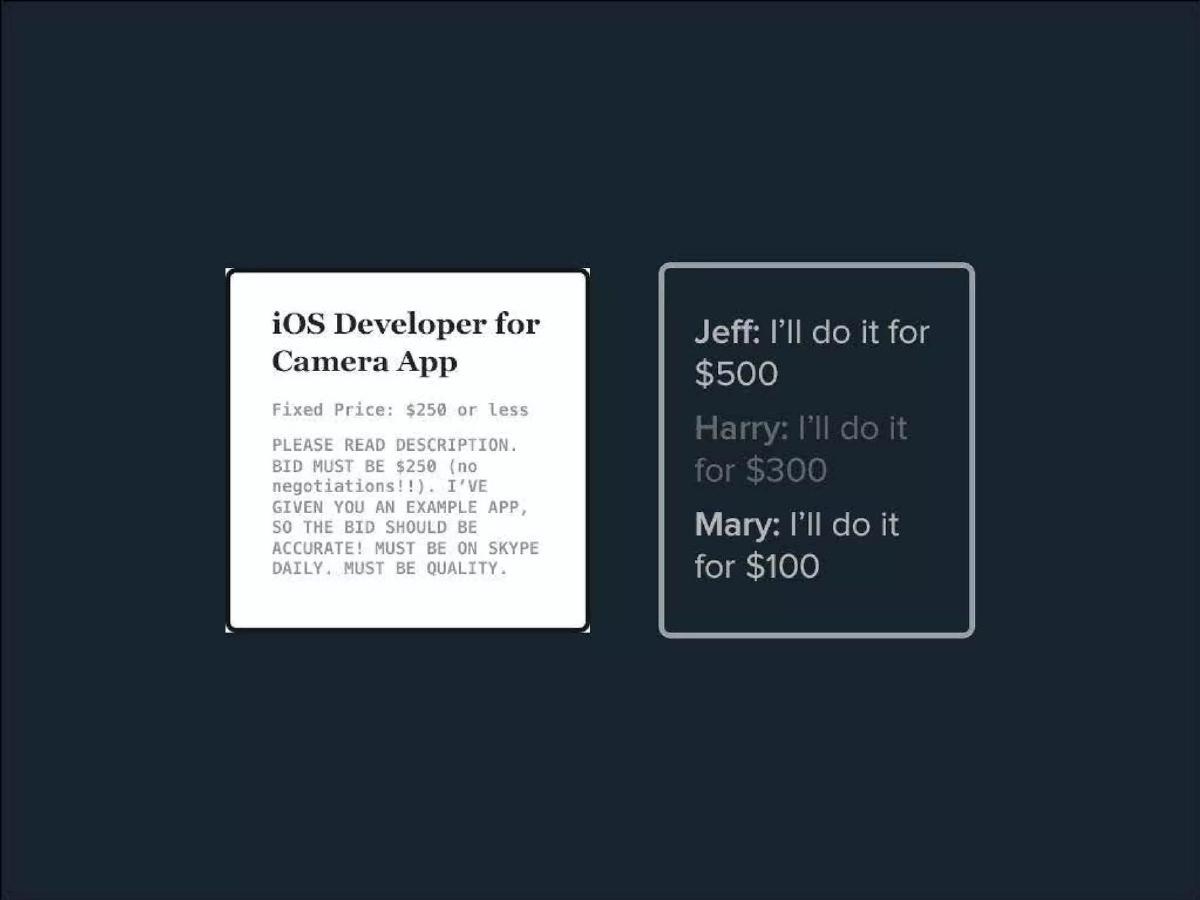
- The deck establishes a clear antagonist on Slide 2 by showing the low-quality bidding wars typical of 2013-era freelance sites.
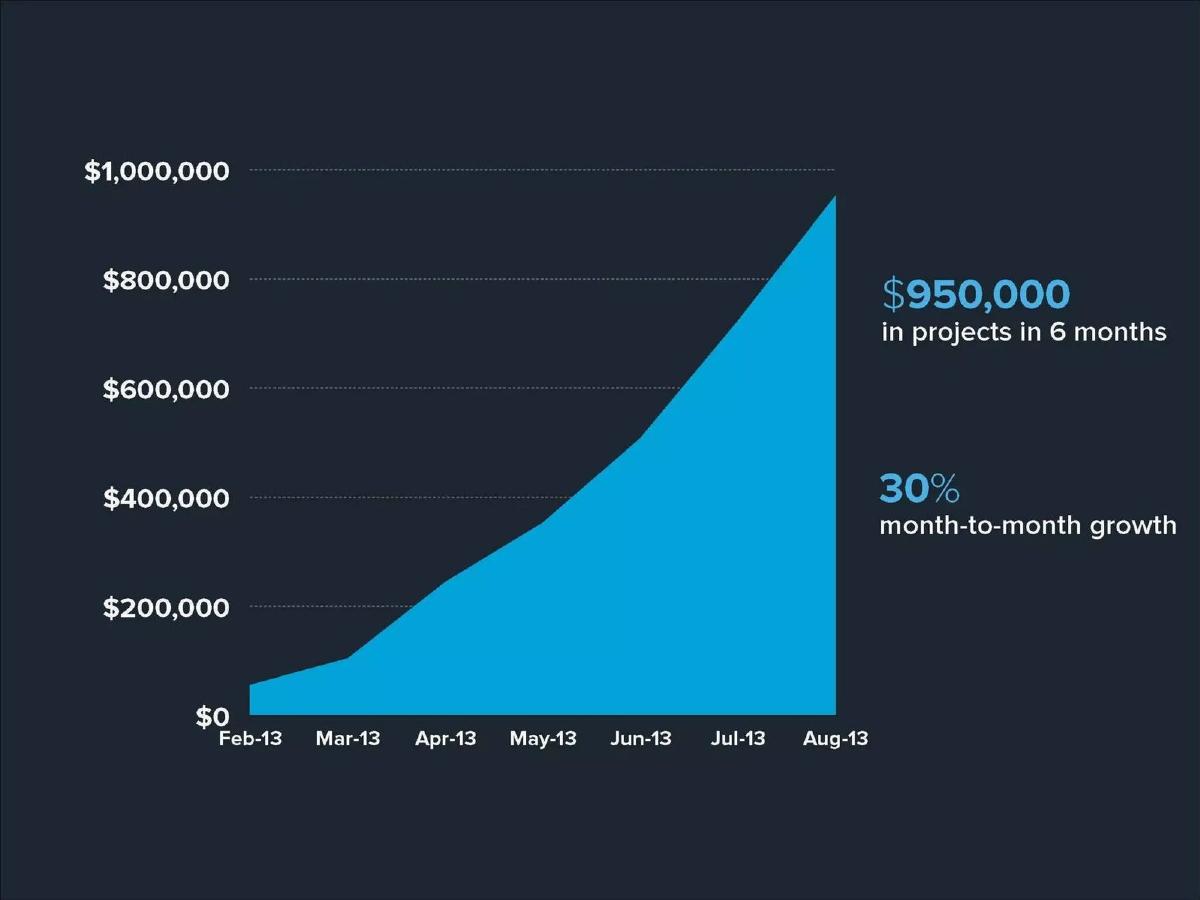
- Traction is the centerpiece, with Slide 5 showing a growth curve from $0 to $950,000 in projects over just six months.
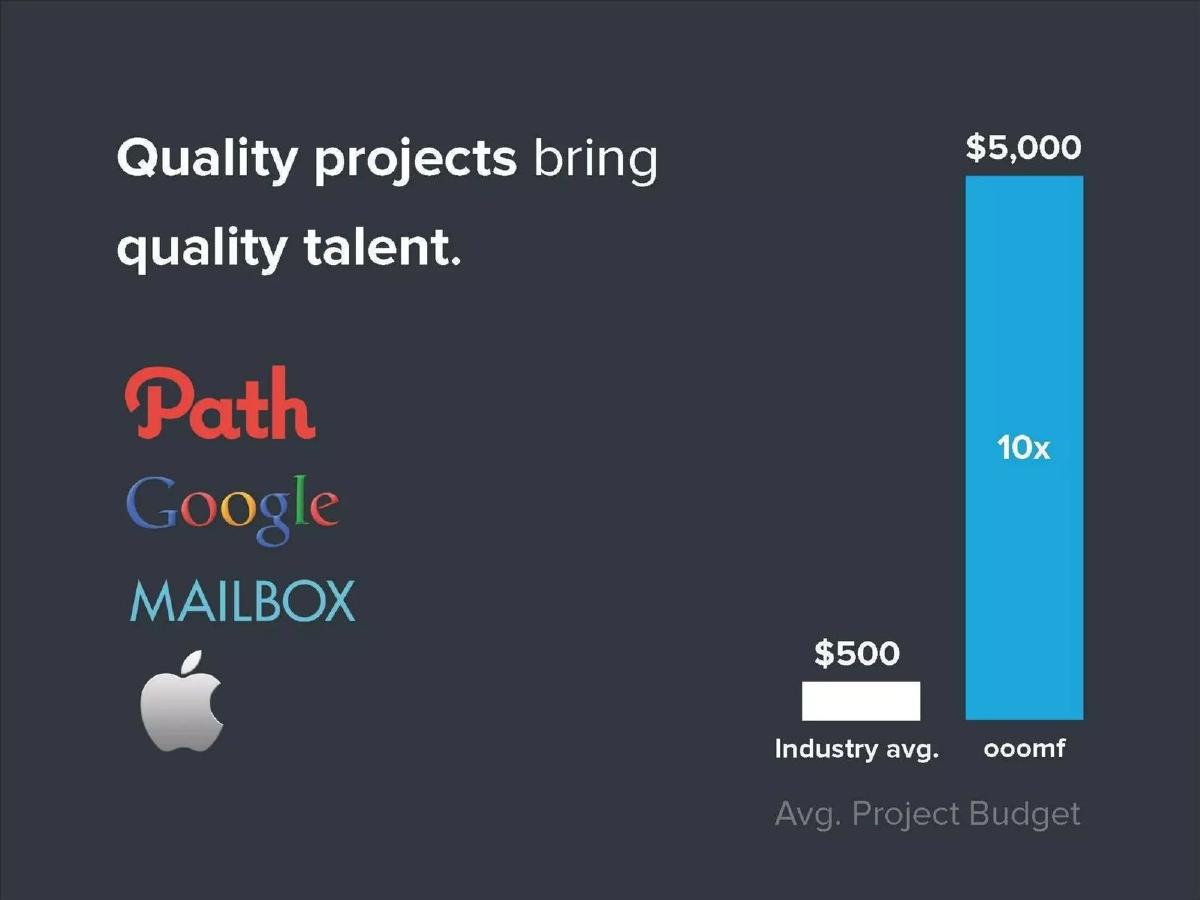
- The company differentiates on price point, claiming an average project budget of $5,000 compared to an industry average of $500 on Slide 6.
- Product simplicity is highlighted through a three-step process: pitch inspiration, automatic budget recommendation, and direct matching (Slides 7-9).
- The marketplace efficiency is validated on Slide 10, stating that 99% of projects are matched within 24 hours without bidding or spam.
- Market size projections on Slide 11 use Online Contractor Billings to show a jump from $1B in 2012 to a projected $4B in 2014.
- The team slide (Slide 13) emphasizes '15+ years experience' and specific individual wins, such as building a blog to 40,000+ subscribers in three months.
- The deck concludes with a bold forward-looking statement on Slide 17, projecting $100MM in booked projects by 2015.
Introduction: The Rebrand from ooomf to Crew
The deck analyzed here belongs to the company now known as Crew, but at the time of this 2013 fundraise, it was operating as ooomf . The transition from a freelance marketplace to a frontline communication app is one of the more famous pivots in recent startup history. This deck represents the company at its peak as a 'premium marketplace,' a position that allowed them to build the network and capital necessary to eventually become Crew. With $58,000,000 raised in total according to catalogue facts, this early Series-stage deck provides a window into how they captured investor interest through high-quality curation and rapid GMV growth.
The Hook and the Problem (Slides 1-3)
Slide 1 introduces the brand with the tagline 'The future of work' and the name Mikael Cho, the founder. It is a minimalist start. Slide 2 immediately dives into the 'Problem' without using that word as a header. It shows a screenshot of a low-budget job posting for an iOS developer with a 'Fixed Price: $250 or less' and a bidding war where 'Mary' offers to do it for $100. This is a visceral representation of the 'race to the bottom' prevalent in early 2010s freelance platforms. Slide 3 punctuates this with a bold statement: 'Average is over.' This sets the stage for a premium alternative.
The Solution and Traction (Slides 4-6)
Slide 4 defines ooomf as a 'premium marketplace of the best mobile & web talent where the talent picks the work.' This is a subtle but important power shift—positioning the platform as talent-first. Slide 5 is the 'money slide.' It features a bright blue area chart showing growth from February 2013 to August 2013. The key figures are '$950,000 in projects in 6 months' and '30% month-to-month growth.' For a Series-stage investor, this chart is the primary proof of product-market fit. Slide 6 reinforces the 'premium' angle by comparing their '$5,000' average project budget against a '$500' industry average, a 10x difference. It also uses logos like Apple, Google, and Path to suggest the caliber of talent or clients involved.
The Product Experience (Slides 7-10)
The deck moves into a product walkthrough that emphasizes simplicity over technical complexity. Slide 7 shows the first step: 'Pitch your inspiration,' where users select between iPhone, iPad, or Android. Slide 8 introduces an 'Automatic budget recommendation' feature, showing a slider between $13,000 and $17,000. This addresses a major pain point in freelance hiring: price uncertainty. Slide 9, titled 'The single best pro comes to you,' shows a profile for 'Edward Scherf,' a UI Designer with an Apple Design Award. This highlights the curation aspect—instead of 50 bad bids, the user gets one great match. Slide 10 summarizes the efficiency: '99% of projects match within 24 hours' with 'no bidding, no spam, no price wars.'
Market Size and Vision (Slides 11-12)
Slide 11 addresses the Market. It uses two circles to represent 'Online Contractor Billings' (citing oDesk, Elance, and 99designs). It claims the market was '$1B' in 2012 and would grow to '$4B' by 2014. While these numbers are specific to the era, the 4x growth projection justifies the venture scale. Slide 12 provides the 'Vision': 'The most trusted, collaborative labor marketplace in the world.' This is the first hint of the 'collaborative' element that would eventually lead the company to pivot into a communication-first product (Crew).
The Team and Social Proof (Slides 13-16)
Slide 13 introduces the team, highlighting '15+ years experience working as independent creative professionals.' This 'founder-market fit' is essential for a marketplace. Specific achievements are listed for Mikael (building a blog to 40,000+), Steph (first profitable business at 16), Angus (founded 2 previous startups), and Luke (built product to 25,000+ downloads). Slide 14 lists 'Investors & Advisors,' including Real Ventures, BDC, and Adam McNamara (whose studio was acquired by Shopify). Slides 15 and 16 use a 'Meet Milan' case study. Milan is an iOS developer who made '$15k in one month' and claims ooomf 'changed the way I work and with that how I live.' This humanizes the data shown earlier.
The Conclusion (Slide 17)
The deck ends on a high-conviction note on Slide 17: 'On track to book $100MM in projects by 2015.' This is a bold projection intended to leave investors with a sense of the company's trajectory. It lacks a specific 'Ask' (amount of money being raised), which suggests this deck may have been used for a demo day or as a teaser before a formal pitch where the terms were discussed privately.
What Works in the Crew (ooomf) Deck
The Antagonist: By showing the $100 bidding war on Slide 2, the deck creates a clear 'enemy' (low-quality marketplaces). This makes the ooomf solution feel necessary and inevitable. · The Traction Curve: Slide 5 is undeniable. 30% month-over-month growth is the gold standard for early-stage startups, and the $950k figure provides a concrete sense of scale. · The 10x Rule: Claiming a 10x higher project budget than the industry average (Slide 6) is a powerful way to signal a 'Blue Ocean' strategy. They aren't fighting for the $500 projects; they are owning the $5,000+ tier. · Speed as a Metric: The '99% match within 24 hours' on Slide 10 is a killer metric for a marketplace. It proves that the liquidity on the platform is high.
What is Missing from the Crew (ooomf) Deck
The Business Model: There is no mention of the take-rate. We know they book $5,000 projects, but we don't know if they keep 5%, 10%, or 20%. This makes it hard to calculate actual revenue from the GMV. · The Ask: As noted, there is no slide stating how much they are raising or what the milestones for the next round will be. · Competition: While they mention oDesk and Elance in the market slide, they don't provide a feature-by-feature comparison or explain why those giants couldn't simply launch a 'premium' tier to crush ooomf. · Unit Economics: There is no data on the cost to acquire a high-spending client versus the lifetime value of that client.
What a Founder Should Copy
Visual Simplicity: This deck uses very little text. It relies on large numbers, clear charts, and high-quality screenshots. It is designed to be read in under three minutes. · The 'Meet [Name]' Slide: Using a specific person (Milan) to illustrate the platform's value is much more effective than a generic 'User Persona' slide. It provides social proof and emotional resonance. · Focus on One Metric: The deck stays laser-focused on 'Projects Booked.' By not cluttering the deck with secondary metrics (like site visits or user registrations), they keep the investor focused on the most important indicator of value. · Automated Budgeting: The inclusion of Slide 8 (the budget slider) is a great example of showing a 'feature as a solution.' It solves the 'how much will this cost' anxiety immediately, which is a major barrier to entry in their industry.
Frequently asked questions
- Why is the company called ooomf in the deck but Crew in the description?
- The company originally launched as ooomf, a marketplace for connecting developers and designers with high-quality projects. Following the success of their internal communication tools used to manage these projects, the company pivoted and rebranded to Crew, focusing entirely on the communication platform for frontline workers. This deck represents the 'ooomf' era of the business.
- What is the primary competitive advantage claimed in this deck?
- The primary advantage is curation and the elimination of 'price wars.' Slide 10 explicitly lists 'no bidding, no spam, no price wars' as their core value proposition. By maintaining a $5,000 average project budget (Slide 6), they attracted 'premium' talent that avoided larger, unvetted marketplaces.
- Does the deck explain how the company makes money?
- The deck is surprisingly quiet on specific take-rates or fee structures. While it mentions '$950,000 in projects' on Slide 5 and 'average project budget' on Slide 6, it does not explicitly state the percentage ooomf keeps as revenue. It focuses on Gross Merchandise Value (GMV) rather than Net Revenue.
- What is missing from this pitch deck?
- This deck lacks several standard components: a detailed 'Ask' slide (how much they are raising and at what terms), a clear 'Use of Funds' breakdown, a detailed competitor matrix beyond the mention of oDesk/Elance, and specific unit economics like Customer Acquisition Cost (CAC) or Lifetime Value (LTV).
- How does the deck handle the 'Product' section?
- The product is shown through a simplified workflow on Slides 7, 8, and 9. It emphasizes a user-friendly interface where clients select app types and styles, receive an automated budget range, and are then presented with a single 'best pro' rather than a list of bidders.