Crisp’s 13-slide deck is a study in narrative-driven fundraising. Rather than leading with complex logistics, the deck prioritizes the 'why'—focusing on a mission to make better quality food available to more people. The company leverages a 'zero-inventory' proprietary software model to solve the traditional waste problems of grocery retail. With a reported 7.4x growth between December 2019 and December 2020 (Slide 11) and a repeat customer rate exceeding 85% (Slide 10), the deck provides the hard data necessary to back up its lifestyle-oriented branding. The lack of a specific 'Ask' slide or…
Key takeaways
- The mission is stated upfront on Slide 1: 'make better quality food available to more people.'
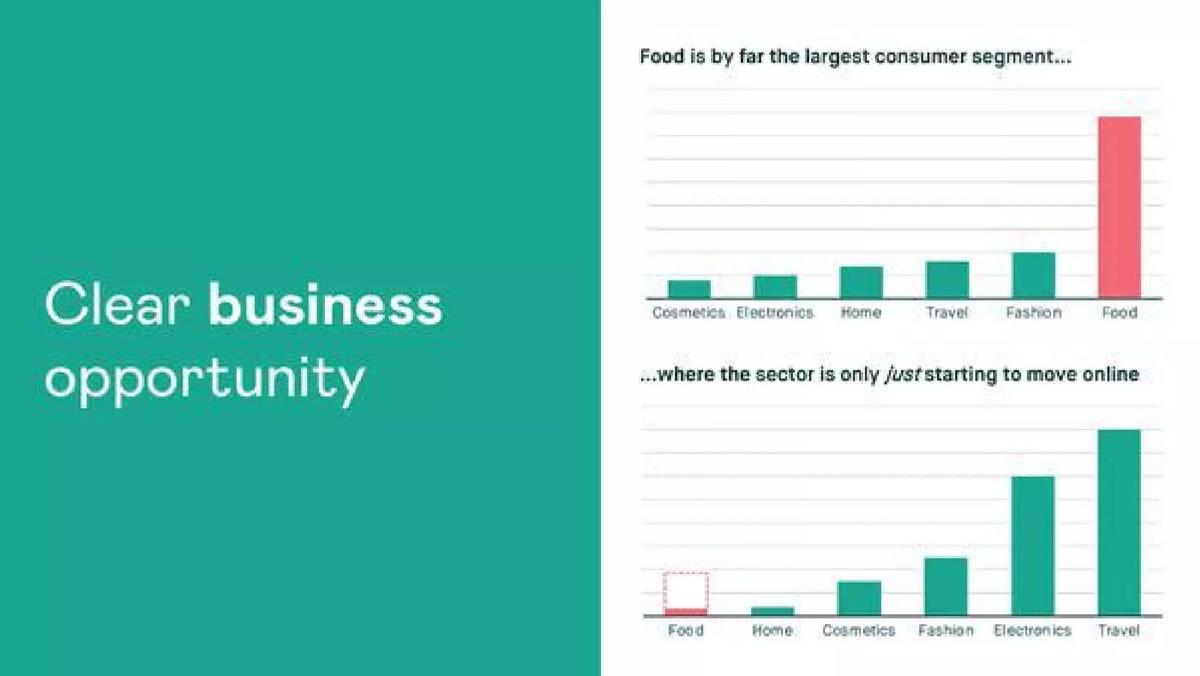
- The deck identifies food as the largest consumer segment but the one with the lowest online penetration (Slide 4).
- A unique 'moral opportunity' slide uses visceral imagery of industrial farming to contrast with Crisp’s sustainable model (Slide 5).
- The business model relies on proprietary software that enables a zero-inventory and zero-waste operation (Slide 9).
- Customer loyalty is a primary metric, with over 85% of orders coming from repeat customers by 2020 (Slide 10).
- The company achieved 7.4x growth in a single year, comparing December 2019 to December 2020 (Slide 11).
- The team is described as a group of 500 experts across food, tech, marketing, and operations (Slide 9).
- The deck highlights significant brand validation, listing nine major Dutch awards won in 2019 and 2020 (Slide 12).
Introduction: The Brand-First Approach to Logistics
Crisp’s pitch deck is a departure from the typical tech-heavy presentation. It leans heavily into high-quality photography and lifestyle branding, reflecting its position as a premium, ultra-fresh food provider. Founded in 2018, the company used this narrative to raise over $121,000,000, proving that in the grocery space, the emotional connection to food is as important as the backend logistics. The deck is concise at 13 slides, focusing on the intersection of sustainability and digital convenience.
Slides 1-2: The Mission and the People
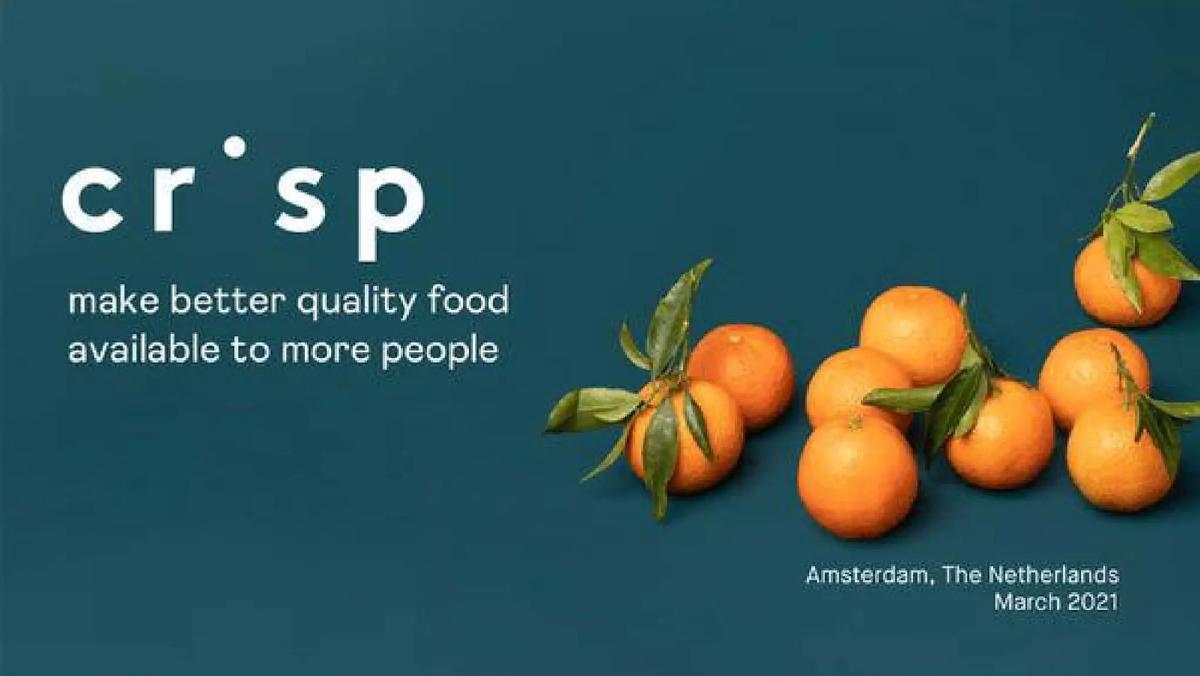
Slide 1 serves as the title card, featuring the company logo and the mission statement: "make better quality food available to more people." The imagery of fresh oranges with leaves still attached immediately signals the "ultra-fresh" promise. The location and date are noted as Amsterdam, March 2021.
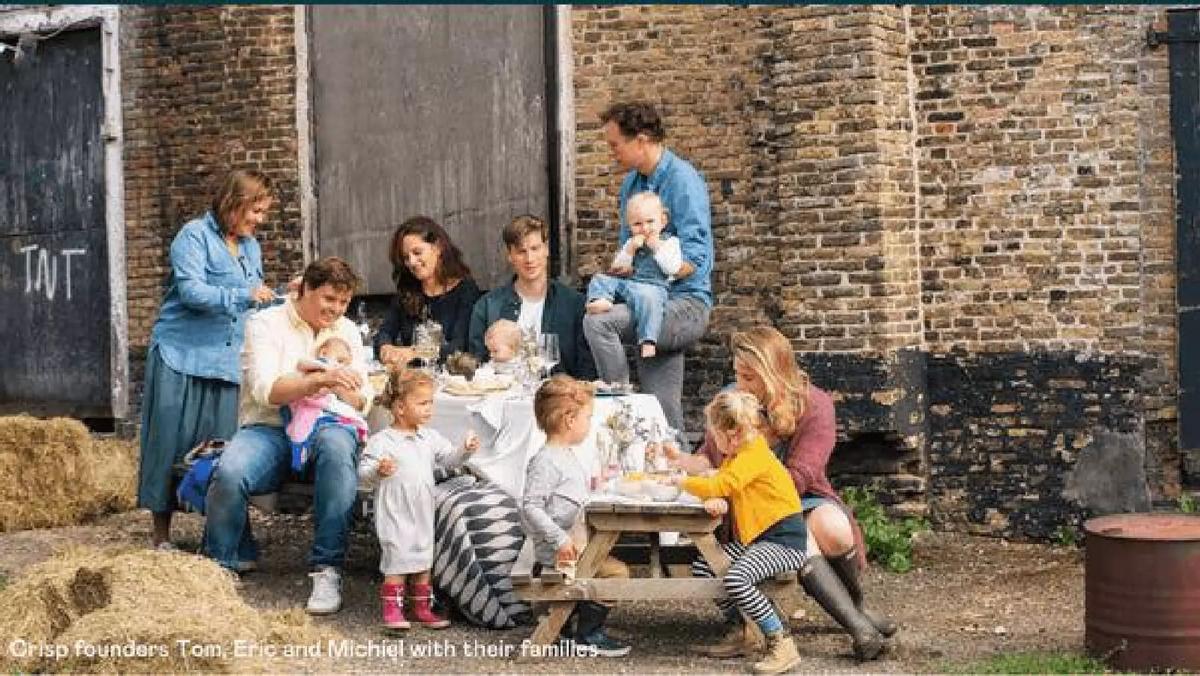
Slide 2 is an unconventional team slide. Instead of headshots and logos of former employers, it shows founders Tom, Eric, and Michiel at a long outdoor table with their families. This choice reinforces the "moral opportunity" and family-centric nature of the food business, though it lacks the professional credentials typically sought by cold-outreach investors.
Slides 3-6: Market Opportunity and The 'Why'
Slide 3 introduces the macro thesis: "The landscape is changing not only how people shop, but also what people shop." This sets the stage for a dual-pronged argument: the shift to digital and the shift to quality.
Slide 4 provides the quantitative backing for the "how." It features two bar charts. The first shows that Food is by far the largest consumer segment compared to fashion, travel, and electronics. The second chart shows that Food is the sector just starting to move online, with significantly lower penetration than travel or electronics. This represents the "Clear business opportunity."
Slide 5 addresses the "what." Titled "Clear moral opportunity," it uses a split-screen image. The top shows a farmer spraying pesticides; the bottom shows crowded industrial livestock. This is a bold move that identifies the "enemy" (industrialized food chains) and positions Crisp as the ethical alternative.
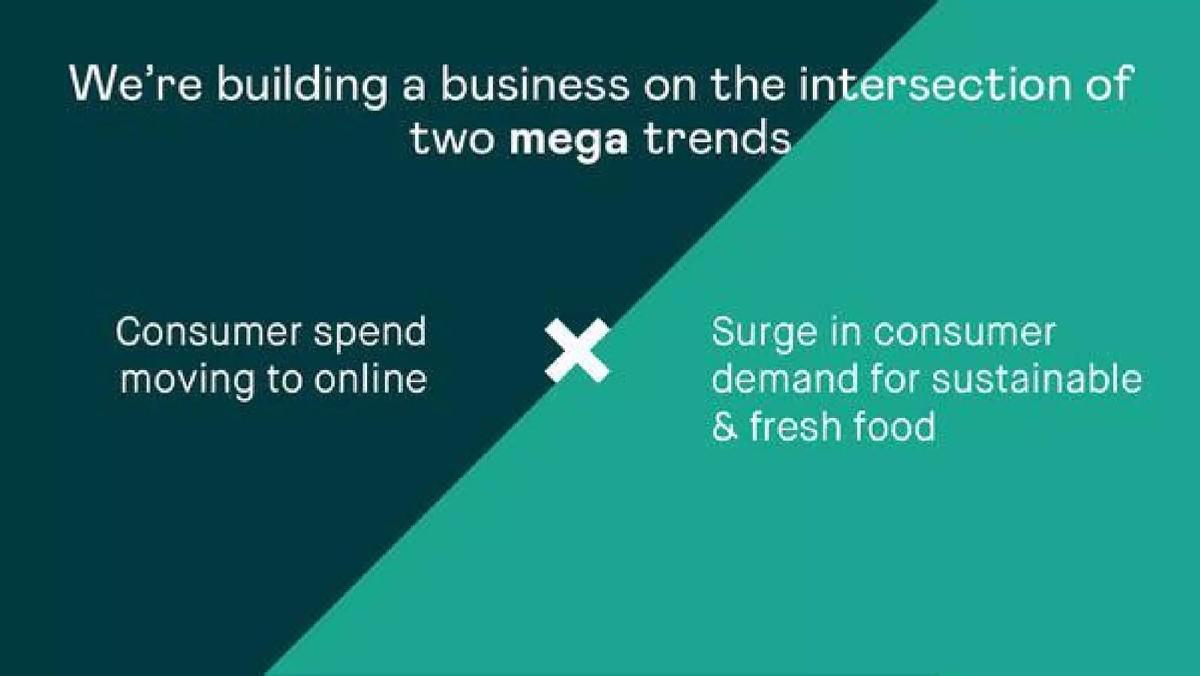
Slide 6 synthesizes these points into the "two mega trends" Crisp is riding: consumer spend moving online and a surge in demand for sustainable and fresh food. This slide acts as the bridge between the market problem and the Crisp solution.
Slides 7-8: The Product and Experience
Slide 7 showcases the app interface. The screenshots highlight a clean, visual-heavy UI with features like "Recipes of the week" and clear pricing for items like "Groene kool" (green cabbage). The app-only nature of the business is a key part of their operational efficiency.
Slide 8 , titled "The experience," is a single high-resolution photo of a Crisp delivery on a kitchen counter. It shows branded brown paper bags and boxes filled with fresh vegetables, wine, and artisanal products. This slide is intended to evoke the feeling of receiving a premium gift rather than a chore-based grocery delivery.
Slides 9-11: Traction and Operations
Slide 9 is the most data-dense slide in the deck, summarizing what has been built in three years. Key metrics include an assortment of over 2,000 products from more than 650 sources and a team of 500 experts. Crucially, it mentions the operational model: "3 temperature zones, no inventory and zero waste model." It also claims "consistent double digit growth per month."
Slide 10 focuses on "High customer loyalty." It shows a line graph of the repurchase rate from 2018 to 2020. The headline figure is that over 85% of orders come from repeat customers. In the high-churn world of grocery delivery, this is a vital metric for proving long-term viability.
Slide 11 displays "High growth" with a bar chart comparing December 2019 to December 2020. The chart indicates a 7.4x growth in scale over that 12-month period. By placing this after the loyalty slide, Crisp proves they aren't just buying growth; they are retaining the customers they acquire.
Slides 12-13: Brand Validation and Closing
Slide 12 highlights "The Crisp brand." It includes a link to a brand movie and lists nine awards won in 2019 and 2020, including "Retailer of the Year" and "Company of the Year" from various Dutch organizations. This external validation serves as a proxy for market leadership.
Slide 13 is the closing slide, featuring a child holding a Crisp box and the Dutch slogan "beter eten, lekker geregeld" (better eating, well arranged). It includes a "Strictly Confidential" footer.
What Works in This Deck
The Narrative Arc: The deck moves logically from a massive market opportunity (Slide 4) to a moral imperative (Slide 5) to a proven solution (Slide 9). It tells a story of a company that is both profitable (via zero inventory) and purposeful.
Visual Consistency: The use of high-end photography makes the product feel premium. For a company selling "better quality food," the deck itself must look high-quality. Crisp succeeds here, avoiding the cluttered, icon-heavy look of many tech decks.
Retention Over Acquisition: Leading with an 85% repeat customer rate (Slide 10) is a powerful way to mitigate investor fears about the high cost of customer acquisition in the grocery space. It proves the product is "sticky."
What is Missing
The Ask: There is no mention of how much money is being raised or what the valuation expectations are. While this information is often handled in the cover email or a separate term sheet, its absence makes the deck feel more like a company profile than a fundraising tool.
Unit Economics: While the deck mentions "negative working capital" in its external descriptions, the slides themselves do not detail the Contribution Margin, Average Order Value (AOV), or Customer Acquisition Cost (CAC). For a Series-stage company, these are usually mandatory.
Competitive Landscape: The deck operates as if Crisp has no competitors. In the crowded European market (Picnic, HelloFresh, Gorillas), failing to address how Crisp defends its niche against larger players is a notable omission.
What a Founder Should Copy
The 'Moral Opportunity' Slide: If your startup is solving a problem with an ethical dimension, don't be afraid to use visceral imagery to show the status quo. Slide 5 is memorable and creates an emotional reason for the investor to want the company to succeed.
The Growth/Loyalty One-Two Punch: Presenting growth (Slide 11) immediately after loyalty (Slide 10) is the best way to prove a sustainable business model. It shows that the 7.4x growth is built on a foundation of happy, returning users, not just a temporary marketing spend.
Operational Simplicity: Crisp distills a complex logistics operation into a few bullet points on Slide 9. Founders should learn to describe their "secret sauce" (like the zero-inventory model) in plain English rather than getting bogged down in technical jargon.
Frequently asked questions
- What is Crisp's core value proposition?
- Crisp positions itself as an app-only supermarket focused on ultra-fresh food. As stated on Slide 9, they offer an assortment of over 2,000 products from more than 650 sources. Their primary differentiator is the combination of high-quality, sustainable sourcing with a next-day delivery model that utilizes one-hour time slots, ensuring both freshness for the consumer and efficiency for the business.
- How does Crisp handle inventory and waste?
- According to Slide 9 and the catalogue listing, Crisp runs on proprietary software that enables a 'zero-inventory' and 'zero-waste' model. By operating as a marketplace that connects farmers directly to consumers, they avoid the traditional supermarket overhead of stocking perishable goods that may not sell, which leads to negative working capital and higher margins.
- What evidence of market fit does the deck provide?
- The deck provides two powerful data points for market fit. Slide 10 shows a 'High customer loyalty' graph where more than 85% of orders come from repeat customers. Slide 11 shows 'High growth,' specifically a 7.4x increase in scale from December 2019 to December 2020. This combination of retention and rapid acquisition is the 'gold standard' for e-commerce investors.
- Who are the founders and what is their background?
- While the deck includes a lifestyle photo of the founders (Tom, Eric, and Michiel) with their families on Slide 2, it does not include traditional professional biographies. The catalogue listing identifies them as Tom Peeters, Michiel Roodenburg, and Eric Klaassen. The deck focuses more on the collective team of 500 experts (Slide 9) rather than individual resumes.
- Is there a clear exit strategy or 'Ask' in this deck?
- No. The 13-slide deck concludes with brand awards and a closing logo slide. It omits a specific funding 'Ask,' a cap table, or an exit strategy. This is common for Series B or C decks where the purpose is to tell a compelling growth story to a pre-selected group of institutional investors who already know the round's parameters.