Crema.co presents a visually-driven pitch deck that emphasizes the emotional and qualitative aspects of specialty coffee while grounding the opportunity in significant market shifts. The deck highlights a 200% growth in specialty coffee consumption among the 25-39 age demographic between 2008 and 2016. Its core value proposition lies in a personalization engine that learns user preferences through ratings and 'Brew Logs,' paired with a storytelling component that connects consumers to individual farmers. While the deck excels at establishing a 'David vs. Goliath' narrative against major congl…
Key takeaways
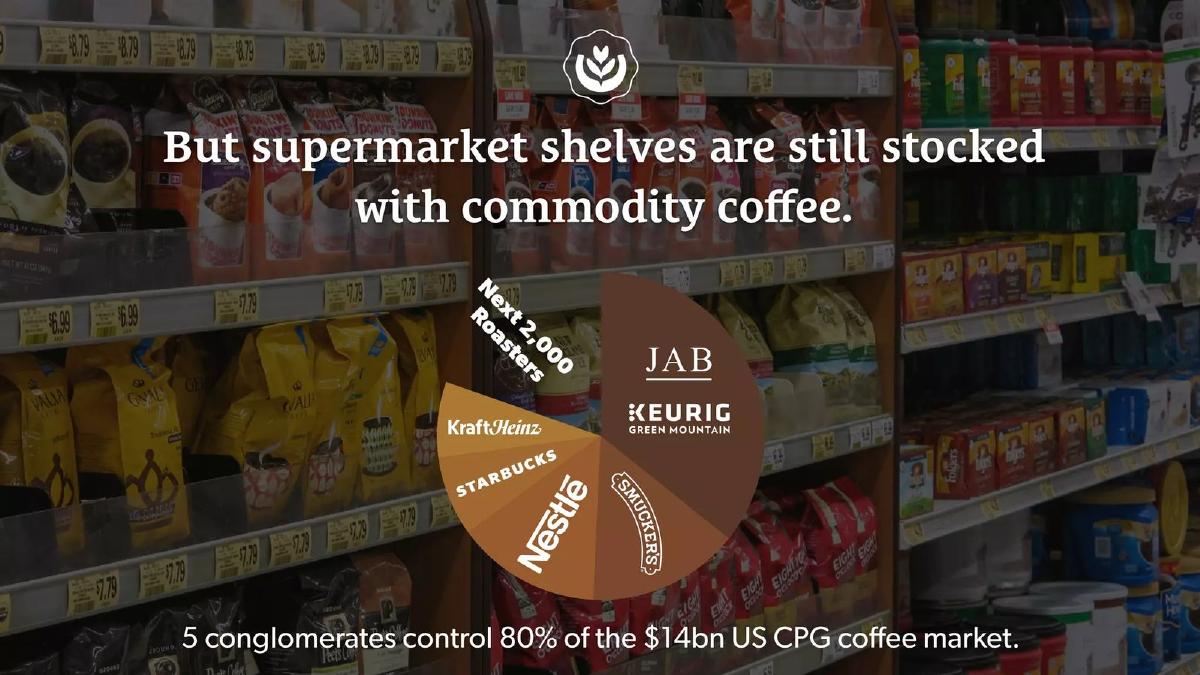
- The US CPG coffee market is valued at $14 billion, with 80% controlled by just five conglomerates including JAB, Nestle, and Starbucks (Slide 2).
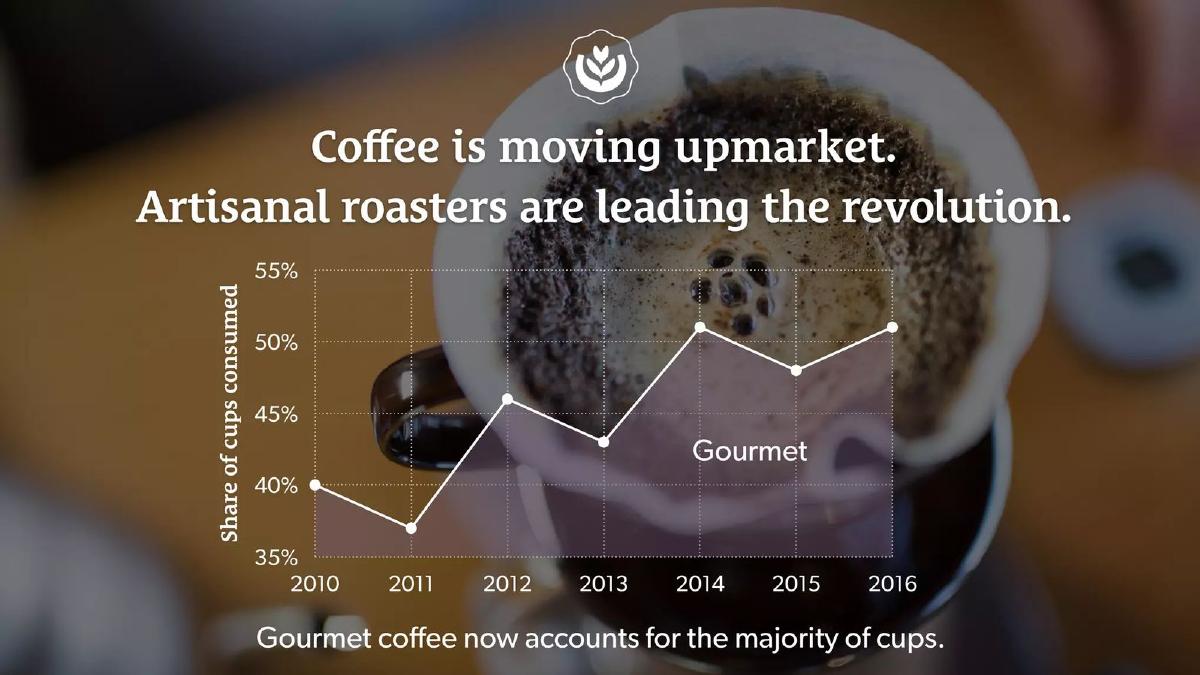
- Specialty coffee penetration among the 25-39 demographic grew by 200% from 2008 to 2016 (Slide 5).
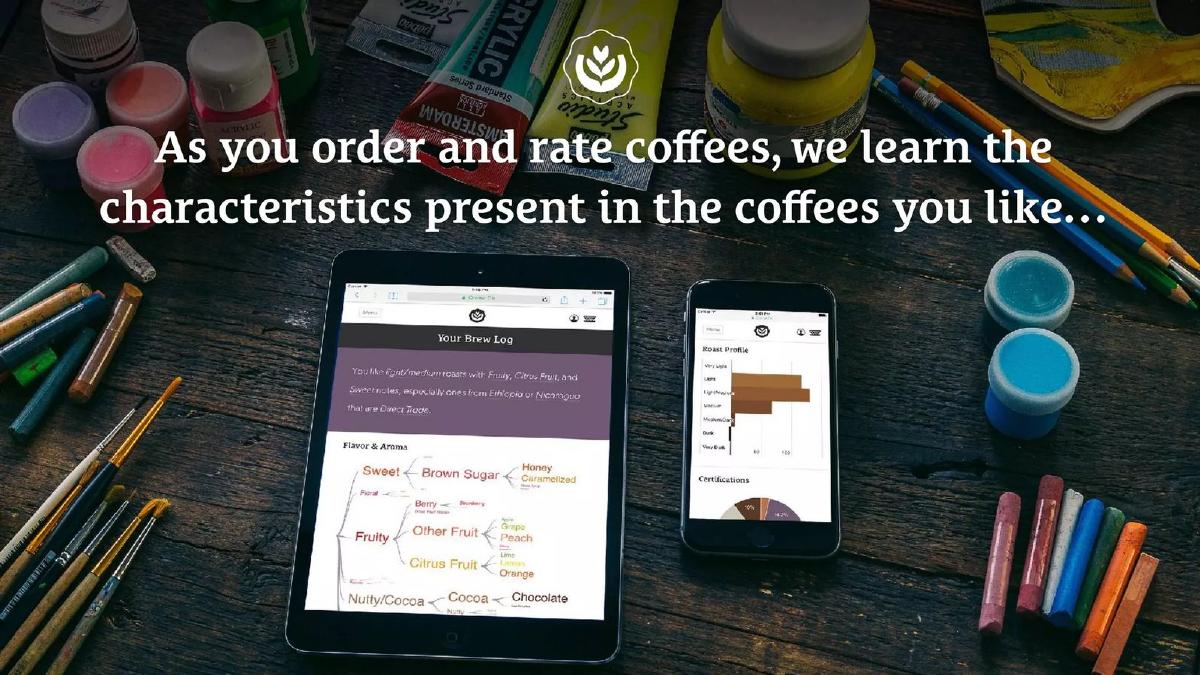
- The platform uses a 'Brew Log' to track user preferences for roast profiles, flavor notes, and certifications (Slide 3).
- Storytelling is a core product feature, with dedicated interfaces to 'meet' the farmers behind specific coffee beans (Slide 4).
- Crema.co has secured media validation from high-tier publications including TechCrunch, Eater, and Food & Wine (Slide 1).
- The deck identifies 'Next 2,000 Roasters' as the fragmented supply side that is currently underserved by traditional retail (Slide 2).
- The product interface includes data visualizations for roast profiles ranging from 'Very Light' to 'Very Dark' (Slide 3).
- The deck utilizes a lifestyle-heavy aesthetic with high-quality photography to align with the 'craft' nature of the product.
Slide-by-Slide Analysis
Slide 1: Title and Social Proof
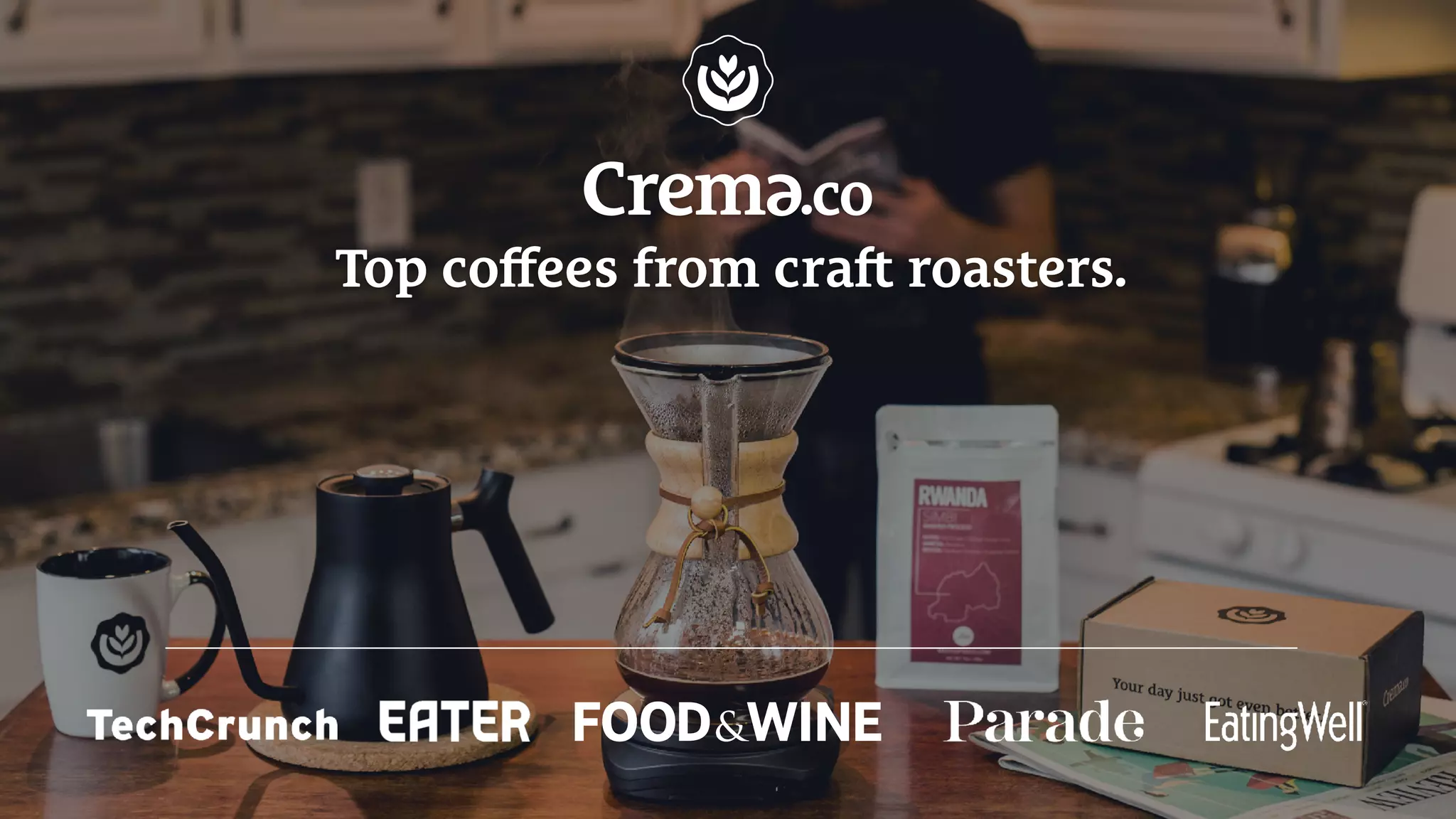
The cover slide for Crema.co establishes a clear, minimalist brand identity. The tagline, "Top coffees from craft roasters," immediately defines the product category. The background imagery—a Chemex brewer and a Fellow Stagg kettle—signals to 'coffee nerds' that the company understands the high-end specialty market. Most importantly, the bottom of the slide features a row of high-authority logos: TechCrunch, Eater, Food & Wine, Parade, and EatingWell . This provides immediate third-party validation, suggesting that the brand has already achieved significant cultural and media mindshare before the investor even sees the first data point.
Slide 2: The Market Problem (The Conglomerate Gap)
Slide 2 uses a compelling visual to illustrate the 'David vs. Goliath' market dynamic. It states that "5 conglomerates control 80% of the $14bn US CPG coffee market." The pie chart breaks down these players: JAB (Keurig Green Mountain), Smucker's, Nestle, Starbucks, and Kraft Heinz . The 'opportunity' is represented by a small sliver labeled "Next 2,000 Roasters." By contrasting the 'commodity coffee' found on supermarket shelves with the fragmented world of independent roasters, Crema.co positions itself as the aggregator for the 20% of the market that is currently underserved by traditional retail infrastructure.
Slide 3: Product Personalization (The Brew Log)
This slide moves into the 'How it Works' phase, focusing on the data-driven nature of the platform. The headline states, "As you order and rate coffees, we learn the characteristics present in the coffees you like..." The slide shows a tablet and smartphone interface displaying a "Your Brew Log." Key data points tracked include Roast Profile (ranging from Very Light to Very Dark) and Flavor & Aroma (a branching tree including Sweet, Brown Sugar, Fruity, and Nutty/Cocoa). This suggests that Crema.co is building a proprietary recommendation engine, moving the business from a simple e-commerce site to a 'Netflix for coffee' model where the value increases with every user interaction.
Slide 4: Storytelling and Transparency
Continuing the product walkthrough, Slide 4 focuses on the emotional connection of the brand: "And learn the story of the people behind the beans." The interface shows a specific product page for "Costa Rica Sonora Colorado Honey" priced at $18 . Next to it, a mobile view features a profile of a farmer, Ruben Ramirez . This slide addresses the 'conscious consumer' trend, highlighting that the platform provides more than just caffeine—it provides a connection to the origin. This is a strategic move to justify premium pricing ($18 for 12oz is significantly higher than supermarket commodity prices) by adding narrative value.
Slide 5: The Growth Opportunity (Demographics)
Slide 5 provides the quantitative 'Why Now?' for the investment. It highlights a "200% growth among target 25-39 demographic." The bar chart compares "Past-day Penetration" of specialty coffee in 2008 (approx. 14-15%) versus 2016 (over 40%). This is a classic venture capital slide: it shows a massive behavioral shift in a high-spending demographic. By focusing on the 25-39 age bracket, Crema.co is signaling that its market is not just growing, but is composed of consumers with decades of high-lifetime-value (LTV) potential ahead of them.
Slide 6: Brand Consistency (Repeat of Title)
The final slide in this set is a repeat of the title slide. In a full presentation, this often serves as the 'Q&A' backdrop. It reinforces the core brand identity and the media validation logos one last time, ensuring the final impression is one of professional polish and established market presence.
What Crema.co Does Well
The Crema.co deck is a masterclass in visual storytelling and brand positioning . It avoids the 'wall of text' trap that plagues many early-stage decks, instead using high-quality lifestyle photography to evoke the premium nature of the product. The deck successfully identifies a massive, stagnant market (the $14bn CPG coffee sector) and highlights a specific, high-growth niche (specialty coffee for Millennials).
The inclusion of the "Brew Log" (Slide 3) is a critical strategic move. It tells investors that this is a technology company, not just a logistics company. By capturing data on flavor preferences, Crema.co creates a 'moat'—the more a customer uses the platform, the better the recommendations get, making it harder for them to switch to a competitor. This data-first approach is exactly what VCs look for in a marketplace business.
What Is Missing from the Deck
While the brand and market slides are strong, the deck is noticeably light on hard business metrics . Based on the 6 slides provided, the following critical elements are missing:
The Business Model: There is no explicit mention of how Crema.co makes money. While we can infer it is a marketplace or subscription model, the specific take rate or subscription tiers are not disclosed. · Traction and Revenue: There are no slides showing GMV (Gross Merchandise Volume), monthly active users, or revenue growth over time. Media logos are great, but they don't replace a revenue chart. · Unit Economics: For a D2C/Marketplace hybrid, investors need to see CAC (Customer Acquisition Cost) and LTV (Lifetime Value). Without these, it is impossible to judge the scalability of the business. · The Team: There is no team slide in this selection. In early-stage fundraising, the 'who' is often as important as the 'what.' · The Ask: The deck does not state how much money is being raised or what the milestones for that capital will be.
What Other Founders Should Copy
1. The "Conglomerate vs. Fragmented" Visual: Slide 2 is an excellent way to show market opportunity. By grouping the 'boring' incumbents together and highlighting the 'Next 2,000' as the untapped supply, the founders make the market feel both huge and ripe for disruption.
2. Leading with Social Proof: Placing high-tier media logos on the very first slide (Slide 1) immediately lowers the investor's skepticism. It signals that the company has already passed the 'sniff test' of major editors and journalists.
3. Demographic Specificity: Instead of saying "everyone drinks coffee," Slide 5 focuses on a specific, high-growth demographic (25-39 year olds). This makes the 'Big Opportunity' claim much more credible and actionable for a marketing-focused investor.
4. Showing, Not Just Telling, the Tech: Slide 3 doesn't just say "we have an algorithm." It shows the user interface and the specific data points being collected. This makes the 'personalization' claim feel tangible and real.
Final Thoughts
Crema.co has built a beautiful, narrative-driven deck that perfectly captures the 'third wave' coffee movement. It successfully bridges the gap between a physical product (beans) and a digital experience (data-driven logs and farmer stories). However, to close a round with sophisticated investors, the founders would need to follow this 'vision' deck with a 'numbers' deck that proves the underlying unit economics are as robust as the brand aesthetic.
Frequently asked questions
- What is the primary problem Crema.co is solving?
- According to Slide 2, the problem is the lack of diversity and quality on supermarket shelves. While consumer interest in specialty coffee is rising, the retail landscape is dominated by five conglomerates that control 80% of the $14 billion market. Crema.co aims to provide a platform for the 'Next 2,000 Roasters' who produce high-quality 'commodity-alternative' coffee but lack the distribution power of companies like Nestle or Kraft Heinz.
- How does Crema.co personalize the user experience?
- As shown on Slide 3, the platform employs a feedback loop where users order and rate coffees. This data populates a 'Brew Log' that tracks specific characteristics such as flavor notes (e.g., Brown Sugar, Citrus Fruit), roast profiles, and origin preferences (e.g., Ethiopia or Nicaragua). This allows the system to learn the user's palate and suggest new coffees that match their historical preferences.
- What demographic is Crema.co targeting?
- Slide 5 explicitly identifies the 25-39 year-old demographic as the primary target. The deck notes that 'past-day penetration' of specialty coffee within this group rose from approximately 14% in 2008 to over 40% in 2016, representing a 200% growth rate. This suggests the company is positioning itself to capture the 'Millennial' shift toward premium, craft-oriented consumption habits.
- Does the deck provide information on the business model or unit economics?
- No. The provided slides focus entirely on the market opportunity, the product interface, and the brand narrative. There is no mention of the take rate (commission) from roasters, the cost of customer acquisition (CAC), the lifetime value (LTV) of a subscriber, or any specific revenue figures. This is a significant omission for a late-stage or highly analytical investor.
- How does Crema.co differentiate itself from other coffee subscription services?
- The deck emphasizes two main differentiators: data-driven personalization and direct storytelling. Slide 4 shows a 'Meet Ruben Ramirez' feature, indicating that the platform isn't just a marketplace but a content layer that connects the consumer to the farmer. By focusing on the 'people behind the beans,' Crema.co attempts to build brand loyalty through transparency and emotional resonance that generic subscription boxes may lack.