Supercast's pitch deck is a textbook example of how to sell a 'business model shift' rather than just a product. In 2019, the company identified that while podcasting was booming, creators were hitting a revenue ceiling due to the limitations of advertising. The deck uses a 21-slide narrative to contrast the low-yield nature of CPM-based ads against the high-margin predictability of recurring subscriptions. By providing specific mathematical comparisons—showing how a 100,000-listener audience could double its revenue through a 5% subscription conversion—Supercast made the opportunity feel ine…
Key takeaways
- The deck explicitly states a goal to make podcasts a 'product, not a billboard' on slide 1.
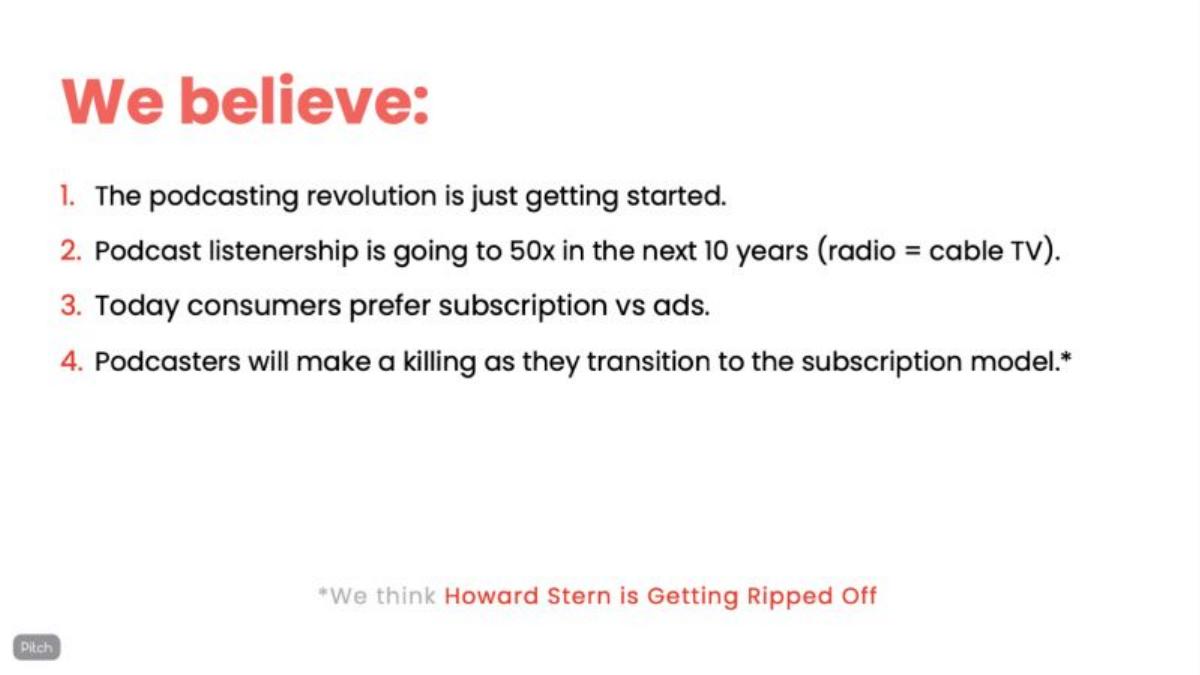
- Supercast predicts podcast listenership will grow 50x in the next 10 years, comparing radio's evolution to cable TV on slide 3.
- A direct mathematical comparison on slide 8 shows subscription revenue ($50,000/mo) potentially doubling advertising revenue ($25,000/mo) for the same audience size.
- The platform offers unique, private RSS feeds for every subscriber to ensure secure content delivery, as noted on slide 10.
- A competitive landscape matrix on slide 12 positions Supercast against Patreon and Glow.fm, claiming superiority in analytics and onboarding.
- The company highlights high-profile users Peter Attia, Shane Parrish, and Rhonda Patrick to demonstrate market fit on slide 15.
- The team slide (17) emphasizes a 'proven team' with backgrounds at Metalab, Tiny, and 99designs.
- The ask is clearly defined on slide 18 as $2MM into a SAFE with a $10MM cap and a 10% discount.
The Narrative: From Billboard to Product
Supercast’s pitch deck, dated September 2019, is built on a single, powerful thesis: the podcasting industry is undervalued because it is over-reliant on advertising. The opening slides establish a clear dichotomy between the 'old way' (ads) and the 'new way' (subscriptions). By framing the podcast as a 'product' rather than a 'billboard,' the founders immediately signal a shift toward the creator economy trends that would dominate the following years.
Slides 1-4: The Thesis and Problem
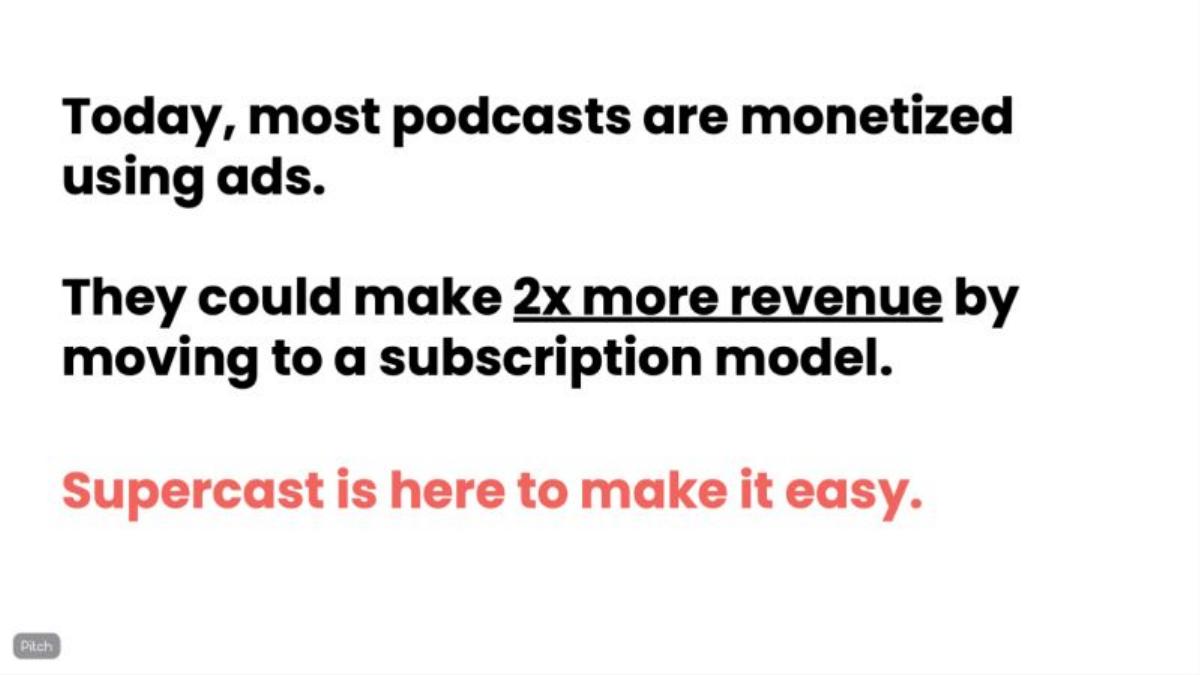
Slide 1 sets the tone with the tagline: 'Make your podcast a product, not a billboard.' This is a high-level value proposition that speaks directly to the creator's desire for ownership and better monetization. Slide 2 gets straight to the point, claiming podcasters could make '2x more revenue' by switching to a subscription model. This is a bold claim that requires immediate proof, which the deck prepares to deliver in the following sections.
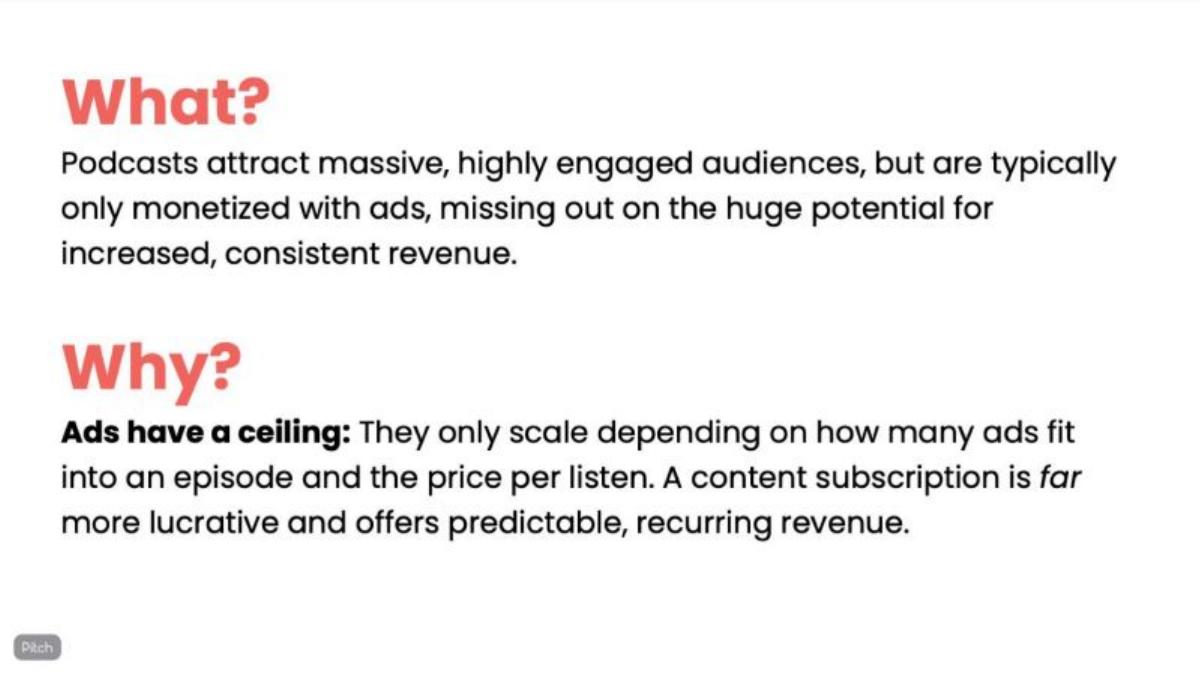
Slide 3 outlines the company's core beliefs. Most notably, they predict that podcast listenership will grow 50x in the next 10 years, drawing a parallel between radio and cable TV. They also include a cheeky footnote: 'We think Howard Stern is Getting Ripped Off,' which serves to highlight that even the biggest names in audio are likely under-monetized. Slide 4 defines the 'Why': ads have a ceiling. They are limited by the number of slots in an episode and the fluctuating price per listen (CPM). Subscriptions, by contrast, offer 'predictable, recurring revenue.'
Slides 5-8: Market Opportunity and Unit Economics
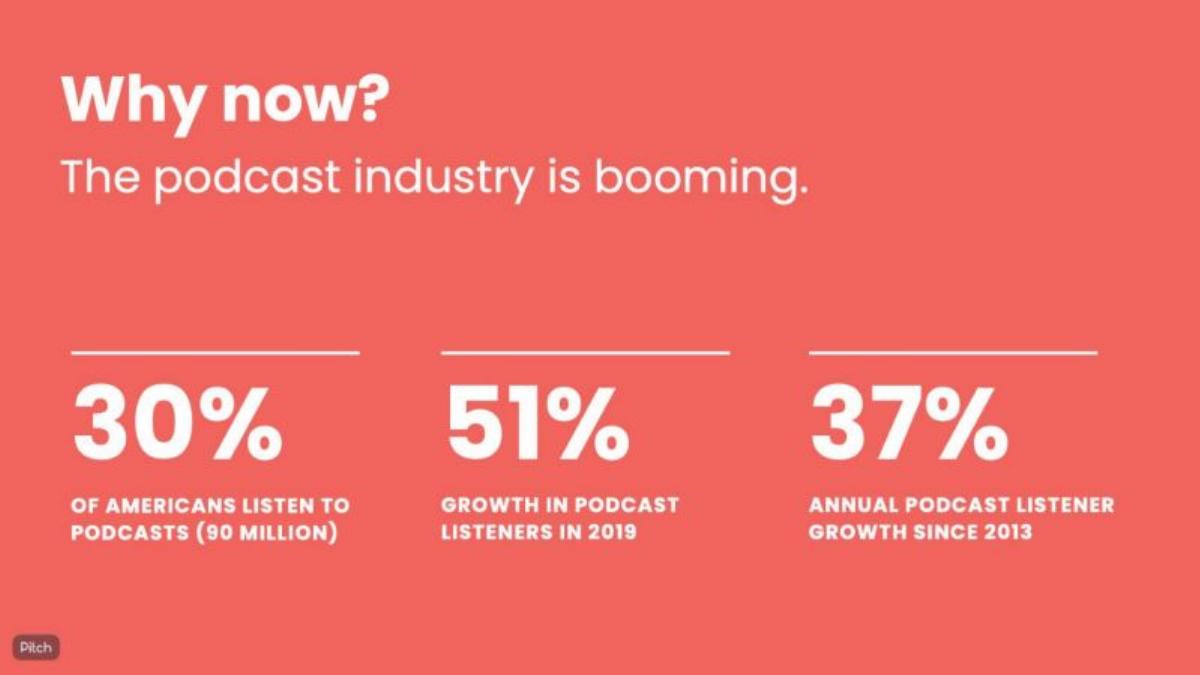
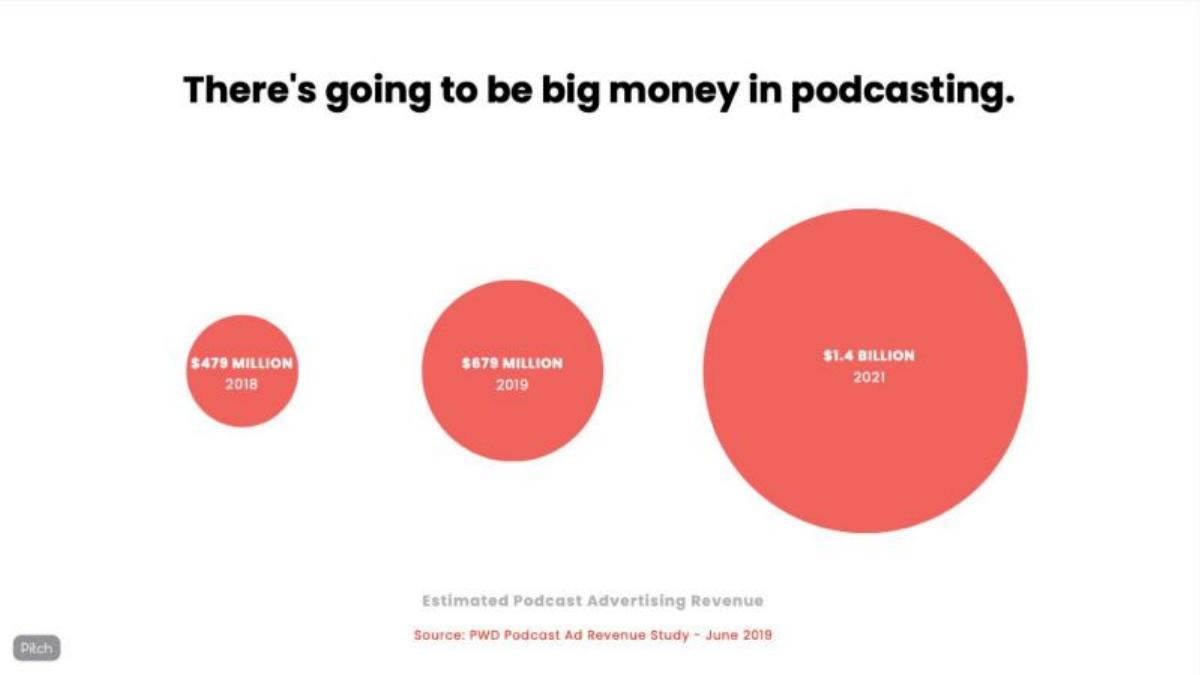
Slide 5 provides the 'Why now?' context, citing that 30% of Americans (90 million people) listen to podcasts, with 51% growth in listeners in 2019 alone. Slide 6 visualizes the growth of podcast advertising revenue, projecting it to reach $1.4 billion by 2021. However, Slide 7 argues that this billion-dollar figure is actually a sign of under-performance, stating that 'only a small % of the value in podcasting is being captured by ad revenue.'
The 'aha' moment of the deck arrives on Slide 8 . This slide presents a side-by-side comparison of Subscription vs. Advertising for an audience of 100,000. Under the advertising model (2 spots at a $25 CPM, 5 episodes a month), the estimated revenue is $25,000. Under the subscription model (5% conversion at $10/month), the revenue jumps to $50,000. This 2x increase is the core mathematical engine of the pitch. It transforms a vague 'better way' into a concrete financial incentive for both creators and investors.
Slides 9-11: The Product and Analytics
Slide 9 introduces the solution with a screenshot of the Supercast dashboard. It emphasizes ease of management and delivery. Slide 10 lists the feature set, which includes customizable landing pages, private RSS feeds, and member management. The mention of 'private RSS feeds' is crucial; it solves the technical hurdle of how to deliver paid content securely without forcing users into a proprietary app.
Slide 11 focuses on 'SaaS Metrics for Your Podcast.' By offering data on total and recurring revenue, average revenue per user (ARPU), lifetime value (LTV), and churn, Supercast is essentially promising to turn a creative endeavor into a measurable business. This appeal to data-driven creators (and their managers) is a significant differentiator from standard hosting platforms that only provide download counts.
Slides 12-14: Competition and Roadmap
Slide 12 is a standard competitive matrix comparing Supercast to Patreon and Glow.fm. Supercast marks itself as the only provider offering automated RSS security, per-user engagement analytics, and upcoming features like email marketing integrations. By checking every box while the competitors have 'X' marks, they position themselves as the 'pro' choice for serious podcasters.
Slide 13 and Slide 14 look toward the future. The deck mentions building 'platform lock-in' by providing features that podcasters currently do manually, such as 'Ask Me Anything' (AMA) questionnaires and show notes. The roadmap on Slide 14 specifically highlights Mailchimp integrations and multi-show/network support, indicating an ambition to move beyond individual creators to serve larger media companies.
Slides 15-17: Social Proof and Team
Slide 15 and Slide 16 provide the necessary social proof. They list Peter Attia (The Drive), Shane Parrish (The Knowledge Project), and Rhonda Patrick (FoundMyFitness) as users. These are not just random podcasters; they are 'high-signal' creators known for having deeply engaged, affluent audiences. A testimonial from Peter Attia on Slide 16 reinforces the 'ease of use' and 'scale' claims made earlier in the deck.
Slide 17 introduces the team. The deck leans heavily on the reputation of Andrew Wilkinson and his firm, Tiny, as well as Metalab. The mention of Jason Sew Hoy’s background as COO of 99designs, where he grew revenue to $65M, provides the operational credibility needed to convince investors that this team can handle the scale they are projecting.
Slides 18-21: The Ask and Conclusion
Slide 18 contains the hard facts of the fundraise: '$2MM into a SAFE. $10MM cap, 10% discount.' The use of proceeds is split between Product Development, Sales, and Marketing, with a 12-18 month runway. The deck concludes with a 'Thank you' on Slide 19 and a standard legal disclaimer on Slide 20 . Slide 21 is an external promotional slide for the deck repository and not part of the Supercast pitch.
What Works in This Deck
The strongest element of this deck is its comparative math . By using a specific audience size (100,000) and industry-standard benchmarks (5% conversion, $25 CPM), they make the 2x revenue increase feel like a mathematical certainty rather than a hopeful projection. This removes much of the 'market risk' in the eyes of an investor.
Furthermore, the social proof is exceptionally high-quality. In the creator economy, winning the 'intellectual' creators (like Parrish and Attia) often leads to a trickle-down effect where other creators follow suit. Showing these names early in the company's life suggests that the product has already passed the hardest test: convincing discerning, high-earning creators to trust them with their revenue stream.
What Is Missing
The deck is notably light on historical traction . While it shows a dashboard with some numbers and lists famous users, it does not provide a clear month-over-month growth chart of Supercast’s own revenue or the total number of podcasters on the platform at the time of the pitch. It relies more on the potential of the market and the quality of the early adopters than on the velocity of the company's own growth.
Additionally, there is very little discussion of churn or customer acquisition cost (CAC) . While they mention that their tools help podcasters track these metrics, they don't share their own. For a seed round, this is common, but as the deck moves into the 'Future of Supercast' and 'Roadmap,' more detail on how they plan to acquire the 'next 1,000 podcasters' would have been beneficial.
Founder Takeaway: Sell the Shift
Founders should study how Supercast sells a shift in the industry rather than just a set of features. They don't start by talking about RSS feeds; they start by talking about how the current way of making money is broken. By the time they show the product, the investor is already convinced that a subscription model is better. The product is then presented as the easiest way to achieve that better outcome.
If you are building a tool that requires users to change their behavior or business model, your deck must first prove that the new model is superior to the old model . Supercast does this perfectly on Slide 8. Use direct, side-by-side comparisons to make your value proposition undeniable.
Frequently asked questions
- What is the core problem Supercast aims to solve?
- Supercast addresses the 'revenue ceiling' of podcast advertising. According to slide 4, ads only scale based on the number of spots and price per listen. The deck argues that podcasters are missing out on consistent, recurring revenue by relying solely on ads rather than direct-to-fan subscriptions.
- How does Supercast differentiate itself from Patreon?
- On slide 12, Supercast claims several advantages over Patreon, including automated RSS feed security, two-tap onboarding, and rich per-user engagement analytics. They position themselves as a purpose-built tool for podcasters, whereas Patreon is a generalist membership platform.
- What are the specific terms of the fundraising round?
- As stated on slide 18, Supercast sought to raise $2 million using a Simple Agreement for Future Equity (SAFE). The terms included a $10 million valuation cap and a 10% discount for early investors.
- Who are the key people behind Supercast?
- The leadership team includes Chairman Andrew Wilkinson (founder of Metalab and Tiny), Co-founder Aidan Hornsby (founder of DoubleUp), and Co-founder/CEO Jason Sew Hoy, who previously served as COO at 99designs and grew revenue to $65M (slide 17).
- What features does the platform provide to podcasters?
- According to slide 10, the platform provides customizable landing pages, simple payment processing, member management, podcast hosting, and 'rich content analytics.' A key technical feature is the generation of unique, private RSS feeds for each individual subscriber.