The June 2017 investor presentation for Summer Infant (Sumr) outlines a mature consumer goods company managing three distinct brands: Summer Infant, SwaddleMe, and BornFree. The deck emphasizes a deep understanding of the 'Millennial Mom' demographic, citing that 9,000 babies are born to this group daily. While the presentation highlights significant product accolades and a top-five industry ranking for their stroller line, the financial data reveals a complex picture. Adjusted EBITDA for the quarter ended April 1, 2017, was $2,360,000, down from $3,168,000 in the prior year period. The deck…
Key takeaways
- The company operates three core brands: Summer Infant (Care & Safety), SwaddleMe (Sleep), and BornFree (Feeding), as shown on slide 4.
- Millennial purchasing power is a central thesis, with the deck claiming this group represents $170 billion in annual spending on slide 7.
- Social proof is heavily emphasized through the 'Cribsie Awards' and 'BabyCenter 2016 Moms' Picks' featured on slides 10 and 16.
- The '3Dtote' stroller is positioned as a key growth driver, achieving a top-five industry ranking within three years according to slide 13.
- Financial transparency is provided via a GAAP to Non-GAAP reconciliation, showing an adjusted EPS of $0.02 for Q1 2017 on slide 19.
- The deck lacks a traditional 'Team' slide in the provided sequence, focusing instead on brand identity and product features.
- Consumer behavior data on slide 7 notes that 59% of millennial moms bought a product recommended by another mom on a parenting site.
- The presentation concludes without a specific 'Ask' or use of funds, typical of a public company investor update (slide 22).
Sumr Investor Presentation: A Deep Dive into Juvenile Product Strategy
The June 2017 investor presentation for Summer Infant (Sumr) serves as a comprehensive overview of a company transitioning from a single-product manufacturer to a diversified brand house. The deck is structured to validate the company's market position through demographic data and product accolades, rather than the speculative growth projections often seen in early-stage venture decks.
Slide 1: Title and Branding
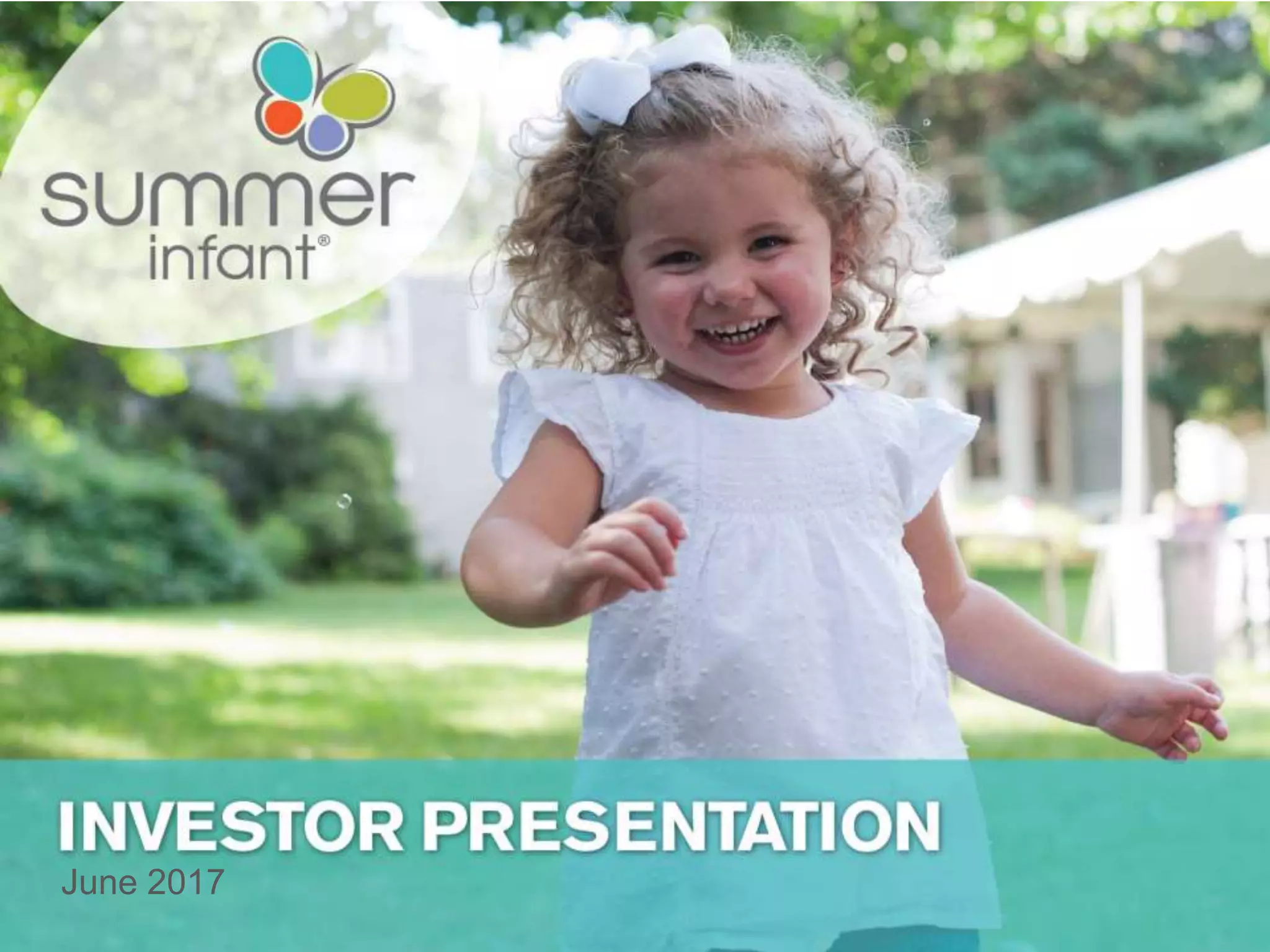
The cover slide establishes the visual identity of the company, featuring the 'Summer Infant' logo with its distinctive butterfly motif. The imagery—a smiling toddler in an outdoor setting—immediately signals the target market. The date 'June 2017' indicates this was a mid-year update, likely following Q1 financial results.
Slide 4: Business Overview and Brand Architecture
This slide is critical for understanding Sumr's corporate strategy. It breaks the company down into three distinct pillars: Summer Infant , SwaddleMe , and BornFree .
Summer Infant: Positioned for 'Care & Safety,' covering monitors, gates, bath, and strollers. · SwaddleMe: Defined as 'The authority on safe sleep,' focusing on wearable blankets and bedding. · BornFree: Focused on 'Safe, calm feeding,' covering bottles, pacifiers, and feeding electronics.
The bottom banner emphasizes 'Leveraging Brand Positioning' to improve consumer relationships, suggesting a cross-selling strategy across the different stages of early childhood.
Slide 7: Understanding Millennial Moms
Sumr uses this slide to justify its marketing spend and digital strategy. The data points are highly specific: 9,000 babies are born to Millennial moms daily, and this group possesses $170 billion in annual purchasing power. The slide highlights the 'Connected' nature of their target customer, noting 17.4 hours spent on social media per week. This slide serves as the 'Market Opportunity' section of the deck, framing the company's digital-first approach as a necessity rather than an option.
Slide 10: Award-Winning Products
This slide acts as a gallery of social proof. It displays a grid of products that have won 'Cribsie Awards.' Items shown include the 'My Size Potty,' 'SwaddleMe Love Sack,' and the 'BABBLE BAND Hands-Free Wearable Audio Monitor.' By showcasing a wide array of winners, Sumr demonstrates that its innovation is recognized across multiple categories, not just a single flagship product.
Slide 13: Stroller Category Growth
Focusing on a specific success story, slide 13 details the '3Dtote' stroller. The headline claims the company reached the 'Industry Top Five in 3 Years.' The slide lists ten specific features, including an 'XXL expandable storage basket' and a '50lbs' weight limit. This slide is intended to prove the company's ability to enter a competitive category (strollers) and quickly capture market share through feature-rich product design.
Slide 16: Awards & Recognition - Safety Gates
Continuing the theme of validation, slide 16 focuses on the 'Multi-Use Extra Tall Walk-Thru Gate.' It highlights the 'BabyCenter 2016 Moms' Picks Award.' The slide includes context about BabyCenter, noting it has 'Over 2M followers on social media' and '26M unique monthly visitors.' This context is important because it explains why the award matters—it reaches a massive, relevant audience.
Slide 19: Adjusted EBITDA & EPS Reconciliation
This is the most data-dense slide in the deck. It provides a bridge between GAAP (Generally Accepted Accounting Principles) and Non-GAAP financials. For the three months ended April 1, 2017, the company reported:
Net Income (GAAP): $170,000 (an improvement over the $333,000 loss in 2016). · Adjusted EBITDA: $2,360,000 (down from $3,168,000 in 2016). · Adjusted EPS: $0.02 (down from $0.05 in 2016).
The inclusion of 'permitted add-backs' ($169,000) is a standard practice for public companies to normalize earnings, but the year-over-year decline in Adjusted EBITDA suggests a period of increased investment or rising costs.
Slide 22: Conclusion
The deck ends with a simple 'Thank You' slide featuring a baby photo and the company logo. There is no call to action, contact information for a specific IR (Investor Relations) lead, or a summary of the 'Ask.' This reinforces that the deck is a reporting tool for existing and prospective public market investors.
What Sumr Does Well
The deck excels at segmentation . By clearly defining three brands with three different 'Unique Positionings' (Slide 4), Sumr avoids the trap of being a 'jack of all trades, master of none.' Each brand has a clear territory. Furthermore, the use of third-party validation (Slides 10 and 16) is relentless. Instead of Sumr claiming their products are good, they let the Cribsie Awards and BabyCenter do the talking. This is a highly effective way to build trust with investors who may not be the primary users of the products.
What is Missing from the Deck
The most notable omission in the provided slides is a Competitor Analysis . While they mention being in the 'Top Five' for strollers, they do not name the other four or explain how they are winning against incumbents like Graco or Evenflo. Additionally, there is no Team Slide in this sequence. While the management of a public company is public record, a slide highlighting the experience of the C-suite in the juvenile space would strengthen the narrative. Finally, the Unit Economics (CAC, LTV) are absent. While they discuss the 'Millennial Mom' at length, they don't show the cost to acquire her or her lifetime value across the three brands.
Founder Takeaways
Founders should study slide 7 for its demographic storytelling . Instead of just saying 'the market is big,' Sumr explains how the market behaves (17.4 hours on social media, 59% follow recommendations). This allows an investor to visualize the marketing funnel. Another takeaway is the Financial Reconciliation on slide 19. For startups approaching a Series B or later, being able to clearly bridge the gap between 'Net Loss' and 'Adjusted EBITDA' is a vital skill for maintaining investor confidence during growth phases where GAAP profitability may be elusive.
Frequently asked questions
- What is the primary business model described in the Sumr deck?
- Sumr operates as a multi-brand consumer products company specializing in the infant and juvenile market. As detailed on slide 4, they utilize a 'Portfolio of Strong Brands' strategy. Each brand has a specific niche: Summer Infant focuses on safety and care (monitors, gates), SwaddleMe dominates the 'safe sleep' category (wearable blankets), and BornFree targets the feeding segment (bottles, electronics).
- How does the company define its target market?
- The company focuses almost exclusively on 'Millennial Moms.' Slide 7 provides a detailed demographic profile, noting that this group spends an average of 17.4 hours a week on social media and that 44% make purchases via smartphones. By aligning their marketing with these digital habits, Sumr aims to capture a share of the 9,000 daily births in this demographic.
- What are the key products highlighted in the presentation?
- The deck highlights the '3Dtote' stroller (slide 13), which features an 'XXL expandable storage basket' and a 50lb weight capacity. It also showcases safety products like the 'Multi-Use Extra Tall Walk-Thru Gate,' which received the BabyCenter 2016 Moms' Picks Award (slide 16), and various monitors and sleep aids under the SwaddleMe brand.
- What do the financial reconciliations on slide 19 indicate?
- Slide 19 shows that while the company achieved a GAAP net income of $170,000 for the quarter ended April 1, 2017, they rely on 'Adjusted EBITDA' ($2.36 million) to show operational health. The reconciliation includes add-backs for interest, taxes, depreciation, and non-cash stock compensation, providing investors with a view of cash flow performance versus the prior year's $3.17 million.
- Is there a specific funding request in this deck?
- No. This presentation is an 'Investor Presentation' dated June 2017, likely intended for quarterly earnings calls or retail investor conferences. Unlike a startup pitch deck, it does not include a slide for 'The Ask' or a 'Use of Proceeds,' as the company was already publicly traded (SUMR) at the time of this presentation.