The Sumo Logic pitch deck is a clear example of a 'product-first' narrative designed for sophisticated technical investors. Rather than relying on flashy graphics, the deck uses detailed architectural diagrams and specific technical pain points—such as manual parser maintenance and data fragmentation—to justify its existence. The presentation identifies a $2.5 billion market opportunity (Slide 3) and systematically dismantles the status quo of on-premise, siloed log management. By promising a transition from a simple service to a community-driven platform, Sumo Logic positioned itself not jus…
Key takeaways
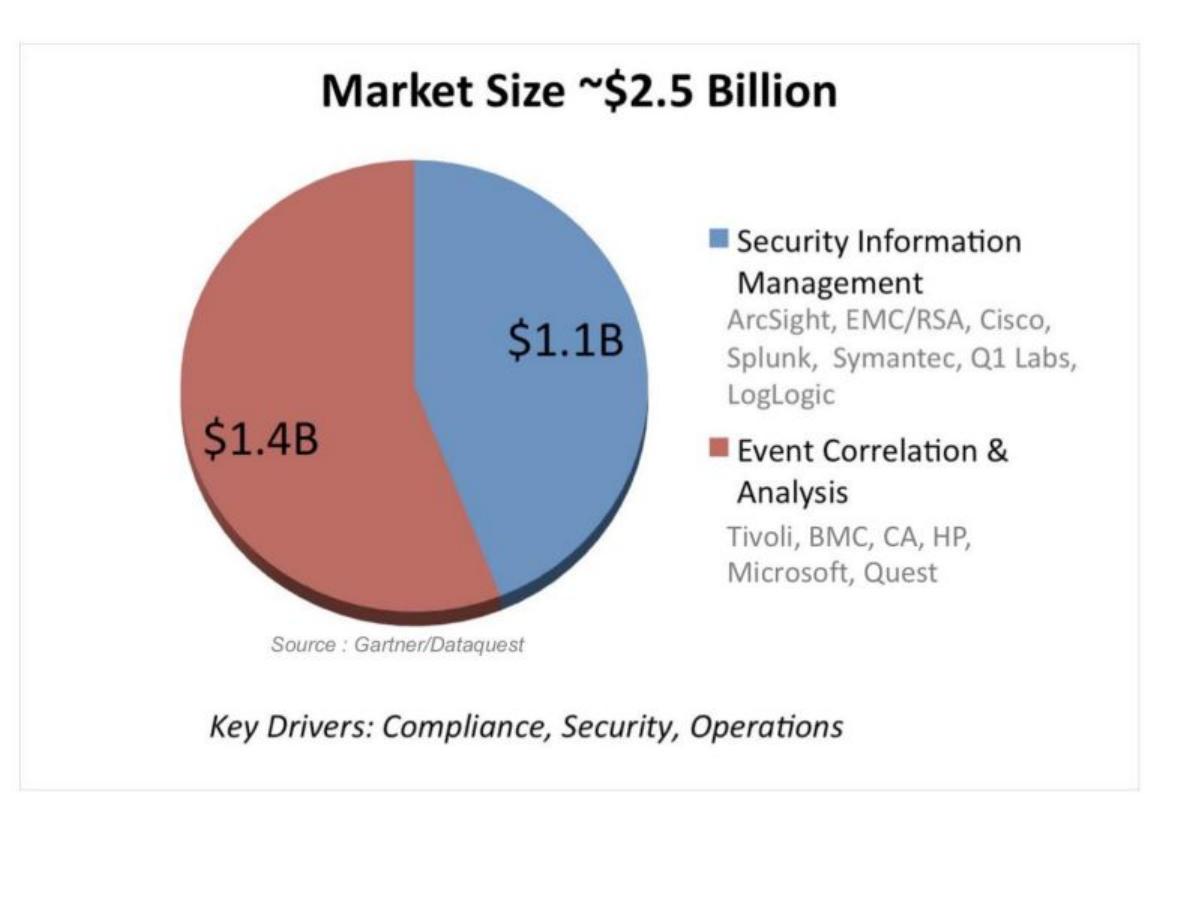
- The deck identifies a total addressable market of ~$2.5 billion, split between Security Information Management ($1.1B) and Event Correlation & Analysis ($1.4B) on Slide 3.
- Legacy competitors are explicitly criticized for being premise-based, not scalable, and operating in silos on Slide 4.
- The platform architecture (Slide 6) introduces a multi-tenant cloud model using 'Collectors' to ingest data from various customer environments.
- A significant portion of the deck (Slides 7, 8, and 9) is dedicated to illustrating the specific failures of current log management architectures.
- The company differentiates itself through 'Global IT Log Intelligence' and a 'Built-in community' for sharing analytics content on Slide 10.
- The go-to-market strategy emphasizes a low-friction freemium or free trial model to achieve 'instant gratification' for users on Slide 11.
- A three-release roadmap (Slide 12) outlines a 9-12 month window for moving from basic anomaly detection to predictive analytics.
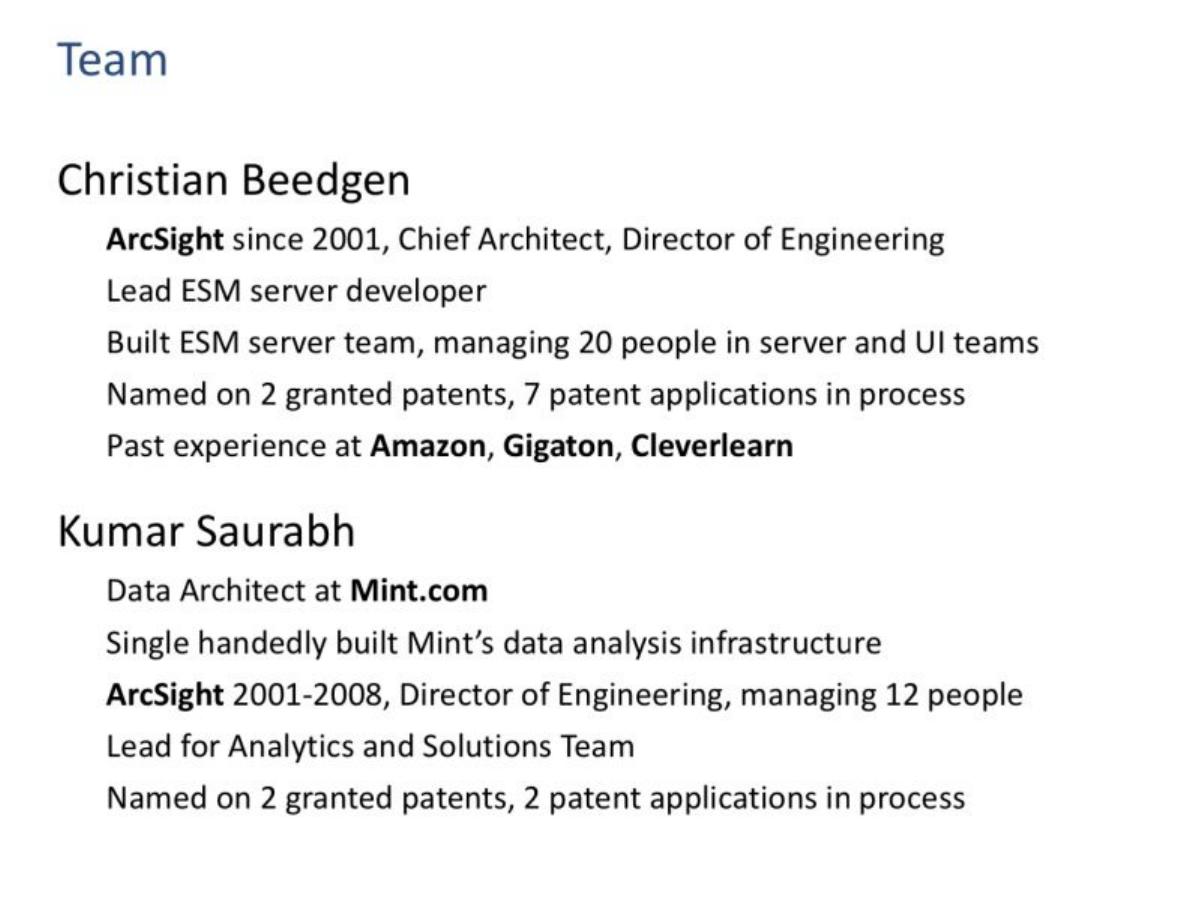
- The team is described on Slide 2 as 'log management veterans,' though specific prior companies or individual bios are not detailed in the provided slides.
The Technical Edge: A Sumo Logic Teardown
Sumo Logic’s pitch deck is a quintessential example of a technical founder's approach to fundraising. In an era where many decks prioritize lifestyle imagery and broad vision statements, this presentation stays grounded in the architectural realities of IT infrastructure. The deck, used to raise a $25 million Seed round in 2020 (per catalogue data), focuses heavily on the 'how' and the 'why now' of cloud-based log analytics.
Slide 1: Title Slide
The deck opens with a minimalist title slide: 'Cloud-based IT Log Analytics.' It lists the founders, Christian Beedgen and Kumar Saurabh. There are no logos, taglines, or decorative elements. This sets a tone of functional utility that persists throughout the presentation.
Slide 2: Overview
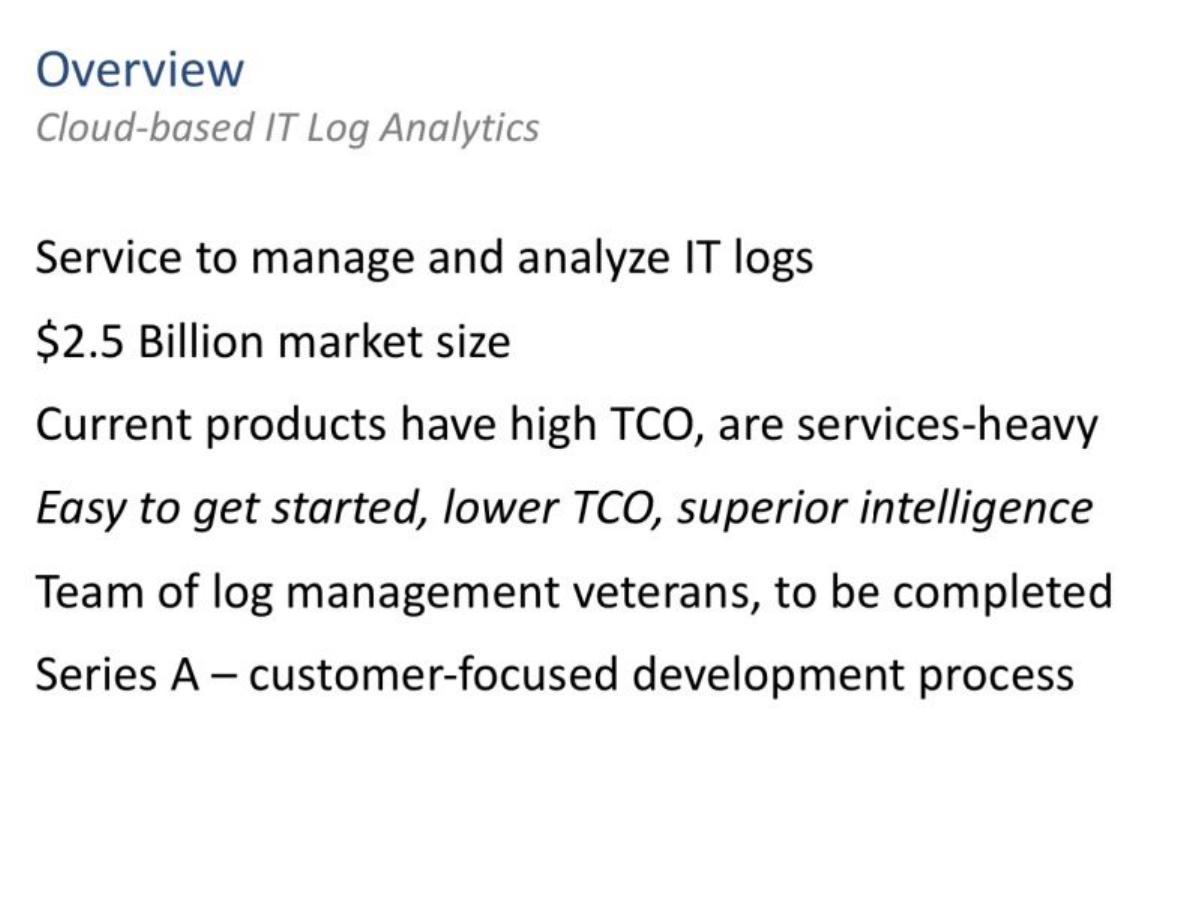
Slide 2 serves as an executive summary. It defines the service as a tool to 'manage and analyze IT logs' and immediately quotes a '$2.5 Billion market size.' Crucially, it highlights the 'high TCO' (Total Cost of Ownership) of current products and positions the Sumo Logic team as 'log management veterans.' This slide establishes the three pillars of the pitch: a large market, a flawed status quo, and a team with the domain expertise to fix it.
Slide 3: Market Size
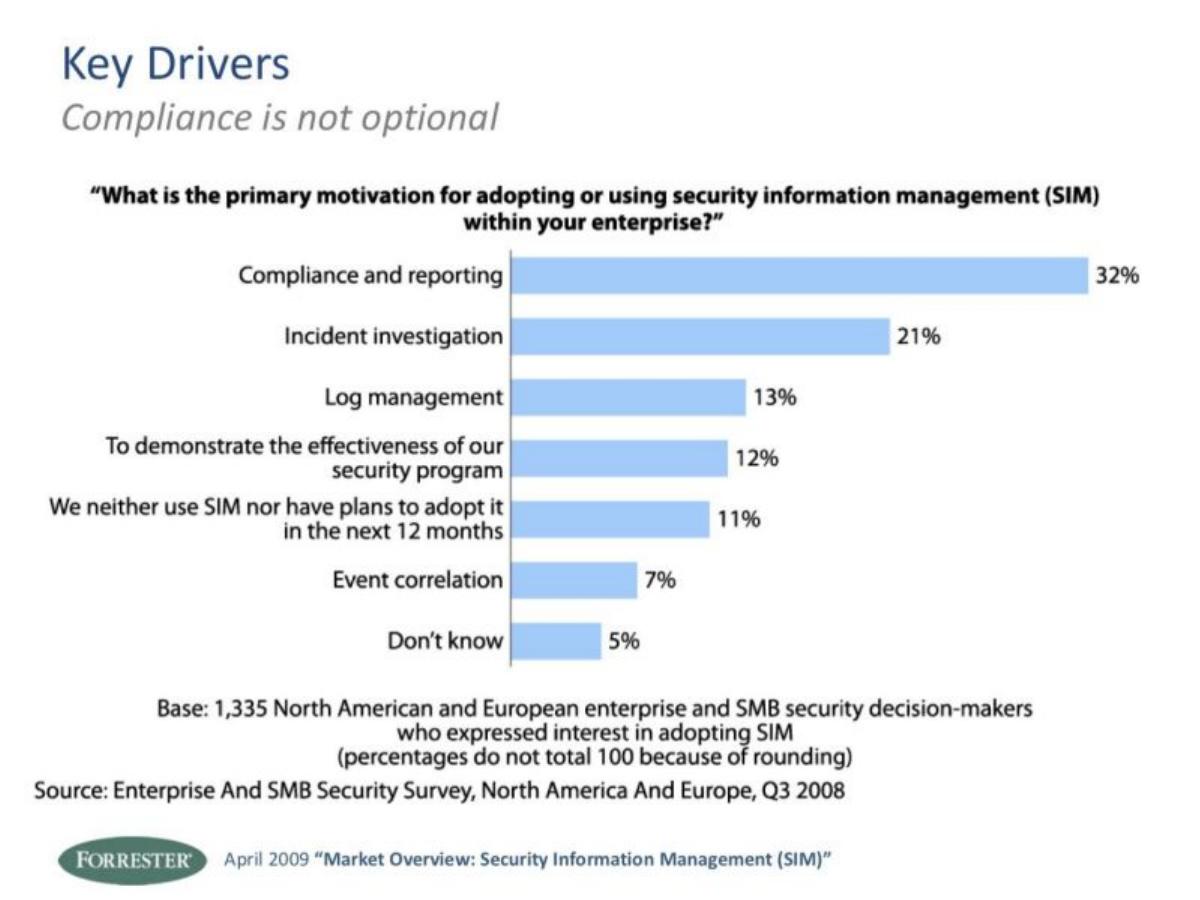
Using Gartner/Dataquest as a source, Slide 3 breaks down the ~$2.5 billion market. It identifies two core segments: Security Information Management ($1.1B) and Event Correlation & Analysis ($1.4B). By listing competitors like Splunk, ArcSight, and IBM Tivoli, the founders show they understand exactly whose budget they are competing for. The slide notes that compliance, security, and operations are the primary drivers for this spend.
Slide 4: Problem Statement
This slide is a direct attack on legacy software. It lists six failures of 'Today’s market leading products': they are premise-based, not scalable, challenged with log parsing, not context-aware, siloed, and not community-aware. The mention of 'expensive hardware' and the need for 'DBAs and sysadmins' highlights the hidden costs of on-premise solutions, setting the stage for a SaaS alternative.
Slide 5: Target Market and Use Cases
Slide 5 visualizes a transition from 'Medium Enterprises' to 'Large Enterprises.' It categorizes use cases into three buckets: Compliance (PCI, SOX, HIPAA), Security (Incident Response, Threat Intelligence), and Operations (Troubleshooting, Service Levels). This demonstrates the platform's versatility across different departments within an organization.
Slide 6: High-level Platform Architecture
This is the most complex slide in the deck. It illustrates a multi-tenant cloud architecture where 'Collectors' sit within customer environments (Customer A, B, and C) and feed data into a central cloud. The diagram highlights components like 'Raw Log Store,' 'Log Parsing,' and 'Full Text Search.' The inclusion of 'Global IT Log Intelligence' and 'Community' as top-layer components suggests that the value of the platform increases as more customers join.
Slides 7, 8, and 9: The Failure of Current Architecture
Sumo Logic takes the unusual step of dedicating three consecutive slides to explaining why current architectures fail. Slide 7 focuses on 'Log parsing challenges,' noting that manual parser maintenance is expensive. Slide 8 addresses 'Scalability tradeoffs,' stating that users often have to choose between performance and intelligence. Slide 9 highlights the 'silo' problem, where advanced analytics are hampered by database limits. This deep dive into technical pain points is clearly intended for a technical audience who has felt these frustrations firsthand.
Slide 10: Differentiators and Customer Benefits
This slide translates the technical features into business value. It lists six differentiators, most notably 'Seamless, transparent scalability' (claiming a jump from 100 to 10,000 events per second) and 'Global IT log intelligence.' The 'Customer Benefit' column uses language like 'Zero day discovery' and 'Instant slice and dice analytics' to make the value proposition concrete.
Slide 11: Go To Market
The GTM strategy is built on 'instant gratification.' The founders propose a self-serve model with free trials and tiered pricing ('Pay for what you use'). This reflects a shift toward the bottom-up adoption model that has become standard in SaaS, moving away from the heavy enterprise sales cycles mentioned as a problem on Slide 4.
Slide 12: Roadmap
The roadmap is structured across five functional areas: Intelligence, Operations, Security, Compliance, and Platform. It spans three releases, with Release 1 (9-12 months) focusing on core functionality like anomaly detection and PCI compliance packs. By Release 3, the company aims to offer 'Predictive Analytics' and 'Context Modeling,' showing a clear path from a utility tool to a sophisticated intelligence platform.
Slide 13: Closing / BestPitchDeck Promo
The final slide in the provided sequence is a promotional slide for the source library and does not contain Sumo Logic company data.
What Works in This Deck
Technical Credibility: The founders do not shy away from architectural diagrams. For a Seed round in a complex infrastructure space, proving that you have solved the 'plumbing' issues (like log parsing and scalability) is vital. The detailed breakdown of why current systems fail (Slides 7-9) builds immense trust with technical investors.
Clear Market Segmentation: Slide 3 does an excellent job of not just stating a big number, but showing exactly where that money is currently being spent and who the incumbents are. This makes the path to revenue feel more realistic.
The 'Community' Angle: By including 'Community' and 'Global Intelligence' in the architecture (Slide 6) and differentiators (Slide 10), Sumo Logic hints at a data moat. They aren't just selling software; they are selling the collective intelligence of all their users, which is a powerful 'winner-take-all' narrative.
What Is Missing
The Team Slide: While Slide 2 mentions 'log management veterans,' the provided slides do not include a dedicated team slide with names, past exits, or specific roles at companies like Splunk or ArcSight. In a $25M Seed round, the pedigree of the founders is usually a primary driver of the valuation.
Financials and Unit Economics: There are no slides covering projected revenue, burn rate, or Customer Acquisition Cost (CAC). While common in early Seed decks, a $25M round usually requires some level of financial modeling, even if speculative.
The Ask: The deck does not explicitly state how much money is being raised or how the funds will be allocated. While the catalogue data confirms a $25M raise, the absence of this information in the slides makes the deck feel more like a product overview than a complete investment proposal.
Founder Takeaway: Copy This
The 'Problem Deep-Dive': Most founders spend one slide on the problem. Sumo Logic spent four. If you are entering a crowded market with established giants, you must meticulously deconstruct why the current solutions are fundamentally broken. Don't just say they are 'slow'; show the architectural bottleneck that makes them slow.
Architectural Transparency: If you are building a SaaS version of a traditionally on-premise tool, use a slide like Slide 6 to show exactly how data flows. It demystifies the 'cloud' and proves you have a handle on security and ingestion—the two biggest hurdles in enterprise SaaS adoption.
Benefit-Driven Differentiation: Slide 10 is a perfect template for any deck. It links a specific technical feature (Differentiator) directly to a 'Customer Benefit.' This ensures that even a non-technical partner at a VC firm can understand why a feature like 'automated structure inference' actually matters to the end user.
Frequently asked questions
- What is the primary problem Sumo Logic aims to solve?
- According to Slide 4, the primary problem is that existing market-leading products are premise-based, expensive, and not scalable. They require significant hardware and manual labor (DBAs and sysadmins) to maintain. Furthermore, these legacy systems operate in silos, meaning insights gathered by one customer cannot be easily shared or used to improve the security posture of others.
- How does Sumo Logic define its market size?
- Slide 3 cites Gartner/Dataquest data to value the market at approximately $2.5 billion. This is broken down into two segments: Security Information Management ($1.1 billion) featuring competitors like ArcSight and Splunk, and Event Correlation & Analysis ($1.4 billion) featuring legacy giants like IBM (Tivoli), HP, and Microsoft.
- What are the key technical differentiators mentioned in the deck?
- Slide 10 lists six key differentiators: a cloud-based service, seamless scalability (moving from 100 to 10,000 events per second), intelligently evolving log parsing via automated structure inference, context modeling for risk assessment, global IT log intelligence for threat discovery, and a built-in community for sharing analytics content.
- What is the proposed business model?
- Slide 11 outlines a Go-To-Market strategy based on a self-serve, tiered pricing model. It mentions 'Pay for what you use' and suggests a freemium or free trial approach to lower the cost of sales. The strategy also includes web sales, telesales, and leveraged partnerships for PaaS add-on sales.
- What does the product roadmap look like?
- Slide 12 provides a three-stage roadmap. Release 1 focuses on anomaly detection and threat analysis. Release 2 introduces pattern mining and business continuity features. Release 3 aims for predictive analytics, data protection, and a fully realized 'community' aspect of the platform.