What belongs on the executive summary slide near the front of a pitch deck: the one-line pitch, proof, and the round.
Executive Summary Slide: Real Pitch Deck Examples
Six executive summary slides, shown in full, compare how companies compress the whole deck into one early slide, and what an investor can decide from each before reading further.
TL;DR
An executive summary slide should let an investor decide whether to keep reading: what the company does in one sentence, the two or three strongest pieces of evidence with numbers and dates, and what is being raised. The examples below that work best (Slope, Edurino, Bower) name the round or a dated revenue figure and back claims with specific numbers. The weaker ones repeat adjectives ("strong MoM growth") or describe features instead of evidence. Keep it to one slide and let later slides carry the detail.
Executive summary slides from real pitch decks
Each example shows the exact stored slide above its analysis and links to the full teardown. Figures and claims are the companies' own and have not been verified. Stage and year are given only where the slide states them.
Slope executive summary slide — slide 2
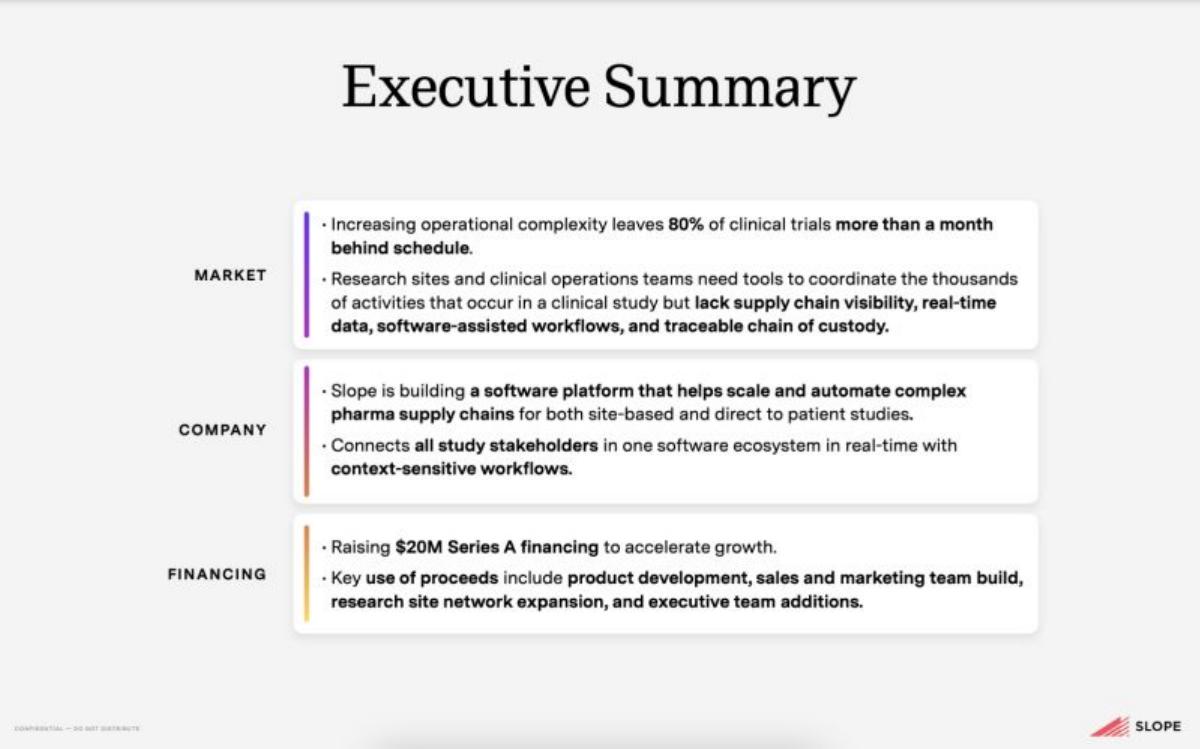
Software for clinical-trial supply chains. The slide says Slope is raising a $20M Series A; the year is not stated.
Slope deck, slide 2. Exact stored slide matched to this analysis.
Our analysis: The labels make the slide scannable, and the financing block answers the question most summaries leave to the last slide. The 80% figure gives the problem a size.
Evidence and limitation: There is no traction row. For a Series A raise, a revenue, customer or study count is the obvious missing line. The 80% figure has no source on the slide.
What a founder can adapt: Use labelled rows for market, company, traction and financing, one or two bullets each.
Supporting analysis
What the deck claims: "Executive Summary" in three labelled blocks. Market: "80% of clinical trials more than a month behind schedule" and research sites lacking supply-chain visibility. Company: a software platform that scales and automates pharma supply chains for site-based and direct-to-patient studies. Financing: "Raising $20M Series A financing to accelerate growth", with use of proceeds (product, sales and marketing, research-site network, executive hires).
Presentation choice: The labels make the slide scannable, and the financing block answers the question most summaries leave to the last slide. The 80% figure gives the problem a size.
When it does not fit: There is no traction row. For a Series A raise, a revenue, customer or study count is the obvious missing line. The 80% figure has no source on the slide.
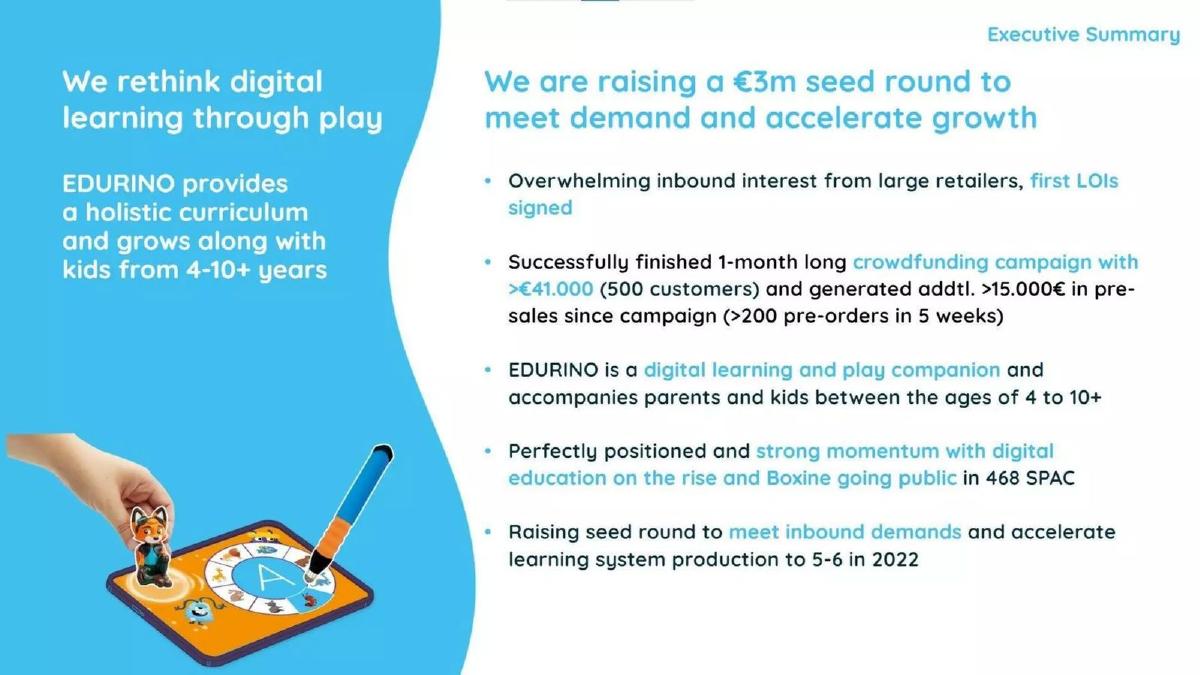
Digital learning and play product for children aged 4 to 10+. The slide says Edurino is raising a €3m seed round and mentions production plans for 2022.
Edurino deck, slide 2. Exact stored slide matched to this analysis.
Our analysis: The ask is the headline and every bullet is a reason to fund it. Crowdfunding and pre-orders are concrete early demand for a consumer hardware-plus-app product. By our arithmetic the campaign averaged about €82 per backer.
Evidence and limitation: "Overwhelming inbound interest" and "first LOIs" have no count. A comparable company's SPAC is market context, not Edurino's traction.
What a founder can adapt: If you are raising, make the round the headline and list the three facts that justify it.
Supporting analysis
What the deck claims: Left: "We rethink digital learning through play" and a one-line product description. Right headline: "We are raising a €3m seed round to meet demand and accelerate growth." Bullets: inbound interest from large retailers with "first LOIs signed"; a one-month crowdfunding campaign with ">€41.000 (500 customers)" and ">15.000€ in pre-sales since campaign (>200 pre-orders in 5 weeks)"; the product; market momentum including Boxine going public via a SPAC; and scaling production in 2022.
Presentation choice: The ask is the headline and every bullet is a reason to fund it. Crowdfunding and pre-orders are concrete early demand for a consumer hardware-plus-app product. By our arithmetic the campaign averaged about €82 per backer.
When it does not fit: "Overwhelming inbound interest" and "first LOIs" have no count. A comparable company's SPAC is market context, not Edurino's traction.
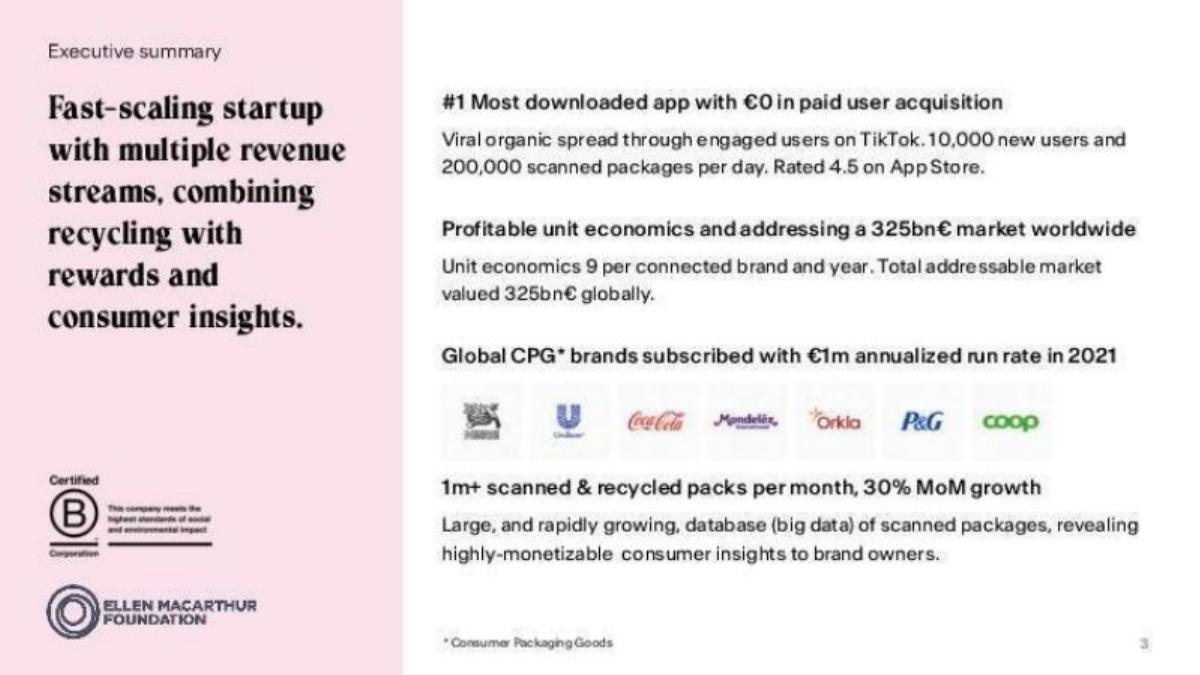
Recycling-rewards app that sells consumer insights to packaged-goods brands. The slide gives a 2021 annualized run rate; the round is not stated.
Bower deck, slide 3. Exact stored slide matched to this analysis.
Our analysis: Each headline is a claim and the line beneath is its evidence, so the slide reads well at a glance and on closer inspection. Revenue, growth and acquisition cost all appear.
Evidence and limitation: "#1 most downloaded" does not say in which store, country or category. "Unit economics 9 per connected brand and year" is unclear, with no currency or definition. The €325bn market figure has no source.
What a founder can adapt: Write each summary point as a bold claim plus one line of numbers that proves it.
Supporting analysis
What the deck claims: Left: "Fast-scaling startup with multiple revenue streams, combining recycling with rewards and consumer insights." Right, four headlines each with a supporting line: "#1 Most downloaded app with €0 in paid user acquisition" (10,000 new users and 200,000 scanned packages a day, 4.5 App Store rating); profitable unit economics and a €325bn market; "Global CPG brands subscribed with €1m annualized run rate in 2021" with seven brand logos; "1m+ scanned & recycled packs per month, 30% MoM growth."
Presentation choice: Each headline is a claim and the line beneath is its evidence, so the slide reads well at a glance and on closer inspection. Revenue, growth and acquisition cost all appear.
When it does not fit: "#1 most downloaded" does not say in which store, country or category. "Unit economics 9 per connected brand and year" is unclear, with no currency or definition. The €325bn market figure has no source.
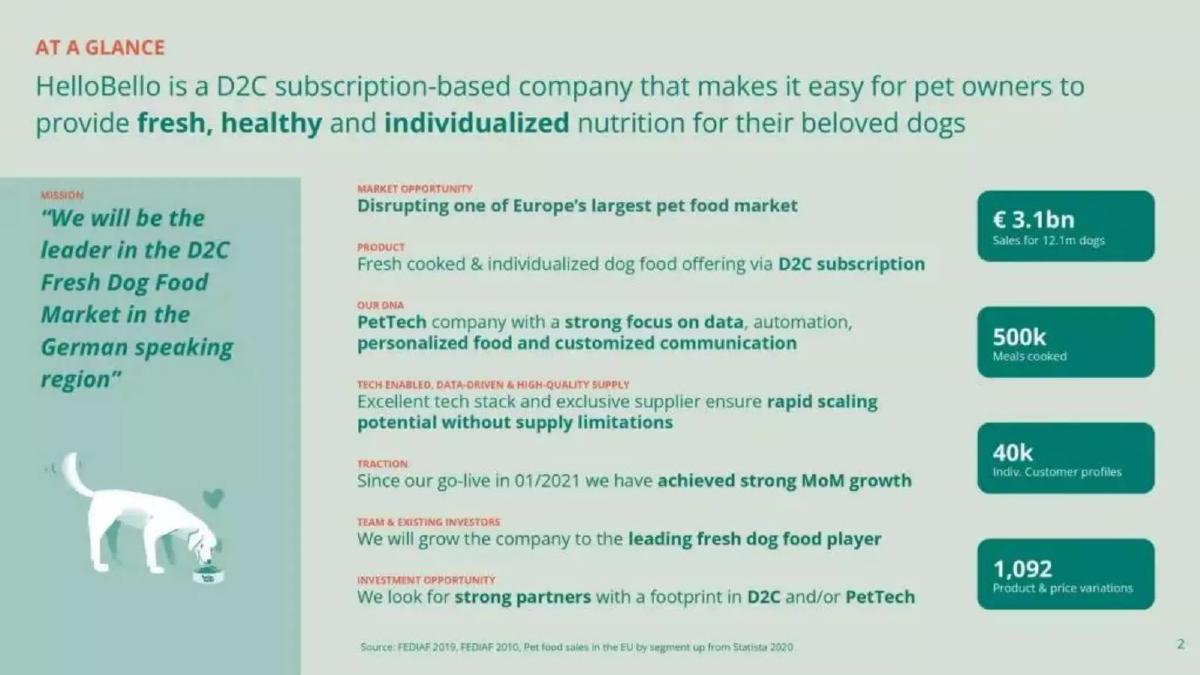
Fresh dog-food subscription in German-speaking Europe. The slide says it went live in January 2021; the round is not stated.
HelloBello deck, slide 2. Exact stored slide matched to this analysis.
Our analysis: The labelled rows cover every section of a deck, and the tiles give concrete scale. Sourcing the market figure on the slide is good practice.
Evidence and limitation: The traction row says only "strong MoM growth", and the investment row asks for "strong partners" with no amount. "Customer profiles" may not be paying customers, and product variations are not a traction metric.
What a founder can adapt: Keep the tile idea, but choose tiles an investor values: paying subscribers, revenue and retention.
Supporting analysis
What the deck claims: "At a glance": a one-sentence description, a mission quote, seven labelled rows (market opportunity, product, DNA, supply, traction, team and investors, investment opportunity) and four number tiles: €3.1bn (sales for 12.1m dogs, sourced to FEDIAF and Statista), 500k meals cooked, 40k individual customer profiles and 1,092 product and price variations.
Presentation choice: The labelled rows cover every section of a deck, and the tiles give concrete scale. Sourcing the market figure on the slide is good practice.
When it does not fit: The traction row says only "strong MoM growth", and the investment row asks for "strong partners" with no amount. "Customer profiles" may not be paying customers, and product variations are not a traction metric.
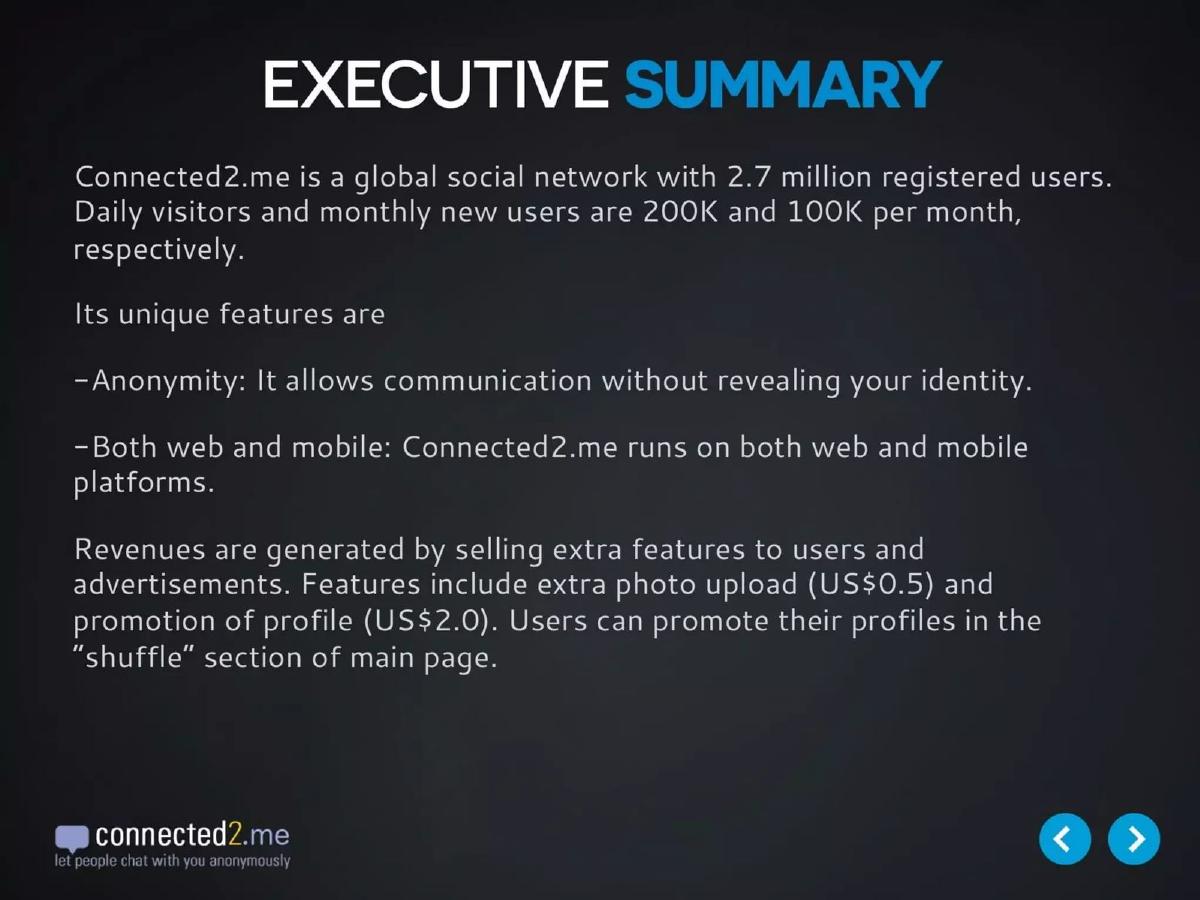
Anonymous chat social network. Stage and year are not stated on the slide.
Connected2.me deck, slide 2. Exact stored slide matched to this analysis.
Our analysis: It gives user scale and the revenue model in plain sentences, which is more than many summaries manage.
Evidence and limitation: Registered users are not active users; the daily-visitor figure is more useful and should lead. There is no revenue figure and no ask. Treat this as a slide to improve on.
What a founder can adapt: Keep the user-scale sentence and the pricing, then replace the features with revenue or paying-user figures.
Supporting analysis
What the deck claims: A paragraph-style summary: 2.7 million registered users, 200K daily visitors and 100K new users a month; two features (anonymity; web and mobile); and revenue from selling extra features (extra photo upload for US$0.5, profile promotion for US$2.0) and advertising.
Presentation choice: It gives user scale and the revenue model in plain sentences, which is more than many summaries manage.
When it does not fit: Registered users are not active users; the daily-visitor figure is more useful and should lead. There is no revenue figure and no ask. Treat this as a slide to improve on.
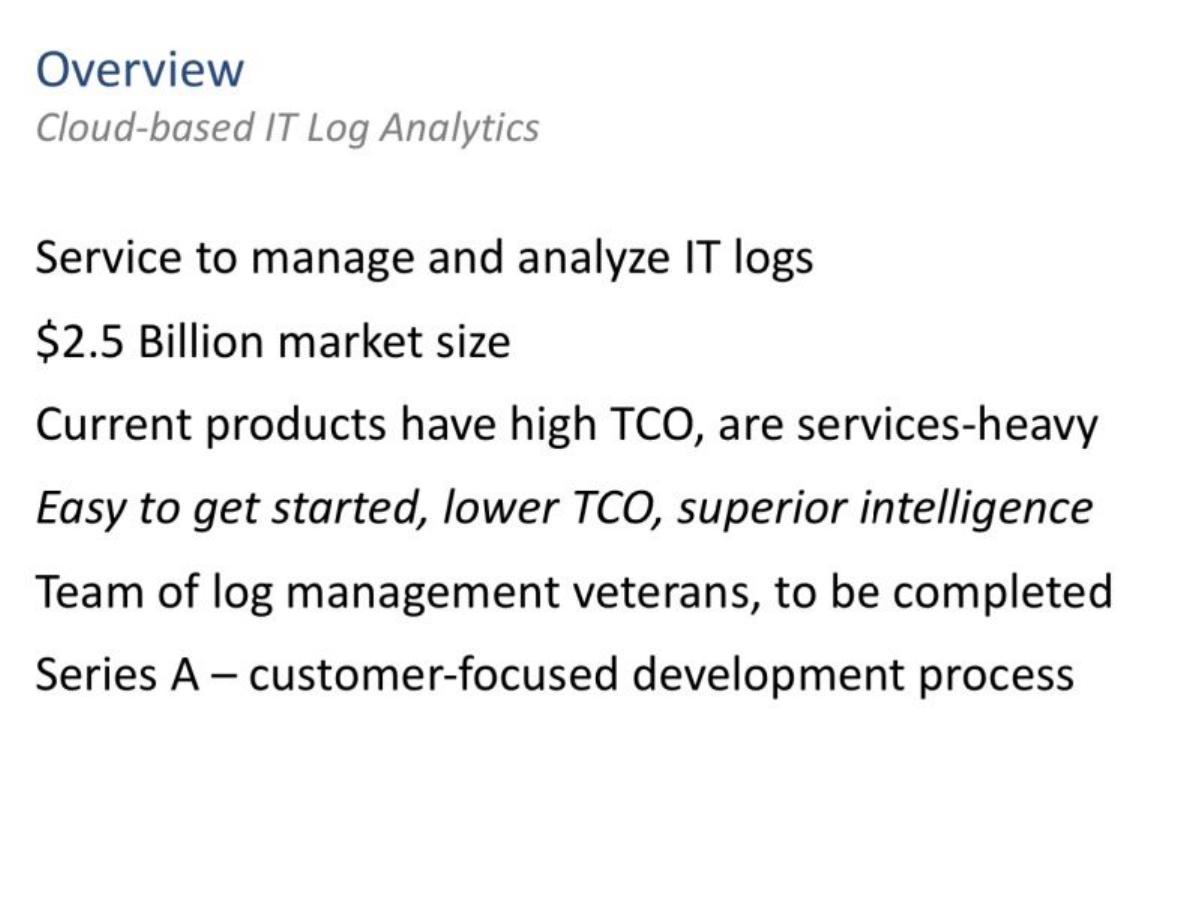
Cloud-based log analytics. The slide refers to a Series A; the year is not stated.
Sumo Logic deck, slide 3. Exact stored slide matched to this analysis.
Our analysis: Six short lines cover product, market, problem, differentiation, team and stage. At an early, pre-traction raise that is a complete summary.
Evidence and limitation: No amount is named for the Series A, and the market size has no source. With traction available, a later deck would need numbers here.
What a founder can adapt: For an early raise with no traction, one line each for product, problem, advantage, team and round can be enough. Say plainly what is still missing.
Supporting analysis
What the deck claims: "Overview: Cloud-based IT Log Analytics" in six lines: service to manage and analyze IT logs; "$2.5 Billion market size"; current products have high TCO and are services-heavy; "Easy to get started, lower TCO, superior intelligence"; "Team of log management veterans, to be completed"; "Series A – customer-focused development process."
Presentation choice: Six short lines cover product, market, problem, differentiation, team and stage. At an early, pre-traction raise that is a complete summary.
When it does not fit: No amount is named for the Series A, and the market size has no source. With traction available, a later deck would need numbers here.
Pick the format that puts your strongest evidence and your ask where an investor sees them first.
Format
Example
Strength
Fits when
Add
Labelled rows (market, company, financing)
Slope
Scannable; ask is explicit
You have a clear round and use of proceeds
A traction row
Ask as headline, evidence below
Edurino
Every line justifies the raise
Early demand is your best argument
Counts for LOIs and interest
Claim plus proof line
Bower
Readable at a glance and in depth
You have several strong numbers
Definitions and sources
Rows plus number tiles
HelloBello
Covers the whole deck
You want a one-page overview
Paying-customer tiles and an ask
Paragraph
Connected2.me
Simple
Rarely; hard to scan
Active users, revenue, the ask
Six-line overview
Sumo Logic
Brief and honest
Pre-traction raises
Round size and a market source
Key Takeaways
Structure the slide as questions an investor asks in order. Slope uses three labelled blocks: market, company, financing. Anyone can find the round ($20M Series A) and the use of proceeds in seconds.
Every claim needs a number beside it. Bower pairs each headline with figures (10,000 new users a day, €1m annualized run rate in 2021, 30% MoM growth); HelloBello's "strong MoM growth" gives none.
Name the round when you are raising. Edurino puts "We are raising a €3m seed round" as the headline and lists the evidence beneath it; Connected2.me and HelloBello never say what they want.
Choose evidence over features. Connected2.me spends half the slide on features (anonymity, web and mobile) that belong on the product slide.
A summary can be honest about gaps. Sumo Logic's early overview says the team is "to be completed"; being explicit is better than hiding a gap investors will find.
Write your executive summary
Answer each prompt in one line. If an answer has no number, find one or cut the line.
What. What do you sell, to whom, in one plain sentence?
Proof. What are your two strongest numbers, and as of what date?
Why you. What single fact about the team or product is hardest to copy?
Ask. How much are you raising, at what stage, and what will it achieve?
Copyable framework: [Company] sells [product] to [customer]. [Metric 1] and [metric 2] as of [date]. [One team or product advantage]. Raising [amount] [stage] to reach [milestone].
Illustrative example 1 — written by us
Before: Fast-growing, innovative platform with strong traction and a world-class team, disrupting a huge market.
After: [Company] sells [product] to [customer]. $[x]K MRR, up [y]% in six months, and [n] paying customers as of [month/year]. Raising $[z]M seed to reach [milestone] in [months].
What improved: Our illustrative rewrite, not any company's text. It replaces adjectives with dated figures and names the round and milestone; bracketed values are placeholders.
What the executive summary slide is for
The executive summary usually sits at slide 2 or 3, right after the cover. Many investors skim a deck sent by email before any meeting; this slide decides whether they read the rest. It also becomes the slide people forward internally.
It is not a table of contents or a mission statement. Each line should be something an investor would otherwise have to hunt for on a later slide: the product in plain words, the strongest traction figure, the market claim, and the ask.
Common mistakes
No ask. If you are raising, say how much and at what stage on this slide.
Adjectives instead of numbers. "Strong growth" needs a rate and a period.
Features instead of evidence. Features belong on the product slide.
Registered users as the headline. Lead with active or paying users.
Unsourced market figures. Add a source or leave the number for the market slide.
Diagnostic checklist
The product and customer fit in one sentence.
At least two claims carry a number and a date.
The round size and stage are stated, if you are raising.
Every line would otherwise require reading a later slide.
Market figures are sourced or left out.
The slide can be read in under 30 seconds.
Frequently asked questions
How we chose these examples
Corpus: published pitch deck teardowns on StartupFundraising.com. Founder-uploaded private decks are excluded.
Selection (2026-09-24): we searched extracted text of slides 2–4 for slides titled executive summary, at a glance, overview, summary, highlights or similar, excluding public-company investor presentations, where a stored slide image exists. We inspected eight candidates and chose six. Matterport slide 4 (a public-company investment-highlights slide) and Awake Security slide 3 were not selected. Summary slides already used in the SaaS traction guide (Hive, Vic.ai, Pathlight, Apollo) were excluded to avoid repetition.
Review: all six stored slide images were inspected on 2026-09-24 and matched to company, deck and slide number (editorial model review). No person has yet completed an editorial review of this page.
Figures and claims such as "#1 most downloaded" and market sizes are shown as the companies state them and have not been independently verified. The Edurino per-backer average is our arithmetic from the slide. We make no claim that any slide caused a fundraising outcome.