HelloBello's 2022 seed deck is a masterclass in regional market positioning. By focusing specifically on the DACH region (Germany, Austria, Switzerland), the company successfully carved out a 'blue ocean' niche within the broader European pet food industry. The deck effectively balances emotional drivers—framing poor nutrition as a cause of canine obesity and cancer—with hard operational metrics, including a six-figure MRR and 40,000 individual customer profiles. Their 'tech-first' narrative, supported by a proprietary food configurator and a highly automated supply chain, justifies their $1.…
Key takeaways
- The company targets a specific €53m SOM within the larger €2.23bn DACH dog food market (Slide 9).
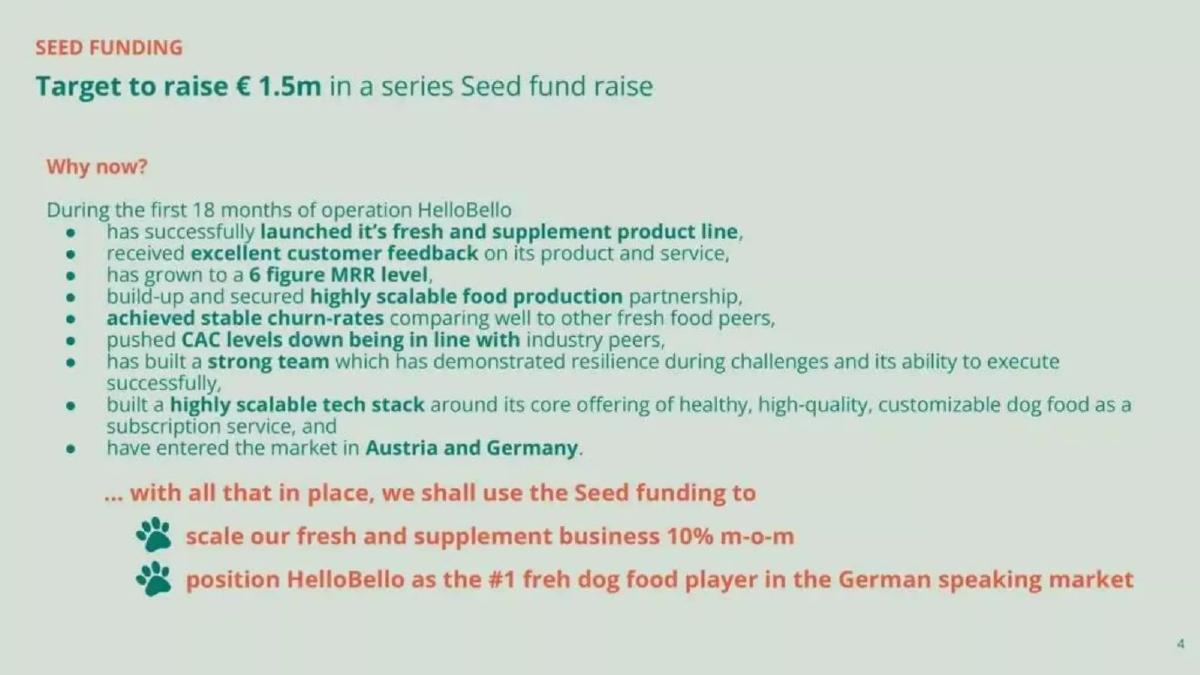
- HelloBello reports achieving a six-figure MRR within its first 18 months of operation (Slide 4).
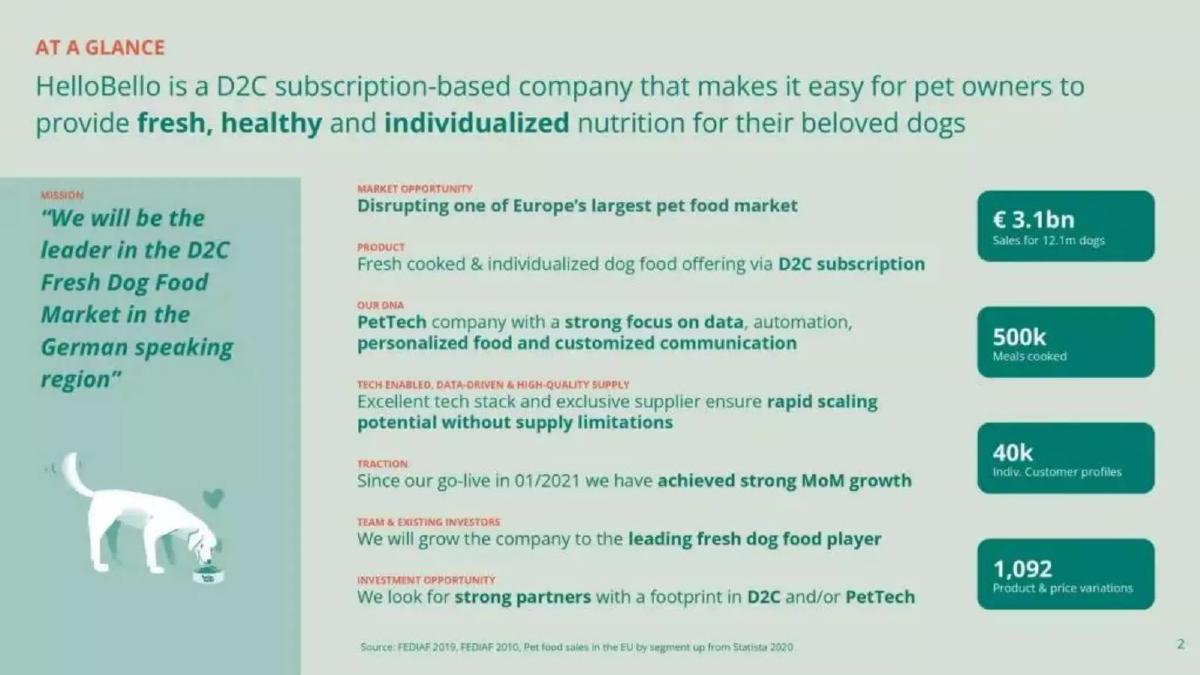
- The platform has generated 40,000 individual customer profiles and 1,092 product and price variations (Slide 2).
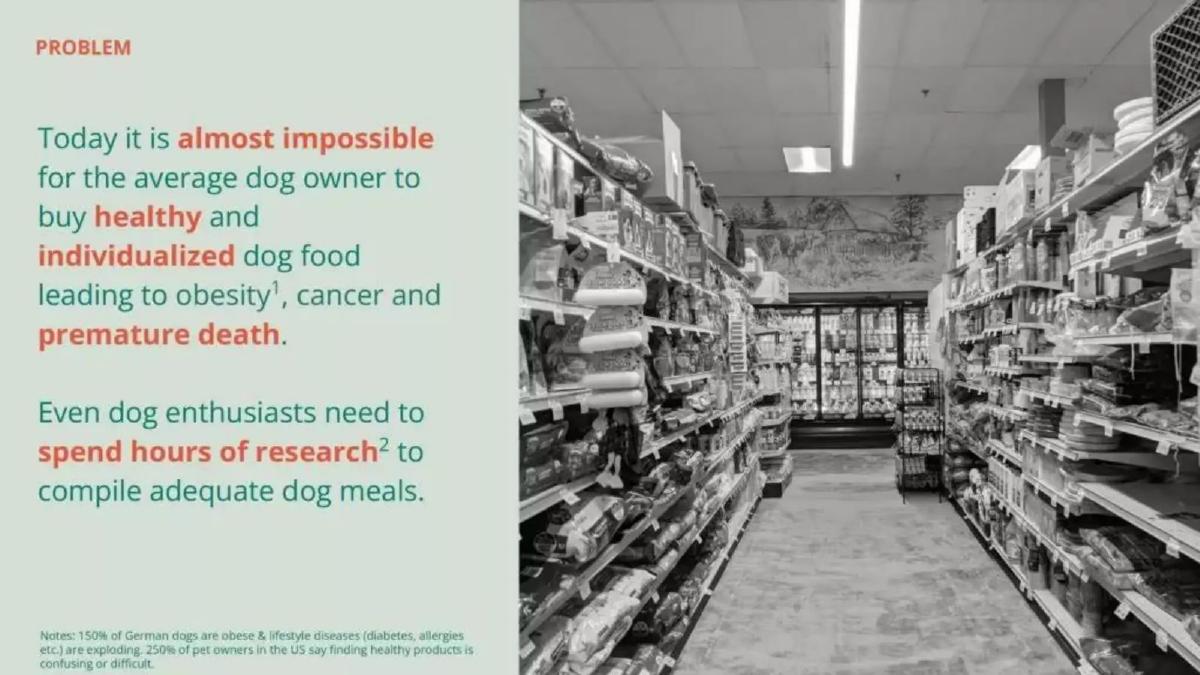
- The deck identifies a 150% obesity rate in German dogs as a primary problem driver (Slide 5).
- Competitive positioning is built on being the 'only one' fresh pet food player in the German-speaking region (Slide 12).
- The team boasts over 1,000 'dog years' of experience, including founders with backgrounds at UBS and JPMorgan (Slide 14).
- Sustainability is a core pillar, with a goal of CO2 neutrality by 2023 and a straw-based packing system (Slide 15).
- The investment ask was €1.5m to scale the business at a 10% month-over-month growth rate (Slide 4).
Executive Summary: The Regional Specialist Play
HelloBello's pitch deck is a strategic document that prioritizes market timing and regional dominance. In a sector—fresh pet food—that had already seen massive valuations in the US (The Farmer's Dog at $1.4bn) and the UK (Butternut Box at $340m), HelloBello makes the case that the German-speaking market is a wide-open 'blue ocean.' By framing their business as a 'PetTech' subscription service, they successfully moved the conversation away from simple manufacturing and toward a high-margin, data-driven SaaS-style model.
Slide 1-2: The Hook and the Snapshot
The deck opens with a high-quality lifestyle image and the tagline 'If Dogs Could Cook!' Slide 2, titled 'At A Glance,' is a dense summary that immediately establishes credibility. It defines the company as a D2C subscription-based PetTech firm. Key figures presented here include a €3.1bn sales market for 12.1m dogs, 500k meals cooked, and 40k individual customer profiles. This slide is effective because it answers the 'what, where, and how much' before the investor even turns the page.
Slide 3-4: Vision and the Seed Ask
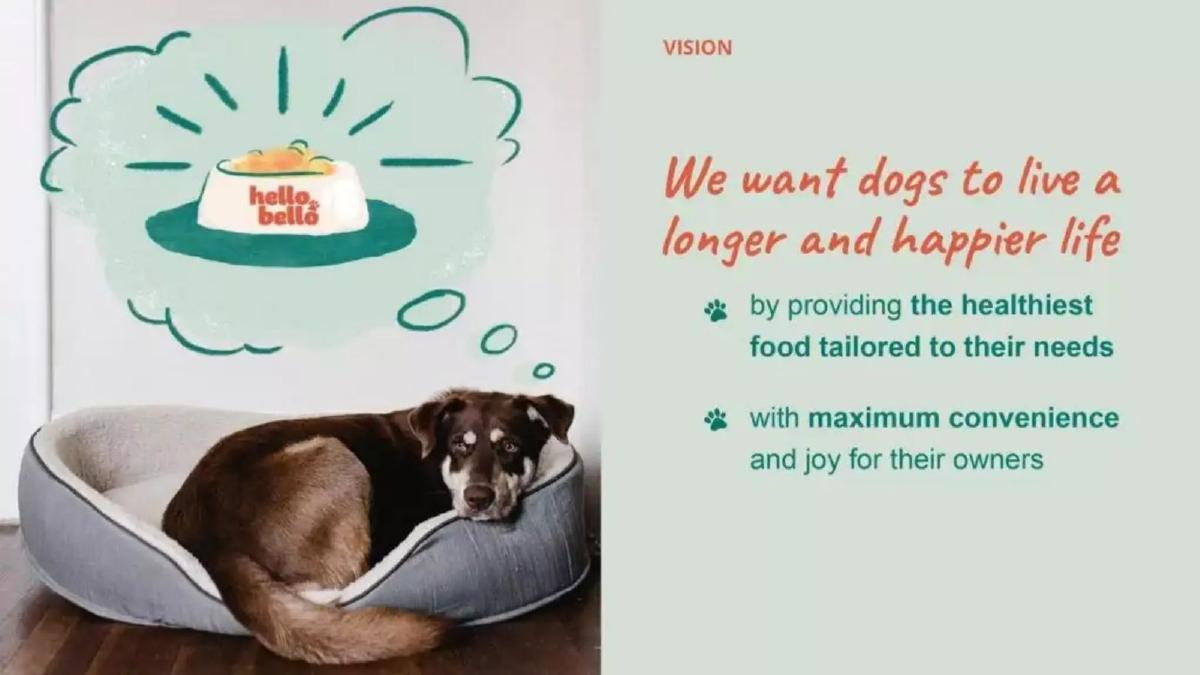
Slide 3 sets the emotional tone: 'We want dogs to live a longer and happier life.' This is immediately followed by Slide 4, which outlines the €1.5m Seed funding target. Unusually, the 'Ask' slide appears very early in the deck. It lists achievements from the first 18 months, most notably a 6 figure MRR level and the successful entry into Austria and Germany . The stated goal for the funds is to scale the business 10% m-o-m and position the brand as the #1 player in the DACH region.
Slide 5-7: Problem, Solution, and Product Journey
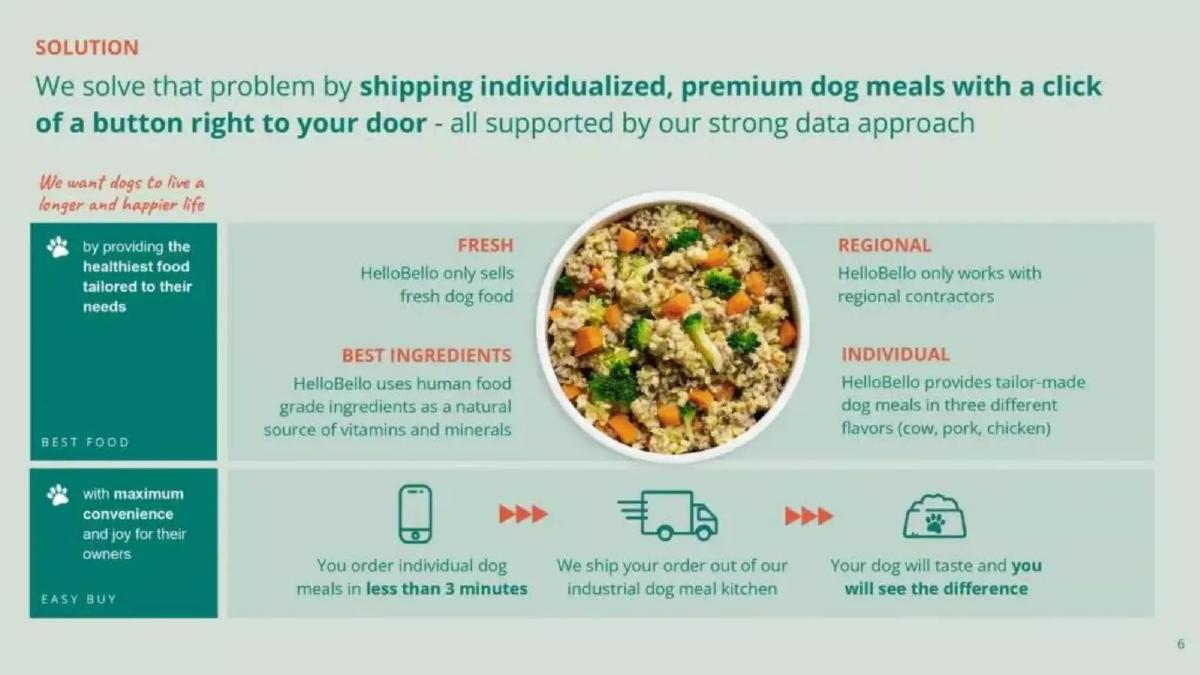
The problem slide (Slide 5) uses stark language, claiming it is 'almost impossible' to buy healthy dog food, leading to obesity, cancer and premature death . A footnote claims that 150% of German dogs are obese (likely a typo intended to mean a 50% increase or a specific high percentage, but the slide reads 150%). Slide 6 introduces the solution: individualized meals shipped with a 'click of a button.' The product journey on Slide 7 illustrates the three-step process: the food configurator , delivery within 24-48h , and pre-portioned meals personalized with the dog's name.
Slide 8: Social Proof
Slide 8 focuses on 'Customer Love,' showcasing a 4.8/5 Trustpilot rating based on 300,000 meals served . The slide includes several screenshots of German-language reviews, emphasizing that customers view the brand as an 'innovator & problem solver.' This social proof is critical for a D2C brand where trust is the primary barrier to subscription conversion.
Slide 9-10: Market Opportunity and Trends
Slide 9 provides a detailed breakdown of the TAM, SAM, and SOM. The TAM is €2.23bn , while their specific SOM (Serviceable Obtainable Market) is €53m . They calculate this based on a 15% online sales share and a 30% target market share over the next 4 years. Slide 10 identifies four key trends: Premiumisation, Humanisation, Cry for Transparency, and Online & Personalized . These trends serve to de-risk the investment by showing that consumer behavior is shifting in HelloBello's favor.
Slide 11-12: The Competitive Landscape
Slide 11 is perhaps the most important slide for a regional play. It lists 'Fresh Food Peers' in the US, UK, and Belgium, showing their massive valuations and funding rounds. The core message is: 'Europe is catching on,' and HelloBello is the only one focusing on the German speaking market . Slide 12 uses a standard 2x2 matrix (Generic vs. Individual and Cheap vs. Premium) to place HelloBello in the top-right quadrant, noting they are the 'Only one in German-speaking region' to offer this level of personalization.
Slide 13-14: Roadmap and Team
Slide 13 shows a simple timeline, moving from the 2020 launch in Austria to the 2022 expansion in Germany, with a 2025 vision to be the 'One-Stop-Shop for pet well-being' across the EU. Slide 14 introduces the team, claiming 1,000+ dog years of experience. The leadership includes Wolfgang Maurer (14 years entrepreneurship), Stephan Freh (14 years M&A at UBS/JPMorgan), and Patrick Etz (15+ years strategy consulting). The slide also notes a total staff of 11 FTE , including 3 'office dogs.'
Slide 15-16: Sustainability and Contact
Slide 15 highlights the company's commitment to ecology, featuring a straw-based packing system that uses 50x less energy than traditional polystyrene. They report that 65% of customers return their packaging. The deck concludes on Slide 16 with contact information for Stephan Freh in Vienna, Austria.
What Works in This Deck
Regional Specificity: The deck doesn't try to claim it will conquer the world. It makes a very disciplined case for why the DACH region is a specific, lucrative, and underserved niche. This focus makes the 10% m-o-m growth target feel achievable rather than speculative.
Metric Density: By Slide 2, the investor knows the MRR scale, the number of meals served, and the number of customer profiles. Leading with traction is the best way to validate a CPG business that might otherwise be dismissed as 'just another food company.'
Tech-First Framing: The emphasis on the 'food configurator' and '1,092 product variations' reframes the business as a data company. This is crucial for achieving the higher valuation multiples typically reserved for SaaS companies rather than traditional food manufacturers.
What Is Missing
Unit Economics Detail: While the deck mentions that CAC (Customer Acquisition Cost) is 'in line with industry peers' and churn is 'stable,' it does not provide the actual numbers. For a subscription business, the LTV/CAC ratio is the most important metric for a Seed round, and its absence is a notable omission.
Financial Projections: There is no slide showing projected revenue, EBITDA, or burn rate over the next 3-5 years. While the roadmap shows geographic expansion, it doesn't quantify what that means for the bottom line.
Manufacturing Logistics: The deck mentions 'regional contractors' and an 'industrial dog meal kitchen,' but it doesn't explain the margin structure of these partnerships. Investors would likely want to know if the company owns its production or if it is vulnerable to third-party price hikes.
Founder's Playbook: What to Copy
The 'Peer Comparison' Slide: Slide 11 is a brilliant way to use the success of others to your advantage. By showing that similar models have reached billion-dollar valuations in other geographies, HelloBello makes their own seed round look like a bargain entry point into a proven model.
The 'At A Glance' Summary: Every deck should have a version of Slide 2. It respects the investor's time by providing a high-level summary of the entire business case in one view. If an investor only looks at one slide, this is the one that will get you the meeting.
The Problem-to-Emotion Bridge: HelloBello doesn't just say dog food is 'low quality.' They link it to 'cancer and premature death.' While aggressive, this creates a sense of urgency. If your product solves a problem that has emotional stakes, don't be afraid to state them clearly.
Frequently asked questions
- What is HelloBello's primary market advantage?
- HelloBello's primary advantage is its regional focus. While fresh dog food competitors like The Farmer's Dog and Butternut Box have scaled in the US and UK, HelloBello identifies itself as the only significant player focusing exclusively on the DACH region (Germany, Austria, Switzerland). This allows them to tailor their marketing, supply chain, and flavor profiles (cow, pork, chicken) to local preferences and regulations.
- How does HelloBello use technology in a CPG business?
- The company positions itself as a 'PetTech' firm rather than just a food producer. They use a 'food configurator' to create personalized meal plans based on individual dog data. This tech-first approach allows for 1,092 product and price variations, creating a high barrier to entry for traditional mass-market pet food brands that rely on static SKUs.
- What are the key growth metrics mentioned in the deck?
- HelloBello highlights several key metrics to prove traction: a six-figure MRR, 500,000 meals cooked, and 40,000 individual customer profiles. They also mention 'stable churn-rates' and 'CAC levels being in line with industry peers,' though specific percentages for these two metrics are not disclosed on the slides.
- How does the company address sustainability?
- Sustainability is integrated into their operations through regionally sourced ingredients and a unique straw-based packing system that consumes 50x less energy than expanded polystyrene. They report that 65% of customers return their used packing material, supporting their goal of reaching CO2 neutrality by 2023.
- What is the background of the founding team?
- The team combines financial rigor with entrepreneurial experience. Co-founder Stephan Freh brings 14 years of corporate M&A experience from UBS and JPMorgan, while 'Lead Dog' Wolfgang Maurer has 14 years of experience in entrepreneurship and international business development. This mix suggests a strong capability for both operational execution and capital management.