Heidi Health’s Series B deck is a masterclass in brevity and momentum. By focusing on a single, powerful narrative—that healthcare IT is shifting from top-down sales to bottom-up user adoption—the company justifies its $65 million ask through sheer velocity. The deck reports reaching 65 million visits to date and saving 16 million hours globally in less than 18 months. Rather than getting bogged down in technical AI specifications, the slides emphasize the 'viral' nature of their product-led growth (PLG) model, claiming market leadership in Canada and high penetration among primary care physi…
Key takeaways
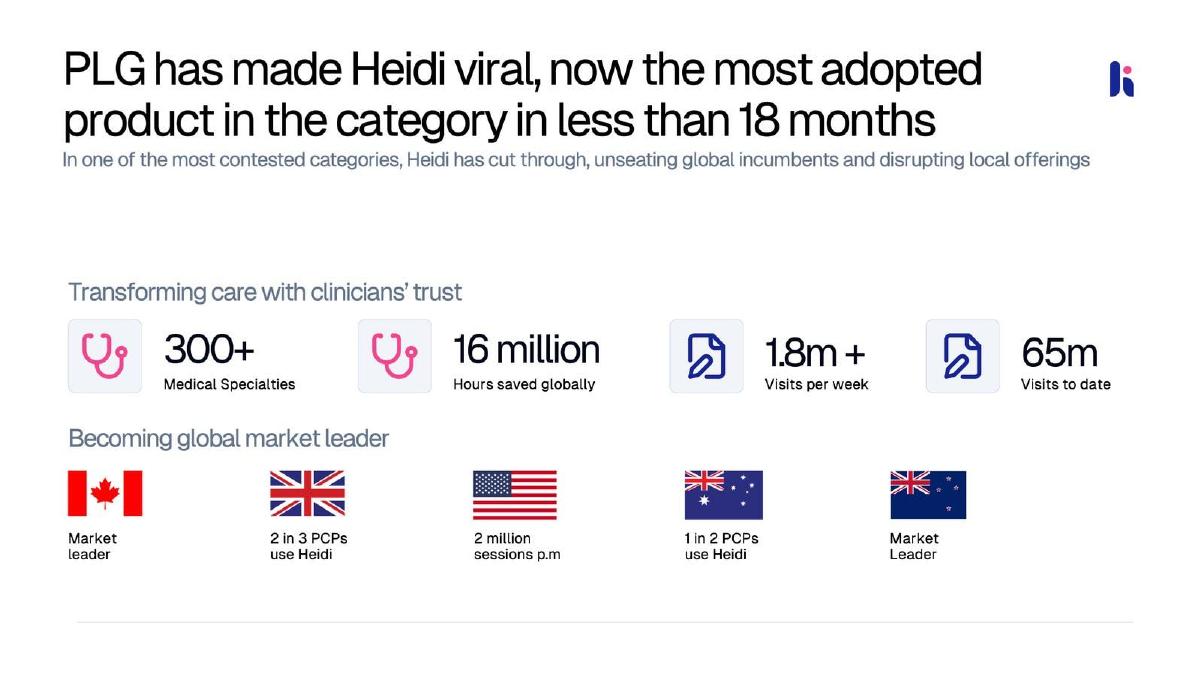
- The company claims to have reached 65 million visits to date and 1.8 million+ visits per week as of Slide 5.
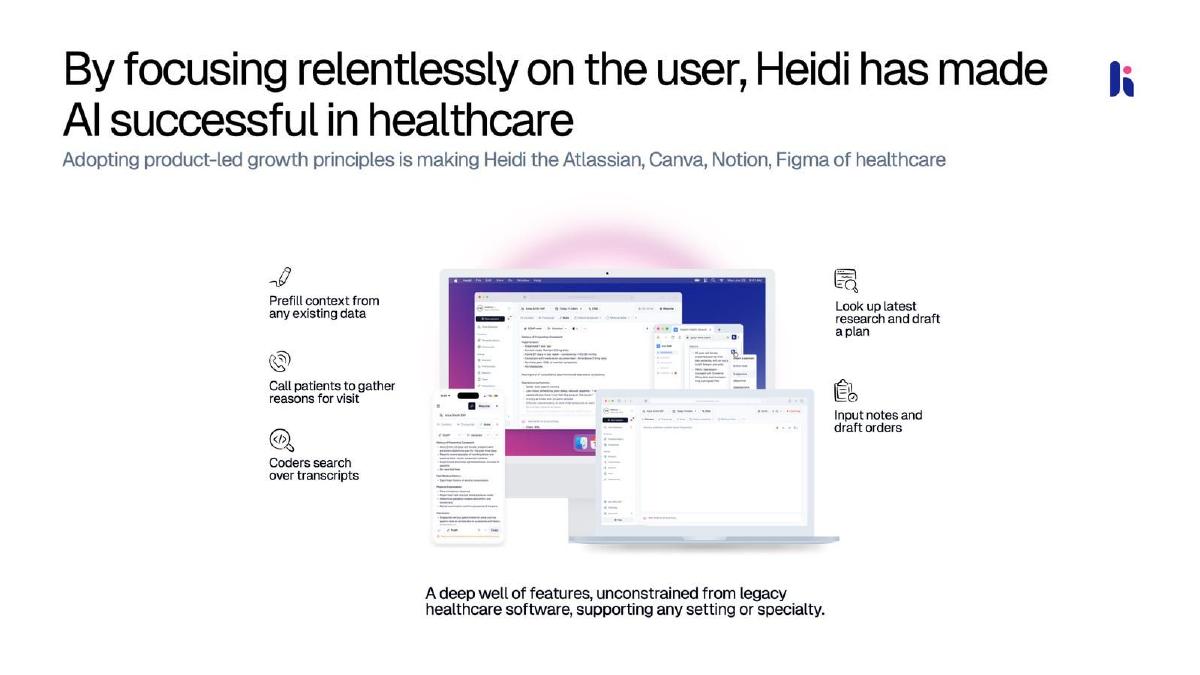
- Heidi Health positions itself as the 'Atlassian, Canva, Notion, Figma of healthcare' by adopting PLG principles (Slide 4).
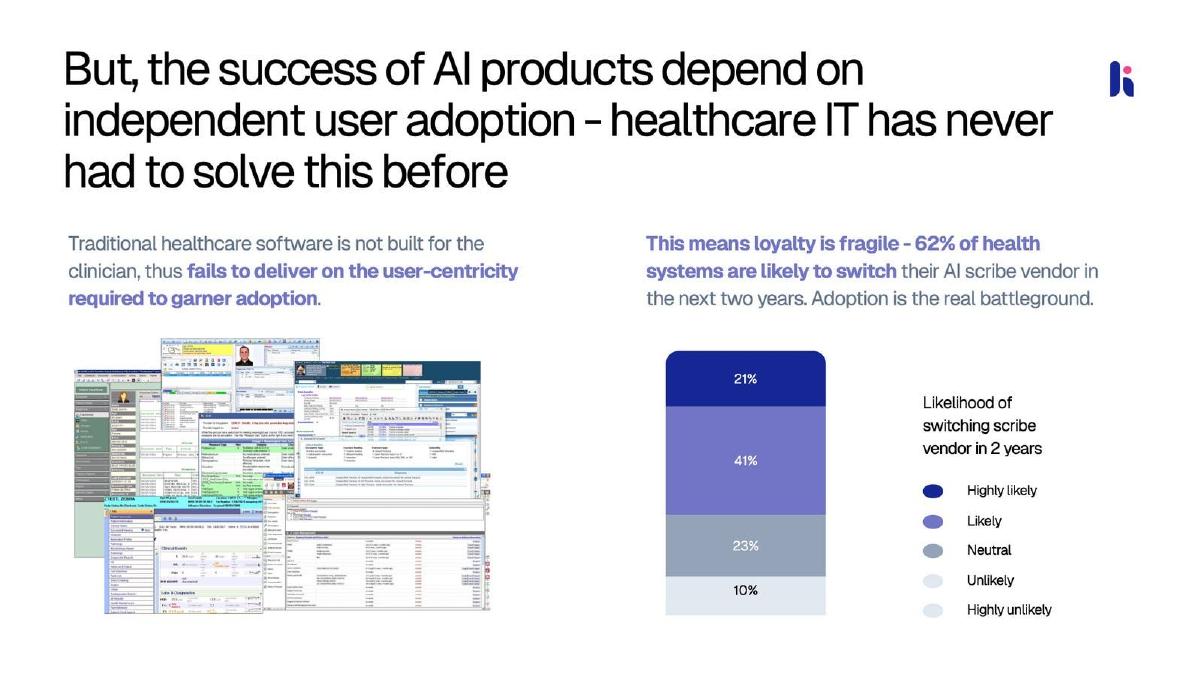
- A significant market insight on Slide 3 suggests 62% of health systems are likely to switch their AI scribe vendor in the next two years, framing adoption as the 'real battleground.'
- The deck reports saving 16 million hours globally across 300+ medical specialties (Slide 5).
- Traction is quantified by regional penetration: 1 in 2 PCPs in Australia and 2 in 3 PCPs in the UK use Heidi (Slide 5).
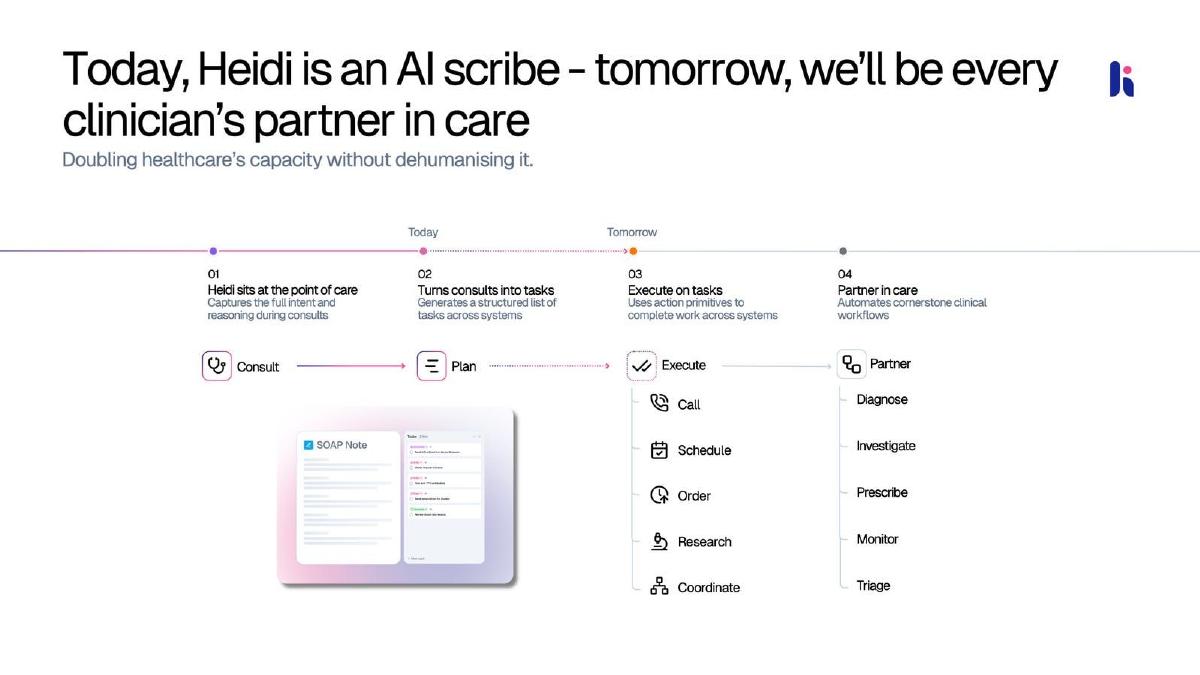
- The product roadmap on Slide 7 outlines a transition from 'Consult' and 'Plan' (today) to 'Execute' and 'Partner' (tomorrow).
- The $65 million raise is earmarked for global expansion into markets including France, Spain, Germany, and the USA (Slide 8).
- The deck entirely omits a team slide, a competitor matrix, and specific unit economics or revenue figures.
Heidi Health: A High-Velocity Series B Narrative
Heidi Health’s Series B pitch deck is a lean, metric-driven document that prioritizes momentum over exhaustive detail. In just nine slides, the Australian-based AI company outlines a vision for disrupting the healthcare IT sector through product-led growth (PLG). As reported by Business Insider, the company successfully raised $65 million in 2024 to fuel this vision. The deck’s primary strength lies in its ability to frame the 'AI scribe' category not as a commodity, but as a user-adoption battleground where the most user-centric product wins.
Slide 1: The Cover
The opening slide is minimalist, featuring the company logo and the text 'Heidi: Series B.' The background uses a blue-to-pink gradient with a waveform pattern, subtly nodding to the audio-capture nature of their AI scribe product without explicitly stating it. It sets a professional, modern tone for a growth-stage company.
Slide 2: The Problem - Clinician Burnout
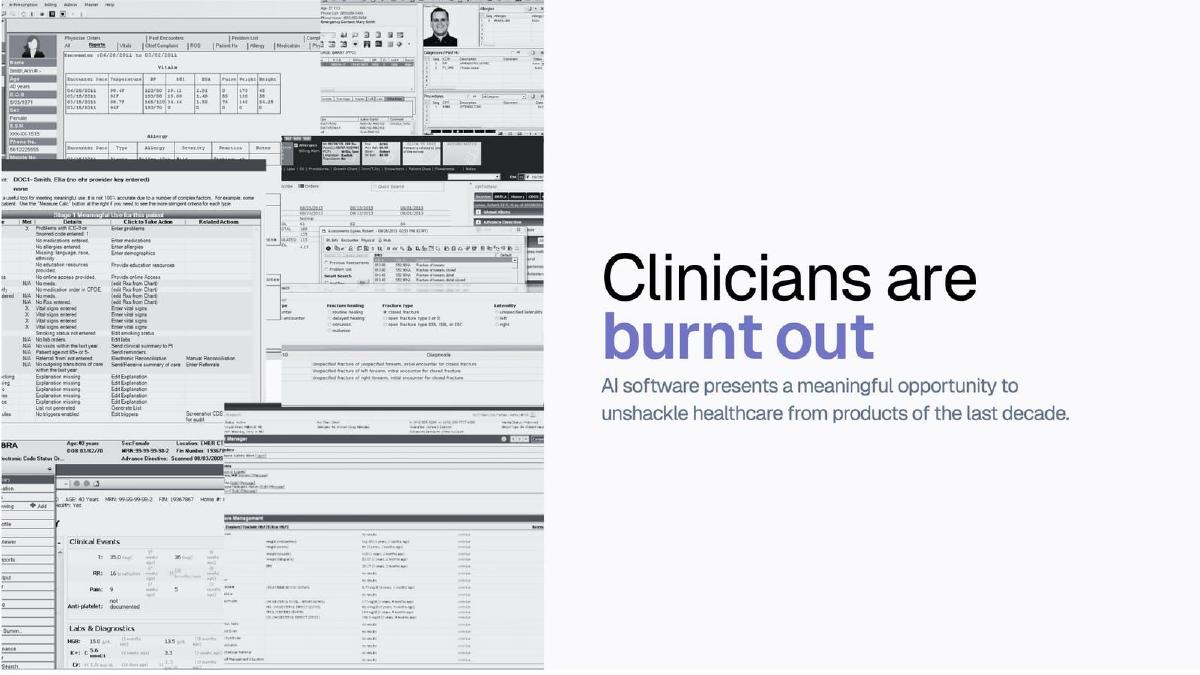
Slide 2 identifies the core pain point: 'Clinicians are burnt out.' The visual choice here is deliberate—a collage of cluttered, archaic-looking Electronic Health Record (EHR) interfaces. The text notes that AI presents an opportunity to 'unshackle healthcare from products of the last decade.' By showing the visual complexity of current systems, Heidi positions itself as the antidote to administrative friction.
Slide 3: The Market Shift - Adoption as the Battleground
This slide introduces a sophisticated market thesis. It argues that unlike traditional healthcare IT, the success of AI depends on 'independent user adoption.' The most striking data point here is that '62% of health systems are likely to switch their AI scribe vendor in the next two years.' A bar chart visualizes the likelihood of switching, with 21% 'Highly likely' and 41% 'Likely.' This frames the market as highly fluid and vulnerable to a superior user experience.
Slide 4: The Solution - The PLG Playbook
Slide 4 positions Heidi as a modern SaaS company, explicitly comparing itself to 'Atlassian, Canva, Notion, Figma.' This is a bold move in healthcare, a sector usually defined by long sales cycles and top-down implementation. The slide showcases the interface across mobile and desktop, listing features such as prefilling context, calling patients to gather reasons for visits, and drafting orders. The tagline emphasizes a 'deep well of features, unconstrained from legacy healthcare software.'
Slide 5: Traction and Global Dominance
This is the 'money slide' of the deck. It provides high-density evidence of growth in less than 18 months. Key figures include: 300+ Medical Specialties, 16 million hours saved globally, 1.8m+ visits per week, and 65m visits to date. The slide also highlights regional market leadership, claiming that 2 in 3 PCPs in the UK and 1 in 2 PCPs in Australia use Heidi, alongside 2 million sessions per month in the US. This level of penetration effectively proves the 'viral' claim made in the headline.
Slide 6: The Business Model - Land and Expand
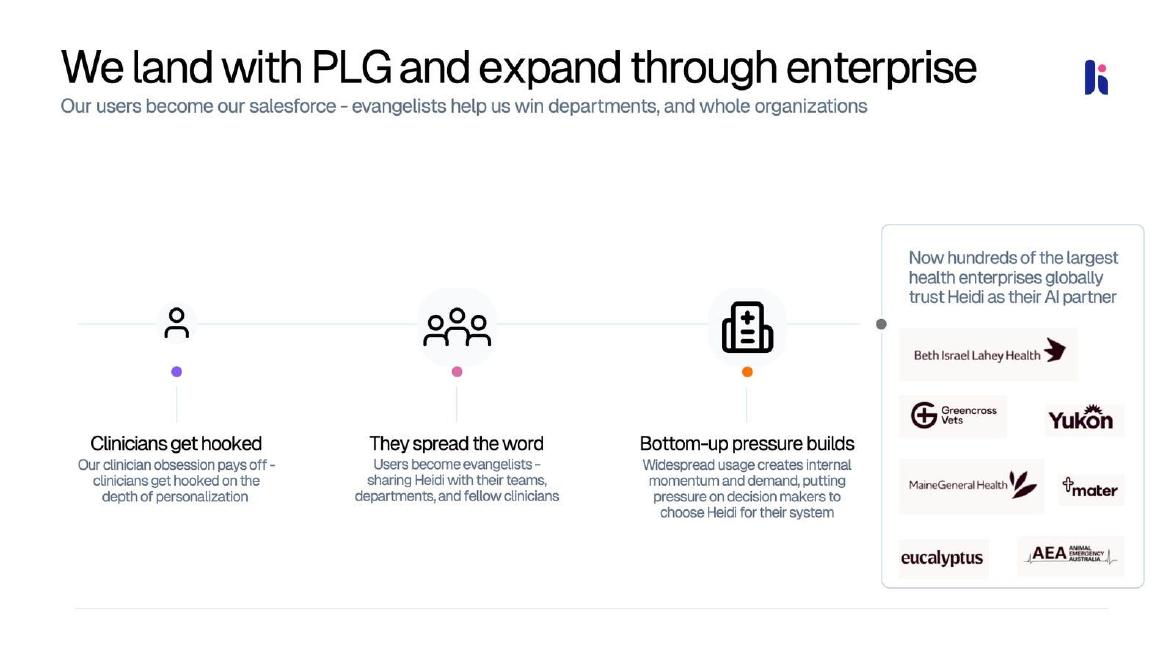
Slide 6 explains the mechanics of their growth. It follows a three-step process: 1. Clinicians get hooked on personalization. 2. Users become evangelists, sharing the tool with teams. 3. Bottom-up pressure builds, forcing decision-makers to adopt the system. A 'trust' box features logos from organizations like Beth Israel Lahey Health, Greencross Vets, and MaineGeneral Health, proving that the PLG strategy successfully converts into enterprise-level partnerships.
Slide 7: The Vision - From Scribe to Partner
This slide addresses the 'what's next' question. It maps out a four-stage evolution. Today, Heidi handles 'Consult' (capturing intent) and 'Plan' (generating tasks). The 'Tomorrow' phase includes 'Execute' (calling, scheduling, ordering) and 'Partner' (automated clinical workflows like diagnosis and triage). This roadmap transforms the company from a utility tool into an essential clinical infrastructure layer.
Slide 8: The Ask - $65 Million
The penultimate slide states the funding goal: $65 million. The allocation is split into three pillars: deepening capabilities (evolving from scribe to partner), supporting growth (expanding into France, Spain, Germany, Ireland, South Africa, Singapore, and Hong Kong), and expanding globally (increasing headcount and office locations in the USA, UK, and Canada). It is a clear, geographic-led growth plan.
Slide 9: Closing
The deck concludes with a simple 'Thank you' slide, maintaining the brand's minimalist aesthetic and the logo.
What Heidi Health Does Well
The deck excels at narrative momentum . By focusing on the 'viral' nature of their growth, they bypass the typical skepticism regarding healthcare sales cycles. The comparison to non-healthcare giants like Canva and Figma is a clever way to signal to investors that this is a high-margin, high-growth software play, not a services-heavy healthcare business. Furthermore, the traction metrics on Slide 5 are undeniable. Reaching 1.8 million weekly visits in under 18 months is a rate of growth that makes the $65 million ask seem like a logical fuel injection for a proven engine.
What is Missing from the Deck
Despite its success, the deck has several notable omissions. There is no team slide , which is highly unusual for a Series B. While the publisher summary mentions they are an Australian company, the deck provides no background on the founders' clinical or technical expertise. There is also no competitor matrix . In a crowded field of AI scribes (such as Nuance/Microsoft or Abridge), Heidi chooses to ignore the competition entirely, relying instead on their internal metrics to imply superiority. Finally, there are no financial specifics regarding Revenue, ARPU (Average Revenue Per User), or CAC (Customer Acquisition Cost). The deck assumes the 'visits' and 'hours saved' are sufficient proxies for financial health.
Founder Takeaways
Founders should study how Heidi Health reframes the market . Instead of saying 'we are another AI scribe,' they say 'the AI scribe market is currently unstable because of poor user experience, and we are the only ones clinicians actually like.' This turns a competitive threat into a market opportunity. Additionally, the use of regional penetration stats (e.g., '1 in 2 PCPs') is often more powerful than raw user numbers because it demonstrates a 'tipping point' in specific markets. If you have high density in one area, highlight it as a blueprint for global expansion.
Frequently asked questions
- How does Heidi Health justify its $65M Series B ask with only 9 slides?
- The deck relies on massive traction metrics rather than volume of information. By citing 65 million total visits and 1.8 million weekly visits on Slide 5, the company demonstrates a scale that typically justifies a Series B. The narrative focuses on 'viral' adoption and a clear path to global expansion, which addresses the primary concerns of growth-stage investors.
- What is the core competitive advantage mentioned in the deck?
- Heidi Health argues that traditional healthcare IT fails because it isn't built for the clinician. Their advantage is a 'relentless focus on the user' and a product-led growth (PLG) model. Slide 3 highlights that 62% of health systems are likely to switch vendors, suggesting that Heidi’s superior user experience allows them to unseat incumbents through bottom-up pressure.
- Does the deck provide any information on the founding team?
- No. The 9-slide deck provided does not include a team slide. This is unusual for a Series B but suggests that the round may have been led by existing investors or that the company’s reputation and metrics were strong enough to make a formal team introduction unnecessary in this specific presentation.
- What specific markets is Heidi Health targeting for expansion?
- According to Slide 8, the company plans to use the funds to build clinician-led adoption in France, Spain, Germany, Ireland, South Africa, Singapore, and Hong Kong. They also intend to increase headcount and office locations in the USA, UK, and Canadian markets to meet existing demand.
- How does the product evolve according to the roadmap?
- Slide 7 shows a progression from a scribe that captures intent (Consult) and generates tasks (Plan) to a partner that executes actions. Future capabilities include calling, scheduling, ordering, and researching, eventually automating clinical workflows like diagnosis, investigation, and triage.