How AI startups plan to win customers: product-led growth, land and expand, partner channels, content and self-serve vs sales tiers.
AI Go-to-Market Slide: Product-Led, Land-and-Expand and Partner Channels
Many AI products can be tried in minutes, so AI startups often lead with free sign-ups and product-led growth, then sell larger contracts to the organisations their users work in. Others sell through cloud and consulting partners. This guide compares eight real AI go-to-market slides, from a user-to-enterprise motion backed by named health systems to a slide that lists target groups without saying how it will reach them.
TL;DR
Say who you reach first, through which channel, and how a first user turns into a bigger contract. Heidi shows clinicians adopting it, spreading it and pressuring their organisations to buy, with named health systems as proof. Jeeva AI puts numbers on its self-serve motion: 35,000 users and a 2-minute activation time. A list of target groups with no channel, cost or conversion step doesn't tell an investor how customers will arrive.
AI go-to-market slides from real pitch decks
Each example shows the slide above its analysis and links to the full teardown. Slides that explain the motion and back it with evidence come first. Claims are as shown on the slides; comments are ours.
Heidi Health go to market slide — slide 6
AI medical scribe for clinicians.
Heidi Health deck, slide 6. Exact stored slide matched to this analysis.
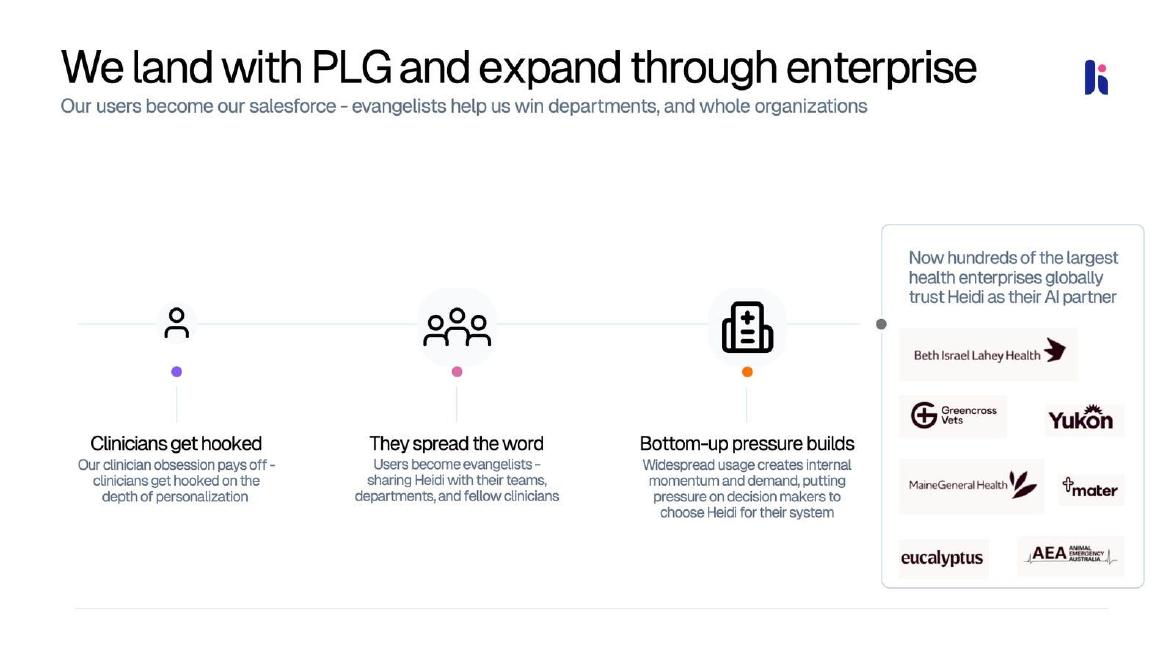
Our analysis: User-to-enterprise motion, with named results.
Evidence and limitation: It explains each step from single clinician to health system and shows named organisations as the result. It doesn't say how many clinicians it takes to trigger a system deal or how long that takes.
What a founder can adapt: "[Users] adopt → spread to [team] → [buyer] signs; [N] organisations so far, typically after [X] users."
Supporting analysis
What the deck claims: "We land with PLG and expand through enterprise." "Our users become our salesforce — evangelists help us win departments, and whole organizations." Three steps: "Clinicians get hooked," "They spread the word," "Bottom-up pressure builds — Widespread usage creates internal momentum and demand, putting pressure on decision makers to choose Heidi for their system." "Now hundreds of the largest health enterprises globally trust Heidi as their AI partner," with logos including Beth Israel Lahey Health and MaineGeneral Health.
Presentation choice: Investors can see how free adoption turns into large contracts.
When it does not fit: Claiming a bottom-up motion without showing organisations that bought.
Jeeva AI deck, slide 8. Exact stored slide matched to this analysis.
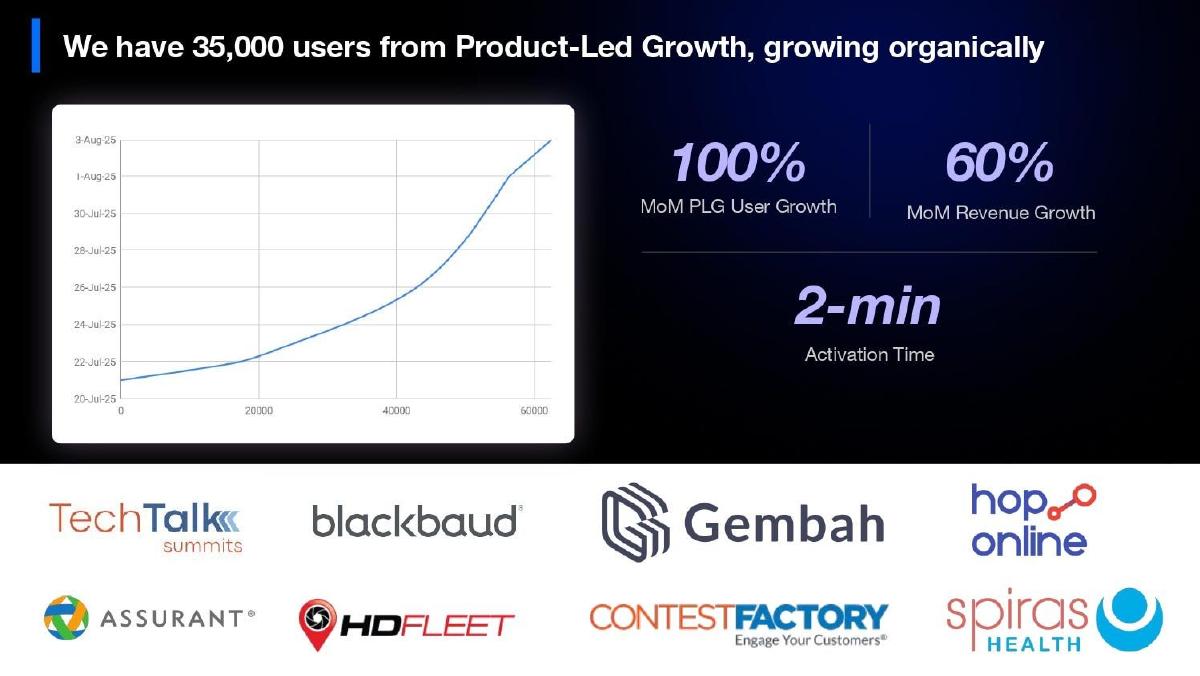
Our analysis: Product-led, with numbers.
Evidence and limitation: It puts numbers on the self-serve motion, including how fast a new user gets started. The chart's axes appear swapped (dates up the side, user counts along the bottom), and the slide doesn't say how many of the 35,000 users pay.
What a founder can adapt: "[N] users, [X]% paying; [Y]-minute activation; [Z]% monthly growth since [date]."
Supporting analysis
What the deck claims: "We have 35,000 users from Product-Led Growth, growing organically." "100% MoM PLG User Growth." "60% MoM Revenue Growth." "2-min Activation Time." A user growth chart and eight customer logos.
Presentation choice: Activation time and user growth are the figures a product-led claim needs.
When it does not fit: User counts without saying how many pay.
Industrial generative AI software (deck prepared for a SPAC merger).
Zapata AI deck, slide 22. Exact stored slide matched to this analysis.
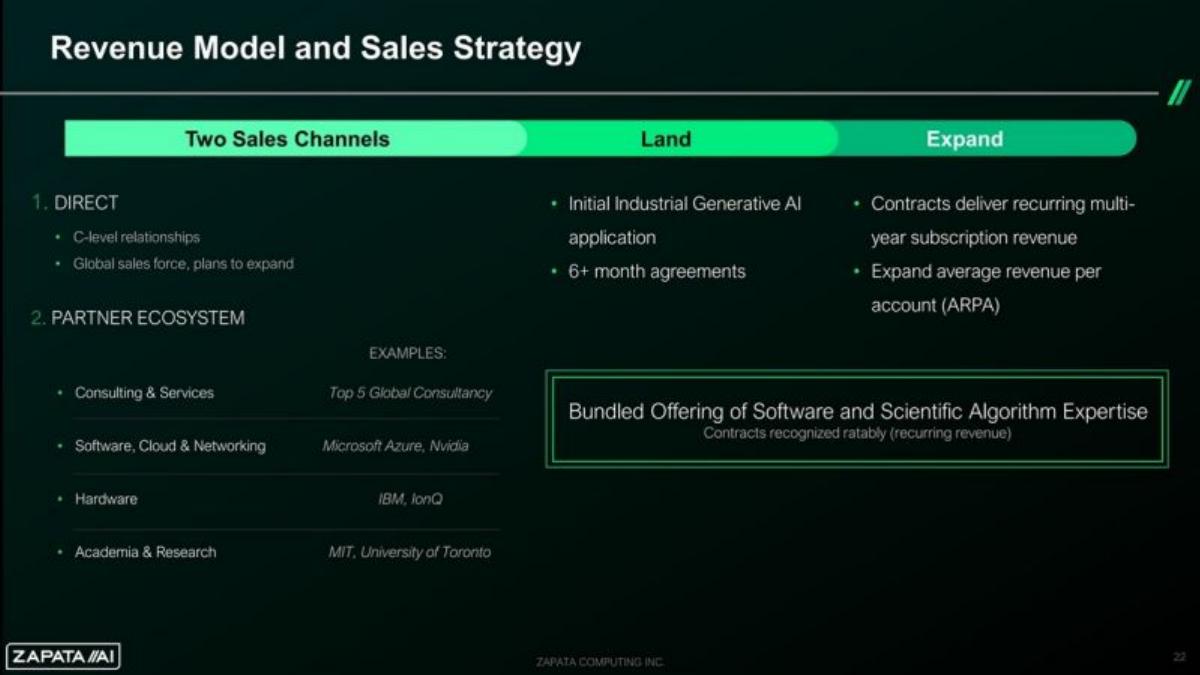
Our analysis: Direct plus partners, land and expand defined.
Evidence and limitation: It separates direct and partner channels, names partners and defines what a first deal and an expanded deal look like. It doesn't say what each partner type does (refer, resell, host) or how much revenue comes through partners.
What a founder can adapt: "Direct: [buyer]. Partners: [name] ([refers/resells]). Land: [first deal, length]; expand: [how]."
Supporting analysis
What the deck claims: "Revenue Model and Sales Strategy." "Two Sales Channels": "1. Direct — C-level relationships; Global sales force, plans to expand" and "2. Partner ecosystem," with examples: Consulting & Services ("Top 5 Global Consultancy"), Software, Cloud & Networking ("Microsoft Azure, Nvidia"), Hardware ("IBM, IonQ"), Academia & Research ("MIT, University of Toronto"). "Land — Initial Industrial Generative AI application; 6+ month agreements." "Expand — Contracts deliver recurring multi-year subscription revenue; Expand average revenue per account (ARPA)."
Presentation choice: Shows both how deals start and how they grow.
When it does not fit: Partner logos without saying what the partner does.
Blitzy deck, slide 7. Exact stored slide matched to this analysis.
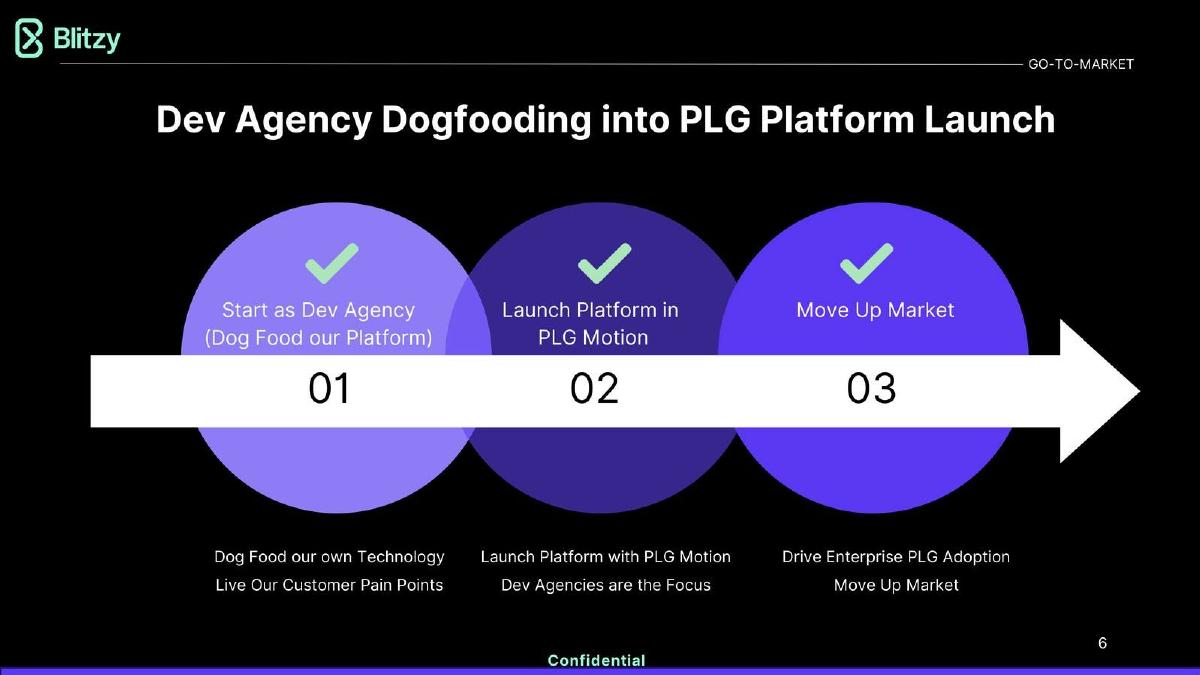
Our analysis: Staged plan, no evidence yet.
Evidence and limitation: It gives a clear order: use the product as a service business first, then sell it to agencies, then to enterprises. It has no dates, no numbers and no channel for reaching agencies.
What a founder can adapt: "Stage 1 ([dates]): [result]. Stage 2 from [date]: reach [segment] via [channel]."
Supporting analysis
What the deck claims: "Dev Agency Dogfooding into PLG Platform Launch." "01 Start as Dev Agency (Dog Food our Platform) — Dog Food our own Technology, Live Our Customer Pain Points." "02 Launch Platform in PLG Motion — Launch Platform with PLG Motion, Dev Agencies are the Focus." "03 Move Up Market — Drive Enterprise PLG Adoption, Move Up Market."
Presentation choice: The sequence is logical, but investors can't tell how far along it is.
When it does not fit: Stages with no dates or progress markers.
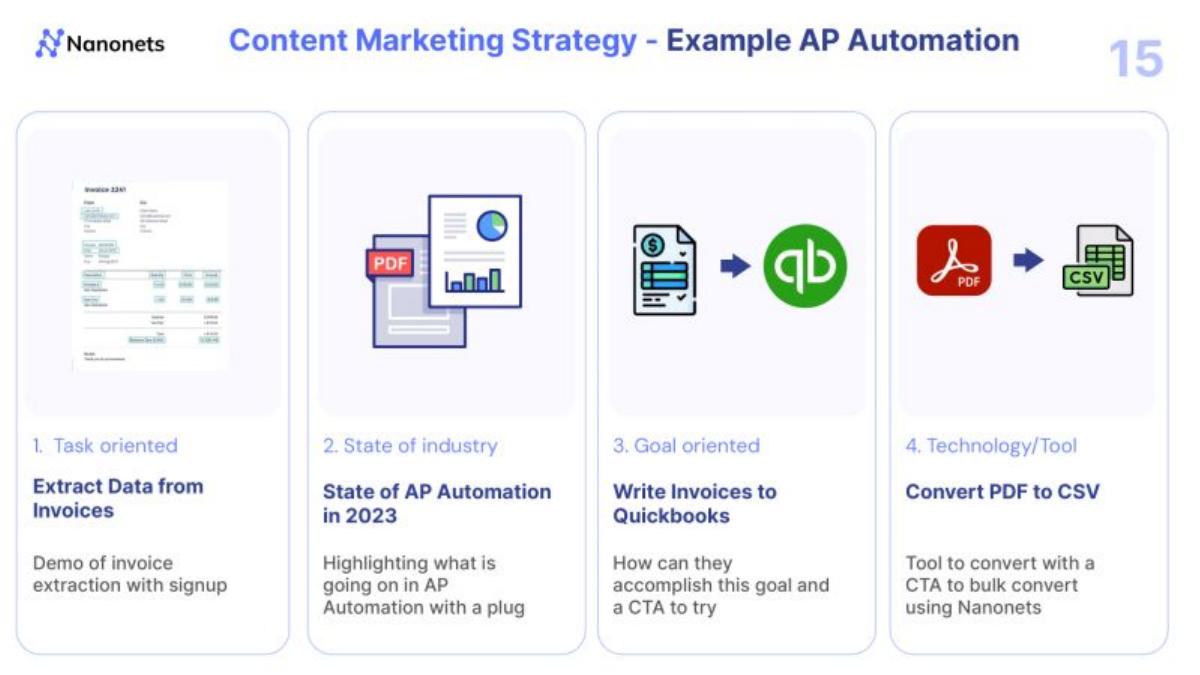
Nanonets deck, slide 15. Exact stored slide matched to this analysis.
Our analysis: One channel explained in detail.
Evidence and limitation: It shows exactly how content leads to sign-ups, with one real use case and a call to action on each piece. This slide doesn't show traffic or sign-ups from the content; the deck's previous slide shows traffic growth.
What a founder can adapt: "[Content type] → [example page] → [sign-up step]; brings [N] sign-ups a month."
Supporting analysis
What the deck claims: "Content Marketing Strategy — Example AP Automation." Four content types: "1. Task oriented — Extract Data from Invoices — Demo of invoice extraction with signup." "2. State of industry — State of AP Automation in 2023 — Highlighting what is going on in AP Automation with a plug." "3. Goal oriented — Write Invoices to Quickbooks — How can they accomplish this goal and a CTA to try." "4. Technology/Tool — Convert PDF to CSV — Tool to convert with a CTA to bulk convert using Nanonets."
Presentation choice: Investors can see the mechanism, not just the word "content".
When it does not fit: Listing "SEO" or "content" with no example.
Code-quality analysis for engineering teams (early deck).
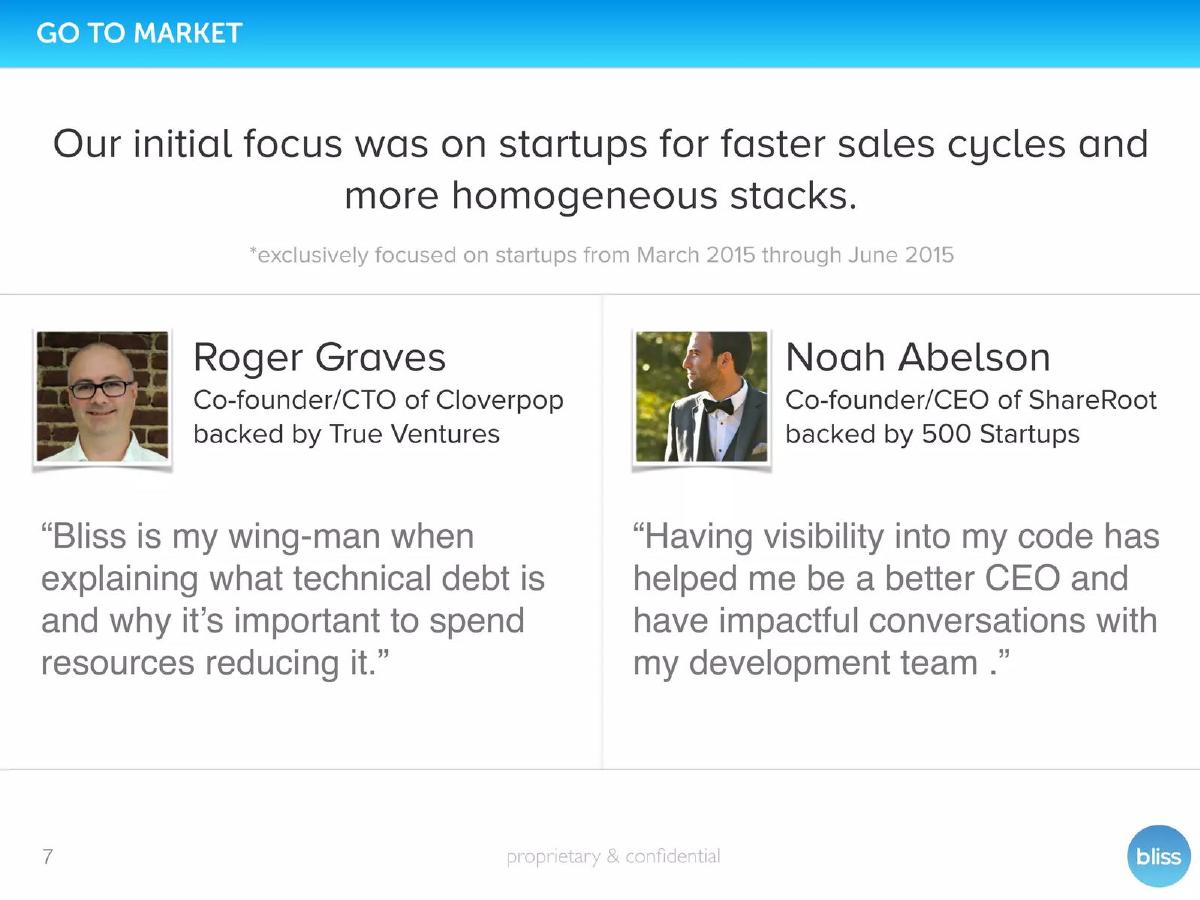
Bliss deck, slide 7. Exact stored slide matched to this analysis.
Our analysis: First segment with a reason.
Evidence and limitation: It explains why it chose its first segment and dates the period. The quotes show customers value it, but the slide doesn't give a channel, a conversion figure or the next segment.
What a founder can adapt: "We start with [segment] because [reason]; since [date]: [N] customers via [channel]."
Supporting analysis
What the deck claims: "Our initial focus was on startups for faster sales cycles and more homogeneous stacks." "*exclusively focused on startups from March 2015 through June 2015." Quotes from Roger Graves (Co-founder/CTO of Cloverpop) and Noah Abelson (Co-founder/CEO of ShareRoot).
Presentation choice: The reason (fast sales cycles, similar tech stacks) is the part investors need.
When it does not fit: Testimonials standing in for a channel.
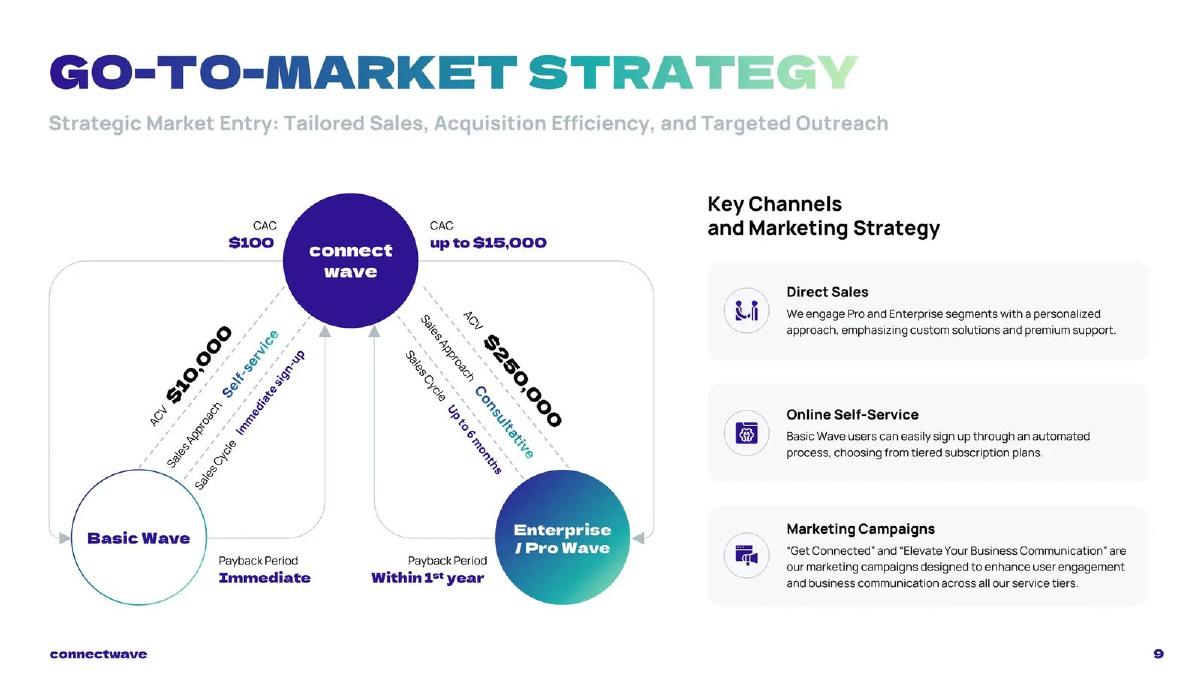
Connectwave deck, slide 9. Exact stored slide matched to this analysis.
Our analysis: Tiered motion, unexplained numbers.
Evidence and limitation: Weaker example. It matches a sales approach to each tier and gives cost and contract figures. It doesn't say whether the figures are measured or planned, and a $10,000 contract bought through a $100 self-serve sign-up would need explaining.
What a founder can adapt: "Self-serve: CAC $[X] (measured, [period]); sales-led: CAC $[Y] ([N] deals)."
Supporting analysis
What the deck claims: "Go-to-Market Strategy." "Basic Wave": "CAC $100," "ACV $10,000," "Sales Approach Self-service," "Sales Cycle Immediate sign-up," "Payback Period Immediate." "Enterprise / Pro Wave": "CAC up to $15,000," "ACV $250,000," "Sales Approach Consultative," "Sales Cycle Up to 6 months," "Payback Period Within 1st year." Channels: Direct Sales, Online Self-Service, Marketing Campaigns.
Presentation choice: The structure is right, but unexplained figures invite doubt.
When it does not fit: Acquisition cost and contract sizes with no source or period.
Which kind of AI go-to-market slide answers which question.
Approach
Example
Answers
Leaves open
User to enterprise
Heidi Health
How free use becomes contracts
Time and users per deal
Product-led with numbers
Jeeva AI
Users and activation
How many pay
Direct plus partners
Zapata AI
Channels, land and expand
Partner roles and share
Staged plan
Blitzy
Order of segments
Progress and dates
One channel in detail
Nanonets
How content drives sign-ups
Results on this slide
First segment with reason
Bliss
Why this segment
Channel and next step
Tiered motion
Connectwave
Sales approach per tier
Source of figures
Targets only
Glystn
Audiences
Channel and conversion
Key Takeaways
Name the first customer and the channel that reaches them.
Show the step from free user to paying organisation.
Back a product-led claim with users, activation or conversion numbers.
Say where acquisition cost and payback figures come from.
A list of targets isn't a plan.
Write your AI go-to-market slide
Answer these before you design the slide.
First customer. Who adopts first, and why do they buy quickly?
Channel. How do you reach them: self-serve, content, sales, partners?
Expansion. How does one user or pilot become a larger contract?
Evidence. Which number shows it works: users, activation, conversion, CAC, payback? Measured or planned?
Copyable framework: [First customer] finds us through [channel] and starts in [time]. [X]% become paying; accounts expand when [trigger]. So far: [evidence] ([measured/planned], [period]).
Illustrative example 1 — written by us
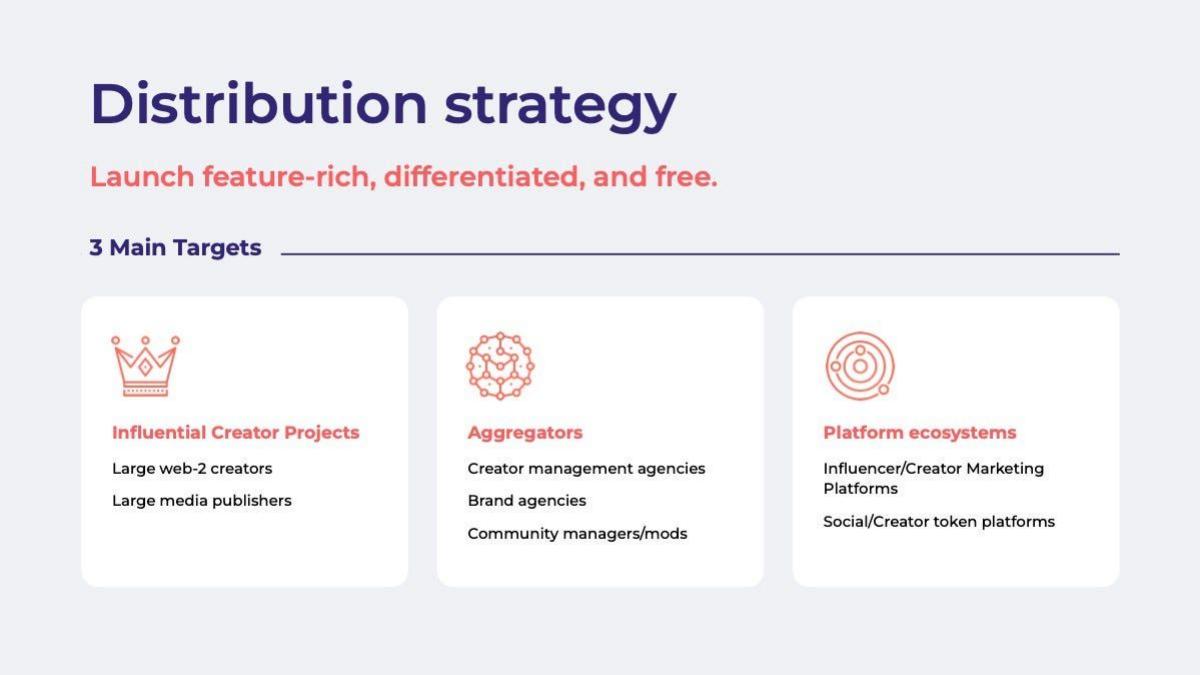
Before: "Distribution strategy. Launch feature-rich, differentiated, and free. 3 Main Targets."
After: "Reach [creator agencies] via [channel]; [N] onboarded since [date]; [X]% move from free to paid."
What improved: Our illustrative rewrite of Glystn's slide; bracketed text is a placeholder, not company fact.
What's different about AI go-to-market
AI tools are often quick to try, so individual users can adopt them before a company buys. That makes bottom-up, product-led growth common, followed by a sales team for larger accounts. AI running costs also make free tiers expensive, so investors look at how quickly free users become paying ones. Some AI companies instead sell through partners who already hold the customer relationship.
What investors check
Who the first customer is and why they buy quickly. Which channel reaches them, and at what cost. How a single user or pilot grows into a larger contract. Whether any number (users, activation, conversion, acquisition cost, payback) supports the motion, and where it comes from.
How we read each slide
We quote the text on the slide images. We have not checked any user count, growth rate, cost or customer. None of these pages was in our stored image set, so we rendered each from the original deck file in our library.
Common mistakes
Targets without channels. Say how each audience is reached.
Users without payers. Say how many free users pay.
Unsourced CAC. Say whether cost figures are measured or planned.
Partner logos only. Say what each partner does.
Undated stages. Show where you are in the plan.
Diagnostic checklist
First customer and reason named.
Channel stated.
Path from user to contract explained.
At least one sourced number.
Frequently asked questions
How should an AI startup show product-led growth on a pitch deck?
Show the steps from user to paying organisation and back them with numbers. Heidi shows clinicians spreading its scribe until health systems buy; Jeeva AI gives 35,000 users and a 2-minute activation time.
Should an AI startup include partners on its go-to-market slide?
Yes, if you say what they do. Zapata AI names Microsoft Azure, Nvidia and a top global consultancy as partners; saying whether each refers or resells would make it stronger.
How we chose these examples
Corpus: published pitch deck teardowns on StartupFundraising.com. Founder-uploaded private decks are excluded.
Selection (2026-09-26): we searched AI teardowns for go-to-market, distribution and customer acquisition headings, rendered ten candidate decks with neighbouring pages, and kept eight.
Excluded: Cent Capital (already used in the fintech traction guide) and Zapata AI's category slide (brand activities, not sales). Blitzy's go-to-market is on deck page 7, not the page 6 named in its teardown.
None of the chosen pages was in our stored image set; we rendered them from the original deck PDFs and stored them with the existing slide-image workflow. All eight decks were confirmed as published teardowns on 2026-09-26.
User counts, growth rates, costs and partners are quoted from the slides and not independently verified.
Review: slide images were checked on 2026-09-26 and matched to company, deck and page (editorial model review). No person has yet completed an editorial review of this page. We make no claim that any slide caused a fundraising outcome.