Customer Acquisition Slides: 6 Real Pitch Deck Examples
How early-stage startups show where their first customers will come from: channel partners with a cost per customer, marketing funnels, channel maps.
Customer Acquisition Slides: Real Pitch Deck Examples
Six slides that answer one investor question: where will your customers come from, and what will each one cost? The strongest name specific channels and put a number on at least one of them. The weakest list marketing activities with no order, target or cost.
TL;DR
A customer acquisition slide should name the few channels you will use, show how a stranger becomes a customer, and give at least one cost or target. Tencube's slide is the most complete here: it names operators, phone makers, distributors and direct marketing as separate channels, says what each partner gets ("Revenue share", "Try-&-Buy"), and puts a figure on direct marketing: "~ $0.50 acquisition cost". Kleoverse names its audience ("Web3 talent – mostly developers") before listing content, SEO, viral and referral channels, with a launch date for the referral program. Tunibibi draws a left-to-right path from social media to fairs, SMS and affiliate posts, next to a first-year revenue target. Market Convoy splits paid and organic channels and says it will test and cut. Simpolium names three customer groups and the software they already use, but not how it will reach them. Be Visible is the weaker example: a list of six ideas with no order, numbers or owner.
Customer acquisition slides
Each example shows the exact stored slide above its analysis and links to the full teardown. Stronger examples first. Claims are as shown on the slides; we have not verified them.
Tencube go to market slide — slide 5
Mobile phone security software (WaveSecure). Four channel columns with partner logos, feeding a consumer price and a revenue-per-user figure.
Tencube deck, slide 5. Exact stored slide matched to this analysis.
Our analysis: Shows the startup reaching customers through companies that already own them, and admits that channels take two-thirds of the price.
Evidence and limitation: Named channel types with partner logos, what each partner gains, a direct acquisition cost and net revenue per user after channel costs.
What a founder can adapt: For each channel partner, write one line on what they gain and one on what they take.
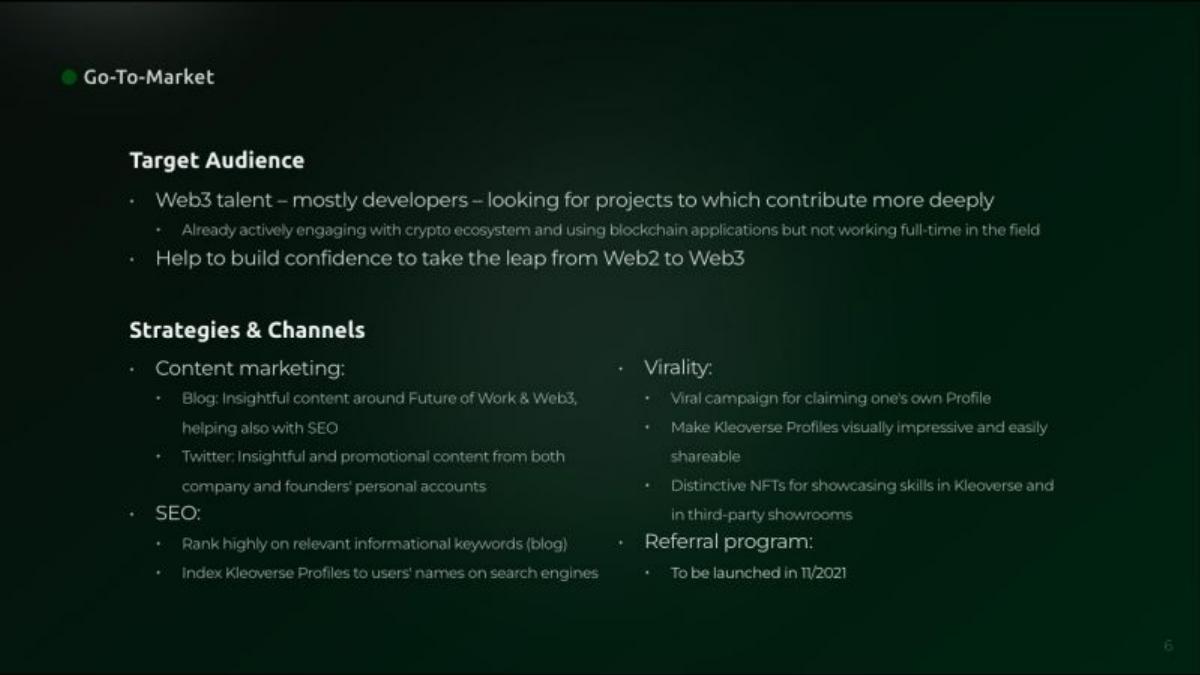
Profiles for Web3 talent. Audience first, then four channels with specific tactics.
Kleoverse deck, slide 6. Exact stored slide matched to this analysis.
Our analysis: The channels fit the audience: developers who search, share and care about showing their skills.
Evidence and limitation: A defined audience, four channels each with a concrete tactic, and a date.
What a founder can adapt: Start with one sentence on who you are reaching, then give each channel one specific tactic.
Supporting analysis
What the deck claims: "Go-To-Market." "Target Audience: Web3 talent – mostly developers – looking for projects to which contribute more deeply"; "Help to build confidence to take the leap from Web2 to Web3." "Strategies & Channels": "Content marketing" (blog, Twitter), "SEO" ("Index Kleoverse Profiles to users' names on search engines"), "Virality" ("Viral campaign for claiming one's own Profile", "Distinctive NFTs for showcasing skills"), "Referral program: To be launched in 11/2021."
Presentation choice: Linking each channel to a real tactic (profiles indexed by name) shows the team has thought about how it works.
When it does not fit: Add a target for at least one channel, such as profiles claimed per month.
Marketing platform. A branching diagram splitting paid and organic channels.
Market Convoy deck, slide 5. Exact stored slide matched to this analysis.
Our analysis: Shows the team knows it will need to find which channels work and watch cost per user.
Evidence and limitation: Paid and organic channels separated, with a stated plan to test and optimise cost per user.
What a founder can adapt: Mark which channels your raise pays for and which grow without spend.
Supporting analysis
What the deck claims: "Go to Market." Paid: "Optimization of ads on social media channels", "Trail and error method to test different marketing channels", "Additional marketing channels to optimize cost/user." Organic: "Blogging and content marketing", "Organic SEO", "Email and Social media marketing."
Presentation choice: Splitting paid from organic tells investors which channels need money from the round.
When it does not fit: "Trial and error" needs a budget and a cost-per-customer target to be a plan.
3D visualisation software for architecture. Three customer groups and the host software they use, beside a rendering.
Simpolium deck, slide 5. Exact stored slide matched to this analysis.
Our analysis: Suggests reach through existing software platforms, but doesn't say how users will find the product.
Evidence and limitation: Named customer groups and the user base of the software it plugs into.
What a founder can adapt: If you ride on another platform, name how you get listed or found there.
Supporting analysis
What the deck claims: "Distribution." "Our global target audience consists of three main categories": large architectural companies with a separate visualisation department, architectural visualisation companies, and freelancers. "Currently we support Autodesk 3ds Max. In the future, we plan to support SketchUp which covers additional 30M users." Figures: "1.2M" (3ds Max), "30M" (SketchUp).
Presentation choice: Plugging into software customers already use is a real channel; naming the user count sizes it.
When it does not fit: The slide is headed Distribution but describes who, not how; add the actual route to customers.
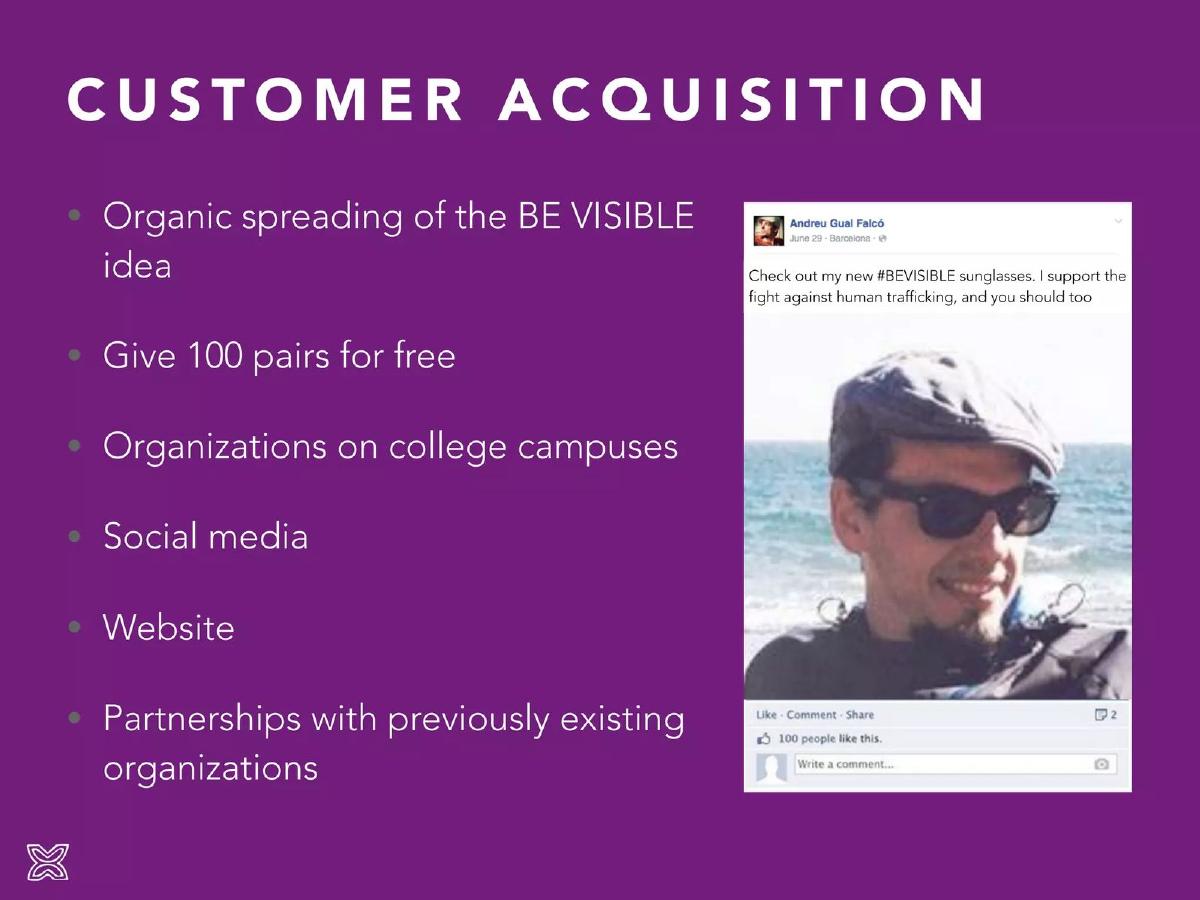
A cause-led sunglasses brand. Six bullets beside a customer's social media post.
Be Visible deck, slide 6. Exact stored slide matched to this analysis.
Our analysis: Included for contrast: the ideas are reasonable, but there is no order, target or cost.
Evidence and limitation: Six ideas and one real customer post.
What a founder can adapt: Pick the best two (campus groups and the 100 free pairs), and say what each should produce.
Supporting analysis
What the deck claims: "Customer Acquisition." "Organic spreading of the BE VISIBLE idea", "Give 100 pairs for free", "Organizations on college campuses", "Social media", "Website", "Partnerships with previously existing organizations." Image: a Facebook post, "Check out my new #BEVISIBLE sunglasses. I support the fight against human trafficking."
Presentation choice: A list of channels doesn't tell investors which one will work or what it costs.
When it does not fit: "Social media" and "Website" are places, not plans; say what happens there.
Whether an investor can see where customers come from and what they cost.
Example
Business
Format
Audience named
Cost or target
Tencube
Mobile security
Channel partner columns
Yes (phone users via partners)
Yes ($0.50 acquisition cost, $6/yr net ARPU)
Kleoverse
Web3 talent profiles
Audience + channels
Yes (developers)
Launch date only
Tunibibi
Online retail
Path arrow
No
Revenue target ($400,000 year one)
Market Convoy
Marketing platform
Paid vs organic diagram
No
No (mentions cost/user)
Simpolium
3D visualisation
Customer groups + platforms
Yes (three groups)
Platform user counts only
Be Visible
Sunglasses
Bullet list
Partly (campuses)
No
Key Takeaways
Name your first audience before your channels.
Pick two or three channels, not six.
Put a cost or target on at least one channel.
Say what each partner gains from selling you.
Show the order: how a stranger becomes a customer.
Build your customer acquisition slide
Show the two or three channels that will bring your first customers, and what each should deliver.
Audience. Who your first customers are, in one line.
Channels. The two or three channels you will use first, in order of importance.
Tactic. One specific action for each channel.
Numbers. A cost per customer or monthly target for at least one channel.
Copyable framework: First customers: [audience]. 1 [channel]: [tactic] → [target]. 2 [channel]: [tactic] → [target]. Cost per customer: [$X] (actual/target).
Illustrative example 1 — written by us
Before: Organic spreading of the idea. Social media. Website. Organizations on college campuses.
After: First customers: students who support anti-trafficking causes. 1 Campus groups: [N] chapters sell at events → [N] pairs/term. 2 Give 100 free pairs to [who] → [N] posts. Cost per customer: [$X] target.
What improved: Our illustrative rewrite; not Be Visible's wording. It picks two channels, adds a tactic and leaves marked places for real figures.
What this guide adds
The library has a general go-to-market guide and an insurtech go-to-market guide. Those cover the whole launch plan: segments, pricing, sales motion and timing. This page looks at one narrower part that early decks often get wrong: the specific channels that will bring in customers and what each costs.
The six decks cover mobile security (Tencube), a Web3 talent network (Kleoverse), online retail (Tunibibi), a marketing platform (Market Convoy), 3D visualisation software (Simpolium) and a sunglasses brand (Be Visible). None of these decks appears in another guide.
Four ways early decks show acquisition
Channel partners (Tencube): who else will sell the product, and what they get in return. Shows reach the startup could not buy alone.
Audience then channels (Kleoverse, Simpolium): who the customer is, then where to find them. Works when both halves are there.
Funnel or path (Tunibibi): the steps from first contact to purchase, in order.
Paid versus organic (Market Convoy): what the startup will pay for and what it will earn through content.
Common mistakes
Too many channels. Lead with the two or three you will fund first.
Places, not plans. "Social media" needs a tactic and a target.
No numbers. Give a cost per customer or target, even if early.
Logos as proof. Mark which partners are signed and which are targets.
Who, not how. A list of customer groups isn't a route to them.
Diagnostic checklist
First audience named.
Two or three channels, in priority order.
One tactic per channel.
A cost or target on at least one.
Partner status labelled.
Frequently asked questions
How we chose these examples
Corpus: published pitch deck teardowns on StartupFundraising.com. Founder-uploaded private decks are excluded.
Selection (2026-09-25): we searched stored slide text for slides headed Go-to-Market, GTM, Marketing Strategy, Sales Strategy, Customer Acquisition or Distribution, kept only slides with a stored image, and excluded decks already used in another guide. Of 13 candidates, 6 were already used elsewhere. Of the remaining 7, Sqeeqee (a revenue-streams list under a Marketing Strategy heading) was left out. Be Visible is included as a weaker example for contrast.
Company descriptions come from the slides themselves.
Review: stored slide text and images were checked on 2026-09-25 and matched to company, deck and slide number (editorial model review). No person has yet completed an editorial review of this page.
Claims are as shown on the slides; we have not verified them. We make no claim that any slide caused a fundraising outcome.