HousePouch presented a pitch deck in late 2017 seeking $500,000 in seed funding to scale a curated home furnishing marketplace. The platform's core value proposition rested on three pillars: convenience, personalization, and style, facilitated by a 'virtual room' feature and an algorithmic recommendation engine. At the time of the pitch, the company had raised $70,000 from friends and family and reported $4.6K in revenue since May 2017. While the deck successfully identifies a clear consumer pain point—the fragmentation of the online furniture market—it relies heavily on future revenue stream…
Key takeaways
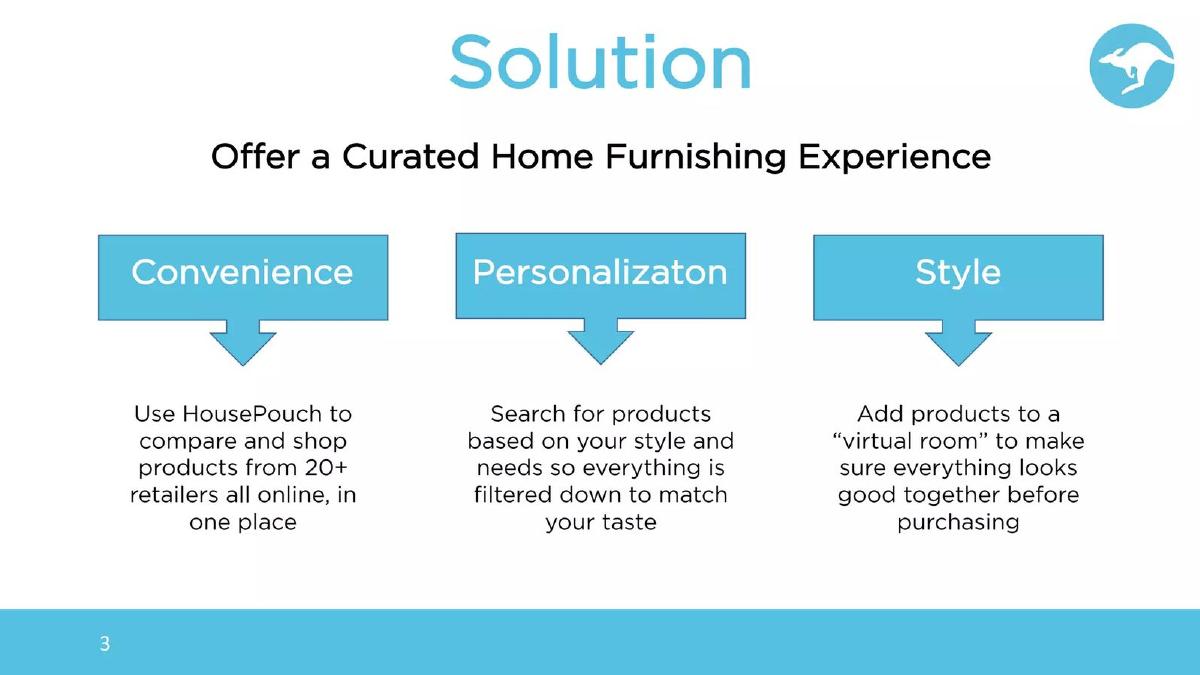
- The company defines its solution through three specific value drivers: Convenience, Personalization, and Style (Slide 3).
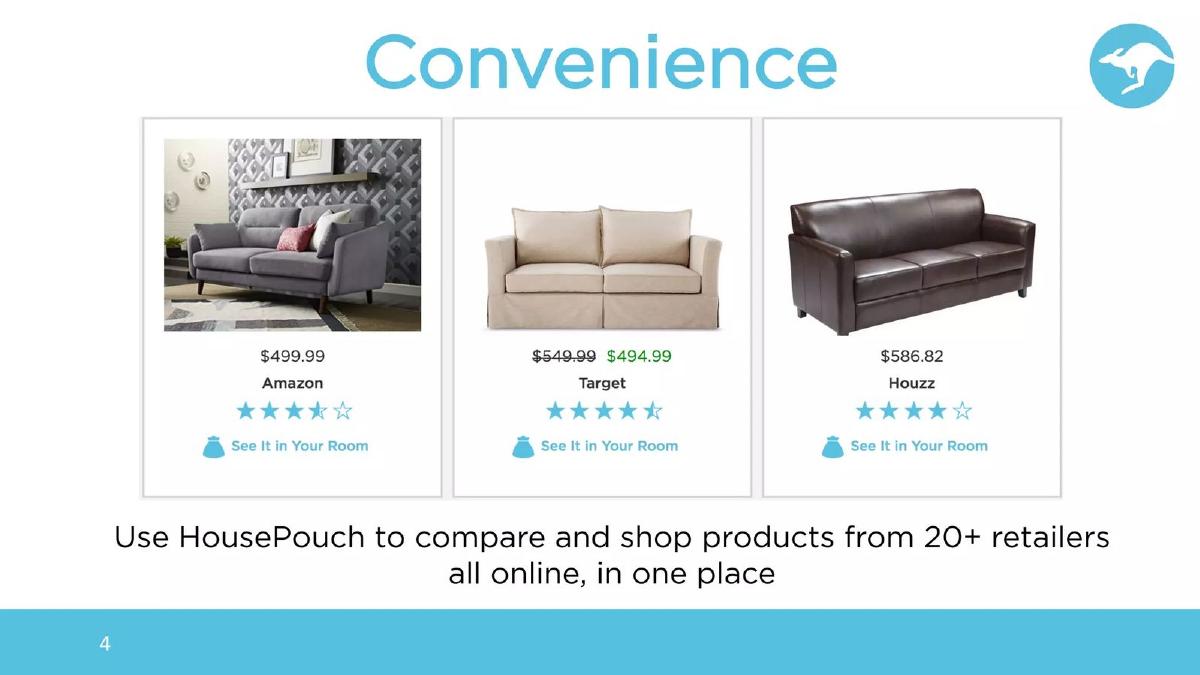
- HousePouch claims to aggregate products from 20+ retailers to allow for comparison in one place (Slide 3).
- The business model relies on a 5-10% sales commission and a 5% processing fee as immediate revenue sources (Slide 9).
- Future monetization strategies include selling anonymized data, branded products, and sponsored advertising (Slide 9).
- Competitive analysis positions HousePouch as the only player offering the combination of guest checkout, algorithmic recommendations, and real-time design (Slide 11).
- Traction metrics since May 2017 include $4.6K in revenue, 1K newsletter signups, and 3K social followers (Slide 13).
- The company lists 24 retail partners, including major brands like Amazon, Target, and Macy's (Slide 13).
- The $500K funding ask is specifically allocated: $260K for employees, $190K for marketing, and $50K for product (Slide 15).
HousePouch Pitch Deck Analysis
The HousePouch pitch deck, dated October 2017, represents a classic seed-stage marketplace proposal. The company positions itself as a curator in the massive but fragmented home goods sector. The deck is structured to move from the high-level value proposition to the technical execution, ending with a specific financial ask. This teardown examines the eight provided slides to understand the company's strategy and market positioning during their 2017 fundraising efforts.
Slide 1: Title Slide
The opening slide introduces the company name, HousePouch , accompanied by a blue kangaroo logo. The tagline, "Furnish Your Home in One Shopping Trip," immediately establishes the core value proposition: efficiency. It promises a consolidated experience in a market where consumers typically browse dozens of disparate websites to furnish a single room.
Slide 3: The Solution
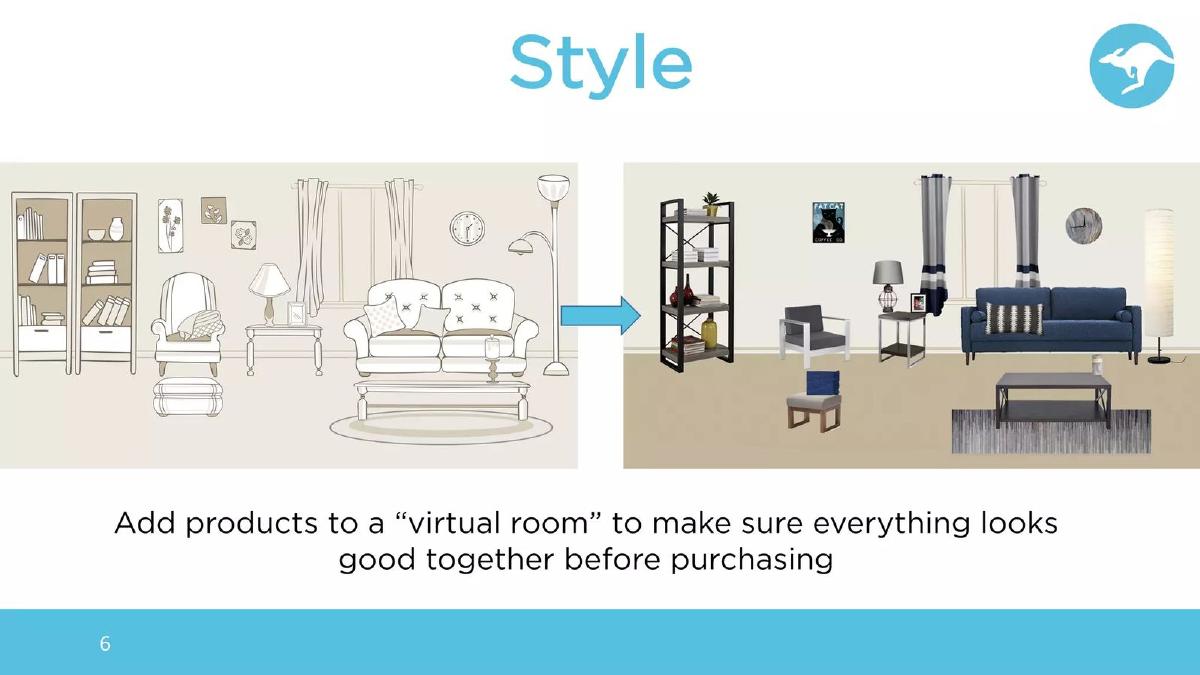
Slide 3 breaks the solution down into three categories: Convenience , Personalization , and Style . Under Convenience, the deck claims users can "compare and shop products from 20+ retailers all online, in one place." Personalization is defined as the ability to filter products to match specific tastes. The Style component introduces the "virtual room," a feature allowing users to visualize products together before committing to a purchase. This slide is effective because it moves beyond the "what" and explains the "how" of the user experience.
Slide 5: Personalization Deep Dive
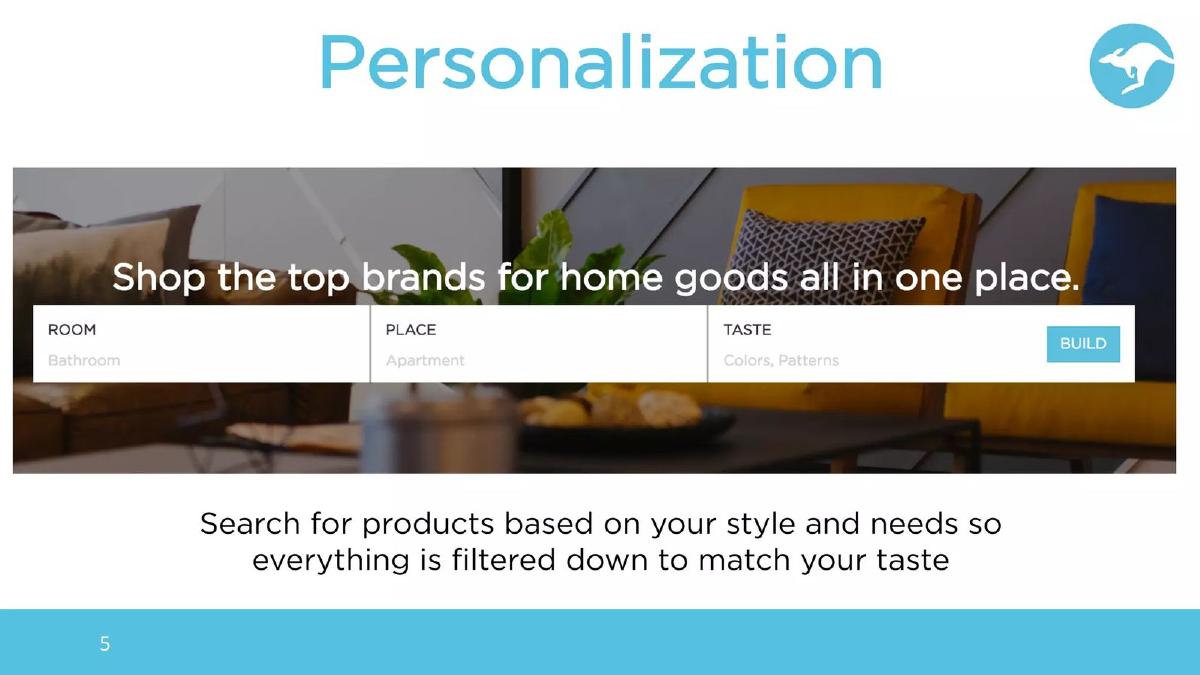
This slide provides a visual representation of the user interface. It shows a search bar with three primary filters: Room (e.g., Bathroom), Place (e.g., Apartment), and Taste (e.g., Colors, Patterns). The text reiterates that products are "filtered down to match your taste." By showing a mockup of the "Build" interface, the founders attempt to demonstrate that the platform is intuitive and reduces the cognitive load of home shopping.
Slide 7: Underlying Magic
Slide 7 addresses the technical and operational backbone of the company. It lists three pillars: "Hand Picked Products by Interior Designers," "API Connections to Refresh Products," and a "Custom Algorithm for Recommendations." This is a critical slide because it suggests a hybrid approach—combining human curation with automated data fetching and machine learning. This combination is intended to create a moat against purely manual curation sites or purely automated scrapers.
Slide 9: Business Model
The revenue strategy is split into "Today" and "Future." Currently, HousePouch earns through a "Commission for Sales 5 - 10%" and a "Processing Fee 5%." This indicates a total take rate of 10-15% per transaction. The "Future" section lists Anonymized Data , Branded Products , and Sponsored Advertising . While these are standard marketplace evolutions, the deck does not provide projections for when these future streams will activate, leaving the heavy lifting to the commission model in the short term.
Slide 11: Competitive Analysis
The competitive matrix compares HousePouch against Modsy , Laurel & Wolf , Hutch , Houzz , IKEA , and Wayfair . HousePouch claims to be the only service offering the full suite of: Personalized Experience , Guest Checkout , Algorithmic Recommendations , Quick Turnaround , and Real Time Design . Notably, it marks IKEA and Wayfair as lacking personalized experiences and algorithmic recommendations, which was a bold claim in 2017 given the engineering resources of those incumbents.
Slide 13: Traction
This slide provides the most concrete data in the deck, covering the period "Since May 2017." The figures are modest but specific: "$4.6K Revenue," "1K Newsletter Signups," and "3K Social Followers." It also highlights "24 Retail Partners," displaying logos for Amazon , The Container Store , Target , and Macy's . While the revenue figure is low, the presence of major retail partners suggests the API integrations mentioned on Slide 7 were functional.
Slide 15: Funding
The final slide details the financial ask. It notes that "$70K" was "Raised" from "Friends & Family" in "January 2017," with a "Runway: April 2018." The company is "Seeking $500K," with a clear allocation plan: "$260K Employees," "$190K Marketing," and "$50K Product." This transparency regarding previous raises and current burn is a strength, though it highlights that the company is seeking a significant step-up in capital relative to its current revenue.
What HousePouch Does Well
The deck excels at clarity of purpose. Within the first three slides, an investor knows exactly what the product does and why it needs to exist. The use of a "virtual room" as a stylistic differentiator addresses a real psychological barrier in e-commerce (the fear that items won't match). Furthermore, the breakdown of the $500K ask is specific; many founders fail to explain exactly how they will spend the capital, but HousePouch identifies hiring and marketing as their primary levers for growth.
What is Missing from the Deck
The most glaring omission in the provided slides is a Team Slide . In a seed-stage round, investors are primarily betting on the founders' ability to execute. Without bios or previous experience listed, there is no way to verify if the team has the design or technical expertise to build the "custom algorithm" they promise. Additionally, the deck lacks Unit Economics . While they mention a 5-10% commission, they do not disclose the Customer Acquisition Cost (CAC) or the Lifetime Value (LTV) of a user. Given that they plan to spend $190K of the new funding on marketing, understanding the efficiency of their current marketing spend is vital. Finally, there is no Market Size (TAM/SAM/SOM) slide, which is standard for justifying a venture-scale investment.
Founder Takeaways
Founders should look at Slide 15 as a model for how to present a funding ask. It is honest about the current runway and provides a logical distribution of funds. However, the competitive analysis on Slide 11 serves as a warning: when claiming that multi-billion dollar incumbents like Wayfair lack "algorithmic recommendations," you must be prepared to back that up with deep technical proof, as it is a claim that invites skepticism. Lastly, always ensure the traction slide (Slide 13) correlates with the ask; $4.6K in revenue is a start, but a $500K ask usually requires a more robust growth trend or a very strong explanation of the product-market fit found during that initial revenue phase.
Frequently asked questions
- What is the primary problem HousePouch is trying to solve?
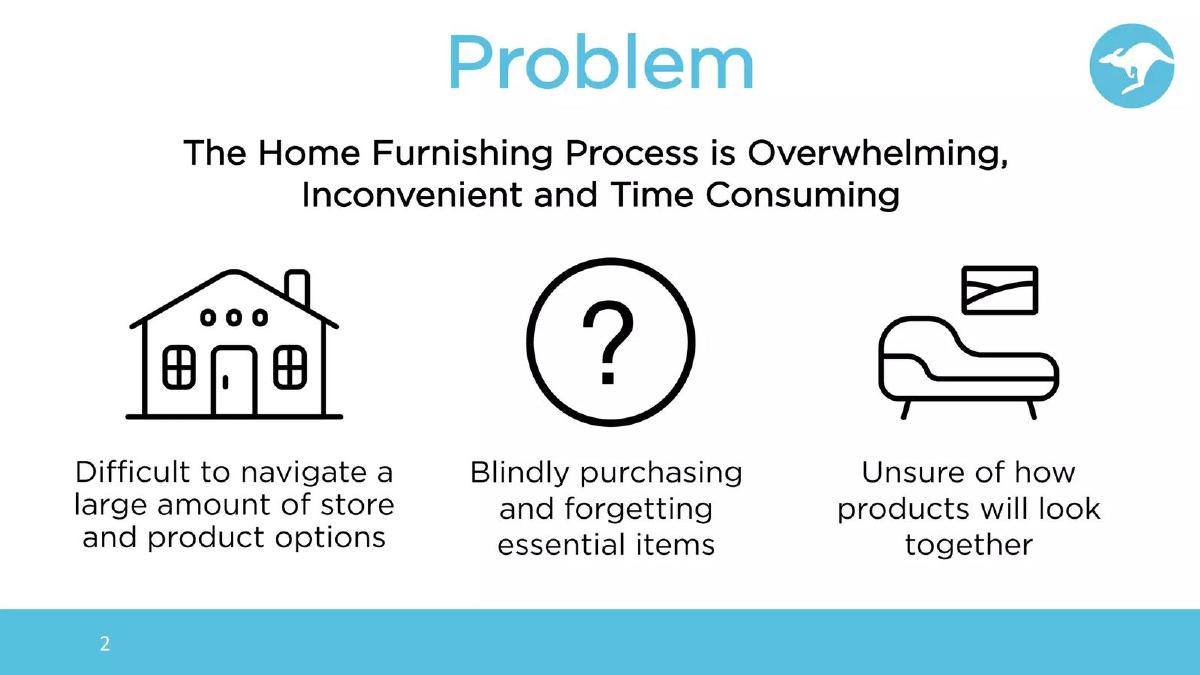
- HousePouch addresses the fragmented and overwhelming nature of online home furnishing. By aggregating products from over 20 retailers, they aim to eliminate the need for consumers to visit multiple sites. Their 'virtual room' feature (Slide 3) specifically targets the uncertainty of whether different furniture pieces will look good together before a purchase is made.
- How does HousePouch generate revenue?
- According to Slide 9, the current revenue model is two-fold: a commission on sales ranging from 5% to 10% and a 5% processing fee. They also outline future plans to diversify income through the sale of anonymized consumer data, launching their own branded products, and offering sponsored advertising slots to furniture brands.
- What specific technology drives the platform?
- Slide 7, titled 'Underlying Magic,' identifies three technical components: hand-picked product curation by interior designers, API connections to maintain a refreshed product catalog from partners, and a custom algorithm designed to provide personalized recommendations to users based on their style and needs.
- What is the company's current financial standing and ask?
- As of the deck's publication, HousePouch had raised $70,000 in January 2017. They reported $4.6K in revenue over a five-month period. They were seeking $500,000 in new capital to provide runway beyond April 2018, with the majority of funds ($260,000) earmarked for hiring (Slide 15).
- Who are HousePouch's main competitors according to the deck?
- Slide 11 lists several competitors: Modsy, Laurel & Wolf, Hutch, Houzz, IKEA, and Wayfair. HousePouch differentiates itself by claiming to offer 'Real Time Design' and 'Algorithmic Recommendations,' features they suggest are missing from established giants like IKEA and Wayfair.