Bandwaggon’s 2013 investor overview positions the company at the intersection of crowdfunding and social commerce, specifically targeting the 'micro-celebrity' market. By citing Amanda Palmer’s $1.1M+ Kickstarter success as a proof of concept, the deck argues that artists can thrive with smaller fan bases if they retain more than the traditional 5% revenue share. The core innovation is a 'Bandwaggon Economy' where fans earn royalties for sharing content, which they can then reinvest in new artists. While the deck outlines a clear 10% transaction fee revenue model and boasts a high-profile adv…
Key takeaways
- The company uses a 'Kickstarter meets AngelList' analogy to define its hybrid crowdfunding and investment model (Slide 2).
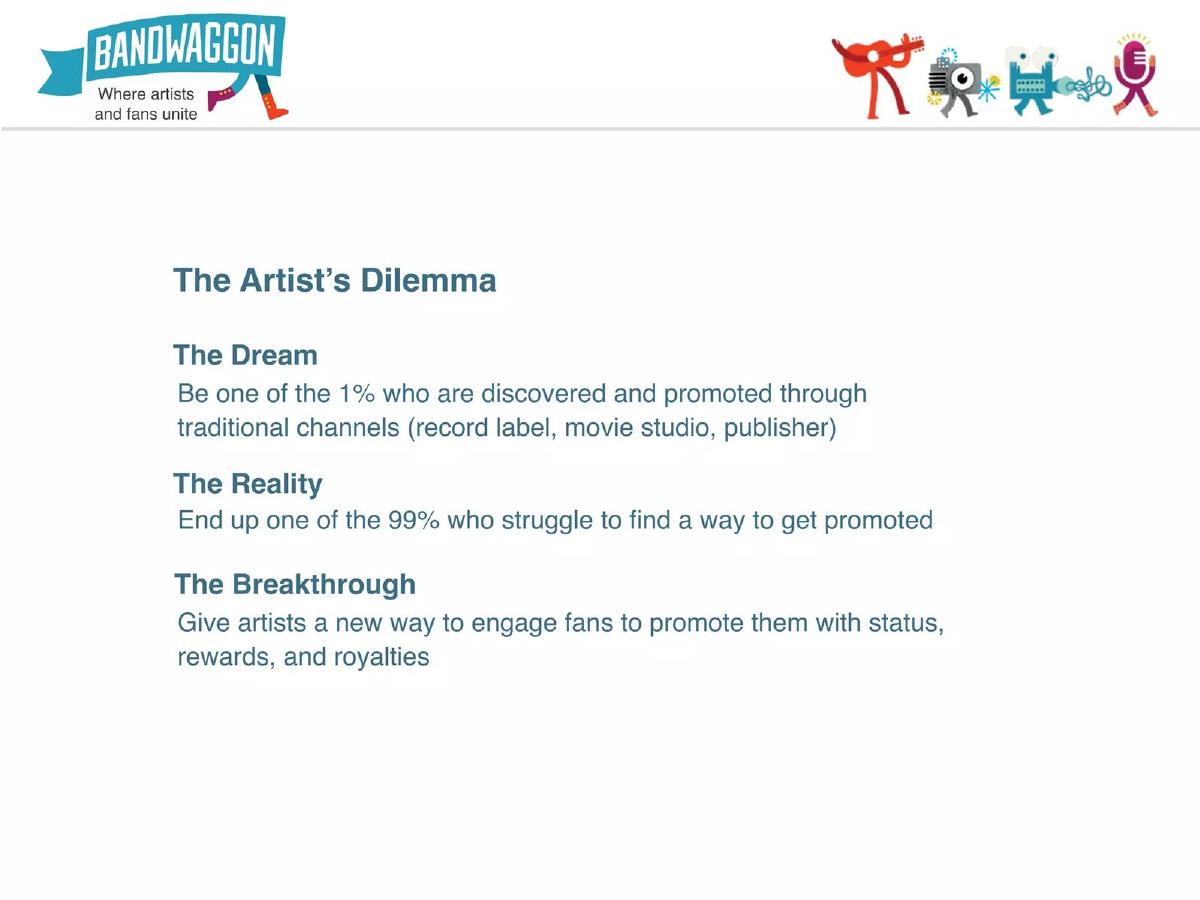
- Traditional industry systems are criticized for leaving artists with less than 5% of revenue, necessitating millions of fans for viability (Slide 3).
- The 'Bandwaggon Economy' is a circular model where fans purchase, share, grow influence, and earn royalties to reinvest (Slide 4).
- Market sizing targets a $6 Billion crowdfunding market and a $30 Billion social commerce market by 2015 (Slide 5).
- Revenue is primarily driven by a 10% transaction fee, supplemented by sponsorships and interest on funds held (Slide 6).
- The growth model assumes an average purchase of $4 per month and a viral outreach of 100 friends per user every 30 days (Slide 6).
- Intellectual property is centered on a pending patent for tracking content sharing and formulating an influence 'score' (Slide 7).
- The 'Supporting Team' slide lists heavyweights from Sony, MTV, Conde Nast, and Wharton, but notably excludes the full-time founding team's operational history (Slide 8).
Executive Summary: The Democratization of Artist Funding
Bandwaggon’s investor deck, dated August 2013, attempts to solve the 'starving artist' problem by re-engineering the economics of the music and content industry. By moving away from the label-heavy model where artists retain only 5% of revenue, Bandwaggon proposes a platform where fans are not just consumers, but stakeholders who earn royalties for their promotional efforts. The deck relies heavily on the 'micro-celebrity' trend, suggesting that the future of media lies in niche, highly engaged communities rather than mass-market blockbusters.
Slide 1: Title and Branding
The cover slide introduces the Bandwaggon logo with the tagline 'Where artists and fans unite.' The visual style is whimsical and illustrative, featuring various characters representing different creative disciplines: a guitarist, a writer, a filmmaker, and a podcaster/singer. The date 8.1.13 is clearly displayed, marking this as a document from the early-to-mid 2010s crowdfunding boom.
Slide 2: The Elevator Pitch
Bandwaggon uses a 'X meets Y' comparison, a common pitch deck trope. They define themselves as 'Kickstarter meets AngelList with a twist.' This immediately signals to investors that the platform involves both project funding (Kickstarter) and equity or royalty-based investment (AngelList). The 'twist' is later revealed to be the social sharing and royalty distribution mechanism.
Slide 3: The Problem and the Micro-Celebrity
This slide establishes the 'Why Now?' and the core problem. It states that in the traditional system, artists retain less than 5% of revenue, making them dependent on millions of fans. The slide features a case study of Amanda Palmer, noting that 25,000 records sold was considered a 'failure' by her label, yet those same 25,000 fans generated $1,192,793 on Kickstarter. This slide effectively argues that the 'Micro-Celebrity' is a viable economic unit if the middleman is removed.
Slide 4: The Bandwaggon Economy
Slide 4 introduces a circular flow diagram titled 'The Bandwaggon Economy.' The cycle consists of four stages: purchase content, share content, grow influence, and earn royalties. The earned royalties then feed back into purchasing more content. This is the 'twist' mentioned in the elevator pitch—turning fans into a decentralized marketing and investment force that is financially incentivized to promote the artists they love.
Slide 5: Market Opportunity
The deck cites several large-scale market figures to justify the opportunity. It estimates the 2013 crowdfunding market at $6 Billion and the 2015 social commerce market at $30 Billion. It also references 2010 spending data: $150 Billion on online content and $50 Billion on music and software downloads. The slide includes a 'PEW Research 2010' citation, though the data is three years old at the time of the pitch.
Slide 6: Revenue and Growth Assumptions
Primary: 10% transaction fees. · Secondary: Sponsorships, promotions, and float on funds held.
The growth assumptions are aggressive, projecting an average purchase per user of $4/month and a viral outreach of 100 friends every 30 days. While the slide mentions low, mid, and high scenarios on the 'next slide,' that specific data is missing from this 9-slide selection.
Slide 7: Intellectual Property
To defend its position, the company highlights two pending patents. The first covers the distribution of ongoing revenue based on content sharing. The second focuses on a 'score' that measures popularity, fan influence, and engagement. This suggests the company views its data and tracking algorithms as a core competitive advantage, rather than just the marketplace itself.
Slide 8: The Supporting Team
Instead of focusing on the founders' day-to-day experience, this slide highlights a high-powered advisory board. Key figures include Len Lodish (Wharton Vice Dean and advisor to Diapers.com/Milo.com), Chris Nagy (former VP Marketing at Sony), and Nick Rockwell (former CTO of MTV). While impressive, the lack of a 'Founding Team' slide in this selection leaves a gap regarding who is actually building the product.
Slide 9: Contact and Closing
The final slide provides contact information for Dean Hollander, CEO/Co-Founder. It invites investors to get in touch to learn more but does not state a specific funding goal, valuation, or 'ask.' This is common in 'teaser' or 'overview' decks intended to secure a first meeting rather than close a round.
What Works in This Deck
The Amanda Palmer case study is a powerful 'anchor' for the pitch. It takes a theoretical concept (the micro-celebrity) and provides a concrete, high-dollar-value example that investors would likely recognize from the news. Furthermore, the revenue model is simple and standard for marketplaces (10% fee), which reduces the cognitive load for an analyst trying to understand how the company makes money. The inclusion of heavy-hitting advisors from Sony and MTV also provides much-needed industry credibility to a disruptive model.
What Is Missing
The most glaring omission in these slides is the Product. There are no screenshots, wireframes, or user flow diagrams showing how a fan actually 'earns royalties' or what the 'influence score' looks like in practice. Additionally, the deck lacks a Competitive Landscape slide. In 2013, platforms like Patreon (founded in May 2013) and existing players like Bandcamp were already addressing similar problems. Finally, the absence of a Financial Ask or a Roadmap makes it difficult to assess the company's immediate needs or its plan for the next 12-18 months.
Founder's Playbook: Lessons to Copy
Founders should emulate the way Bandwaggon uses a circular economy diagram to explain a complex multi-sided marketplace. If your business model involves re-investing revenue or a viral loop, a simple visual is far more effective than three paragraphs of text. Additionally, the 'Rise of the Micro-Celebrity' slide is a masterclass in Narrative Positioning —it identifies a macro trend and positions the company as the inevitable solution to that trend's friction points. However, ensure your market data is more current than the three-year-old stats used here, and always include a clear 'Ask' slide to tell investors exactly what you want from them.
Frequently asked questions
- What is the 'twist' in Bandwaggon's elevator pitch?
- The 'twist' mentioned on Slide 2 refers to the royalty-sharing mechanism. Unlike traditional crowdfunding where fans receive one-time rewards, Bandwaggon proposes a system where fans earn royalties for their influence and sharing activities. These royalties can then be reinvested into other artists on the platform, creating a self-sustaining investment ecosystem for creative content.
- How does the company justify the shift toward smaller fan bases?
- Slide 3 uses the 'Rise of the Micro-Celebrity' thesis. It contrasts Amanda Palmer's failure under a traditional label (where 25,000 records sold was non-viable) with her Kickstarter success (where 25,000 fans generated over $1M). The argument is that by increasing the artist's revenue share, a 'modest' fan base becomes financially sufficient for a career.
- What are the primary revenue streams for Bandwaggon?
- According to Slide 6, the primary revenue stream is a 10% transaction fee on all commerce through the platform. Secondary revenue streams include sponsorships, promotional placements, and the 'float' (interest earned) on funds held within the system before they are distributed to artists or fans.
- What specific technology does Bandwaggon claim to own?
- Slide 7 details two pending patents. The first is a system for tracking content sharing to distribute revenue, applicable to social commerce and multi-level marketing. The second is a scoring system that measures views, shares, and purchases to create a unique popularity metric, effectively quantifying fan influence and content engagement.
- Who are the key advisors mentioned in the deck?
- The 'Supporting Team' on Slide 8 includes Len Lodish (Wharton Vice Dean), Rick Bank (Solebury Search), Chris Nagy (former VP Marketing at Sony), and Nick Rockwell (former CTO of MTV and SVP at Conde Nast). This suggests a strong network in both academia and the traditional media/entertainment sectors.