CaddySnack presents a mobile ordering solution specifically designed for golf resorts, aiming to solve the 'hungry and thirsty' guest problem while recapturing lost sales for courses. The deck, likely produced around late 2015 or early 2016, leans heavily on the consolidation of the golf industry, noting that management companies are increasingly taking over individual courses. Financially, the company projects a massive leap from $303,713 in 2016 revenue to over $29 million by 2018, driven by a footprint expansion to 5,608 courses. While the product interface is straightforward, the deck lac…
Key takeaways
- The platform focuses on on-demand ordering and delivery specifically within resort environments (Slide 1).
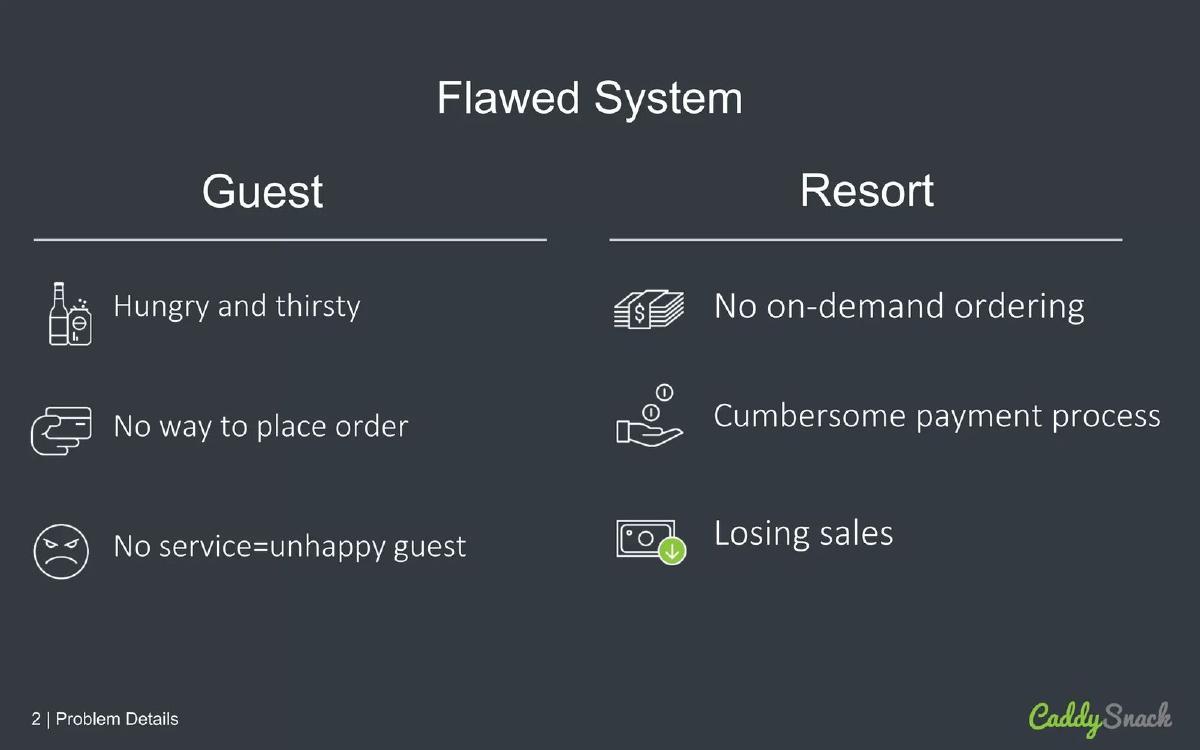
- The problem is framed as a double-sided loss: guests are hungry without a way to order, and resorts lose sales due to cumbersome payment processes (Slide 2).
- The guest app interface includes resort selection, a beverage menu, and a tipping slider (Slide 6).
- Industry trends show a rise in management-owned courses, reaching 1,340 by 2015, which CaddySnack views as a growth lever (Slide 7).
- The global market is sized at 34,000 courses and 1.088 billion rounds played per year (Slide 10).
- Financial projections estimate reaching 5,608 courses and $29,123,311 in revenue by 2018 (Slide 15).
- The business model includes both transactional revenue and recurring revenue components (Slide 15).
- Potential exits are categorized into course management software, lifestyle brands, and management companies like Troon (Slide 20).
CaddySnack: The On-Course Delivery Solution
CaddySnack enters the niche but high-spend world of golf resorts with a mobile ordering platform. The deck is structured to highlight a specific operational inefficiency in the golf industry: the difficulty of getting food and drinks to players while they are in the middle of a round. By digitizing the 'beverage cart' experience, CaddySnack positions itself as a revenue-enhancement tool for resort operators.
Slide 1: Title and Vision
The cover slide establishes the brand identity with a high-resolution image of a golf course at sunset. The tagline is functional: "On-demand ordering and delivery within resorts." It is important to note the use of the word "resorts" rather than just "golf courses," suggesting a broader potential for the technology in other hospitality environments, though the rest of the deck focuses almost exclusively on golf.
Slide 2: The Flawed System
This slide uses a classic two-column problem format. For the Guest, the pain points are being "Hungry and thirsty" with "No way to place order," leading to an "unhappy guest." For the Resort, the pain points are "No on-demand ordering," a "Cumbersome payment process," and "Losing sales." This slide effectively argues that the current status quo is a lose-lose scenario, setting the stage for a technology-driven intervention.
Slide 6: Product Details - The Guest Experience
Slide 6 provides a three-step UI walkthrough. The first screen shows a resort selection menu featuring high-profile names like Pebble Beach Resort and The Resort at Pelican Hill. The second screen displays a beverage menu with specific pricing (e.g., Miller Light for $7, Stone IPA for $11). The final screen shows the checkout process, which includes a gratuity slider (set to 20% in the example) and a field for "Cart Number." This confirms the delivery mechanism relies on the user providing their location via their golf cart ID.
Slide 7: The Industry Shift
Titled "Times, they are a-changin’," this slide uses a line graph to show the divergence between individual resort courses and those owned by management companies. It notes that by 2015, there were 1,340 management courses. The text argues that leveraging relationships with these large management companies can "accelerate our growth exponentially." This is a key strategic point: CaddySnack isn't just selling course-by-course; they are targeting the enterprise level.
Slide 10: Market Size
The market slide provides hard numbers on the global golf industry. It claims 15,000 courses in the USA and 19,000 internationally, totaling 34,000 courses. More importantly, it cites 1.088 billion rounds played per year globally. This volume of rounds represents the total addressable number of transactions CaddySnack could potentially facilitate.
Slide 15: Financial Projections
This is the most data-dense slide in the deck. It outlines a three-year trajectory from 2016 to 2018. In 2016, the company expects to be in 71 courses with $303,713 in revenue and a net loss of $264,687. By 2018, the projections scale to 5,608 courses and $29,123,311 in revenue, with a net profit of $25,608,313. The deck claims a 99% gross margin by 2018, which suggests the company views itself strictly as a software provider that does not take on the labor costs of delivery. A bullet point notes that they expect to be "Cash flow positive by the end of 2017."
Slide 20: Possible Acquisitions / Exits
The exit strategy slide lists major players in the golf and hospitality space. It highlights GolfNow (Comcast) with a $145 billion valuation and Ezlinks (PGA Tour) with over $1 billion in revenues. It also mentions lifestyle brands like Top Golf and Callaway ($821MM). The inclusion of management companies like Troon (> $1b) aligns with the strategy mentioned on Slide 7. This slide serves to reassure investors that there is a liquid market for this type of specialized software.
Slide 24: Contact Information
The deck concludes with the same sunset imagery as the cover, providing a single contact email: invest@caddysnack.net. There are no social media links or physical addresses provided in this version of the deck.
What CaddySnack Does Well
The deck is highly focused. It identifies a single, relatable problem and proposes a single, clear solution. The UI mockups on Slide 6 are clean and professional, giving the impression of a product that is ready for deployment. By focusing on "resorts," the company targets a high-spending demographic where a $11 beer is standard, making the transactional revenue model more attractive. The strategic emphasis on management companies (Slide 7) shows an understanding of how to scale in a fragmented industry.
What is Missing from the Deck
The most glaring omission is the Team slide. In early-stage fundraising, the pedigree of the founders is often as important as the idea itself. Without knowing who is building the tech or who has the connections to the golf industry, the projections on Slide 15 feel speculative. Additionally, there is no mention of competition. While CaddySnack frames the "system" as flawed, they do not address other GPS-based ordering systems or existing POS (Point of Sale) integrations that many modern golf carts already feature. Finally, the "Ask" is missing; while the financials mention a $500,000 financing activity, the deck does not explicitly state what they are looking for from the investor reading the deck.
Founder Takeaways
Target the Aggregators: If your industry is fragmented (like golf courses or restaurants), show investors that you understand who the 'big fish' owners are. CaddySnack’s focus on management companies is a strong B2B strategy. · Be Specific with UI: Showing the "Cart Number" field on the checkout screen (Slide 6) is a small detail that proves the founders have thought through the logistics of delivery on a 150-acre property. · High-Margin Clarity: The 99% gross margin projection (Slide 15) tells a clear story: this is a platform play, not a service play. If you aren't hiring the delivery drivers, make sure your financials reflect that. · Exit Comps Matter: Listing specific acquisitions made by companies like GolfNow (Slide 20) shows that you have researched the M&A landscape and know who the active buyers are.
Frequently asked questions
- What is CaddySnack's primary value proposition?
- According to Slide 2, CaddySnack aims to eliminate the 'flawed system' where guests remain hungry and thirsty due to a lack of ordering infrastructure. For the resort, the value is in capturing sales that are currently lost to cumbersome manual payment processes and a lack of on-demand ordering options.
- How does the product actually work for the user?
- Slide 6 illustrates a three-step process: the golfer launches the app to select their resort (e.g., Pebble Beach), places an order from a digital menu of beverages, and then confirms the order by adding a gratuity and entering a cart number for delivery.
- What are the company's growth expectations?
- The projections on Slide 15 are aggressive. The company expects to grow from 10 courses in Q2 2016 to 5,608 courses by the end of 2018. This expansion is projected to flip the company from a net loss of $264,687 in 2016 to a net profit of over $25.6 million in 2018.
- Who are the potential buyers for a company like CaddySnack?
- Slide 20 lists several categories of acquirers: Course Management Software (GolfNow/Comcast, Ezlinks), Golf Brand & Lifestyle Companies (Top Golf, Callaway, TaylorMade), and Management Companies (ClubCorp, Troon). The slide notes that current investors already have connections to Top Golf.
- What critical information is missing from this deck?
- The provided slides omit a team slide, which is vital for assessing execution capability. It also lacks a specific 'Ask' slide detailing how much capital is being raised and how it will be allocated, though Slide 15 mentions 'Financing Activities' of $500,000 in 2016.