Café Créatif operates as a startup incubator and consultancy based in Cameroon, specifically targeting the high failure rate of local businesses. The deck highlights a stark statistic: 89 out of 100 startups identified in Dschang between 2015 and 2018 no longer exist. To combat this, the company provides services ranging from business plan formatting to 'Commando Expeditions' to Silicon Mountain. The deck outlines a transition from an abandoned house in 2015 to a formal SARL (Limited Company) in 2019. Seeking 500,000 frs CFA for a 60% equity stake, the founders aim to scale their support from…
Key takeaways
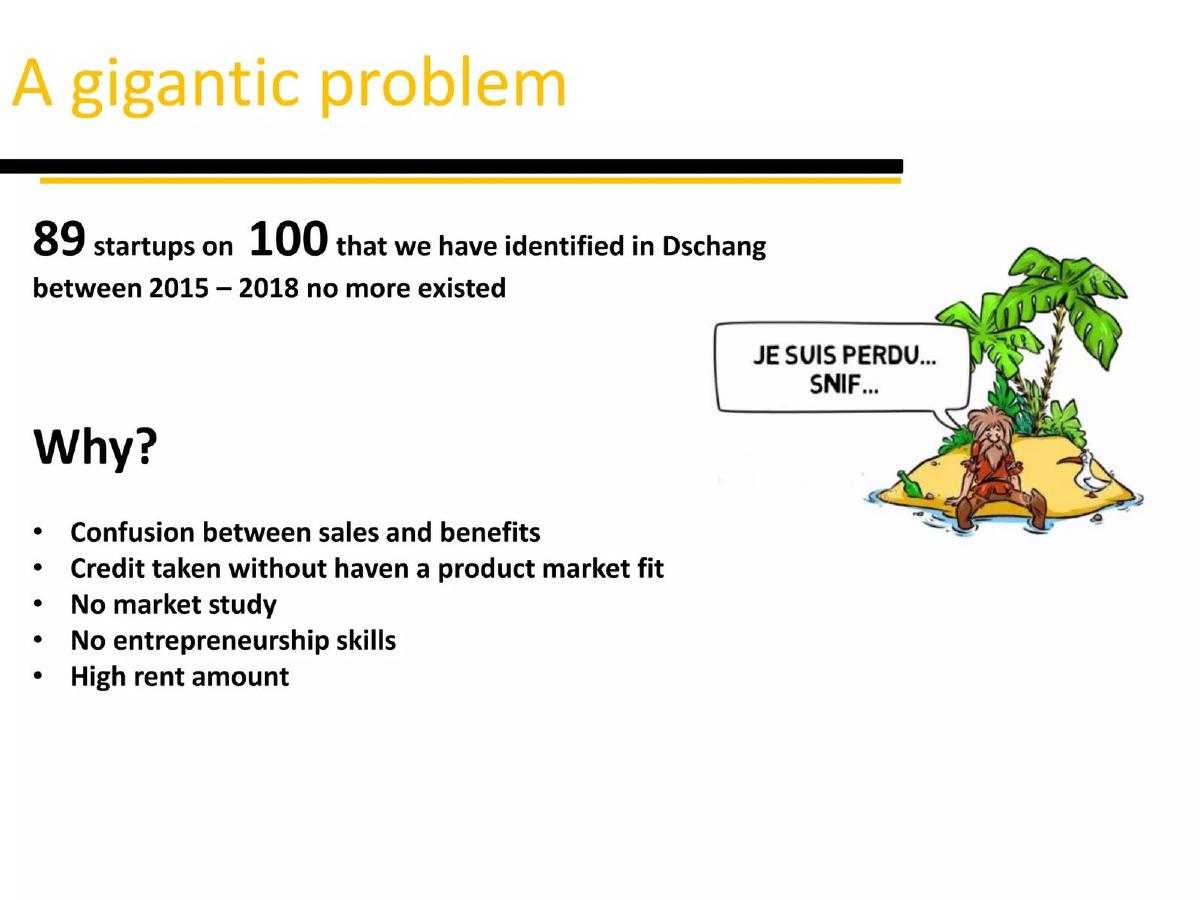
- The company identifies a critical local problem: an 89% startup failure rate in Dschang between 2015 and 2018 (Slide 2).
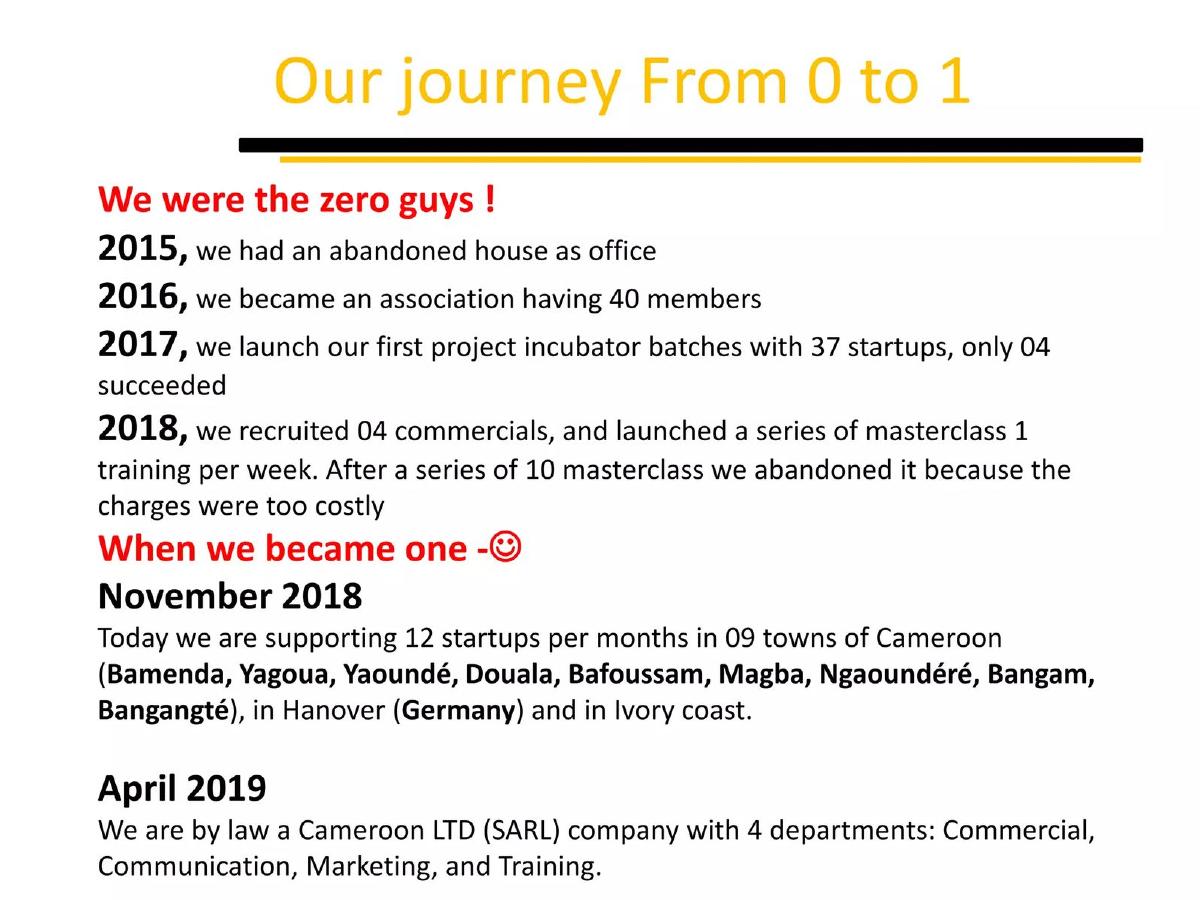
- Café Créatif evolved from a voluntary association with 40 members in 2016 to a formal SARL company in April 2019 (Slide 3).
- The incubator has a geographic reach spanning 9 towns in Cameroon, plus presence in Germany and Ivory Coast (Slide 3).
- Service offerings include designing new technologies, pitch deck formatting, and creating market partnerships (Slide 4).
- A unique 'Commando Expedition' is organized every six months to Silicon Mountain, Cameroon's primary startup ecosystem (Slide 5).
- The financial ask is 500,000 frs CFA in exchange for 60% of the company's capital (Slide 6).
- Revenue is generated through entrance fees (30,000 frs CFA) and a 3% equity stake in successful startups (Slide 6).
- The deck projects a net margin of 61% upon reaching a scale of 36 startups per month (Slide 6).
Café Créatif: A Localized Solution for Cameroon's Startup Mortality
The Café Créatif pitch deck is a fascinating look at grassroots entrepreneurship support in West Africa. Rather than focusing on high-level software metrics, the deck focuses on the survival of physical and digital businesses in a challenging economic environment. The narrative is one of grit, moving from an 'abandoned house' to a multi-city operation. However, the deck presents a significant valuation challenge, offering 60% of the company for a very modest sum of capital.
Slide 1: Title and Vision
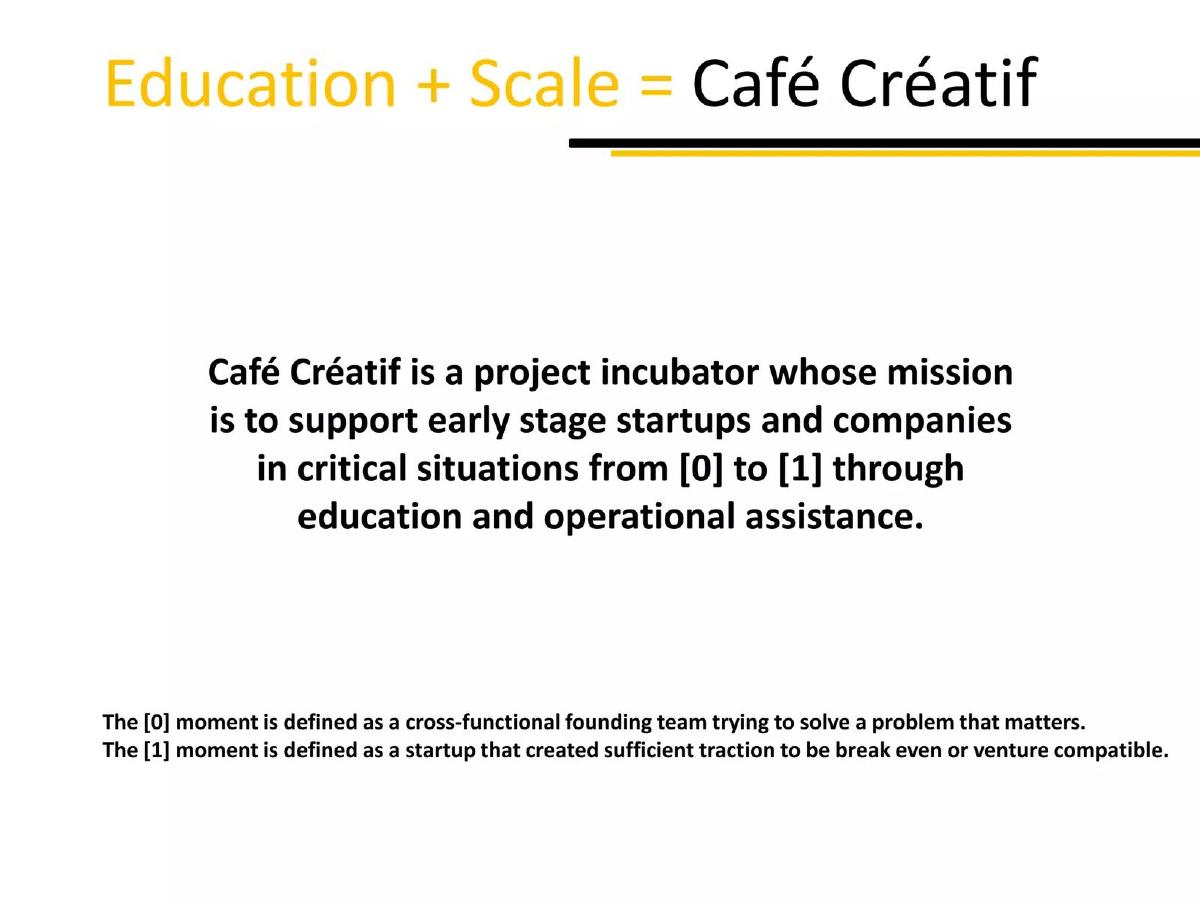
The cover slide features a simple graphic of two directional signs: 'EDUCATION' and 'SCALE.' This sets the dual-purpose mission of the company. The name 'Café Créatif' suggests a community-centric, perhaps co-working or hub-based approach to business development. The aesthetic is functional, utilizing basic clip art and bold yellow text, which is consistent throughout the presentation.
Slide 2: The Gigantic Problem
This is the strongest slide in the deck from a data perspective. It claims that 89 out of 100 startups identified in Dschang (a city in western Cameroon) between 2015 and 2018 'no more existed.' The slide lists five specific reasons for these failures: confusion between sales and benefits, taking credit without product-market fit, lack of market studies, lack of entrepreneurship skills, and high rent. This slide successfully establishes the 'why' by using local, verifiable (though unsourced) statistics that highlight a clear market gap for business education and support.
Slide 3: Our Journey From 0 to 1
This slide provides a chronological history of the organization. It is remarkably honest about past failures, noting that in 2017, they launched an incubator with 37 startups but 'only 04 succeeded.' It also mentions that in 2018, they abandoned a masterclass series because the 'charges were too costly.' By November 2018, they claim to support 12 startups per month across 9 towns in Cameroon, as well as in Germany and Ivory Coast. The slide concludes with their formal registration as a SARL (Limited Company) in April 2019, organized into four departments: Commercial, Communication, Marketing, and Training.
Slide 4: Daily Operations and Services
Slide 4 uses a photograph of a young man working with a small mechanical device (possibly a 3D printer or plotter) to illustrate their hands-on approach. The services listed are: designing new technologies, formatting pitch decks and business plans, creating economic partnerships between startups and the market, and providing mentorship. This suggests the company acts as both a technical lab and a business consultancy.
Slide 5: The Commando Expedition
This slide introduces a unique program: a 'Commando Expedition to Silicon Mountain.' Silicon Mountain is the colloquial name for the tech ecosystem in Buea, Cameroon. The program is described as an 'Organized & Planned immersion' occurring every six months. The goal is to 'Get boosted' through partnerships and investments. This slide demonstrates that Café Créatif understands the importance of networking within the broader national ecosystem beyond their home base in Dschang.
Slide 6: The Ask and Financial Projections
The final slide contains the most critical financial information. The company is seeking 500,000 frs CFA (Central African CFA franc) in exchange for 60% of the company's capital. The funds are earmarked for two purposes: 150,000 frs CFA for 'Constitution' (legalizing the company and terms) and 350,000 frs CFA to 'Boost the performances' by recruiting personnel and financing a marketing plan. The slide projects that this investment will allow them to triple their capacity from 12 to 36 startups per month. They anticipate monthly sales growing from 200,000 frs CFA to 1,000,000 frs CFA, maintaining a net margin of 61%. The revenue model is clearly stated as a 30,000 frs CFA entrance fee plus a 3% equity stake in the startups.
What Works in This Deck
Local Data: The use of a specific failure rate (89/100) in a specific city (Dschang) makes the problem feel urgent and real. It moves away from generic 'startups are hard' platitudes and gives a concrete reason for the company's existence.
Honesty and Transparency: The founders do not hide their early struggles. Mentioning the abandoned house, the failed masterclasses, and the low success rate of their first incubator batch builds a narrative of 'lessons learned' rather than unearned confidence.
Clear Revenue Model: The deck explicitly states how they make money (fees + equity) and how they plan to use the investment. There is no ambiguity about the business model.
What Is Missing or Concerning
The Valuation: Offering 60% of the company for 500,000 frs CFA (roughly $825 USD at current rates) is a massive red flag for traditional investors. It suggests the founders are looking for a 'boss' or a buyer rather than a partner, as they are giving up majority control for a very small amount of capital. This may be appropriate for a local micro-grant or a specific type of social impact investment, but it is not a standard venture capital structure.
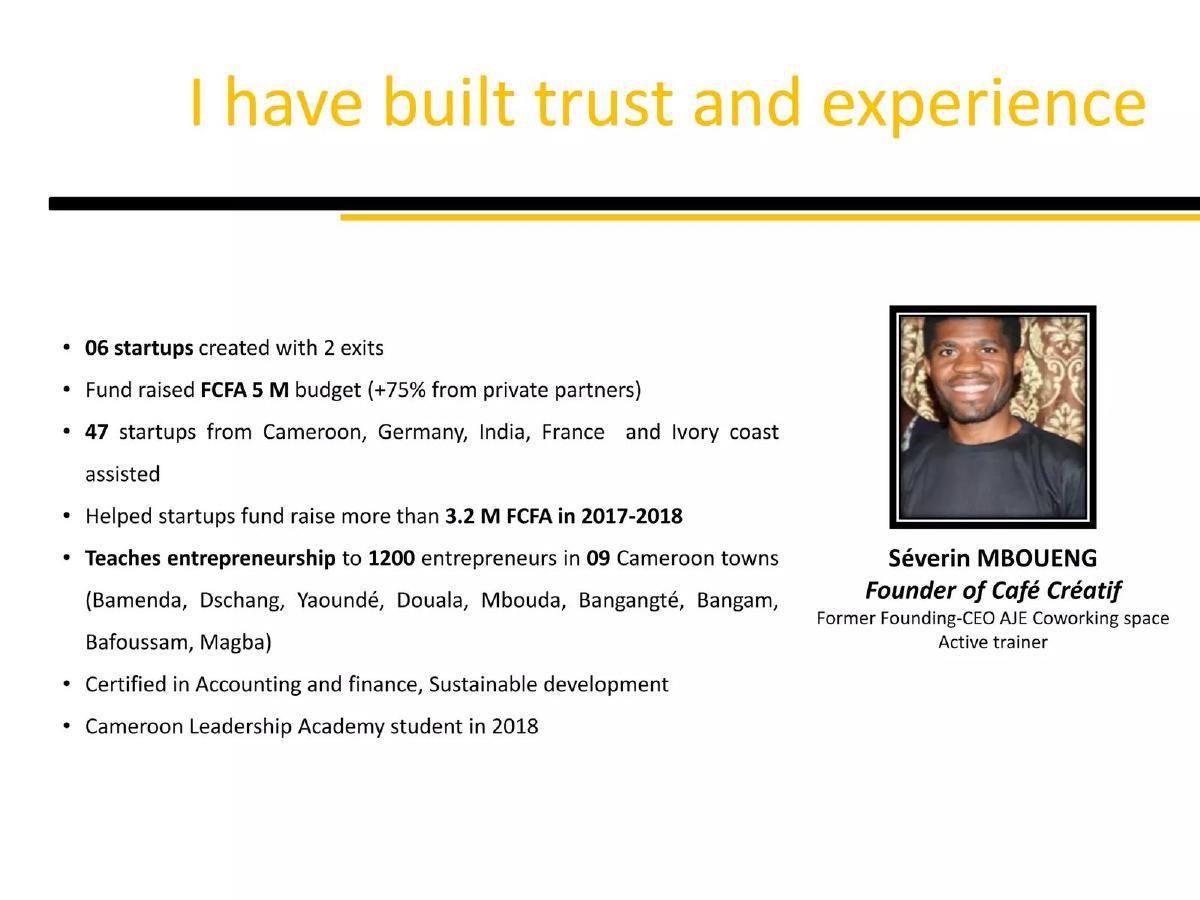
Team Slide: There is no slide introducing the founders or the 'competent personnel' they intend to hire. In a service-based business like an incubator, the pedigree and experience of the mentors are the primary product. Without knowing who is behind the 'Commercial, Communication, Marketing, and Training' departments, it is difficult to assess the quality of the support.
Unit Economics: While they mention a 61% net margin, they do not explain the cost structure of supporting 36 startups per month. If they are providing physical space, technology design, and mentorship, the overhead could easily exceed the projected 1,000,000 frs CFA monthly revenue.
Founder Takeaways
Don't sell the farm too early: Giving up 60% of your company in your first formal round makes it nearly impossible to raise subsequent rounds of funding. Founders should aim to give up 10-25% per round to ensure they remain motivated and 'investable' for the long term.
Quantify your impact: Café Créatif did a great job quantifying the problem. They should apply that same rigor to their '04 successful startups.' Naming those companies and showing their growth would provide the social proof needed to justify the expansion.
Define your 'Product': The deck lists many services (tech design, pitch decks, market partnerships). For a small team, this is a lot to manage. A stronger deck would focus on the one or two services that provide the most value and explain how those are delivered at scale.
Frequently asked questions
- What is the primary problem Café Créatif is solving?
- According to Slide 2, the company is addressing the 'gigantic problem' of startup mortality in Cameroon. They cite that 89% of startups in Dschang failed between 2015 and 2018 due to factors like confusion between sales and benefits, lack of market studies, high rent, and a lack of entrepreneurship skills. They position themselves as the educational and scaling bridge to prevent these failures.
- How does the company generate revenue from its incubated startups?
- Slide 6 details a two-pronged revenue model. First, startups pay an entrance fee of 30,000 frs CFA. Second, Café Créatif takes a 3% equity stake ('3% offer from their capital') in the startups they support. The deck also mentions a goal to create a monthly credit line of 500,000 frs CFA with a bank to further finance these startups.
- What is the significance of 'Silicon Mountain' in this deck?
- Slide 5 introduces the 'Commando Expedition to Silicon Mountain,' which they describe as the '1st startup ecosystem in Cameroon.' Every six months, Café Créatif organizes a planned immersion for their entrepreneurs to gain partnerships, investments, and mentorship within this specific geographic tech hub, likely located in Buea.
- What are the specific terms of the investment ask?
- The investment request is highly specific but unusual for venture standards. As stated on Slide 6, they are seeking 500,000 frs CFA to 'open 60% of Our capital.' This implies the founders are willing to give up majority control for a relatively small amount of capital (approximately $800-$900 USD depending on exchange rates) to formalize the business and hire staff.
- How has the company's structure changed over time?
- Slide 3 tracks a clear progression: starting in an abandoned house in 2015, becoming an association in 2016, launching incubator batches in 2017, and finally registering as a Cameroon LTD (SARL) in April 2019. The company now operates with four distinct departments: Commercial, Communication, Marketing, and Training.