Loqr's 2016 investment pitch deck focuses on the friction-heavy reality of modern authentication, proposing a passwordless future. The deck is notable for its clear articulation of the 'password problem' using relatable cultural touchstones and specific technical pain points. While the market sizing is broad, the company demonstrates significant early-stage momentum through participation in prestigious accelerators like Startup Braga and SXSW, alongside high-volume Proof of Concepts (PoCs) with major Portuguese banks and telecommunications firms. The deck's structure emphasizes 'The Achieveme…
Key takeaways
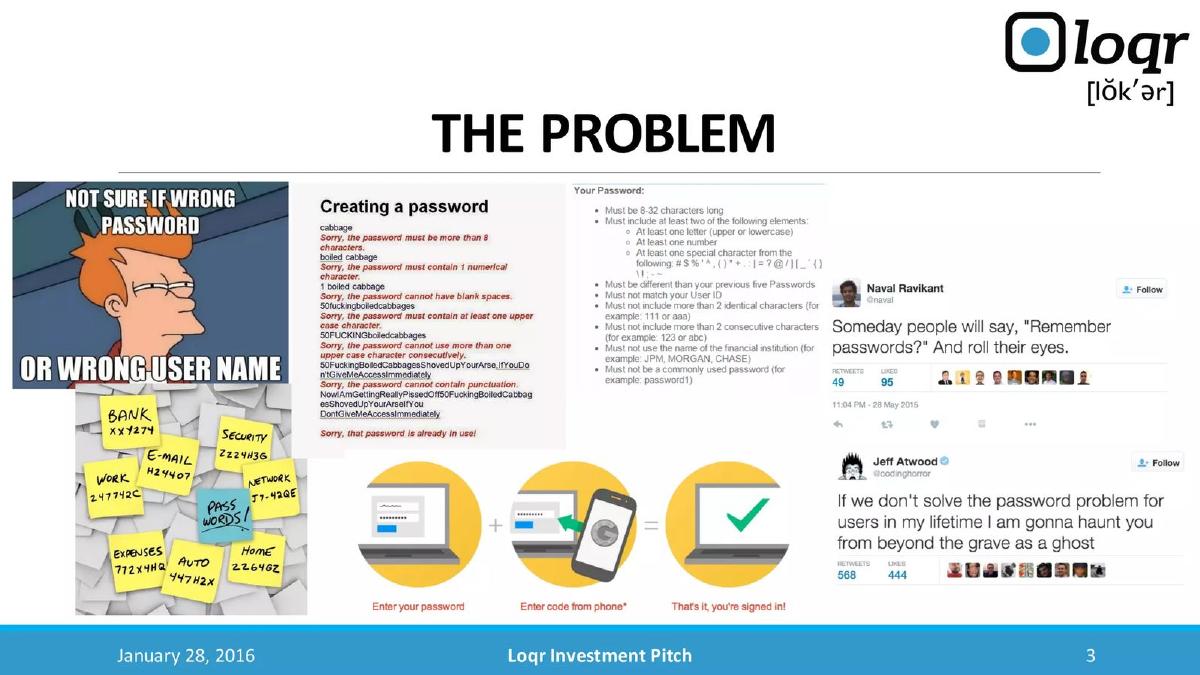
- The problem slide (Slide 3) effectively uses memes and social proof from industry figures like Naval Ravikant to validate the frustration with current password systems.
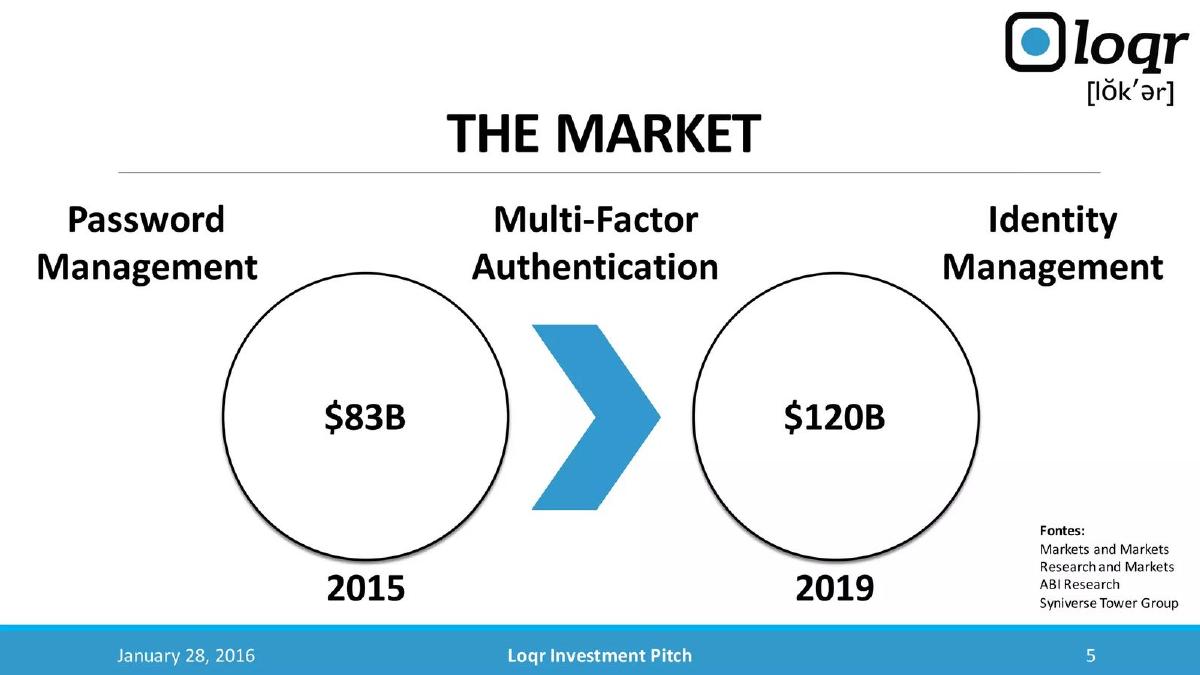
- Market projections (Slide 5) estimate a growth from an $83B market in 2015 to $120B by 2019 across password, multi-factor, and identity management.
- The company projects an aggressive user growth curve (Slide 7), aiming for approximately 10 million users by 2018.
- Loqr differentiates itself (Slide 9) by claiming to eliminate passwords entirely rather than just managing them, while stating they do not store user data.
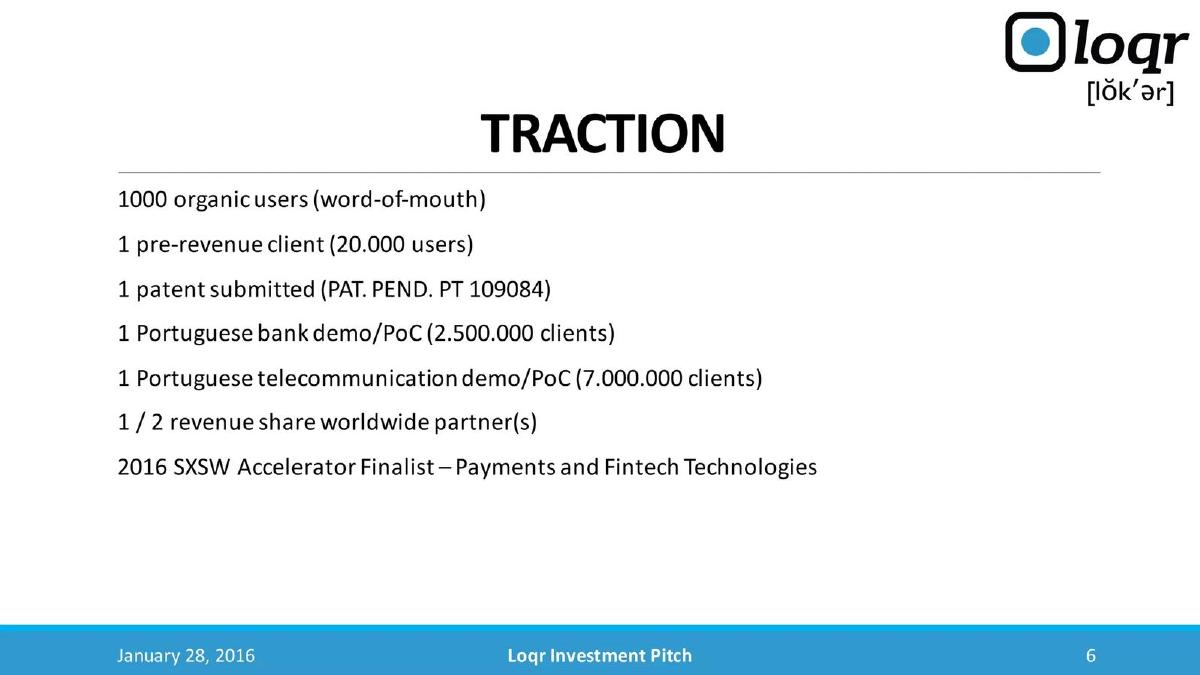
- Traction is anchored by two major 2016 PoCs (Slide 11): one with a Portuguese bank (2.5M users) and another with a telecommunications company (6M users).
- The deck highlights a 'Mentors' slide (Slide 13), showcasing external expertise in Marketing, Business Development, and Product Design.
- The 'Cap Table' slide (Slide 15) identifies the core leadership team and lists REDangels as an early investor.
- The deck is dated January 28, 2016, and was prepared for the Caixa Empreender Award, which explains the focus on high-level achievements over granular financials.
Loqr Pitch Deck Teardown: The Quest for a Passwordless Future
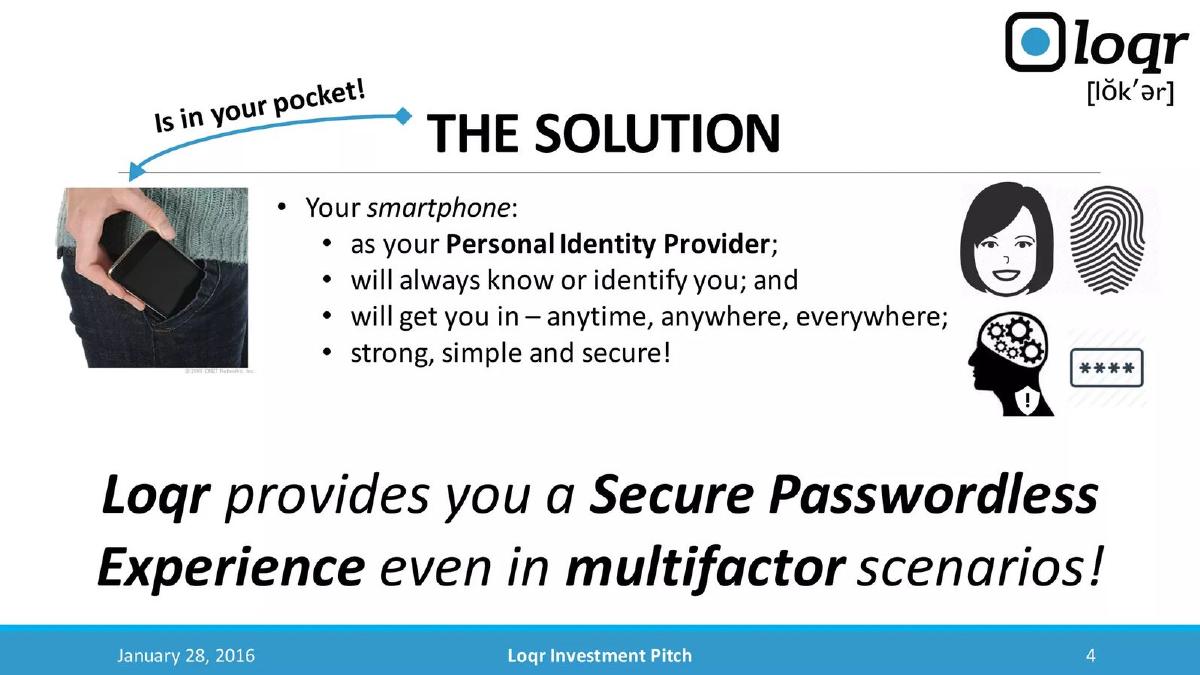
The Loqr pitch deck, presented for the Caixa Empreender Award in early 2016, is a focused look at a startup attempting to solve one of the most persistent frictions in the digital age: the password. At a time when two-factor authentication (2FA) was becoming standard but remained cumbersome, Loqr positioned itself as the 'simple' and 'secure' alternative. This teardown examines how the company balanced a relatable problem with impressive enterprise-level traction.
Slide 1: Title and Branding
The cover slide is minimalist, featuring the Loqr logo and a phonetic guide [lŏk’ər]. The tagline, "Authentication made simple!" , immediately establishes the value proposition. The date, January 28, 2016, places this deck at the start of a pivotal year for the company, coinciding with their SXSW Accelerator finalist status.
Slide 3: The Problem
Slide 3 is a collage of user frustration. It uses the 'Futurama' Fry meme ("Not sure if wrong password or wrong user name") alongside a screenshot of a complex password requirement list that many users find infuriating. Crucially, it includes social proof via tweets from Naval Ravikant and Jeff Atwood . Ravikant’s quote, "Someday people will say, 'Remember passwords?' And roll their eyes," serves as a visionary anchor for the company's mission. The slide effectively transitions from the emotional pain of the user to the technical clunkiness of current 2FA methods (entering codes from phones).
Slide 5: The Market
Loqr defines its market broadly, encompassing Password Management, Multi-Factor Authentication, and Identity Management. The slide cites a $83B market size in 2015 , growing to $120B by 2019 . While these figures are massive, the deck does not break down the specific Serviceable Addressable Market (SAM) for their particular solution. The sources cited include Markets and Markets, ABI Research, and Syniverse Tower Group, providing necessary credibility to these large numbers.
Slide 7: Projections
The projections slide features two charts: Users vs. Year and Authentications vs. Year . The growth curves are classic 'hockey sticks,' projecting a jump from near-zero in 2015 to 10 million users by 2018 . Authentications are projected to scale even more aggressively, nearing 400 million by 2018. While these are ambitious, they are backed by the enterprise PoCs mentioned later in the deck, which provide a plausible path to these volumes.
Slide 9: Differentiation
This slide uses a 2x2-style matrix (though presented as a quadrant-less graph) to plot Loqr against competitors. The axes are "Simple" and "Secure." Loqr places itself in the top-right corner, superior to Password Managers (like LastPass or 1Password) and traditional 2FA apps (like Duo or Authy). The key claims here are that Loqr "addresses the entire spectrum of Authentication," "fights to eliminate passwords," and "don’t gets or store any user data." The latter is a bold technical claim that addresses the primary security concern of centralized identity providers.
Slide 11: The Achievements
This is the strongest slide in the deck. It lists a chronological series of wins that demonstrate significant momentum. Highlights include:
2015: Startup Braga Acceleration Program and Web Summit Alpha Startup. · 2016: Loqr protocol patent submitted. · 2016 Q1: Demo/PoC with a Portuguese Bank (2,500,000 users) . · 2016 Q1: Demo/PoC with a Portuguese Telecommunication Company (6,000,000 users) . · 2016 March: SXSW Accelerator Program Finalist.
The mention of specific user counts for the PoCs (totaling 8.5 million) gives weight to the aggressive projections shown on Slide 7.
Slide 13: The Mentors
Including a 'Mentors' slide is a common tactic for early-stage startups to borrow credibility. Loqr highlights Sandra Sick (Marketing and Business Development) and Rui Barroca (Product Design / UX). By providing LinkedIn URLs for these individuals, the founders invite due diligence and show they are surrounding themselves with specialized expertise outside of their core technical competencies.
Slide 15: Cap Table and Team
The final slide in this set, titled 'Cap Table,' functions as a team slide. It introduces Ricardo Costa (CEO, "driver") , José Dias (BDM, "stratego") , and Jorge Silva (Legal) . Below the founders, the logo for REDangels is prominently displayed with the text "From Scratch," indicating they were the seed or angel investors who helped launch the company. This slide confirms that the company has already cleared the hurdle of securing initial external capital.
What Works in the Loqr Deck
The deck excels at contextualizing a technical problem . By using memes and tweets, they make the 'password problem' feel urgent and universal. Furthermore, the traction slide is exceptional for a 2016-era startup. Landing PoCs with multi-million user enterprises (banks and telcos) is a high-bar achievement that validates the technology's scalability and market demand. The inclusion of a legal lead in the core team (Slide 15) is also a subtle but smart move for a company operating in the highly regulated space of identity and finance.
What is Missing
The most glaring omission is a Business Model slide . While 'Revenue share' is mentioned in the achievements, there is no explanation of how Loqr actually makes money. Is it per-user, per-authentication, or a flat licensing fee? Additionally, the 'Ask' is missing . We do not know how much money they were seeking at the time of this presentation or what the specific milestones for the next 18 months were. Finally, for a product claiming to 'eliminate passwords' without 'storing user data,' a Technical Architecture slide would have been beneficial to explain the 'how' behind their 'what.'
Founder Takeaways
Founders should take note of how Loqr used third-party validation . They didn't just say passwords are bad; they showed that industry leaders like Naval Ravikant agree. They didn't just say their tech works; they showed that major banks are testing it. If you are in a crowded space like cybersecurity, these external markers of quality are more persuasive than any internal metric. Also, the use of a Mentors slide is a highly effective way to fill gaps in a founding team's resume, provided those mentors are genuinely active and recognizable in their fields.
Frequently asked questions
- What is Loqr's primary value proposition?
- Loqr aims to make authentication simple by eliminating passwords entirely. As stated on Slide 9, they differentiate themselves from password managers by fighting to remove the password layer rather than just storing credentials. They also emphasize privacy, claiming they do not 'get or store any user data,' which is a significant security claim for an identity management platform.
- How does Loqr demonstrate market traction?
- Traction is showcased through a timeline of achievements on Slide 11. Key milestones include participation in the Startup Braga Acceleration Program, winning the FLAP Award, and being a finalist at SXSW 2016. Most importantly, they cite two massive Proof of Concepts (PoCs) with a Portuguese bank and a telecom company, representing a combined potential reach of 8.5 million users.
- Who are the key people involved in Loqr according to the deck?
- The leadership team (Slide 15) includes Ricardo Costa (CEO), José Dias (Business Development Manager), and Jorge Silva (Legal). The deck also highlights a mentorship layer (Slide 13) featuring Sandra Sick for Marketing and Business Development, and Rui Barroca for Product Design and UX, suggesting a focus on both commercial and user-experience excellence.
- What market size is Loqr targeting?
- According to Slide 5, Loqr operates at the intersection of Password Management, Multi-Factor Authentication, and Identity Management. They cite research from firms like Markets and Markets and ABI Research to value this combined space at $83 billion in 2015, with a projected increase to $120 billion by 2019.
- What is missing from this pitch deck?
- The deck lacks several standard venture capital components, most notably a specific 'Ask' slide detailing how much capital they are raising and the intended use of funds. It also omits detailed unit economics, a business model slide explaining how they generate revenue (though 'Revenue share' is mentioned on Slide 11), and a deep dive into the underlying technology protocol.