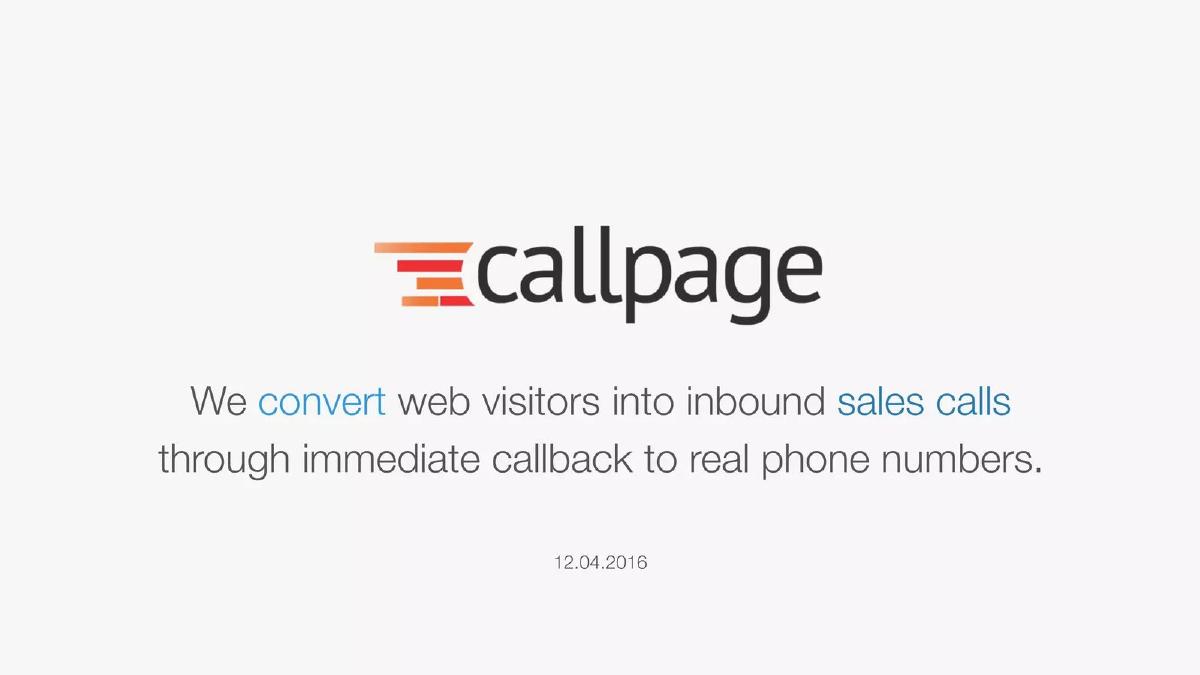
CallPage's 2016 pitch deck is a lean, 14-slide presentation that prioritizes traction and social proof over dense technical explanations. The company, which facilitates immediate callbacks for website visitors, successfully highlights a jump from $250 to $5,000 in Monthly Recurring Revenue (MMR) within a three-month window. By showcasing a client list that includes global brands like PwC and Volkswagen, the deck establishes immediate credibility. While it lacks a traditional competitive landscape or detailed product roadmap, the focus on a 75% increase in conversion rates and a clear $500,000…
Key takeaways
- The deck leads with massive social proof, citing over 500 clients including PwC, BDO, and Volkswagen on slide 3.
- Traction is the central theme, showing 15,000 inbound sales calls generated in just three months on slide 2.
- The product value proposition is distilled into a single metric: a 75% increase in conversion rates for inbound calls (slide 7).
- Financial growth is aggressive, moving from $250 MMR to $5,000 MMR in three months, with a target of $100,000 by late 2017 (slide 12).
- Customer acquisition costs are clearly defined across three channels: $130 for inbound, $110 for cold calling, and $0 for viral traffic (slide 9).
- The market opportunity is valued at a broad $5 billion, though the deck lacks a specific bottom-up calculation (slide 8).
- The team slide emphasizes longevity and functional roles, with each founder having 4-5+ years of experience in their respective fields (slide 10).
- The ask is unambiguous, requesting $500k on a standalone slide, though it lacks a breakdown of fund allocation (slide 13).
Executive Summary: The Power of Minimalist Traction
The CallPage pitch deck, dated December 4, 2016, is a 14-slide presentation that exemplifies the 'less is more' philosophy in early-stage fundraising. At a time when many SaaS decks were becoming increasingly bloated with complex feature lists and multi-year projections, CallPage focused on three things: who is using it, how fast it is growing, and what it costs to get a customer. This teardown explores how the founders used a 20x revenue jump to anchor a $500,000 seed round ask.
Slides 1-3: The Hook and Social Proof
Slide 1: Title The deck opens with a clear, one-sentence value proposition: 'We convert web visitors into inbound sales calls through immediate callback to real phone numbers.' It includes the date (12.04.2016) and a clean logo. This sets a professional, no-nonsense tone immediately.
Slide 2: The Scale of Activity Instead of explaining how the technology works, the founders lead with volume: '15,000 inbound sales calls during last 3 months.' This is a high-impact metric that proves the system is not just a prototype but a functioning utility being used by thousands of people.
Slide 3: The Logo Wall The company claims '>500 clients.' The logos displayed are heavy hitters: PwC, BDO, docplanner.com, and Volkswagen. For a startup at this stage, having two of the 'Big Four' accounting firms and a global automotive giant as clients is an incredibly strong signal of product-market fit and security compliance.
Slides 4-7: The Problem, Solution, and Result
Slide 4: The Philosophy A simple equation: 'Human Interaction = CallBack.' This slide serves as the 'Problem' slide, implying that digital interactions lack the personal touch required to close sales, and that a phone call is the ultimate solution.
Slide 5: The Speed Factor 'Immediate CallBack from Sales' accompanied by a rocket icon. This emphasizes the core differentiator: speed. In sales, lead response time is a critical metric, and CallPage is positioning itself as the fastest possible option.
Slide 6: The Product in Action This is the only slide showing the UI. It depicts a simple pop-up on a blurred website background asking, 'Would you like to receive a free call back in 28 seconds?' with a countdown timer showing '0:27,99.' It effectively communicates the user experience without needing a demo video.
Slide 7: The Value Metric The 'So What?' slide. It claims a '75% increasing CR [Conversion Rate] in inbound calls on website.' A bar chart visually reinforces this growth. This is the primary ROI argument for any potential customer or investor.
Slides 8-9: Market and Unit Economics
Slide 8: Market Size A world map with the text 'Our Market 5B$.' This is perhaps the weakest slide in the deck. It provides a large number without any context, segmentation (TAM/SAM/SOM), or source. While it shows global ambition, it lacks the rigor seen in the traction slides.
Slide 9: Customer Acquisition This slide is excellent for its transparency. It lists three channels: Inbound ($130), Cold Calling ($110), and Viral Traffic ($0). By showing that they have a 'viral' component (likely the widget itself acting as an advertisement), they demonstrate a path to scalable, low-cost growth.
Slides 10-12: Team and Financial Traction
Slide 10: The Team A black-and-white photo of the three founders: Sergey (Marketing, >4 years), Ross (Business, >5 years), and Andrew (Technical, >5 years). The slide is simple, focusing on their functional roles and years of experience rather than long resumes. It portrays a lean, focused founding team.
Slide 11: Growth Momentum A bar chart showing '70% monthly growth' from October to March. While the Y-axis lacks specific numbers, the visual trend is a classic 'hockey stick' curve, which is exactly what seed investors look for.
Slide 12: The Revenue 'Money Slide' This is the most important slide in the deck. It shows MMR (Monthly Recurring Revenue) at three points in time: $250 (3 months ago), $5,000 (Now - March 2016), and a target of $100,000 (by the end of 2017). The 20x growth in 90 days is the ultimate validation of the business model.
Slides 13-14: The Ask and Contact
Slide 13: The Investment A single number: '$500k.' There is no mention of valuation, equity offered, or how the money will be spent. While bold, it leaves a lot of questions for the follow-up meeting.
Slide 14: Contact Information Direct contact for Ross Knap, CEO, with a professional email address. It maintains the minimalist aesthetic of the rest of the deck.
What CallPage Did Well
Traction First: By putting the 15,000 calls and 500+ clients at the very beginning, they earned the right to be brief in the rest of the deck. · Clear Unit Economics: Stating exactly what it costs to acquire a customer ($110-$130) shows the founders understand the mechanics of their business. · Visual Simplicity: The deck uses a consistent color palette (blue, grey, white) and very little text, making it easy to digest in under two minutes. · The 'Viral' Factor: Highlighting $0 acquisition cost for viral traffic is a major plus for SaaS investors looking for organic growth loops.
What Is Missing from the Deck
Competitive Landscape: There is no mention of competitors like TalkTo, Google Click-to-Call, or traditional live chat software. Investors would want to know why CallPage wins against established players. · Use of Proceeds: A $500k ask usually requires at least a high-level breakdown (e.g., 50% Engineering, 30% Sales, 20% Ops). · Churn and Retention: While they show new revenue growth, they don't show if the 500+ clients are staying. In SaaS, retention is as important as acquisition. · Market Calculation: The $5B market figure is unsubstantiated. A bottom-up calculation based on the number of target websites multiplied by an average contract value would have been more persuasive.
Founder's Playbook: What to Copy
The 3-Month Snapshot: If you have a period of explosive growth, highlight it exactly like Slide 12. Showing the 'Before' ($250) and 'After' ($5,000) creates a powerful narrative of momentum. · Logo Validation: If you have recognizable brands using your product, put them on Slide 3. Don't wait until the end of the deck to show you are trusted by industry leaders. · The Single-Metric Solution: CallPage didn't list 20 features. They listed one result: a 75% increase in conversion. Find the one metric your product moves most and make it the hero of your solution section.
Frequently asked questions
- What is the core product offered by CallPage?
- Based on slides 1 and 6, CallPage is a widget-based service that converts website visitors into inbound sales calls. It triggers a pop-up offering a 'free call back in 28 seconds.' The system then facilitates an immediate connection between the potential customer and the company's sales team using real phone numbers.
- How does the company justify its $500k funding ask?
- The justification is built on rapid revenue and user growth. Slide 12 shows that the company grew its Monthly Recurring Revenue (MMR) from $250 to $5,000 in just three months. Combined with a 70% monthly growth rate shown on slide 11, the founders are signaling that the business model is proven and requires capital to scale toward their $100k MMR goal.
- Which major companies were already using CallPage at the time of this deck?
- Slide 3 features the logos of four significant clients: PwC, BDO, docplanner.com, and Volkswagen. The slide claims a total of over 500 clients, suggesting that while they have large enterprise users, the product is also widely adopted across a broader customer base.
- What are the primary customer acquisition channels for CallPage?
- Slide 9 outlines three specific channels and their associated costs. Inbound leads cost $130 to acquire, while cold calling is slightly more efficient at $110. Most notably, they claim a $0 acquisition cost for 'Viral Traffic,' likely referring to the 'Powered by CallPage' branding on their customer-facing widgets.
- What information is missing from the CallPage deck?
- The deck omits several standard components, including a detailed competitive analysis, a breakdown of how the $500k will be spent (use of proceeds), a technical architecture slide, and a specific breakdown of the $5B market size. It relies almost entirely on current traction to carry the narrative.