Camdog's 13-slide deck, published in 2020, pitches a Video Surveillance as a Service (VSaaS) platform that aims to disrupt the traditional security market by decoupling software from hardware. The company positions itself against high-cost professional installations, citing that existing solutions often start at $500 per license plus hardware costs. Camdog offers 24/7 monitoring, AI-powered object detection, and ALPR (Automatic License Plate Recognition) through a cloud-based interface accessible from any device. While the deck provides a clear business model of $49/month plus usage fees and…
Key takeaways
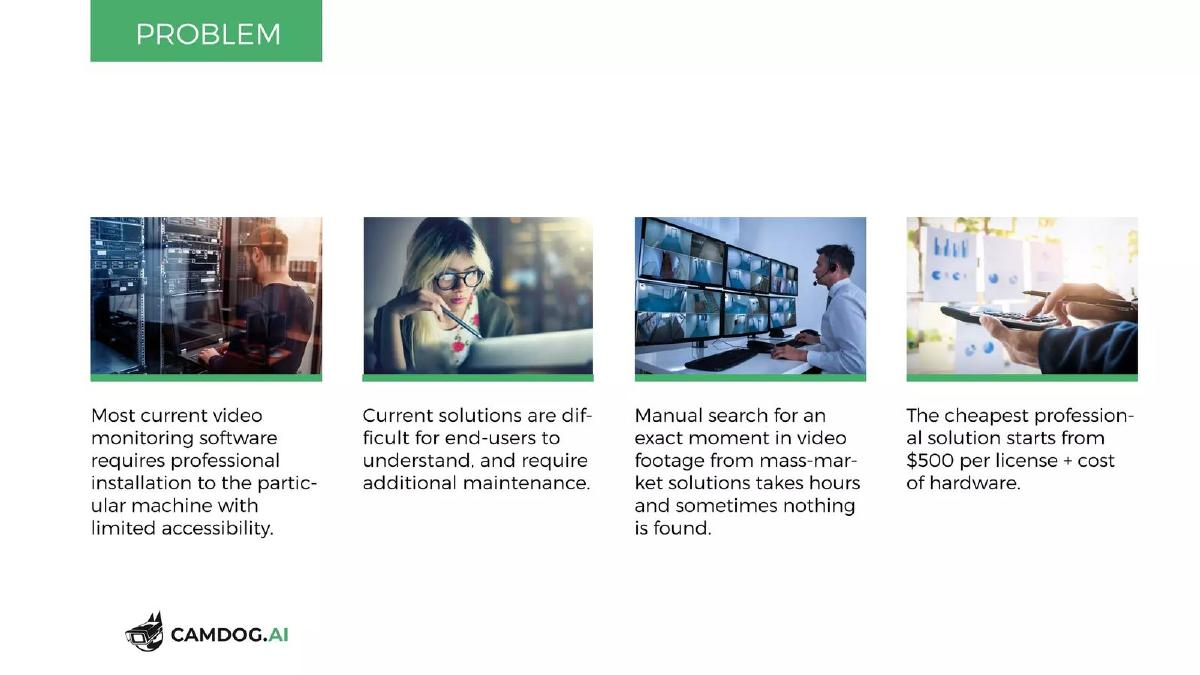
- The startup identifies a market pain point where professional solutions cost upwards of $500 per license plus hardware (Slide 2).
- Camdog offers a hardware-agnostic solution, working with any camera the client already owns (Slide 8).
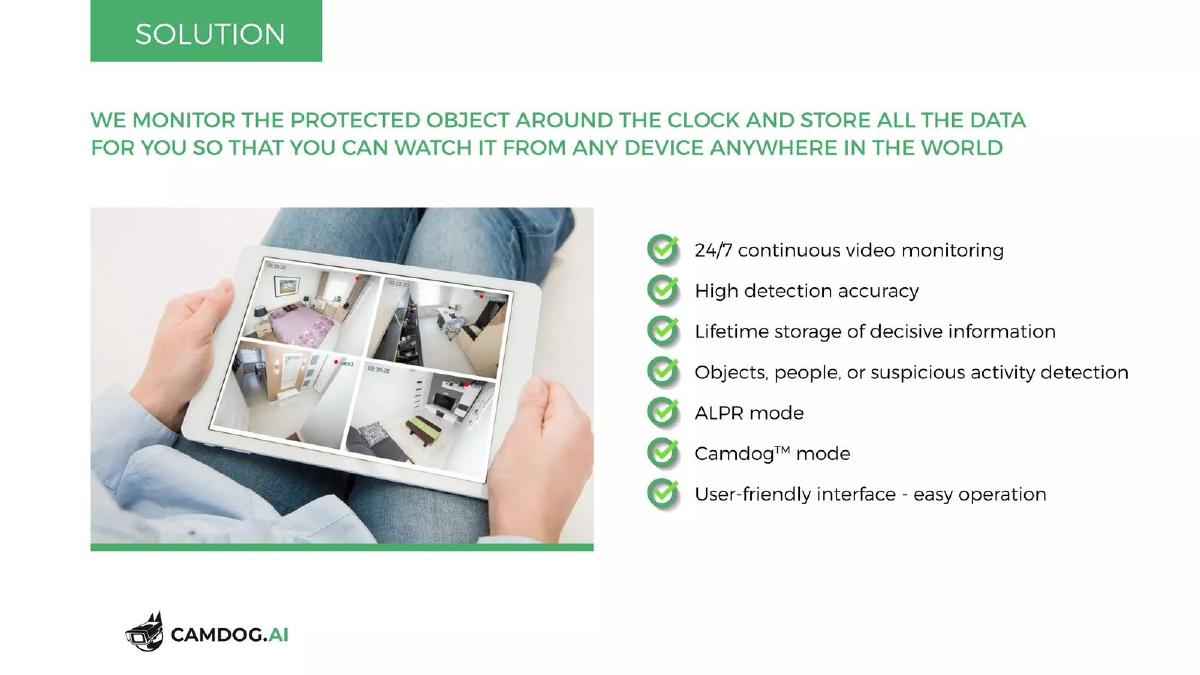
- The platform includes advanced features like ALPR (Automatic License Plate Recognition) and 'Camdog mode' (Slide 3).
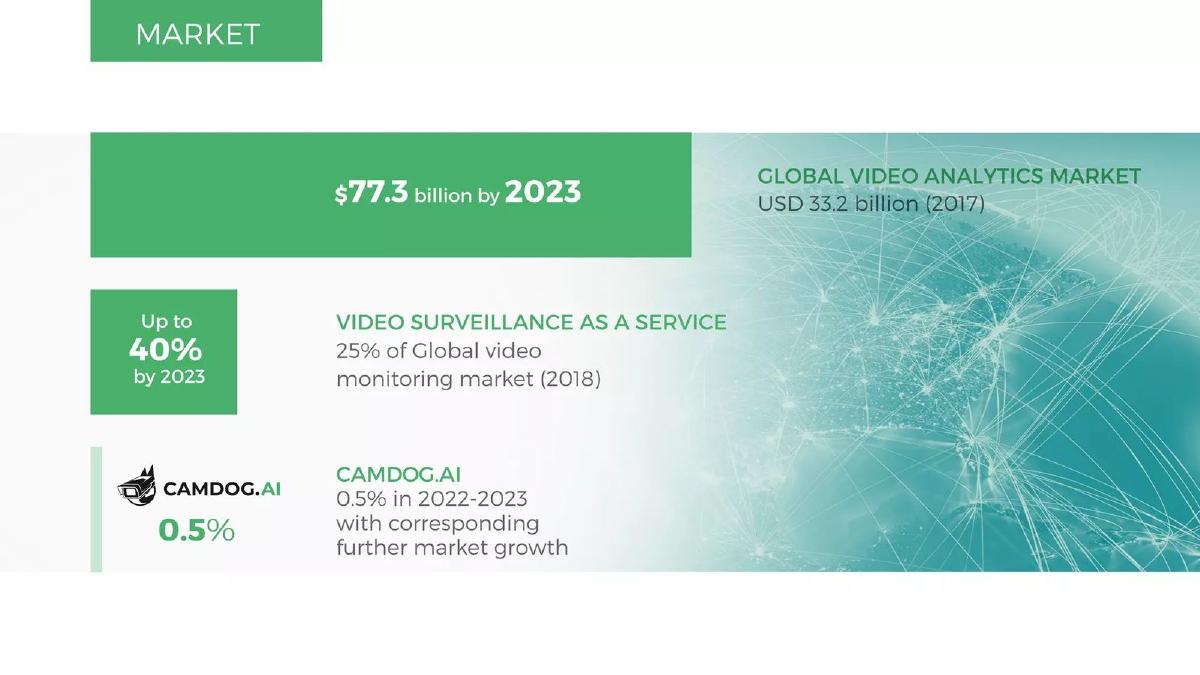
- Market projections estimate the global video analytics market reaching $77.3 billion by 2023 (Slide 5).
- The business model is a hybrid of a $49/month subscription and a $0.1/hour pay-as-you-go fee for additional time (Slide 6).
- Traction as of May 2020 included a prototype release and 60 engaged first clients during a free trial period (Slide 10).
- Revenue projections for 2021 target $60,000 in monthly revenue by December from 1,100 users (Slide 11).
- The team is led by Dmytro Usenko (CEO) with 25 years in sales and Dmytro Havriluk (CTO) with 6+ years in computer vision (Slide 12).
Slide-by-Slide Analysis
Slide 1: Title Slide
The title slide introduces Camdog.ai with the tagline "Create your own security agency" and the category descriptor "Video Surveillance as a Service." The visual elements include a smartphone interface and a close-up of a CCTV camera, immediately establishing the link between traditional hardware and mobile software.
Slide 2: Problem
Camdog identifies four core problems in the current market: professional installation requirements, difficult user interfaces, time-consuming manual searches for footage, and high costs. Specifically, it notes that the cheapest professional solutions start at $500 per license + cost of hardware . This slide effectively sets up the "cost and complexity" barrier that the company intends to break.
Slide 3: Solution
The solution slide presents a tablet interface showing a four-camera split view. Key features listed include 24/7 continuous monitoring, high detection accuracy, and lifetime storage of "decisive information." It also mentions ALPR mode (Automatic License Plate Recognition) and Camdog mode . The value proposition is centered on accessibility: "watch it from any device anywhere in the world."
Slide 4: How It Works
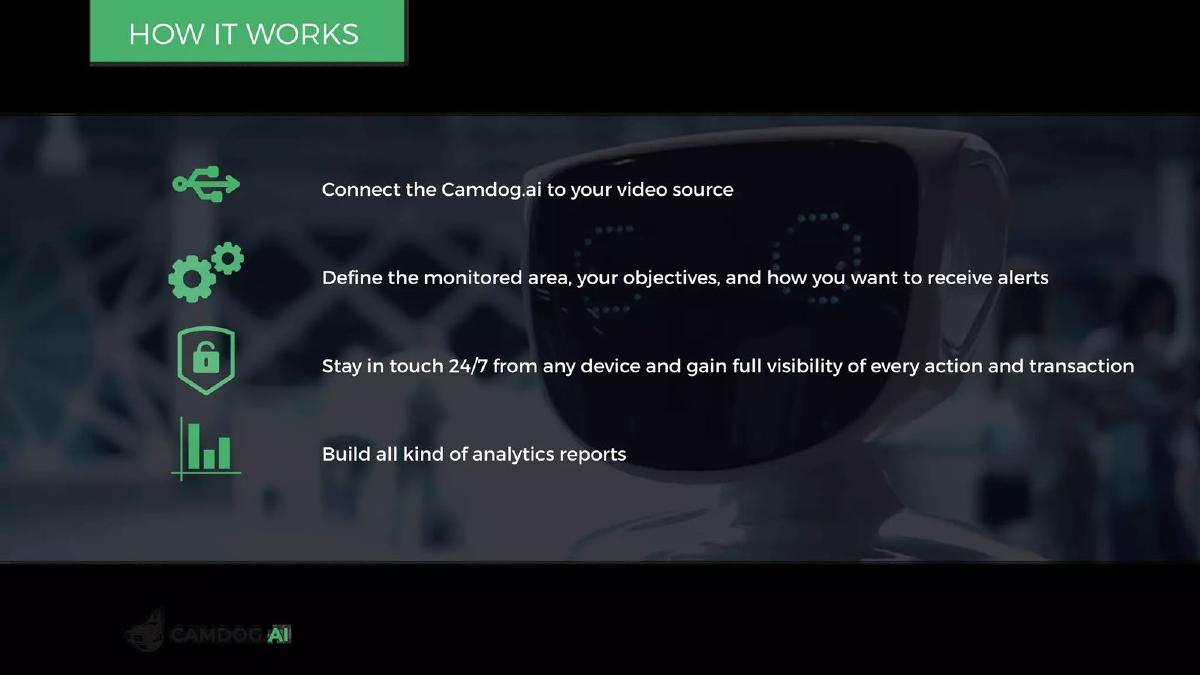
This slide outlines a four-step process: connect the video source, define monitored areas/objectives, stay in touch 24/7 via any device, and build analytics reports. The icons suggest a plug-and-play approach, emphasizing the software-first nature of the product.
Slide 5: Market
The market slide uses data from 2017 and 2018 to project 2023 figures. It claims the Global Video Analytics Market will reach $77.3 billion by 2023 . It also notes that Video Surveillance as a Service (VSaaS) represented 25% of the global market in 2018 and is expected to grow to 40% by 2023. Camdog sets a target of capturing 0.5% of the market in 2022-2023.
Slide 6: Business Model
The business model is straightforward: a $49/month subscription plus a pay-as-you-go plan of $0.1/hour for additional time. This is a classic SaaS model adapted for high-bandwidth video data, allowing for a low entry price while maintaining upside for heavy users.
Slide 7: Competitors
Camdog provides a logo cloud of 24 competitors, including Verkada, Solink, and Rhombus Systems . The slide critiques these competitors for being hardware-dependent, on-premises based, or overly expensive. By listing so many competitors, the company acknowledges a crowded market but insists its hardware-agnostic, low-cost approach is the differentiator.
Slide 8: Advantages
This slide summarizes the competitive edge into four categories: Accessible (cloud-based), Freedom of Choice (works with any camera), Smart (professional features), and Cheap (enterprise-level for a reasonable price). The statement "We don't sell hardware" is the most critical takeaway here, as it defines their capital-light business model.
Slide 9: Go-To Market Plan
The roadmap starts in November 2020 with the creation of an MVP and the start of sales. By January 2021, the goal was to validate the product in the US market. By July 2021, the target was 1,000 clients , leading to a goal of 2,000 clients and preparation for a Seed/Series A round.
Slide 10: Traction
The traction slide provides a historical timeline. The startup was founded in August 2019. By May 2020, they released the prototype featuring object/human detection and started a free trial period that engaged 60 first clients . This slide shows the company was in the very early stages of user validation at the time the deck was produced.
Slide 11: Users/Revenue Projection, 2021
This bar and line chart projects growth through 2021. It starts at 110 users and $6,600 in revenue in January, scaling to 1,100 users and $60,000 in monthly revenue by December. This implies an Average Revenue Per User (ARPU) of approximately $54.50, which aligns with the $49 base subscription plus some overages.
Slide 12: Team
The team consists of three key members: Dmytro Usenko (CEO) with 25 years in Sales and Management, Dmytro Havriluk (CTO) with 6+ years in Computer Vision, and Svetlana Lopatina (BDM) with 10+ years in Sales and Finance. The team appears to have a strong balance of technical computer vision expertise and veteran sales experience.
Slide 13: Contact Slide
The final slide provides a physical address in Claymont, DE, a website, and a contact email. It concludes with a simple "Thank You!"
What Works in This Deck
Clear Differentiation: The deck does a good job of hammering home the "no hardware" message. In a sector dominated by companies that force customers into expensive proprietary camera ecosystems (like Verkada), Camdog's hardware-agnostic stance is a compelling value proposition for cost-sensitive businesses.
Transparent Pricing: Many enterprise SaaS decks hide their pricing behind "Contact Sales" buttons. Camdog is explicit about its $49/month starting point, which helps qualify the right kind of lead and investor immediately.
Logical Flow: The deck follows the standard venture capital format (Problem, Solution, Market, Business Model, etc.), making it easy for an analyst to digest the core thesis quickly.
What Is Missing
The Ask: The most significant omission is a funding slide. While the Go-To Market slide mentions preparing for a Seed/Series A, the deck does not state how much money is being raised, the valuation, or how the funds will be allocated. This is a critical missed opportunity to drive investor action.
Unit Economics: While the revenue projections are clear, the costs are not. Video surveillance is data-intensive. The deck does not explain the margins on the $49 subscription after accounting for cloud storage and AI processing costs. Investors would want to see the Customer Acquisition Cost (CAC) vs. Lifetime Value (LTV) projections.
Technical Depth: The deck mentions "Camdog mode" and "high detection accuracy" but provides no data to back these claims. In the crowded AI field, showing a confusion matrix or specific benchmarks against industry standards would strengthen the CTO's credentials.
What a Founder Should Copy
The Competitor Logo Cloud: Slide 7 is a great example of how to acknowledge a massive competitive field without being intimidated by it. By grouping competitors by their flaws (hardware dependence, high cost), Camdog turns a crowded market into a justification for their specific niche.
The Revenue/User Chart: Slide 11 is excellent because it tracks two metrics simultaneously—users and revenue. This allows investors to see the implied ARPU and ensures the growth story is grounded in a specific volume of customers rather than just vague dollar amounts.
Problem-Solution Alignment: The transition from Slide 2 to Slide 3 is very tight. Every problem mentioned (cost, complexity, search time) is directly addressed by a feature in the solution slide. This internal consistency is vital for a persuasive narrative.
Frequently asked questions
- What is Camdog's primary value proposition?
- Camdog positions itself as an 'accessible' and 'cheap' alternative to enterprise-level security. By being cloud-based and hardware-agnostic, it removes the need for initial investments in DVRs, NVRs, or proprietary hubs. It allows users to turn existing cameras into an AI-powered security agency for a monthly subscription starting at $49.
- How does the company plan to generate revenue?
- The business model relies on a monthly subscription fee of $49. Additionally, there is a 'pay as you go' component where customers are charged $0.1 per hour for additional monitoring time. This suggests a tiered or usage-based scaling mechanism beyond the base subscription.
- What specific AI features does the platform offer?
- According to slide 3, the platform provides high detection accuracy for objects, people, and 'suspicious activity.' It also includes an ALPR (Automatic License Plate Recognition) mode and a proprietary 'Camdog mode,' though the specific technical details of the latter are not defined in the deck.
- What is the competitive landscape for Camdog?
- Slide 7 lists 24 competitors, including well-known names like Verkada, Rhombus Systems, and Eufy. Camdog differentiates itself by claiming these competitors either require specific hardware, are on-premises only, or are too expensive/multifunctional for specific client needs.
- What are the company's growth targets for 2021?
- The revenue projection slide (Slide 11) shows a goal of growing from 110 users and $6,600 in monthly revenue in January 2021 to 1,100 users and $60,000 in monthly revenue by December 2021. This represents a 10x growth in user base over 12 months.