Cambridge GaN Devices (CGD) presents a highly technical, credibility-first pitch deck that prioritizes founder expertise and intellectual property over traditional financial projections. With a team boasting over 150 patent applications and successful exits to companies like AMS and Power Integration, the deck establishes immediate authority. The core value proposition centers on 'HiGaN' intelligence—an on-chip solution that eliminates the need for the extra components typically required by standard Gallium Nitride (GaN) devices. While the deck excels at explaining the technical 'Why Now' and…
Key takeaways
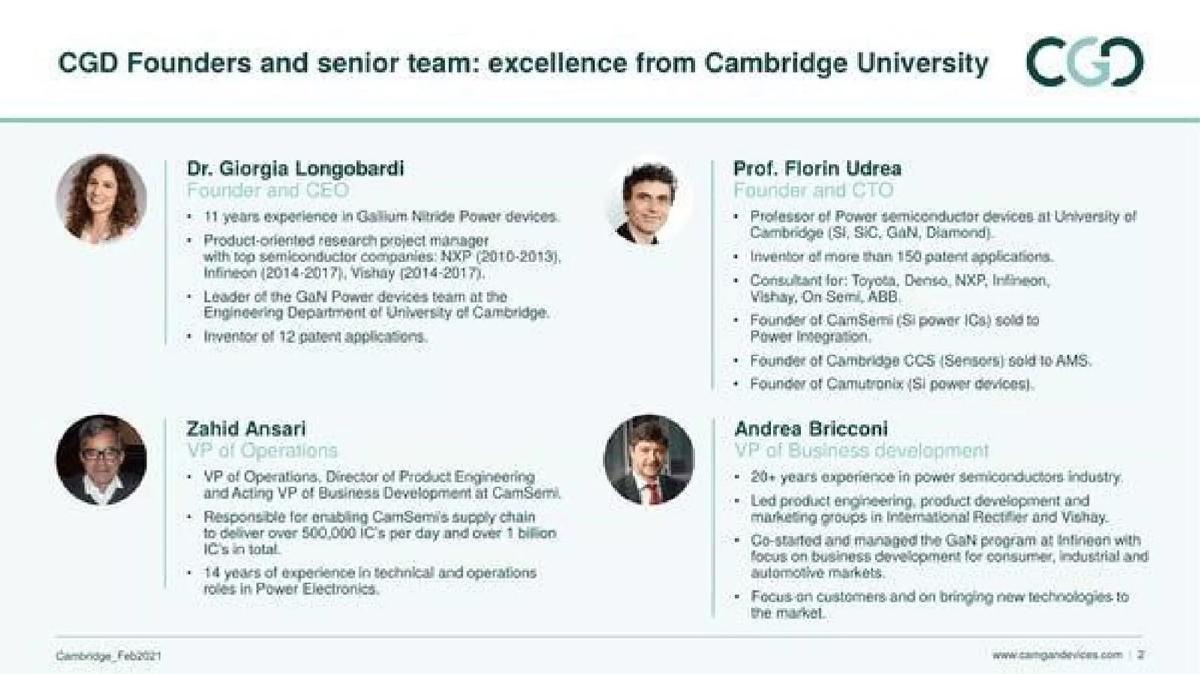
- The team slide (Slide 2) is the deck's strongest asset, highlighting founders with 150+ patents and multiple successful exits in the semiconductor space.
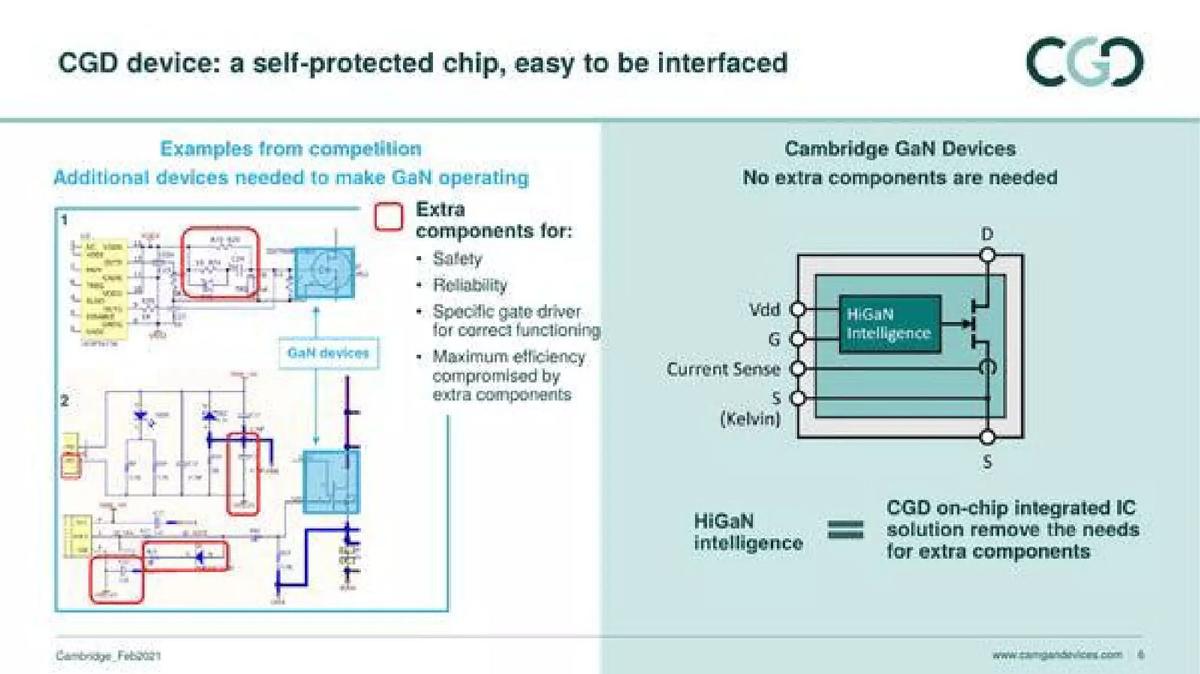
- CGD identifies a specific technical pain point: standard GaN devices require complex extra components for safety and reliability, which CGD solves with on-chip integration (Slide 6).
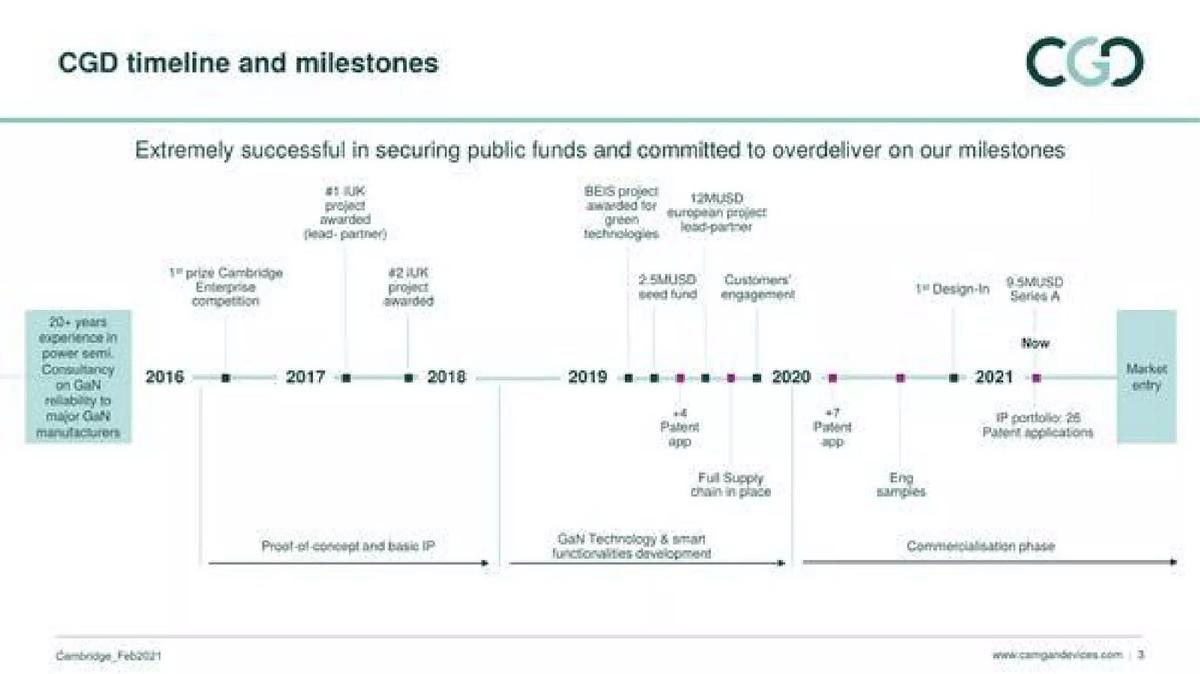
- The company has a proven track record of securing non-dilutive funding, including a 12M USD European project where they served as lead partner (Slide 3).
- Market sizing is aggressive, citing a $45 billion TAM for the broader power semiconductor market and a $1 billion specific GaN market by 2026 (Slide 7).
- The IP portfolio is a central theme, growing from 'basic IP' in 2016 to 26 patent applications by 2021 (Slide 3).
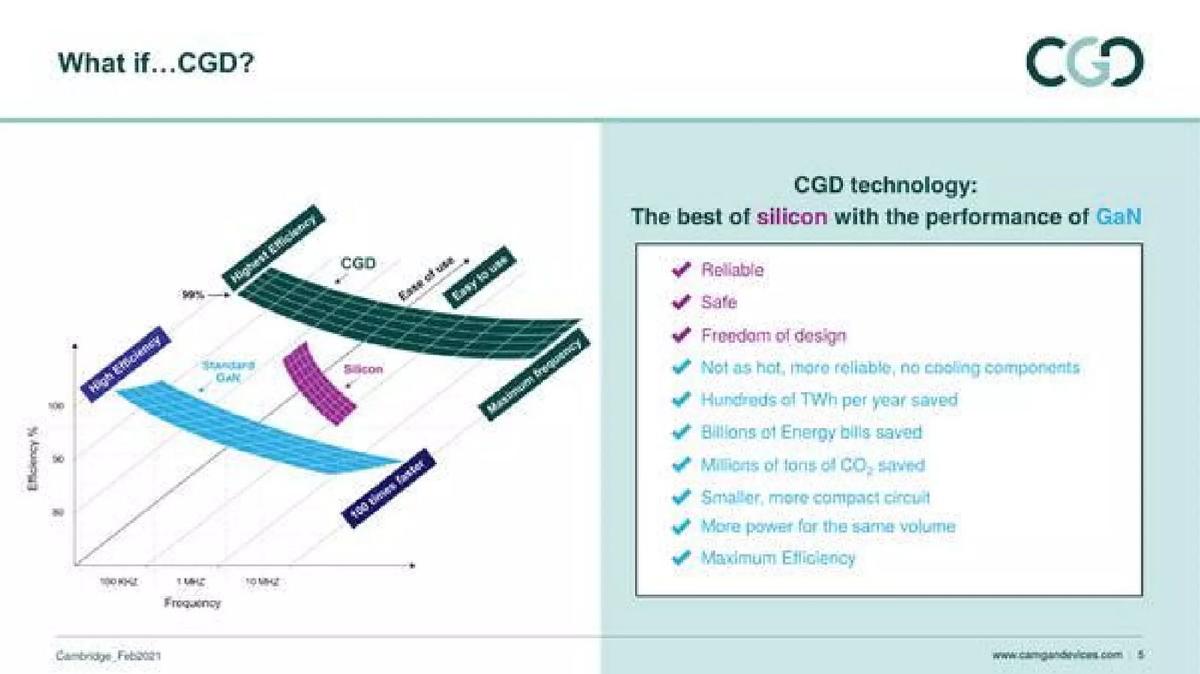
- The deck utilizes a 'What if' framework to contrast CGD against both traditional Silicon and standard GaN, claiming the 'ease of use' of the former with the 'performance' of the latter (Slide 5).
- Strategic partnerships are validated through the GaNext project, involving 13 partners across 3 countries and $12.5 million in funding (Slide 9).
- There is no slide dedicated to the investment ask, valuation, or use of proceeds, which are standard for Series B decks.
Deep Tech Credibility: The Cambridge GaN Devices Strategy
Cambridge GaN Devices (CGD) operates in the highly specialized world of power semiconductors. Their 11-slide deck is a textbook example of how a deep-tech company uses academic prestige and intellectual property as a moat. Rather than focusing on user acquisition or viral loops, CGD focuses on the physics of efficiency and the complexity of integration. The deck is dated February 2021, coinciding with their Series A/B transition period.
The Foundation: Team and Traction (Slides 1-3)
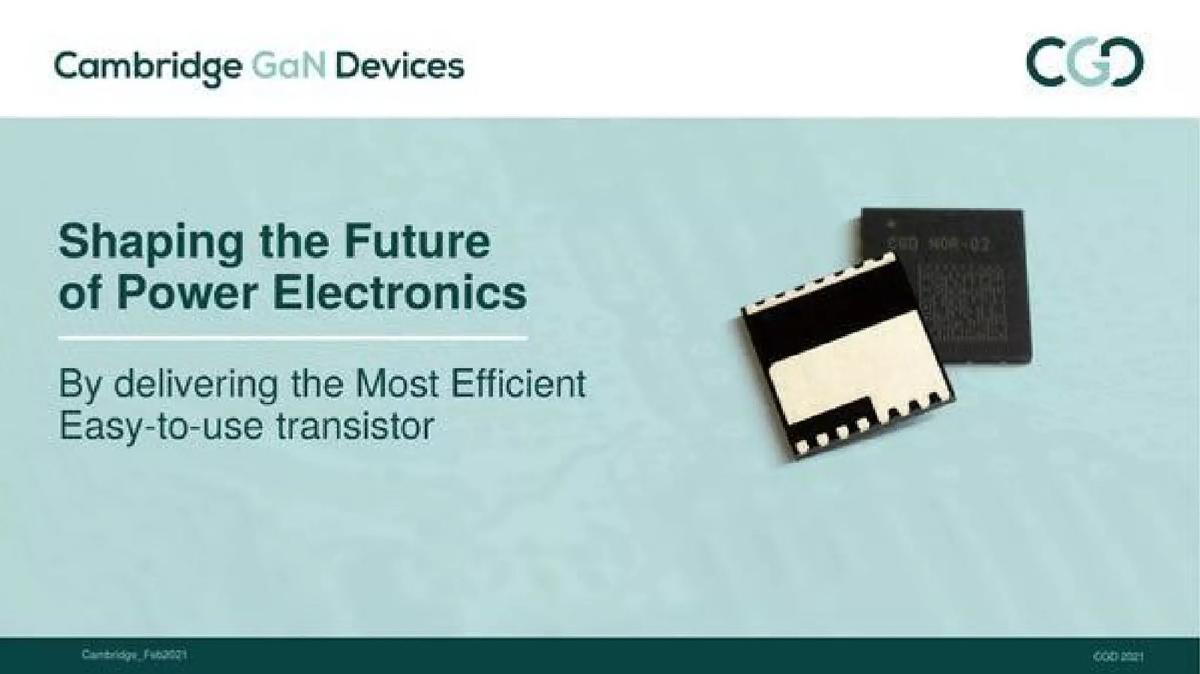
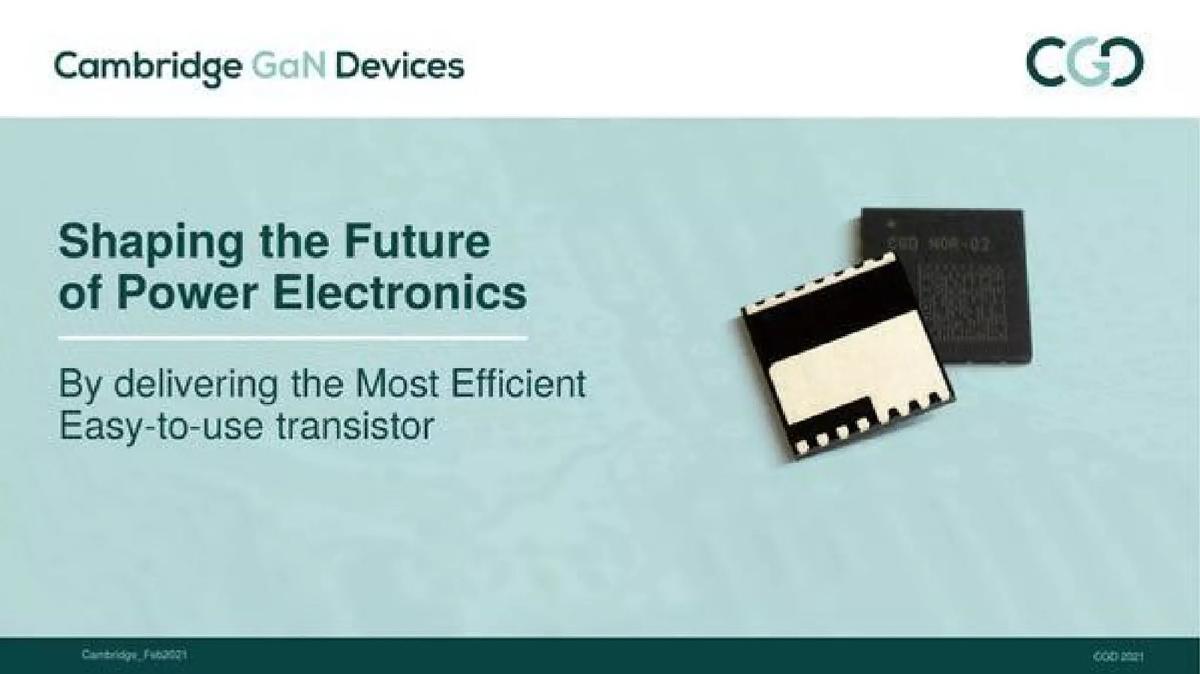
Slide 1: Title The deck opens with a clear value proposition: "Shaping the Future of Power Electronics By delivering the Most Efficient Easy-to-use transistor." The visual of the actual chip provides immediate tangibility to a highly technical product.
Slide 2: CGD Founders and senior team This is arguably the most important slide in the deck. In deep tech, the 'who' is often more important than the 'what' in early stages. The slide highlights Prof. Florin Udrea, a University of Cambridge professor with 150+ patent applications and a history of successful exits (CamSemi sold to Power Integration, Cambridge CCS sold to AMS). CEO Dr. Giorgia Longobardi adds 11 years of GaN experience. By listing past employers like NXP, Infineon, and Vishay, the team establishes that they aren't just academics—they are industry veterans who understand the supply chain.
Slide 3: CGD timeline and milestones This slide tracks the company from its 2016 inception to its 2021 "Market entry" phase. Key data points include a 2.5M USD seed fund in 2019, a 9.5M USD Series A in 2021, and the growth of their IP portfolio to 26 patent applications. The mention of being a "lead partner" in a 12M USD European project is a significant signal of technical dominance, as these grants are highly competitive and peer-reviewed.
The Problem and Technical Solution (Slides 4-6)
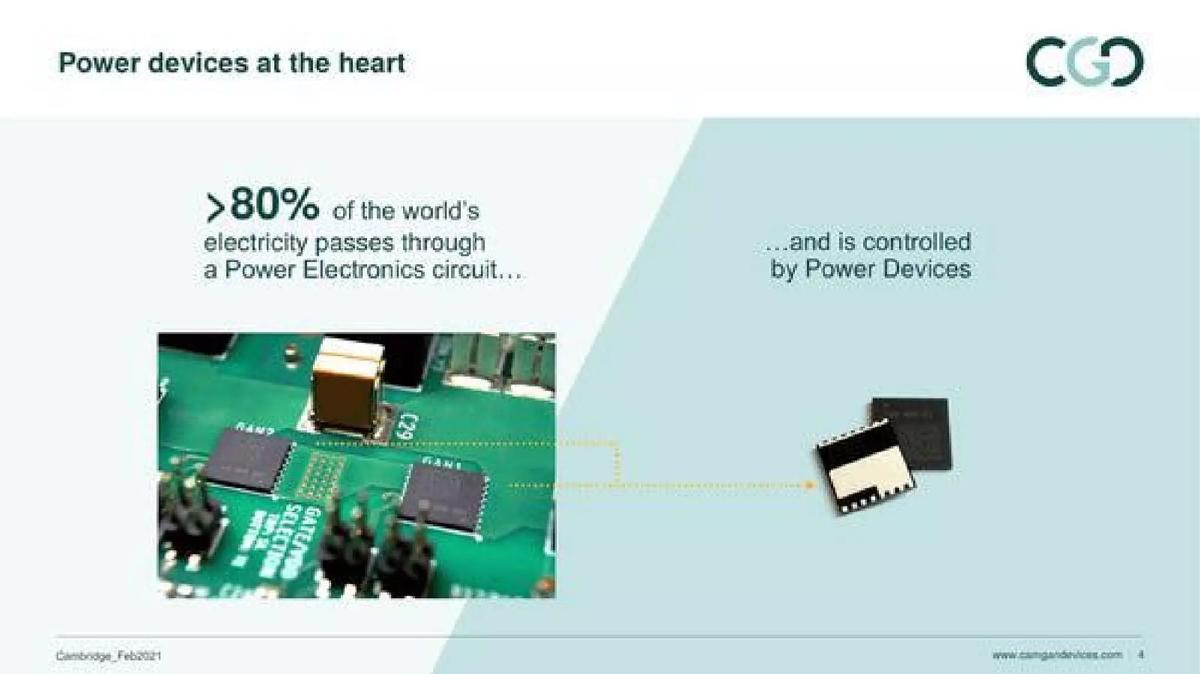
Slide 4: Power devices at the heart CGD sets the stage by noting that ">80% of the world's electricity passes through a Power Electronics circuit." This establishes the ubiquity of the problem: energy loss during power conversion is a global inefficiency.
Slide 5: What if...CGD? This slide uses a quadrant-style graph to position CGD against standard Silicon and standard GaN. The claim is that CGD offers the "highest efficiency" and "maximum frequency" while maintaining the "ease of use" of silicon. The right side of the slide lists benefits like "Billions of Energy bills saved" and "Millions of tons of CO2 saved," framing the technical product as a key ESG (Environmental, Social, and Governance) enabler.
Slide 6: CGD device: a self-protected chip This is the core technical differentiator. CGD contrasts their solution with "Examples from competition," which show messy circuit diagrams requiring "Extra components for safety, reliability, and specific gate drivers." CGD’s "HiGaN intelligence" integrates these functions on-chip. The takeaway is clear: CGD makes GaN technology plug-and-play, removing the engineering hurdles that prevent wider adoption.
Market Opportunity and Ecosystem (Slides 7-9)
Slide 7: Market opportunity CGD cites a TAM of $45 Billion for the total power semiconductor market. More specifically, they show a bar chart (sourced from IHS 2019) predicting the GaN-specific market will reach over $1bn by 2026. This shows a realistic understanding of their niche within the broader industry.
Slide 8: The markets we operate in The company identifies four key sectors: Consumer Electronics, Industrial, Data Centres, and Automotive. They provide specific KPIs for these sectors, such as "OPEX reduction by 10% or more" for data centers and "50% smaller OBCs" (On-Board Chargers) for electric vehicles. This translates technical specs into business value.
Slide 9: GaNext: an example of international cooperation This slide acts as a massive social proof engine. It lists 13 partners across 3 countries, including industry giants like Infineon and academic institutions like TU Eindhoven. Being the lead on a $12.5 million project involving their own competitors (Infineon) suggests that CGD’s IP is considered foundational by the rest of the industry.
Summary and Contact (Slides 10-11)
Slide 10: CGD gathered professionals from the industry A Venn diagram summarizes the company's strengths: Unique proposition, Market readiness, Experienced team, and University of Cambridge research. Logos from ARM, Infineon, and ABB reinforce the team's pedigree.
Slide 11: Contact The deck ends with contact information for the CEO and VP of Business Development. Notably, there is no "Ask" slide here—no mention of how much money they are looking for or what the specific terms are.
What Works in This Deck
Pedigree as a Moat: The founders don't just have degrees; they have exits and hundreds of patents. In a hardware business where R&D costs are astronomical, this level of experience reduces perceived execution risk.
Visualizing the Differentiator: Slide 6 is excellent. By showing the "messy" competitor circuit versus the "clean" CGD integrated solution, they make a complex engineering advantage understandable to a non-technical investor.
Non-Dilutive Validation: Highlighting the 12M USD and 12.5M USD grant projects shows that the technology has been vetted by government and industry bodies, which serves as a powerful proxy for due diligence.
What is Missing
The Financial Ask: There is no slide detailing how much capital is being raised in the current round or how those funds will be allocated (e.g., manufacturing scale-up, sales team expansion, further R&D).
Revenue and Projections: While the deck mentions "1st Design-In," it provides no information on current revenue, pipeline value, or projected growth. For a Series B deck, this is a significant omission.
Unit Economics: There is no mention of the cost to manufacture these chips versus the expected sale price. In the semiconductor world, margins and yield rates are critical metrics that are entirely absent here.
What a Founder Should Copy
The 'Why Now' Slide (Slide 8): CGD does a great job of linking their technology to macro trends like the electrification of cars and the growth of data centers. Founders should always tie their product to a larger, unstoppable market shift.
The Competitor Comparison (Slide 6): Instead of a standard checkmark table, CGD uses a schematic comparison. If your product simplifies a complex process, show the "before and after" or "them vs. us" visually rather than just listing features.
Leveraging Ecosystem Partners: If you are part of a consortium or have research partners, use their logos (Slide 9). It creates a sense of inevitability—if all these major players are working with you, it’s harder for an investor to say no.
Frequently asked questions
- What is the primary technical advantage of CGD's technology?
- According to Slide 6, CGD's 'HiGaN' intelligence is an on-chip integrated IC solution. Unlike competitors who require 'extra components' for safety, reliability, and specific gate driving, CGD's device is 'self-protected' and requires no additional external components. This reduces circuit complexity and prevents the efficiency compromises often caused by those extra parts.
- How does the company validate its market readiness?
- CGD uses a timeline (Slide 3) to show a progression from proof-of-concept in 2016 to '1st Design-In' and 'Eng samples' in 2020-2021. They also highlight their leadership in the GaNext project (Slide 9), a $12.5 million international cooperation involving industry giants like Infineon, which serves as a massive third-party validation of their technology's viability.
- Who are the key people behind Cambridge GaN Devices?
- The deck emphasizes a high-pedigree team from the University of Cambridge. CEO Dr. Giorgia Longobardi has 11 years of GaN experience and 12 patents. CTO Prof. Florin Udrea is a prolific inventor with 150+ patents and has founded three previous semiconductor companies (CamSemi, Cambridge CCS, and Camutronix) that were sold to major industry players (Slide 2).
- What market segments is CGD targeting?
- Slide 8 identifies four primary verticals: Consumer Electronics (power supplies), Industrial (LED drivers), Data Centres (power supplies), and Automotive (On-Board-Chargers for EVs). They specifically note that automotive and power supplies are the largest markets, with the potential to reduce EV charger sizes by 50%.
- Is there any financial information or a funding ask in the deck?
- No. The deck mentions past funding—specifically a 2.5M USD seed fund in 2019 and a 9.5M USD Series A in 2021 (Slide 3)—but it does not state the amount currently being raised, the valuation, or any revenue projections. This suggests the deck is designed for technical and strategic positioning rather than a cold-call financial pitch.