ConextVR's 11-slide deck, dated 31 May 2016, pitches a VR social network for professionals - 'the LinkedIn for VR' - with virtual event spaces, live 360 broadcasts and on-the-spot job interviews. It is well designed and unusually well sourced on its problem slide, including a primary customer survey. But it is a story deck, not a fundraising one: there is no ask, no valuation, no use of funds and no financial projection. The market slide asserts 150 million professionals adopting VR citing a LinkedIn report that contains no VR data, six revenue streams are listed with no prices, the lead acqu…
Key takeaways
- ConextVR's 11-slide May 2016 deck pitches a VR social network for professionals with no funding ask, no valuation, no use of funds and no financial projections anywhere.
- The traction slide, titled 'Our rocket ride to success!', lists four milestones and contains zero metrics - no users, no events, no revenue, no waitlist.
- The market slide claims 150 million professionals adopting VR, citing only a LinkedIn Q4 2015 financial report that discusses no VR data at all.
- Six revenue streams are listed - premium features, sponsorships, recruiter services, advertising, commissions and promotions - and not one carries a price.
- The deck positions itself as 'the LinkedIn for VR' on slide 2 and places LinkedIn as a competitor on slide 8, never reconciling the two.
- The lead acquisition channel is 'Twitterbots, web crawlers, & automated drip email campaigns' - tactics that breached platform terms of service in 2016 and now.
- The strongest asset in the deck, a CEO who was director of engineering at Netscape, gets five words on the team slide.
- The deck's best distribution idea - publishing recorded live events to YouTube 360 to reach people without headsets - gets a single line at the bottom of the go-to-market slide.
What this deck actually is
Eleven slides, dated 31 May 2016, from ConextVR — a virtual reality social network for professionals. The positioning is stated in quotation marks on slide two: "We are the LinkedIn for VR". The deck runs cover, positioning, problem, solution, market, business model, go-to-market, competition, team, traction, thanks.
It is a well-produced document. The design is consistent, the problem slide carries three footnoted sources, and the competitive 2x2 places six real named companies. Nothing here looks amateur.
What it is not is a fundraising deck. There is no ask, no amount, no valuation, no use of funds, no runway, no revenue, no financial projection of any kind, and not a single user number anywhere in eleven slides. The traction slide is titled "Our rocket ride to success!" and contains four milestones, none of which is a metric. This is a story deck — the kind you present at a demo night or attach to a first cold email — and the entire commercial half of an investor conversation is absent from it.
The deeper problem is timing. In May 2016 the Oculus Rift had shipped in March and the HTC Vive in April. The consumer VR installed base was in the low millions worldwide, overwhelmingly gamers. This deck's market slide asserts 150 million professionals adopting VR, cited to a LinkedIn financial report that says nothing about VR at all.
Slide-by-slide walkthrough
Slide 1 — Cover
The ConextVR wordmark over "Meaningful connections anytime anywhere", on a full-bleed photograph of a person in a VR headset looking up, mouth open in awe. No date, no round, no presenter, no contact details.
The image is doing something specific and worth noting: it sells the feeling of VR rather than the product. That is the correct instinct for a category most viewers in 2016 had never experienced. The tagline is weaker — "meaningful connections anytime anywhere" describes Zoom, Slack, LinkedIn and a telephone equally well, and does not contain the word that makes the company interesting.
Slide 2 — Positioning
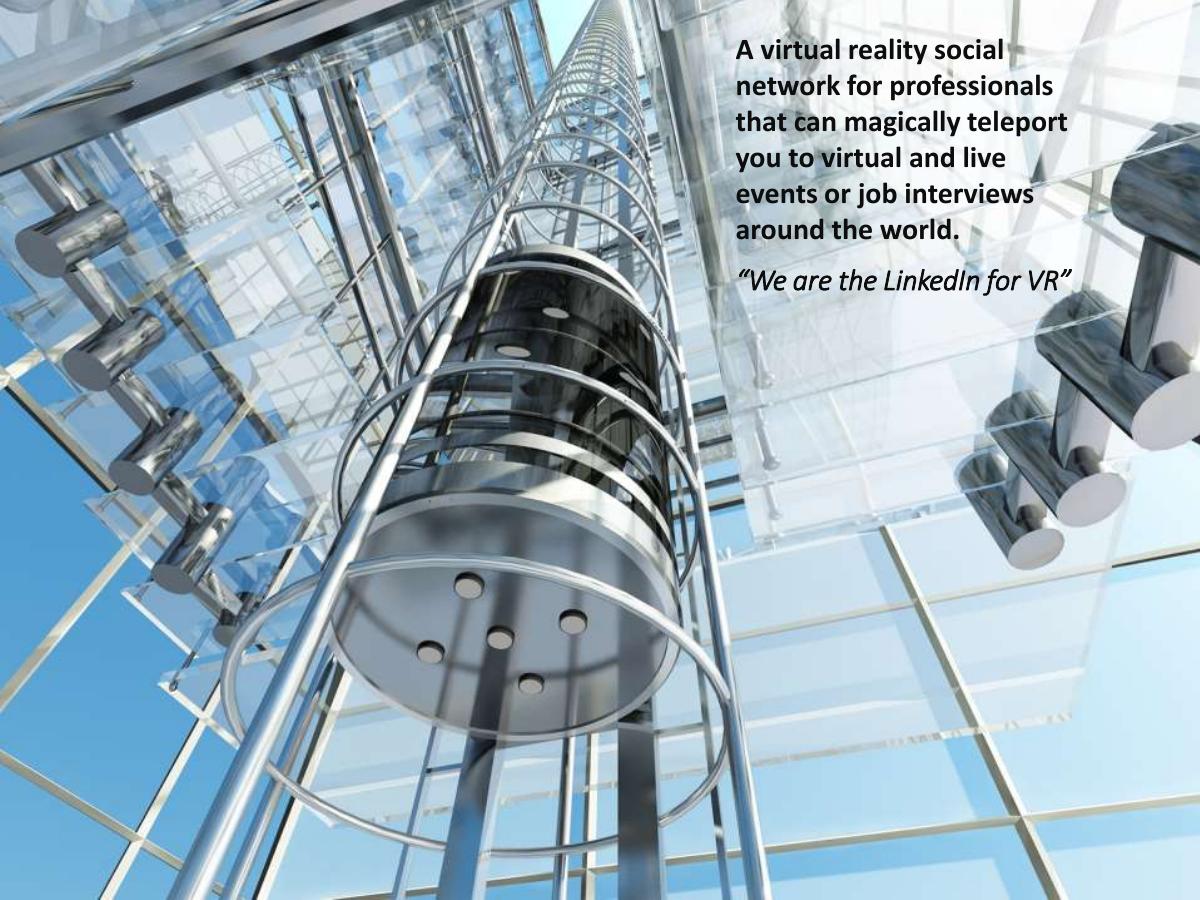
One sentence: "A virtual reality social network for professionals that can magically teleport you to virtual and live events or job interviews around the world." Underneath, in quotation marks: "We are the LinkedIn for VR".
The first sentence is genuinely good. It names the user (professionals), the mechanism (VR), and three concrete use cases (virtual events, live events, job interviews) in twenty-six words. An investor who reads only this slide understands the company.
The "LinkedIn for VR" line then undoes it. X-for-Y framing borrows credibility, but it also imports the reference company's whole business — and LinkedIn's business is a professional identity graph with 400 million profiles and a recruiting product built on top of it. Saying you are the LinkedIn for VR invites the question of what happens when LinkedIn ships a VR app, and the deck never answers it. It is also placed above the competition slide, where LinkedIn appears as a competitor. The deck compares itself to LinkedIn and competes with LinkedIn on two different pages without connecting them.
Slide 3 — Problem
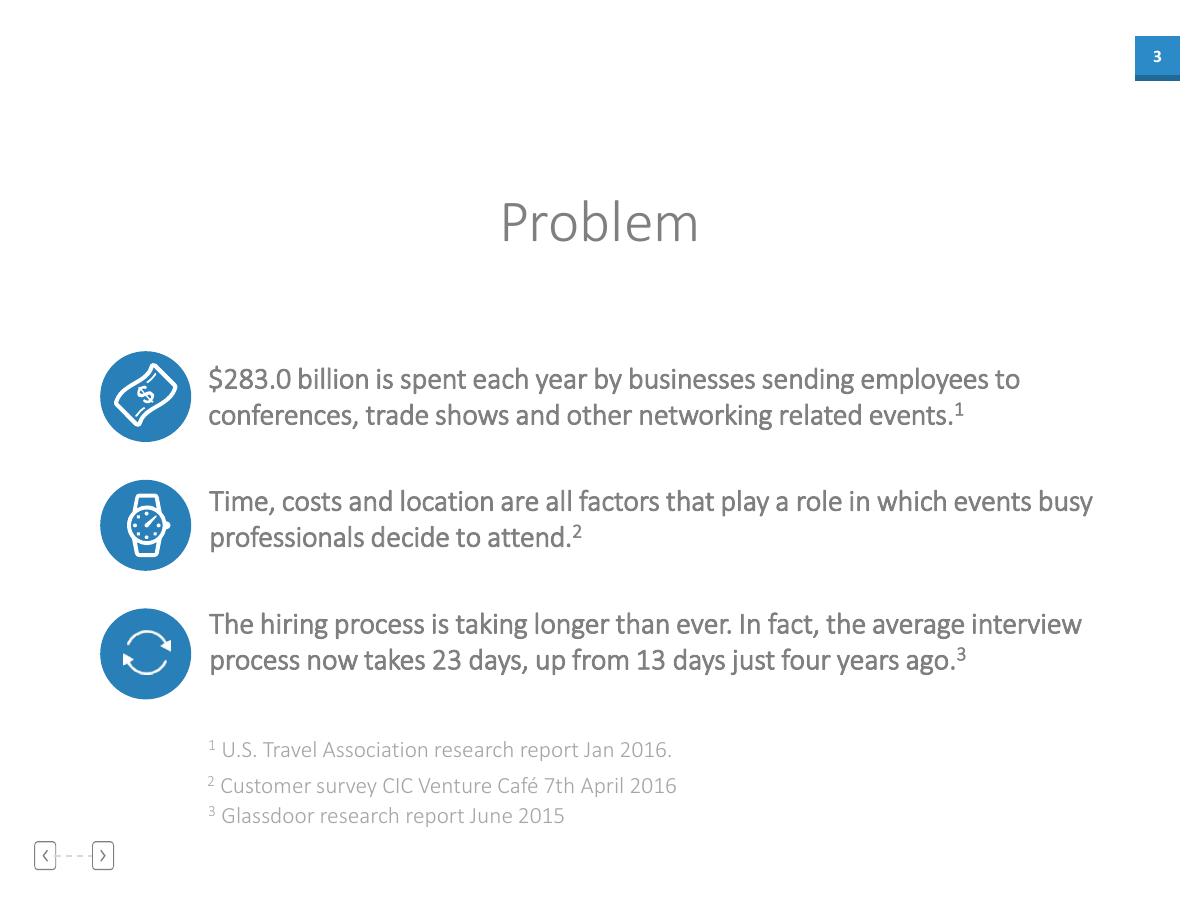
Three claims, each footnoted. $283.0 billion is spent each year by businesses sending employees to conferences, trade shows and other networking events, sourced to a U.S. Travel Association report from January 2016. Time, cost and location determine which events busy professionals attend, sourced to a customer survey run at CIC Venture Café on 7 April 2016. And the average interview process now takes 23 days, up from 13 four years earlier, sourced to Glassdoor research from June 2015.
Three footnotes on a problem slide, with the survey dated to the day and the venue named, is better sourcing practice than most seed decks manage in 2016 or now. The middle citation in particular — a primary survey the founders ran themselves — is the sort of thing investors ask for and rarely receive.
The claims still do not stack into an argument. The $283 billion is business travel spend, which is a cost the company hopes to displace, not revenue available to it; if ConextVR captured a tenth of a percent of professionals' event budgets, that would be a different and much smaller number, and the deck never converts one into the other. The 23-day interview statistic is real and interesting, but the deck does not say why length is a VR problem: an interview takes 23 days because of scheduling, screening and internal approvals, not because the candidate cannot get into the building. The mechanism connecting the pain to the product is missing on all three bullets.
Slide 4 — "Our Amazing Solution"
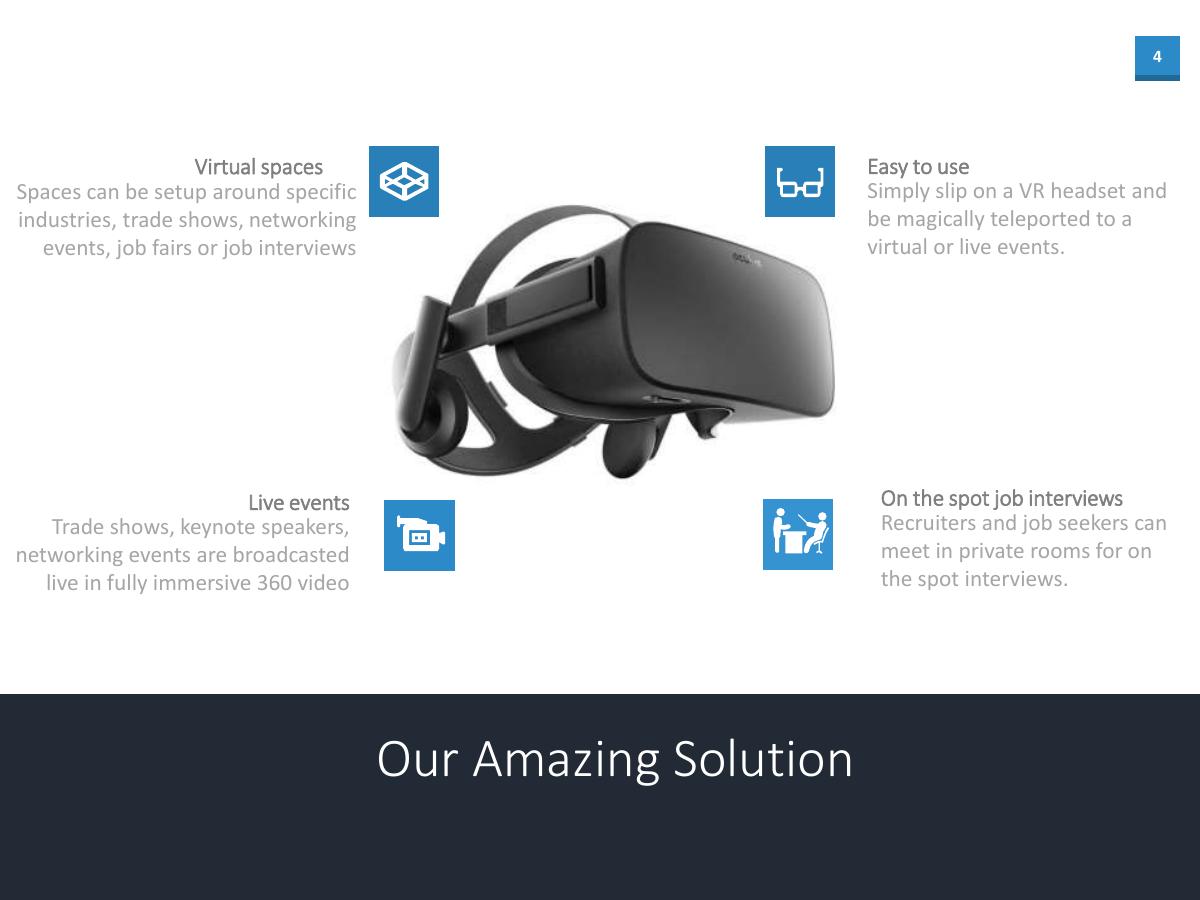
Four features with icons: virtual spaces set up around industries, trade shows, networking events, job fairs or interviews; ease of use — "simply slip on a VR headset"; live events broadcast in fully immersive 360 video; and on-the-spot job interviews in private rooms.
These are four separate products. A persistent virtual venue, a live 360 broadcast platform, a recruiting marketplace and a video interview tool have different buyers, different content pipelines and different technical problems. A seed-stage team of three is proposing all four simultaneously, and the deck offers no sequencing: nothing says which one ships first, which one is the wedge, or which one the MVP on slide 10 actually contains.
"Simply slip on a VR headset" is also the assumption the whole deck rests on, stated as if it were a feature. In May 2016 that sentence required the reader to own a Rift or a Vive, which had been on sale for eight and six weeks respectively, plus a PC capable of driving one. The deck treats headset ownership as ambient and never mentions hardware, cost, or a non-VR fallback.
The title is a small self-inflicted wound. "Our Amazing Solution" asks the reader to accept the adjective before seeing the evidence; "Solution" alone would have been stronger.
Slide 5 — Market Opportunity
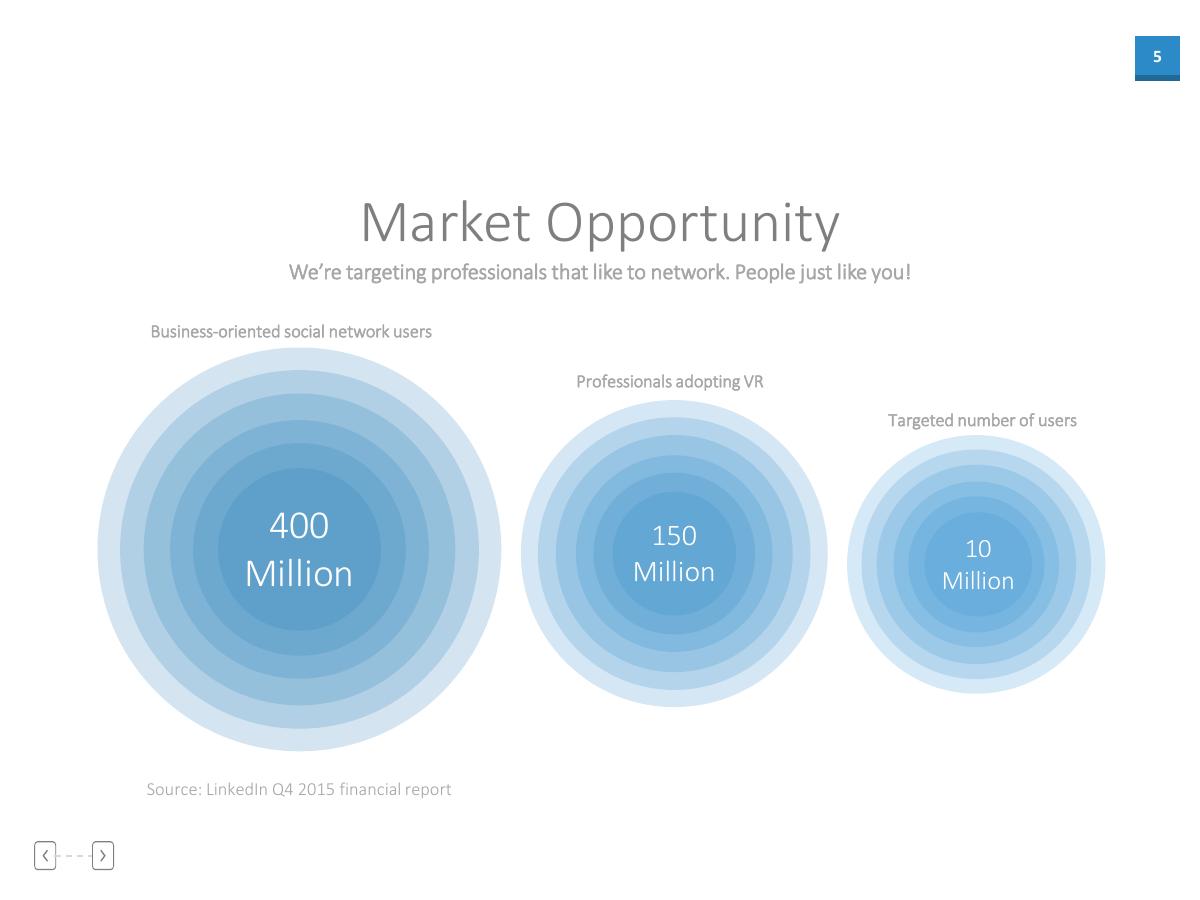
A funnel of three numbers under the line "We're targeting professionals that like to network. People just like you!": 400 million business-oriented social network users, 150 million professionals adopting VR, 10 million targeted users. One source at the bottom: LinkedIn Q4 2015 financial report.
The funnel shape is right — total, addressable, target — and shrinking to 10 million rather than claiming the whole 400 million shows restraint most decks lack.
The sourcing does not survive inspection. LinkedIn's Q4 2015 report supports the 400 million figure and nothing else on the slide. There is no citation at all for "150 million professionals adopting VR", which is the load-bearing number, because it is the step where a social network becomes a VR social network. In May 2016, shipped consumer VR headsets numbered in the low millions globally and were bought overwhelmingly by gamers. Asserting 150 million professional adopters — 37.5% of every business social network user on earth — with no source and no date is the single largest credibility gap in the deck.
The 10 million target has no basis either: no share rationale, no timeframe, no path. And no number on this slide is denominated in money. There is no TAM in dollars, no revenue per user, and therefore no way to connect this page to the six revenue streams on the next one.
Slide 6 — Business Model
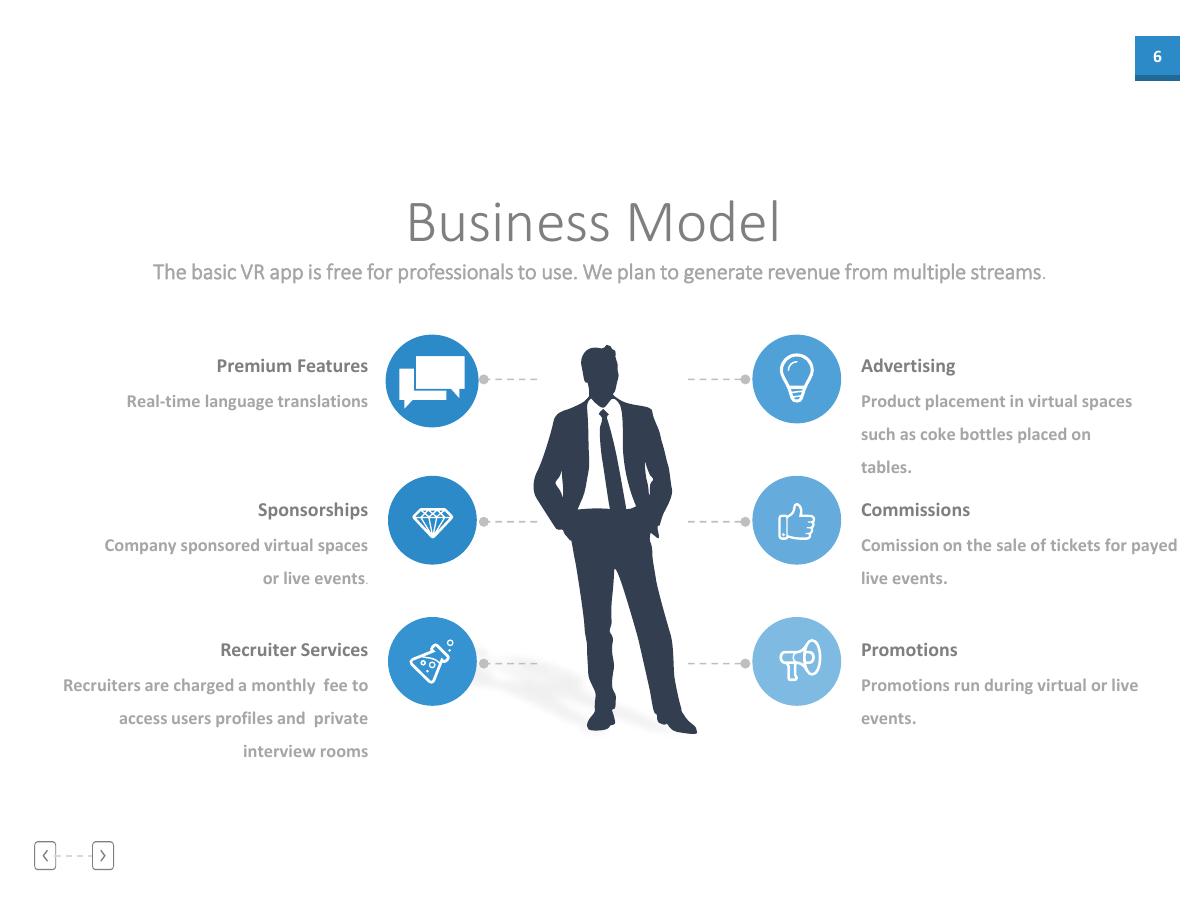
The basic app is free. Six revenue streams follow: premium features (real-time language translation), sponsorships of virtual spaces and events, recruiter services charged monthly for profile access and private interview rooms, advertising via product placement "such as coke bottles placed on tables", commissions on paid event tickets, and promotions run during events.
Six monetisation routes before a single dollar of revenue is the classic pre-revenue tell. It reads as optionality but lands as indecision: with six streams and no price on any of them, the reader cannot tell which one the company believes in. Not one carries a number — no monthly recruiter fee, no commission rate, no sponsorship price, no take rate, no conversion assumption. A business model slide with no prices on it is a list of ideas.
Recruiter services is plainly the strongest of the six. It has a named buyer with an existing budget, a monthly recurring shape, and it connects directly to the 23-day interview statistic on slide 3. It sits fourth in a list of six, formatted identically to product placement of virtual Coke bottles.
The product placement line also carries a risk the deck does not acknowledge: advertising inside a headset, in a professional networking context, with no user base yet, is the least likely of the six to produce early revenue and the most likely to damage the experience.
Slide 7 — Go-To-Market Strategy
Four channels: automated marketing ("Twitterbots, web crawlers, & automated drip email campaigns"), direct sales teams targeting recruiters and event promoters, promotional campaigns at industry events, and virality via posting live broadcast recordings to the YouTube 360 channel.
The YouTube 360 idea is the best thing on the slide and is given one line. Recording a live VR event and publishing it as a 360 video is a genuine distribution loop: it reaches people who do not own headsets, demonstrates the product, and creates a searchable artefact. It should have had the slide to itself.
The first bullet is a liability. Twitterbots and web crawlers were, in 2016 and now, against the terms of service of the platforms involved, and a deck that names them as its lead acquisition channel is telling an investor that the growth plan carries platform-ban risk. Combined with automated drip email, the top-of-funnel strategy for a professional network is functionally unsolicited outreach at scale — an odd foundation for a product whose promise is "meaningful connections".
Direct sales to recruiters is the right motion for the strongest revenue line, but there is no sales team on the team slide and no budget anywhere. Nothing on this slide has a cost, a target or an owner.
Slide 8 — Competition
A 2x2 with business-versus-consumer on one axis and online-versus-virtual-reality on the other. LinkedIn sits in business/online. Facebook, Twitter and Google+ sit in consumer/online. AltspaceVR and vTime sit in consumer/VR. ConextVR sits alone in business/VR.
Using six real named companies with real logos and placing two actual VR competitors — AltspaceVR and vTime, both live in 2016 — is more honest than the average competition slide, which tends to invent axes until the empty quadrant appears.
But this is still an empty-quadrant slide, and the quadrant is empty for a reason the deck should have addressed: in mid-2016 there were almost no professionals in VR to network with. An empty box can mean an unserved market or an unproven one, and the deck asserts the first without arguing against the second.
Three things are missing. There is no comparison of features — nothing on what ConextVR does that AltspaceVR, which already ran live events and talks in VR, could not. There is no moat: no technology, no exclusive event content, no data, no network effect described. And Facebook, in the box marked consumer/online, had acquired Oculus two years earlier — the one competitor with a stated plan to move into ConextVR's quadrant is positioned on the slide as if it were staying put.
Slide 9 — Meet The Team
Three people under the line "A team oozing both technical and business experience". Mark Neville, CTO, "serial entrepreneur with an extensive technical background". Delon Dotson, CEO, "director of engineering for Netscape". Tommy-Lee Neville, "3D artist and Blender ninja" — with no title.
Netscape is a strong credential and it is stated in five words. Director of engineering at one of the defining internet companies is exactly the kind of background that earns a first meeting, and the deck spends less space on it than on virtual Coke bottles. No years, no team size, no what-happened-next, no other companies.
The other two entries are thinner still. "Serial entrepreneur with an extensive technical background" names no company the entrepreneur was serial about. "Blender ninja" is a tool proficiency, not a role, and the third team member is the only one with no job title on the slide. Two of the three share a surname, which is unremarkable in itself but goes unmentioned in a deck that otherwise never explains why these three people are the ones to build this.
Three people, no advisors, no VR-specific credential anywhere, and no one whose background is events, recruiting or enterprise sales — the three markets the business model depends on.
Slide 10 — Traction
Four milestones under "Our rocket ride to success!", running bottom to top: idea formation in September 2014 working on artificial intelligence and VR/AR; a pivot in January 2016 to VR social networking for professionals, when ConextVR was born; "Prefect Fit" — face-to-face customer surveys run to validate product/market fit; and MVP complete, with full consumer rollout planned for Q3 2016.
This is the slide that decides the meeting, and it contains no numbers. Not one user, sign-up, waitlist entry, event hosted, minute watched, recruiter contacted or dollar earned. "Ran face-to-face customer surveys" does not say how many people, what was asked or what they answered — and the survey is cited on slide 3 as a source, so the data exists somewhere and is not shown. "MVP complete" does not say what the MVP does or who has used it.
The timeline also works against the company when read carefully. Founded September 2014 on AI and VR/AR, pivoted January 2016, deck dated May 2016 — so nearly eighteen months went into a different idea, and the current one is four months old with a full consumer rollout promised for the quarter starting six weeks later. Neither the eighteen months nor the six weeks is explained.
And the heading contains a typo. "Prefect Fit" on a slide titled "rocket ride to success", in a deck with no metrics on it, is the detail a reader remembers.
Slide 11 — Thanks For Listening!!
Two exclamation marks, and one contact route: info@conextvr.com.
The deck ends with no ask, no amount, no valuation, no use of funds, no milestones, no named person to reply to, and a generic inbox. A reader who wanted to invest at this moment has been given an info@ address and nothing to respond to.
What this deck does better than most startup pitch decks
The one-sentence positioning is genuinely clear. Twenty-six words that name the user, the mechanism and three use cases. · The problem slide cites three sources. Named, dated, and one of them a primary survey the founders ran themselves at a specific venue on a specific day. · The market funnel narrows. 400m to 150m to 10m shows restraint where most decks claim the top number as their market. · Real named competitors, including two in VR. AltspaceVR and vTime were live products and appear by name rather than being ignored. · The Netscape credential is real. Director of engineering at Netscape is a first-meeting credential on its own. · The cover sells the feeling of the category. For a product most readers had never tried, an image of awe does more than a screenshot would. · The YouTube 360 loop is a real distribution idea. Publishing recorded live events reaches the 99% of the audience without a headset. · The pivot is disclosed. Many decks quietly rewrite their founding date; this one states that the company did something else until January 2016.
Where this deck would fail in an investor meeting
There is no ask. No amount, no round, no valuation, no equity, no instrument, no use of funds, no runway. · There are no financial projections. Not one dollar figure of forecast revenue anywhere in eleven slides. · The traction slide has no metrics. Four milestones, zero users, zero events, zero revenue, zero waitlist. · The headline VR number is uncited. "150 million professionals adopting VR" is sourced only by a LinkedIn financial report that does not discuss VR. · The market is never denominated in money. Three user counts, no TAM, no revenue per user, no link to the six revenue streams. · Six revenue streams, none priced. No recruiter fee, no commission rate, no sponsorship price, no conversion assumption. · Four products at once. Virtual venues, live 360 broadcast, a recruiting marketplace and interview rooms, with no sequencing and no stated wedge. · Headset ownership is assumed away. "Simply slip on a VR headset" in the quarter the Rift and Vive shipped, with no hardware, cost or fallback discussion. · The lead acquisition channel breaks platform rules. Twitterbots and web crawlers as bullet one on the go-to-market slide. · No moat. No technology, content exclusivity, data or network-effect argument against AltspaceVR, vTime or anyone else. · Facebook is mispositioned. The company that had owned Oculus for two years is placed in the consumer/online quadrant as if it would stay there. · "LinkedIn for VR" is both the pitch and the competitor. Stated as positioning on slide 2, placed as a rival on slide 8, reconciled nowhere. · The team slide is three lines long. No years, no prior companies beyond Netscape, no title for the third member, no advisors. · Nobody on the team is from events, recruiting or enterprise sales — the three markets the revenue depends on. · The rollout date is six weeks after the deck with no launch plan, no beta cohort and no readiness evidence. · Survey data is cited but never shown. The customer survey backs a claim on slide 3 and produces no reportable findings on slide 10. · A typo on the traction slide. "Prefect Fit", in the section claiming product/market fit. · The close is a generic inbox. "Thanks For Listening!!" and info@, with no named contact and nothing to say yes to.
Story deck vs fundraising deck
Element What ConextVR's deck shows What a seed fundraising deck needs
Close "Thanks For Listening!!" and info@ Ask, valuation, use of funds, named contact
Traction Four undated-by-metric milestones Users, retention, events run, revenue, growth rate
Market 400m / 150m / 10m users Dollar-denominated TAM, revenue per user, share path
Business model Six unpriced streams One or two priced streams with unit economics
Product Four features presented in parallel One wedge, with the rest as roadmap
Competition 2x2 with an empty quadrant Feature comparison plus a stated moat
Team Three one-line bios Prior companies, years, why this team wins this market
Adoption risk Not mentioned Headset installed base, and the plan if it grows slowly
How you would rebuild this deck without changing the company
Pick the recruiting wedge and lead with it. Recruiter subscriptions have a named buyer, an existing budget and a stated pain on slide 3. Make the company "on-the-spot VR interviews for recruiters" and demote the other three products to roadmap. · Put the survey data on the traction slide. How many professionals, what they were asked, what percentage said they would attend an event in VR. The research exists; it is cited as a footnote and never reported. · Cite the VR number or drop it. Replace "150 million professionals adopting VR" with the real 2016 installed base and a growth forecast from a named analyst, then show the target share against that. · Convert the market into dollars. Recruiter seats times monthly fee, or events times ticket commission. One line of arithmetic beats three user counts. · Price two revenue streams, cut the other four. A monthly recruiter fee and an event commission rate, each with a number. Product placement can wait until there is an audience to place products in front of. · Address the headset problem head-on. One slide on installed base, on the desktop or mobile fallback, and on what happens to the plan if VR adoption is slower than hoped. · Replace the Twitterbots bullet with the YouTube loop. Make recorded 360 event footage the lead channel: it is compliant, it compounds, and it reaches people without headsets. · Answer AltspaceVR directly. A feature table against the two named VR competitors, plus one sentence on what happens when Facebook applies Oculus to professional networking. · Expand the team slide. Years and companies for each founder, the full Netscape story, a title for the third member, and any advisor with events or recruiting credibility. · Add the ask slide the deck never had. Amount, instrument, runway in months, a percentage split of the spend, and the three metrics that will be true when the money is gone. · Fix the typo and cut the exclamation marks. "Prefect Fit" and "Thanks For Listening!!" both cost credibility for free.
The transferable lesson
ConextVR's deck is a good story told well. The positioning sentence is sharp, the problem is sourced, the competitors are real, and one founder has a credential that opens doors. If the objective was to make a stranger understand and like the idea in ninety seconds, the deck works.
It fails at the second job, which is to make that stranger able to act. There is no number to underwrite, no price to model, no metric to diligence and no request to accept or decline. An investor who finishes this deck feeling positive has nowhere to put that feeling except an info@ inbox.
Most founders build the first deck and assume it is the second. The test is quick: after your last slide, could a reader who wanted to invest state the amount, the terms and what the money buys? If the answer is no, the deck is a story, and stories do not close rounds — they only earn the meeting where the numbers get asked for. Have those numbers ready, and put them in the deck.
Frequently asked questions
- What was ConextVR?
- ConextVR was a virtual reality social network for professionals, pitched in 2016 as 'the LinkedIn for VR'. The product proposed virtual spaces built around industries and trade shows, live events broadcast in 360 video, and private rooms where recruiters and candidates could hold on-the-spot job interviews. The company started in September 2014 working on AI and VR/AR and pivoted to professional VR networking in January 2016.
- Is the ConextVR deck a real investor pitch deck?
- It is a story deck rather than a fundraising deck. It has the narrative sections an investor expects - problem, solution, market, business model, go-to-market, competition, team, traction - but it contains no funding ask, no valuation, no equity, no use of funds and no financial projections. It ends on 'Thanks For Listening!!' and a generic info@ email address, leaving a persuaded reader with nothing to act on.
- What is the biggest weakness in the ConextVR pitch deck?
- The traction slide. It is the page an investor reads first and it contains no numbers at all - four milestones covering idea formation, a pivot, customer surveys and a completed MVP, with no users, sign-ups, events hosted or revenue. The founders ran a face-to-face customer survey that is cited as a source on the problem slide, so the data exists and is simply never reported.
- Why is ConextVR's market slide a problem?
- It funnels 400 million business social network users to 150 million professionals adopting VR to a 10 million target, with one citation: LinkedIn's Q4 2015 financial report. That source supports the 400 million figure only. The 150 million VR figure is the load-bearing number and it has no source, in a quarter when the Oculus Rift and HTC Vive had just launched and the global consumer VR installed base was in the low millions.
- How should a deck in an unproven category handle adoption risk?
- Name it and price it. State the current installed base honestly, cite a named forecast for growth, show the target share against that forecast rather than against the total professional population, and describe the fallback - a desktop or mobile experience that works without hardware. Investors discount decks that assume a hardware wave; they engage with decks that show what happens if the wave is slow.
- Which ConextVR slides should founders copy?
- The positioning slide, for describing the user, the mechanism and three use cases in one 26-word sentence. The problem slide, for footnoting all three claims including a primary customer survey with a named venue and date. And the competition slide, for using six real named companies with logos, including two direct VR rivals, instead of inventing axes until the field looks empty.