Confection’s deck is a narrative-driven pitch centered on the obsolescence of third-party cookies. The company positions itself as a 'path to salvation' for marketers who will lose access to ad targeting and engagement tracking once Google Chrome phases out cookies. The product is described as a server-side script that collects data in a way browsers cannot block, while remaining GDPR/CCPA compliant. While the deck excels at establishing a sense of urgency—predicting a 'winner-take-all' scenario—it lacks traditional venture metrics. There is no mention of current revenue, specific customer na…
Key takeaways
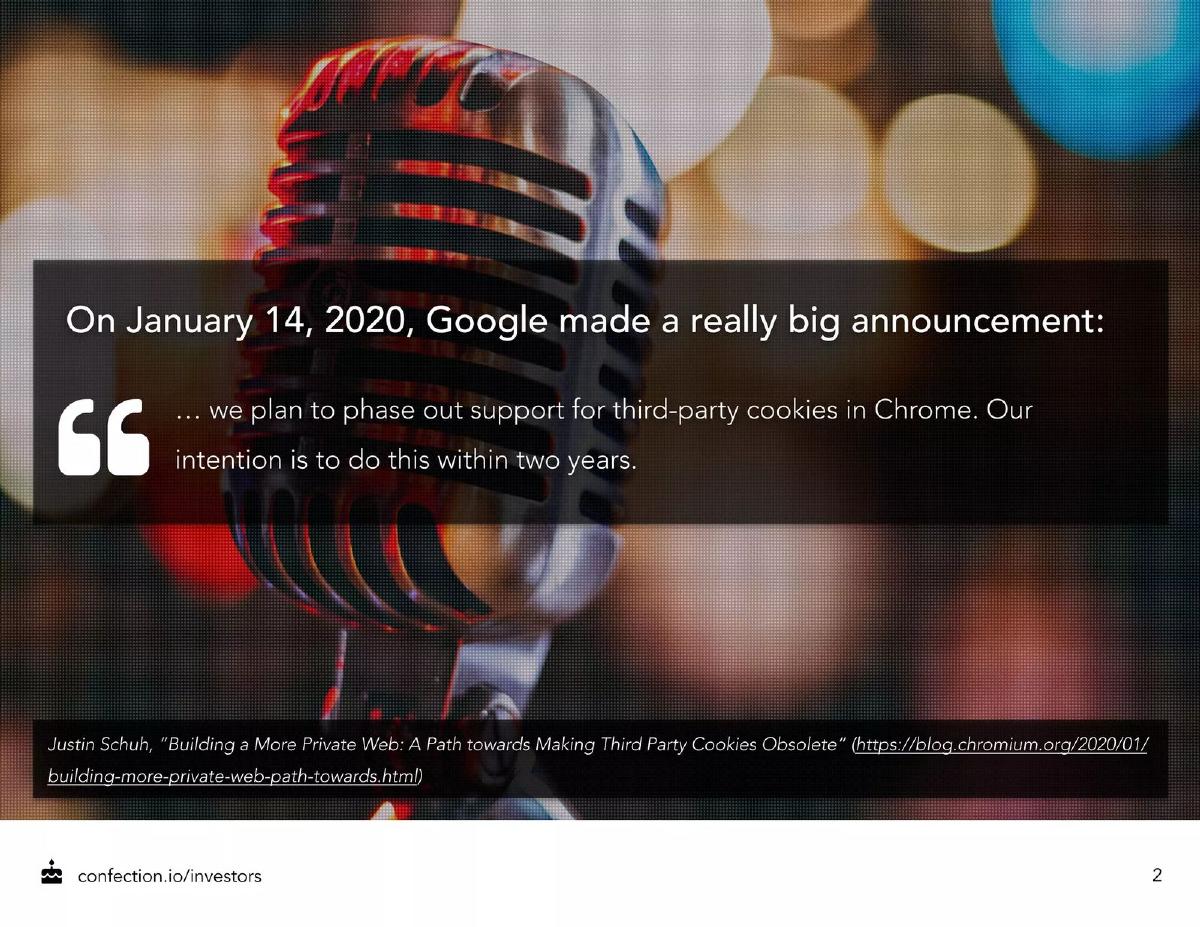
- The deck identifies a specific market catalyst: Google's January 14, 2020, announcement to phase out third-party cookies within two years (Slide 2).
- The solution is a server-side script that collects form data and other information traditionally managed by cookies in a way that is 'un-blockable' (Slide 13).
- Confection proposes a usage-based business model with monthly fees ranging from $99 for 1,000 requests to $499 for 10,000 requests (Slide 22).
- The company anticipates a 'winner-take-all' market dynamic, aiming to capture the value of the discarded cookie market in a matter of weeks (Slide 19).
- A significant portion of the requested funds (50%) is earmarked for a 'PaaS Reserve' and marketing to handle rapid scaling during 'Uh-Oh Day' (Slide 23).
- The deck lacks a comprehensive team slide, listing only founder Quimby Melton on the final contact page (Slide 23).
- Growth projections are purely hypothetical, showing a jump from $0 to $100,000,000 based on a '100x growth' scenario at $100 MRR per user (Slide 21).
- The roadmap targets a potential exit within 24-36 months of the 2020 seed round (Slide 20).
Executive Summary
Confection’s investor deck, dated July 2020, is a classic 'market shift' pitch. It relies almost entirely on the disruption caused by privacy changes in the web browser ecosystem. The deck is structured to build fear, uncertainty, and doubt (FUD) regarding the future of digital marketing, then presents Confection as the technical 'salvation.' While the narrative is compelling, the deck is light on the operational realities of the business, such as current traction or team depth.
The Macro Catalyst (Slides 1-9)
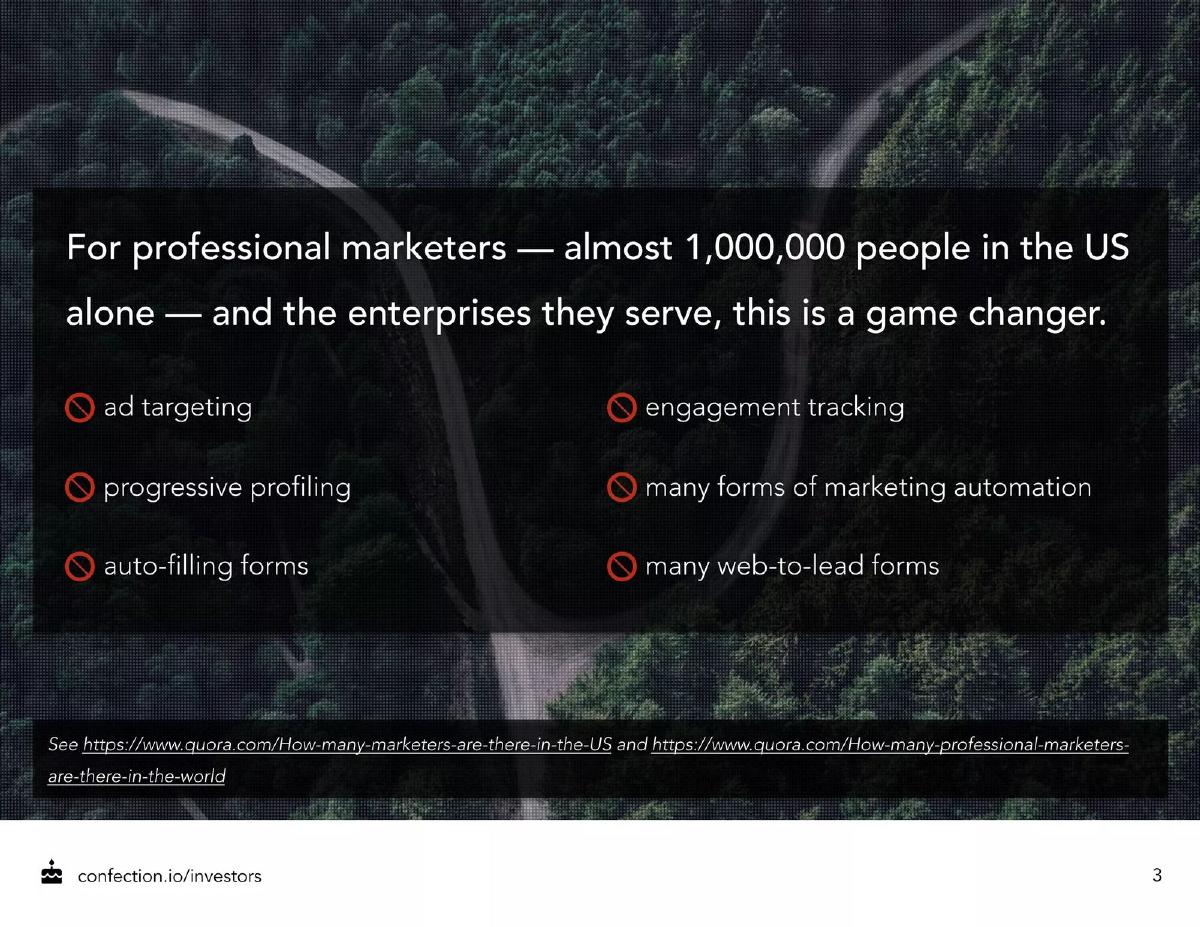
The deck opens by anchoring the company's existence to a specific date: January 14, 2020. Slide 2 quotes Google’s announcement to phase out third-party cookies in Chrome within two years. This sets the stage for the 'Problem' section. Slide 3 quantifies the impact, noting that nearly 1,000,000 marketers in the US will see their playbooks for ad targeting, engagement tracking, and lead forms become obsolete.
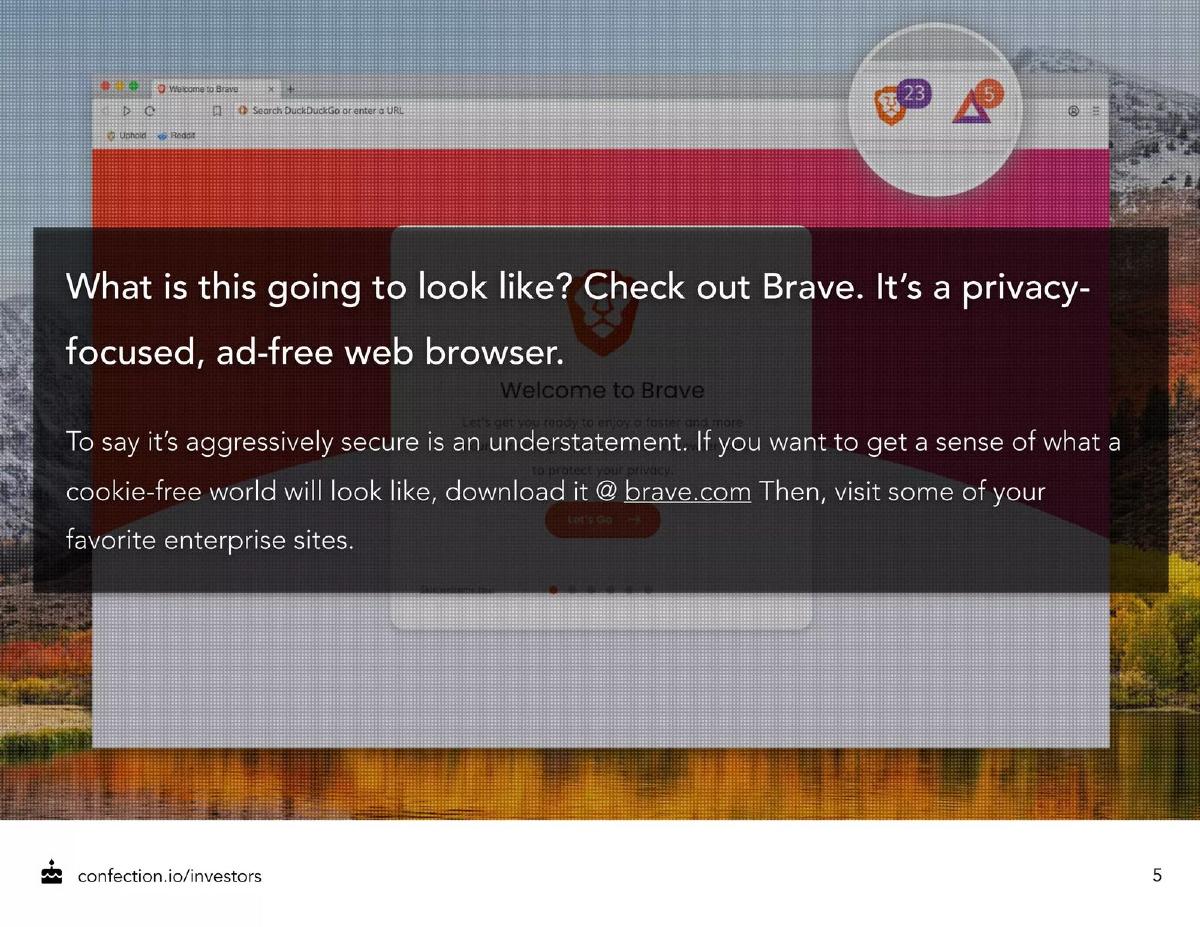
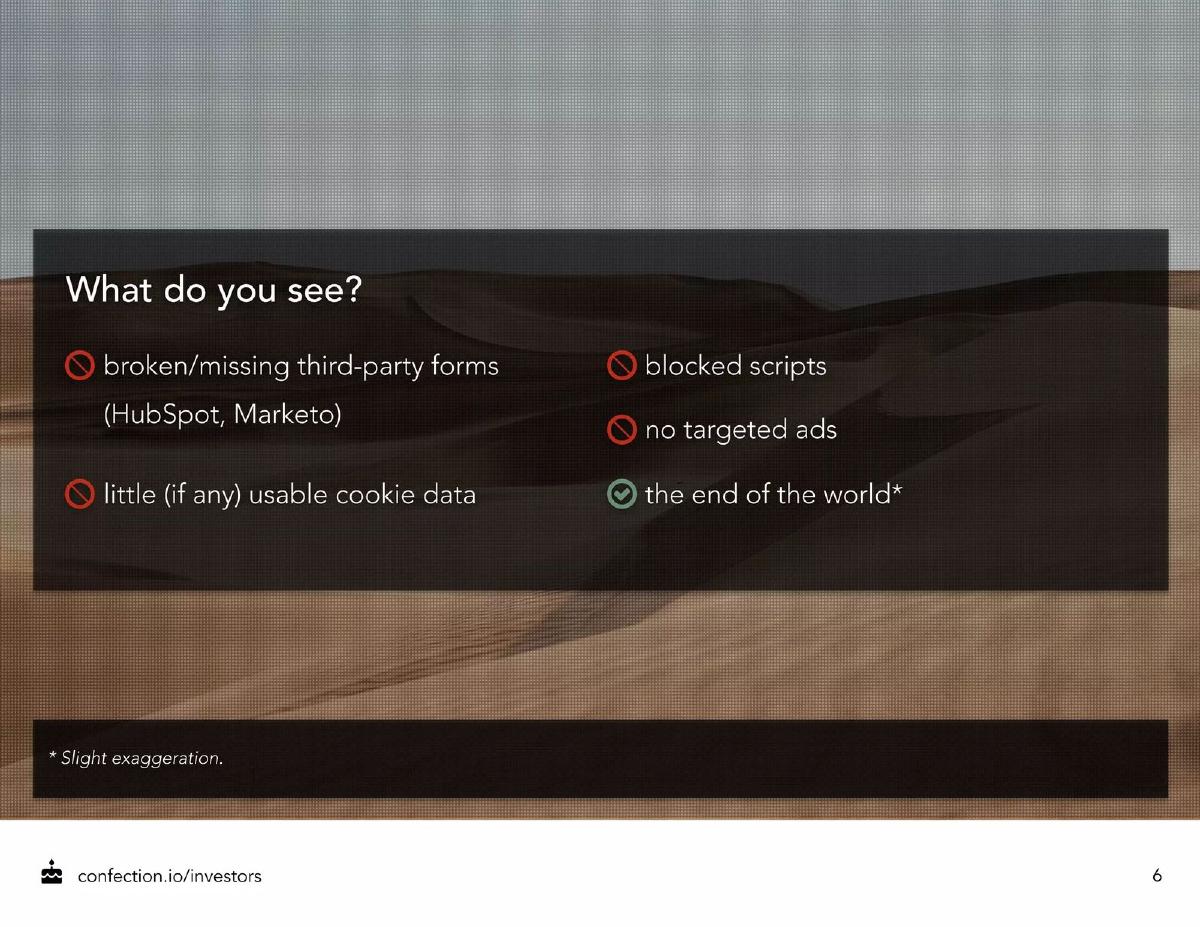
To illustrate the future, Slide 5 points to the Brave browser as a precursor to a cookie-free world. Slide 6 lists the consequences of this shift: broken forms, blocked scripts, and no targeted ads. The deck takes a swipe at Google in Slide 7 , suggesting that the move toward 'walled gardens' is a monopoly move disguised as GDPR compliance. Slide 8 uses a pie chart to show that while Brave is currently small (8M MAU vs Chrome's 1B MAU), the 'Chrome experience' will soon mirror Brave’s privacy restrictions, affecting 60%+ of web users ( Slide 9 ).
The Solution and Product (Slides 10-14)
Slide 10 introduces Confection as a 'data management solution for the post-cookie world.' The value proposition is split three ways on Slide 11 : it is good for business (un-blockable, easy to install), good for people (GDPR compliant, allows data monetization), and good for investors (rapid scale). Slide 12 makes a bold claim that if data had been platform-agnostic since the 90s, 'the data stores at Google and Facebook look pretty quaint.'
The technical workflow is visualized on Slide 13 . It shows a four-step process: 1. Businesses install a single server-side script. 2. Confection collects form data in a way browsers cannot block. 3. Data flows out via API. 4. Data is sent to existing apps like CRMs. Slide 14 emphasizes user control, stating the system allows people to opt out, be forgotten, and even monetize their own data.
The 'Uh-Oh Day' Strategy (Slides 15-19)
The middle of the deck focuses on the timing of the investment. Slide 15 asks 'Why are you raising money?' and introduces the concept of 'Uh-Oh Day.' Slide 16 uses a Google Trends chart to argue that while awareness of 'post cookie' issues is currently low, interest will spike violently when the technology actually breaks. Slide 17 defines 'Uh-Oh Day' as the moment people wake up to find their ads and forms are no longer working.
Slide 18 positions the fundraise as a way to prepare for this inevitable rush. Slide 19 contains the most aggressive language in the deck, using the hashtag #yoink to describe their goal: to capture the total accumulated value of the cookie market and replace it 'all at once, likely in a matter of weeks.' The slide claims a 'winner-take-all mandate.'
Roadmap and Financials (Slides 20-22)
The timeline on Slide 20 shows the company was in the 'Build App & Close Seed Round' phase in Q2 2020. It projects a beta launch in Q3-Q4 2020, followed by 'Uh-Oh Day' and 'Hyperscale' in 2022. Notably, the timeline includes a '(Potential) Exit' as early as 24-36 months from the start.
Slide 21 is a purely hypothetical growth chart. It uses memes from the movie Spaceballs ('Ludicrous Speed') to illustrate a jump from $0 to $100,000,000 in revenue. The chart assumes '100x growth' and a value of '$100 MRR/user.' It admits this presents 'infrastructure and accounting challenges' but claims their PaaS vendor offers one-click scaling. Slide 22 outlines the actual pricing tiers, starting at $99/month for 1,000 API requests and scaling to custom enterprise plans for over 10,000 requests.
The Ask and Team (Slide 23)
The final content slide ( Slide 23 ) provides a pie chart for the use of funds: 50% for 'Uh-Oh Day Marketing/PaaS Reserve,' 25% for 'Dev, Leadership & Admin,' 15% for 'Marketing & Sales,' and 10% for 'Immediate-Term Infrastructure Costs.' The deck does not state a specific dollar amount for the raise. The 'Team' is represented solely by founder Quimby Melton, with links to his LinkedIn and the company's Crunchbase profile.
What Confection Does Well
Urgency: The deck creates a powerful 'why now' narrative by tying the company's success to a specific, inevitable event (Google's cookie phase-out). · Clarity of Problem: By listing specific marketing functions that will break (Slide 3), the founders make the abstract concept of 'privacy changes' tangible for investors. · Business Model Simplicity: The usage-based pricing table on Slide 22 is easy to understand and aligns costs with customer value.
What is Missing from the Deck
Traction: There are no mentions of current users, pilot programs, or revenue. The growth chart on Slide 21 is entirely speculative. · Team Depth: A startup is more than its founder. The lack of a team slide showing engineering or data privacy expertise is a significant omission for a technical product. · Competitive Landscape: Confection is not the only player in the 'post-cookie' space. The deck fails to mention how they differ from other server-side tracking solutions or identity resolution platforms. · The 'Ask': While the use of funds is shown, the actual amount being raised is missing, which is standard for a deck intended for broad distribution but frustrating for a targeted pitch.
Founder's Playbook: What to Copy
The 'Macro-to-Micro' Flow: Starting with a massive industry announcement (Google) and narrowing it down to a specific product solution is a highly effective way to frame a pitch. · Visualizing the Workflow: Slide 13 does a great job of explaining a complex technical process (server-side data collection) using simple icons and a linear path. · The 'Timeline of Events': Using a roadmap that includes external market catalysts (like Slide 20's 'Uh-Oh Day') shows that the founder is thinking about market timing, not just product development.
Frequently asked questions
- What is the core problem Confection is solving?
- Confection addresses the 'death of the cookie.' As browsers like Brave and Chrome move toward privacy-first models, traditional marketing tools like ad targeting, progressive profiling, and web-to-lead forms break. Confection provides a server-side data management solution that allows businesses to continue collecting necessary data without relying on third-party cookies, ensuring marketing automation and tracking remain functional.
- How does the technology work according to the deck?
- The product is described as a 'single server-side script' that businesses install. It collects form data and other information traditionally managed by cookies. Because it operates server-side, the deck claims it is 'un-blockable' by browsers. This data then flows via API to third-party integrations like CRMs and marketing automation platforms, allowing for platform-agnostic data storage.
- What is 'Uh-Oh Day'?
- This is Confection's term for the specific moment when Google 'flips the switch' and third-party cookies become truly obsolete. The deck argues that most marketers are procrastinating, and when their forms and ads suddenly stop working, there will be a massive, rapid migration to solutions like Confection. They view this as a 'winner-take-all' moment that will happen in weeks, not years.
- What are the biggest omissions in this pitch deck?
- The deck is missing several standard components: a dedicated team slide (only the founder is named), current traction metrics (revenue, user count, or growth to date), and a competitive landscape analysis. It also lacks a specific 'Ask' amount, though it provides a percentage breakdown of how funds will be used. The financial projections are entirely hypothetical rather than based on historical performance.
- What is the proposed business model?
- Confection uses a usage-based SaaS model. Customers pay a monthly fee for a set number of API requests (e.g., $99/month for 1,000 requests). Additional requests are billed at a declining rate per request (from $0.25 down to $0.05). The deck also mentions a future plan to share a percentage of revenue with web users to incentivize them not to opt out.