COMSovereign’s March 2021 investor presentation positions the company as a domestic alternative in the global 5G race, emphasizing U.S.-based manufacturing and a vertically integrated supply chain. The deck outlines a complex corporate structure comprising multiple subsidiaries like DragonWave, Virtualnetcom, and InduraPower, which together provide hardware, software, and backup power solutions. While the presentation highlights a significant IP portfolio of 112 granted patents and a customer base of over 700 telco networks, it lacks specific financial projections, detailed unit economics, an…
Key takeaways
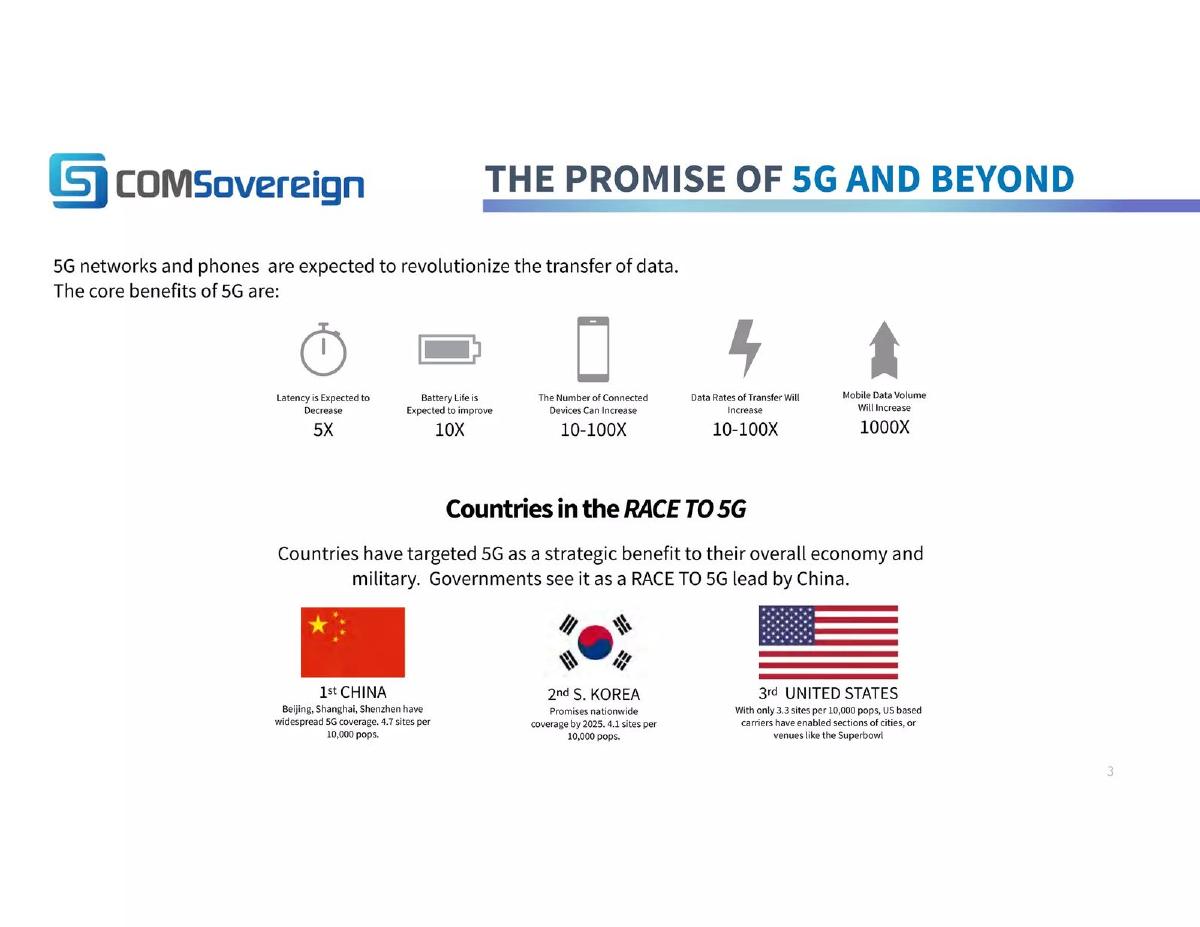
- The company positions 5G as a global race where the U.S. currently ranks 3rd with 3.3 sites per 10,000 people, trailing China and South Korea (Slide 3).
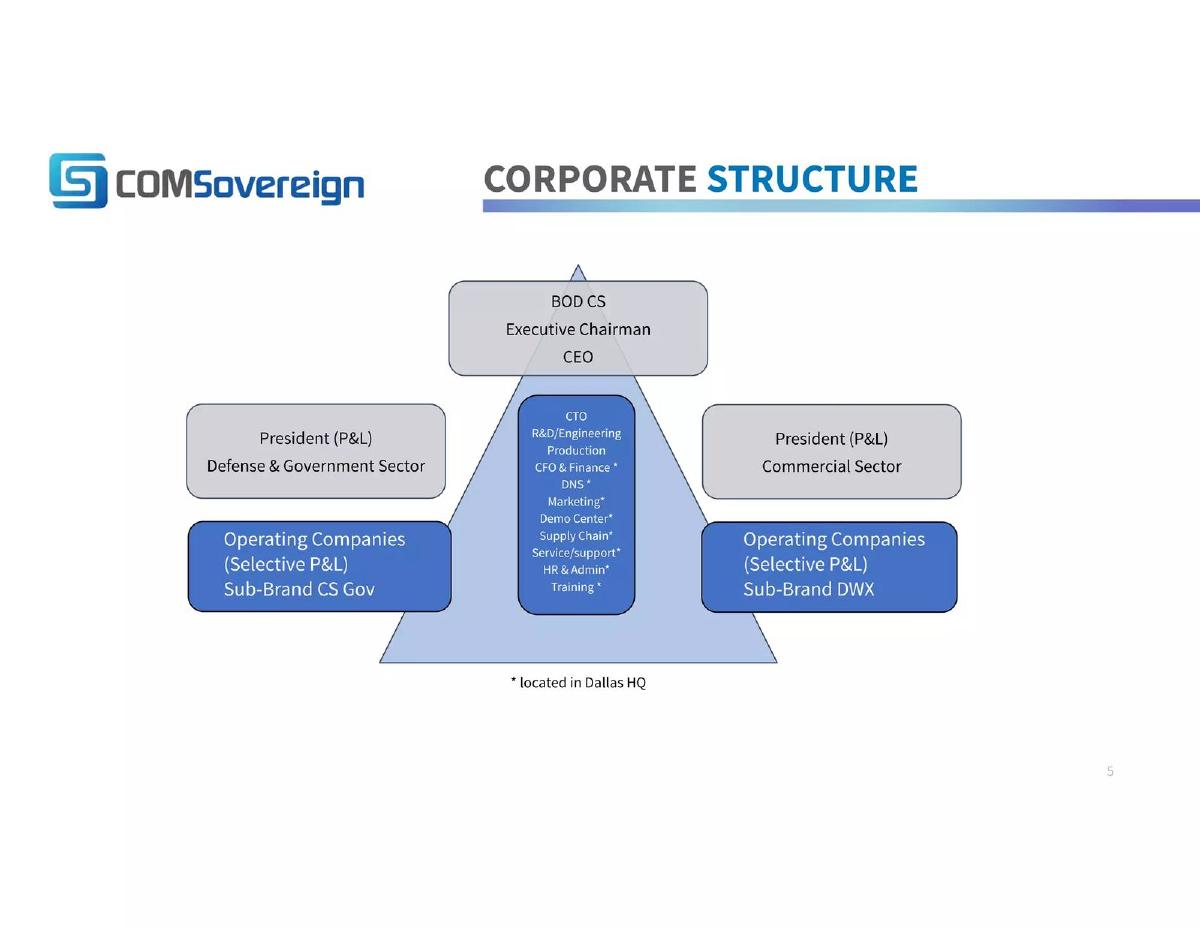
- COMSovereign operates through a dual-sector structure divided into Defense & Government and Commercial sectors, each with its own P&L (Slide 5).
- The technical solution is presented as a puzzle of acquired brands, including Drone Aviation, Virtualnetcom, DragonWave, and Fastback Networks (Slide 7).
- Product claims include the world’s first miniaturized, fully virtualized 5G network Core (vCore) and instant standup of private LTE networks (Slide 9).
- A significant portion of the value proposition is based on a U.S.-controlled supply chain, claiming lead-time reductions of up to 90% via Sovereign Plastics (Slide 13).
- The company reports a substantial IP moat with 112 granted patents, 100 of which are concentrated in the Dragonwave/Fastback division (Slide 15).
- Market traction is summarized as having over 700 telco network customers and more than $1B of equipment in customer networks across 100 countries (Slide 17).
- The deck omits a specific 'Ask' or use of proceeds slide, typical for a company already listed on the NASDAQ (Slide 1).
Executive Summary: The Domestic Infrastructure Play
COMSovereign’s March 2021 investor presentation is a classic example of a 'sovereign capability' pitch. By branding their offering as 'The American 5G Story,' the company attempts to align its commercial success with national strategic interests. The deck focuses heavily on the breadth of their integrated solutions—spanning from software cores to the physical batteries and plastic housings—rather than the depth of any single product’s market share. This teardown examines the 9 provided slides to evaluate how the company communicates its complex conglomerate structure to the public markets.
Slide 1: Title and Positioning
The cover slide establishes the primary narrative: 'The American 5G Story.' By including the NASDAQ ticker (COMS) and the date (March 2021) over a map of the United States, the company immediately signals that its value proposition is rooted in domesticity and public market transparency. The tagline 'Connecting Tomorrow' is generic, but the visual emphasis on the U.S. map reinforces the geopolitical angle that follows.
Slide 3: The Global 5G Race
This slide serves as the 'Problem' or 'Market Context' slide. It defines the benefits of 5G—such as 10-100x increases in connected devices and 1000x increases in data volume—but the real focus is the 'Race to 5G.' By ranking the United States 3rd behind China and South Korea in terms of sites per 10,000 population (3.3 vs 4.7 and 4.1 respectively), COMSovereign creates a sense of urgency. The implication is that the U.S. needs domestic champions to close the gap, providing a macro-economic tailwind for the company's business model.
Slide 5: Corporate Structure
Slide 5 reveals a complex organizational hierarchy. COMSovereign acts as a holding company for two distinct sectors: Defense & Government (Sub-brand CS Gov) and Commercial (Sub-brand DWX). Both sectors are noted as having 'Selective P&L,' which suggests they operate with a degree of financial autonomy. The central triangle indicates that core functions like R&D, Finance, and the Demo Center are centralized at the Dallas HQ. This structure is typical of an acquisition-heavy growth strategy, where various specialized firms are brought under one corporate umbrella.
Slide 7: The Telecom Network Puzzle
This slide attempts to explain 'Where do we come in?' by overlaying subsidiary logos onto a telecom network diagram. It shows how Virtualnetcom handles the Core and Edge, DragonWave and Fastback handle the backhaul (the links between towers), and Drone Aviation provides aerial components. While the puzzle piece graphic is a bit dated, it effectively communicates that COMSovereign is not just a component maker but a full-stack infrastructure provider. It visualizes the 'end-to-end' claim made later in the deck.
Slide 9: Integrated Access Solutions
Focusing on the Virtualnetcom subsidiary, this slide lists technical achievements. Key claims include the 'World’s first miniaturized, fully virtualized 5G network Core' and the ability to provide 'Instant standup of private LTE and 5G networks.' The slide lists compliance with 3GPP standards and the use of CBRS (Citizens Broadband Radio Service) frequencies. The imagery at the bottom shows a variety of hardware form factors, emphasizing that their software is paired with ruggedized, deployable hardware.
Slide 11: Backup Power and Reliability
Infrastructure is only as good as its uptime, and Slide 11 focuses on the InduraPower subsidiary. The pitch here is 'Ai-Driven Intelligent Battery Management.' The company claims their lithium power units have a lifespan up to 10x longer than traditional units and recharge 7 times faster than lead-acid batteries. By including remote management via iOS and Android apps and features like 'built-in self-heating' for cold weather, they position their power solutions as high-tech components rather than simple commodities.
Slide 13: Supply Chain Control
This is perhaps the most unique slide in the deck. It highlights 'Sovereign Plastics' and the company's 100% ownership of plastics and metals fabrication. The claim that 'Lead-times are reduced by up to 90%' is a powerful differentiator in a sector often plagued by global shipping delays. The slide notes that their 13 plants produced over 20 million parts in 2019, demonstrating that this isn't just a small internal shop but a high-volume manufacturing operation that also generates external sales to aid profitability.
Slide 15: Intellectual Property Portfolio
Slide 15 provides a quantitative look at the company’s 'Grassroots Value.' The table breaks down patents by division, showing a total of 112 granted patents, 20 pending, and 21 to be filed. The Dragonwave/Fastback division holds the lion's share with 100 granted patents. This slide is crucial for an infrastructure company, as it suggests a significant defensive moat and a history of R&D investment that predates the current corporate structure.
Slide 17: Summary and Traction
The final slide summarizes the 'American 5G Story' with a list of high-level metrics. Most notable is the claim of 'More than 700 telco network customers around the globe' and '>$1B of equipment in customer networks in >100 countries.' It also mentions that the first full 5G system was delivered in December 2020. This slide attempts to transition from the 'what we do' to 'proof that it works,' though it lacks the specific names of major customers or recent revenue figures that would solidify the claim.
What COMSovereign Does Well
The deck excels at framing a narrative. By leaning into the 'American 5G' theme, COMSovereign taps into a powerful sentiment regarding domestic manufacturing and national security. They also do a good job of showing the breadth of their capabilities. For an investor worried about a single-point-of-failure in a startup's product line, COMSovereign’s 'puzzle' of subsidiaries offers a diversified approach to the 5G market.
The inclusion of the supply chain slide (Slide 13) is a masterstroke for the time period. In 2021, supply chain resilience was a top-of-mind issue for investors. Showing actual factory floors and citing a 90% reduction in lead times provides a tangible competitive advantage that is easier to understand than the nuances of virtualized 5G cores.
Omissions and Weaknesses
The most glaring omission is the lack of financial data. While the company is public, an investor presentation should still highlight key financial milestones, such as revenue growth, gross margins, and cash burn. Without these, the '>$1B of equipment' figure on Slide 17 feels like a legacy metric rather than a reflection of current performance.
Furthermore, the 'Team' slide is missing from this 9-slide selection. In a conglomerate structure, the ability of the management team to integrate disparate acquisitions is the most critical factor for success. Investors need to know who is running the show and what their track record is in M&A and telecom. Finally, the deck lacks a clear 'Roadmap' slide. While they mention new radios coming in 2021, there is no multi-year vision for how these various subsidiaries will eventually merge into a single, cohesive brand or platform.
Founder Takeaways
Vertical Integration as a Story: If your company owns more of the value chain than your competitors, make it a centerpiece of your pitch. COMSovereign’s focus on owning the 'plastics and metals' is a great example of turning a mundane operational detail into a strategic advantage.
Macro-Alignment: Align your company’s success with a larger national or global trend. By framing their business as the solution to the U.S. 'losing' the 5G race, COMSovereign makes their success feel necessary, not just opportunistic.
IP Quantification: Don't just say you have a 'strong IP portfolio.' Use a table like the one on Slide 15 to break down granted vs. pending patents across different business units. This adds a layer of technical credibility that bullet points cannot achieve.
Visualizing the Ecosystem: If you have a complex product with many moving parts, use a 'Network Diagram' or 'Puzzle' graphic to show how they fit together. It helps investors visualize the 'end-to-end' nature of your solution without needing a PhD in the subject matter.
Frequently asked questions
- What is COMSovereign's primary value proposition?
- COMSovereign positions itself as a U.S.-based, end-to-end provider of 5G and LTE network infrastructure. The core of their pitch is 'The American 5G Story,' emphasizing that they own the entire stack—from virtualized cores and radios to the physical plastic and metal fabrication of the hardware. This vertical integration is intended to solve supply chain vulnerabilities and reduce lead times by up to 90%.
- How does the company address the competitive landscape of 5G?
- Rather than naming specific corporate competitors like Nokia or Ericsson, the deck frames competition as a geopolitical race. Slide 3 notes that China leads with 4.7 sites per 10,000 people, followed by South Korea at 4.1, while the U.S. lags at 3.3. By framing the problem this way, COMSovereign positions its domestic manufacturing as a strategic national asset.
- What specific technologies does COMSovereign claim to own?
- The company claims several 'firsts' and specialized technologies across its subsidiaries. These include a miniaturized 5G vCore, AI-driven battery management systems for network reliability (InduraPower), and aerial tower systems used by the DoD and DHS. Their IP portfolio is heavily weighted toward backhaul technology, with 100 granted patents in the Dragonwave/Fastback division.
- What are the most significant omissions in this presentation?
- The deck is notably silent on financial performance and future projections. There are no slides covering revenue growth, EBITDA, or margins. Additionally, while Slide 5 shows a corporate hierarchy, there are no headshots or bios for the executive team or Board of Directors. For a public company, the lack of a clear 'path to profitability' or detailed financial breakdown is a significant gap.
- How does COMSovereign manage its manufacturing and supply chain?
- The company utilizes a 'Just-in-Time' model through its subsidiary, Sovereign Plastics. According to Slide 13, they operate 13 large plastic injection-molding plants that produced over 20 million parts in 2019. They claim to have 100% ownership of their plastics and metals fabrication, allowing them to handle custom orders with no minimums and significantly reduced lead times.