Compensate’s 2019 pitch deck prioritizes brand identity and mission over technical specifications or financial projections. The narrative centers on the idea of 'overcompensating' for carbon emissions through seamless consumer integrations, such as airline bookings and credit card transactions. While the deck excels at creating a cohesive visual language and a clear ethical stance, the 10 slides provided are notably light on operational mechanics, competitive analysis, and team credentials. It positions the company more as a 'movement' or a 'trademark' than a traditional SaaS platform, bankin…
Key takeaways
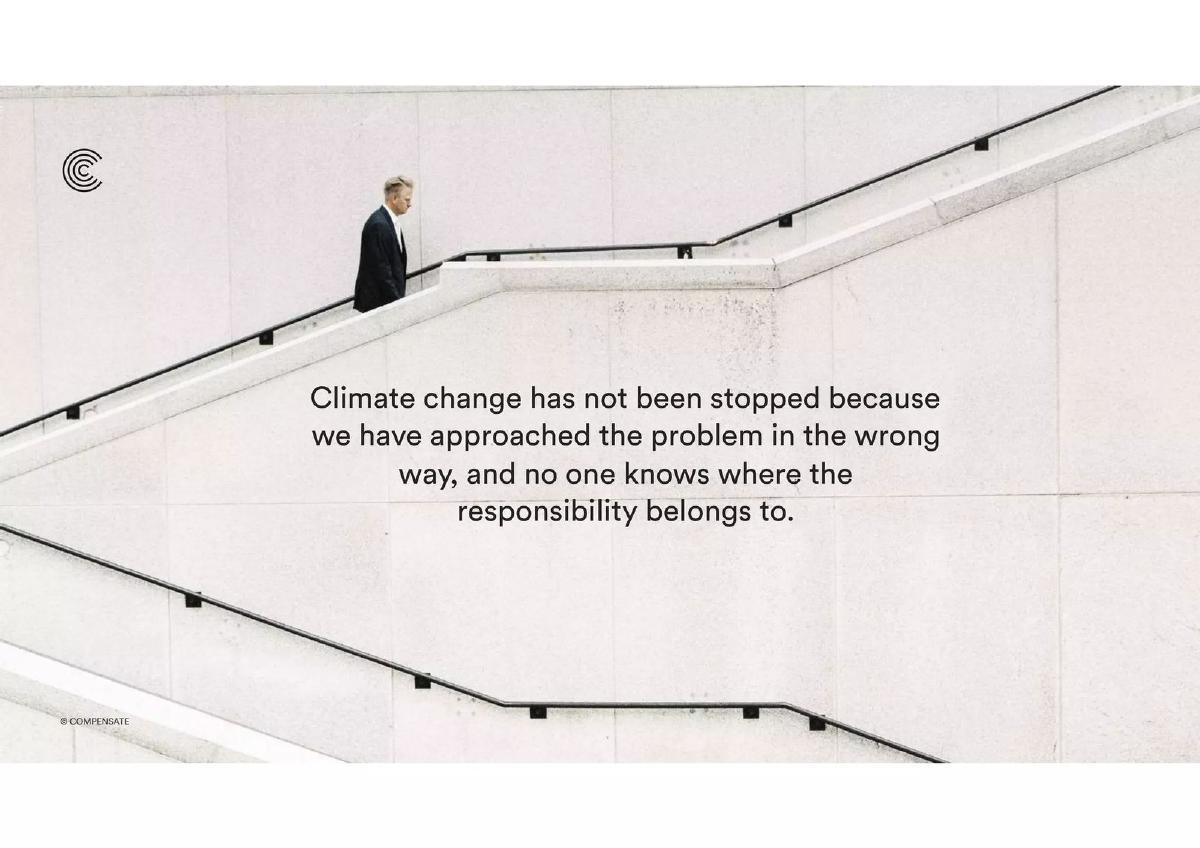
- The deck defines the problem as a lack of clear responsibility for climate change on slide 2.
- Compensate proposes a model of 'overcompensation,' capturing more carbon than daily activities create, as stated on slide 3.
- The company quantifies the cost of offsetting for an average Finnish person at 220€ annually or 0,60€ daily on slide 4.
- Product integration is shown as a frictionless 'CO2 Compensated' toggle in a flight booking flow on slide 6.
- The deck emphasizes brand visibility, suggesting the logo can be used on physical assets like cars to signal responsible choices on slide 7.
- A physical credit card mockup on slide 8 suggests a fintech-adjacent strategy for making consumption responsible.
- The company positions itself as a 'trademark' that can create a global movement on slide 9.
- The mission is explicitly stated as starting a global movement to empower people to stop climate change on slide 10.
The Narrative-Driven Approach to Climate Tech
The Compensate pitch deck from 2019 is a distinct departure from the data-heavy, chart-filled presentations common in the climate tech sector. Instead of leading with atmospheric chemistry or complex carbon credit supply chain logistics, Compensate leads with a philosophical and brand-centric argument. The deck is designed to sell a vision of a world where carbon responsibility is automated and visible.
Slide 1: Brand Identity
The title slide is minimalist, featuring only the Compensate logo—a stylized 'C' composed of concentric circles—and the company name. There is no tagline or subtitle. This immediately establishes the company's focus on high-end design and brand recognition, suggesting that the 'trademark' mentioned later in the deck is a core asset.
Slide 2: The Problem of Responsibility
Slide 2 features a man walking up a stark, white staircase. The text states: "Climate change has not been stopped because we have approached the problem in the wrong way, and no one knows where the responsibility belongs to." This slide identifies the 'Problem' not as carbon emissions themselves, but as the lack of accountability and the failure of current methodologies. It sets the stage for a solution that reassigns responsibility to the individual and the brand.
Slide 3: The Solution - Overcompensation
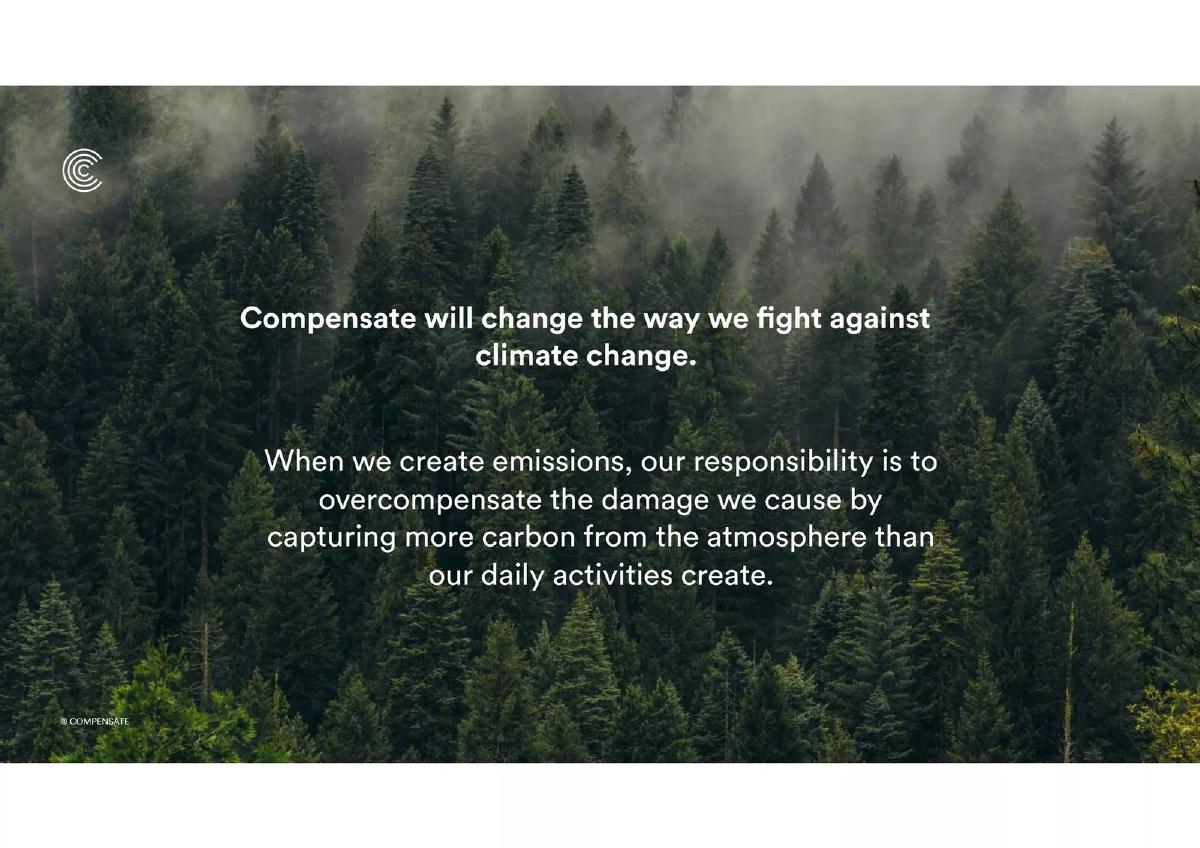
Set against a backdrop of a dense forest, Slide 3 introduces the company's core value proposition: "Compensate will change the way we fight against climate change." It defines their method as 'overcompensating'—capturing more carbon than daily activities create. This is a strategic move to move beyond 'neutrality' and toward a 'net-positive' impact, which is a more compelling marketing hook for modern consumers.
Slide 4: Quantifying the Cost
Slide 4 provides the first hard figures in the deck. It breaks down the cost of "Compensating the average annual emissions of one Finnish person" as 220€ , which equates to a "Daily average" of 0,60€ . By breaking a large annual cost down to 60 cents a day, the deck makes the solution feel affordable and attainable for the average citizen.
Slide 5: Consumer Demand
This slide bridges the gap between the individual and the business. It claims that "People are yearning to find real ways to fight climate change" and that sustainability is a key value consumers demand from businesses. The imagery contrasts a busy urban crosswalk with a serene lake, reinforcing the idea that Compensate exists at the intersection of modern life and nature.
Slide 6: Product Integration (The Flight Toggle)
Slide 6 is the most 'product-focused' slide in the set. It shows a mobile app interface for booking a flight from Helsinki to New York. A "CO2 Compensated" option is visible, showing a price increase from 372€ to 401€. The text states: "Compensating does not have to require any extra steps from the consumer." This demonstrates the B2B2C API-led strategy where the offset is a simple 'opt-in' during an existing checkout flow.
Slide 7: Brand Visibility
Slide 7 shows the Compensate logo as a sticker on the rear window of a car. The text reads: "Responsible choices can be made visible." This reveals a key part of their strategy: social signaling. By making the 'choice' visible, they turn carbon offsetting into a status symbol or a badge of honor, which helps drive viral growth and brand loyalty.
Slide 8: Fintech Ambitions
Slide 8 features a mockup of a silver credit card with the Compensate logo. The text states: "Consumption can be made responsible extremely easily." This suggests that the company envisions a future where every transaction made with a specific card or linked account automatically triggers an offset, further removing friction from the process.
Slide 9: Scaling the Movement
Slide 9 shows a hand holding a smartphone with the Compensate logo. The text describes the company as "A trademark that can create a movement that scales globally." The use of the word 'trademark' is specific; it implies that the value of the company lies in its intellectual property and its ability to certify others, rather than just being a broker of carbon credits.
Slide 10: The Mission Statement
The final slide in this set summarizes the company's purpose: "Our mission: It is time to start a global movement that truly empowers people to stop climate change." It includes the hashtag #WeCompensate , reinforcing the community-driven, social-media-ready nature of the brand.
What Works in the Compensate Deck
1. Emotional Resonance: The deck uses high-quality photography and minimalist text to create a sense of urgency and hope. It avoids the 'gloom and doom' often associated with climate change, focusing instead on empowerment.
2. Frictionless Solution: The mockups on Slides 6 and 8 clearly communicate how the product works without needing a technical deep dive. Investors can immediately see how the business integrates into existing consumer habits.
3. Clear Differentiation: The concept of 'overcompensation' (Slide 3) is a strong differentiator. It positions Compensate as a 'premium' or 'more effective' version of existing offset providers.
What is Missing from the Compensate Deck
1. The Team: There is no information about who is building this. In the carbon market, where trust and verification are paramount, the lack of a 'Team' slide featuring experts in climate science or carbon markets is a notable gap.
2. Unit Economics and Revenue Model: While the deck shows what a consumer pays (Slide 4), it does not explain how Compensate makes money. Is there a transaction fee? A SaaS fee for the API? A margin on the carbon credits? This is left unanswered.
3. Supply Side Logistics: Carbon offsetting is only as good as the projects being funded. The deck does not mention where the carbon is being captured, what projects they support, or how they verify the 'overcompensation' claim.
4. Competition: The deck operates as if Compensate is the only player in the space. There is no mention of other offset providers or how they compare on price, verification standards, or ease of integration.
Founder Takeaways
Build a Brand, Not Just a Utility: Compensate understands that in a crowded market, a strong, recognizable brand can be a moat. Founders should consider how their logo and mission can become a 'badge' for their users.
Simplify the Cost: If your product has a complex pricing structure, find a way to distill it into a 'daily average' or a 'per-transaction' cost that feels negligible to the end-user.
Show, Don't Just Tell: The flight booking mockup is worth a thousand words of technical documentation. It shows exactly where the company sits in the value chain.
Frequently asked questions
- What is the core business model of Compensate based on this deck?
- Based on the slides, Compensate appears to be a B2B2C carbon offsetting platform. It focuses on integrating carbon compensation directly into consumer transactions, such as booking flights (Slide 6) or using a branded credit card (Slide 8). The goal is to make offsetting 'frictionless' for the end-user while allowing businesses to meet the sustainability demands of their customers.
- How does Compensate differentiate its offsetting approach?
- Compensate introduces the concept of 'overcompensation' on Slide 3. Rather than just reaching net-zero for a specific activity, the company aims to capture more carbon from the atmosphere than the daily activity creates. This 'carbon-negative' philosophy is their primary differentiator against standard offset providers.
- What geographic market is the primary focus in this deck?
- The deck specifically cites the 'average annual emissions of one Finnish person' on Slide 4 and shows a flight path from Helsinki (HEL) to New York (JFK) on Slide 6. This indicates that the company is likely headquartered in Finland and is using its domestic market as the initial proof of concept.
- Is there any mention of the team or founders in the slides?
- No. The 10 slides provided do not include a team slide, founder bios, or an advisory board. This is a significant omission for a pitch deck, as investors typically prioritize the 'who' as much as the 'what' in early-stage startups.
- What is the 'Ask' in this pitch deck?
- The provided slides do not contain a formal 'Ask' or fundraising slide. There is no mention of the amount being raised, the valuation, or the intended use of funds. The deck concludes with a mission statement and a hashtag (#WeCompensate) rather than a financial request.