NeuraLegion’s 11-slide Seed deck is a masterclass in market positioning within a crowded technical vertical. The company identifies a specific 'gap' in the market—the inability of legacy security tools to keep pace with modern CI/CD practices and microservices. By framing the problem as a conflict between security-focused legacy tools and developer-focused modern needs, NeuraLegion justifies its AI-powered DAST solution. The deck relies heavily on market validation from firms like Forester and Markets & Markets to establish a >$20BN opportunity. While it lacks granular financial data or a spe…
Key takeaways
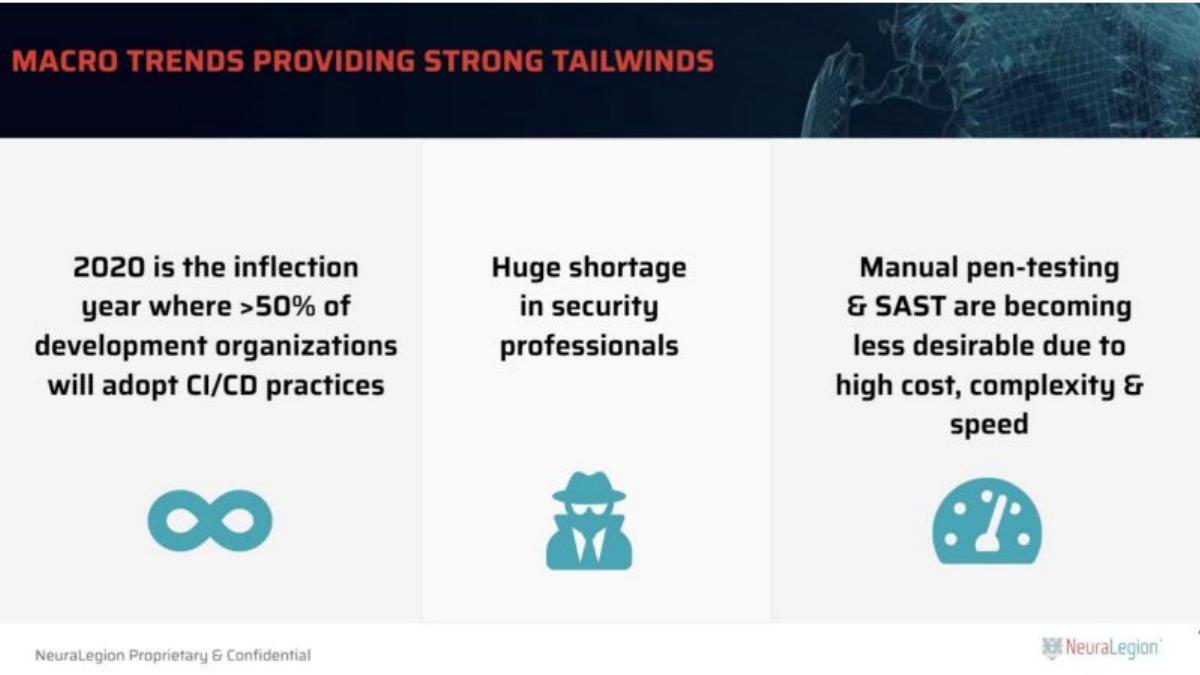
- The deck identifies 2020 as a critical inflection point where over 50% of development organizations adopted CI/CD practices (Slide 4).
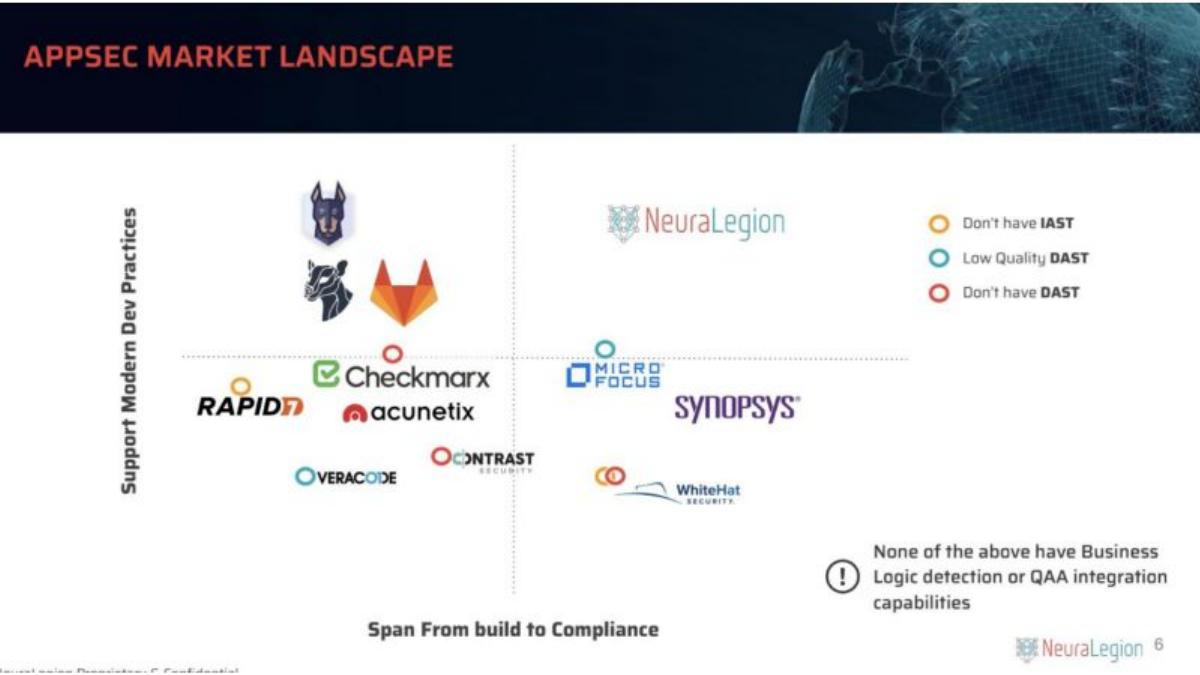
- NeuraLegion positions itself as the only solution spanning from build to compliance while supporting modern dev practices (Slide 6).
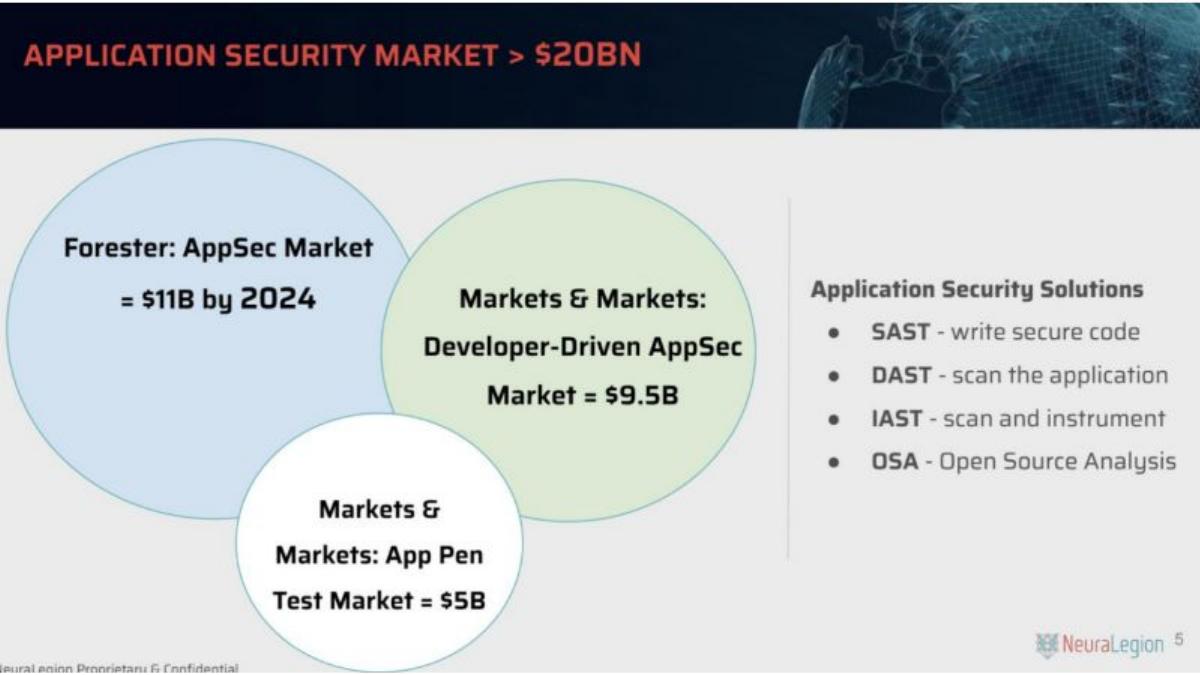
- The total addressable market is calculated at over $20BN, combining AppSec, Developer-Driven AppSec, and App Pen Testing segments (Slide 5).
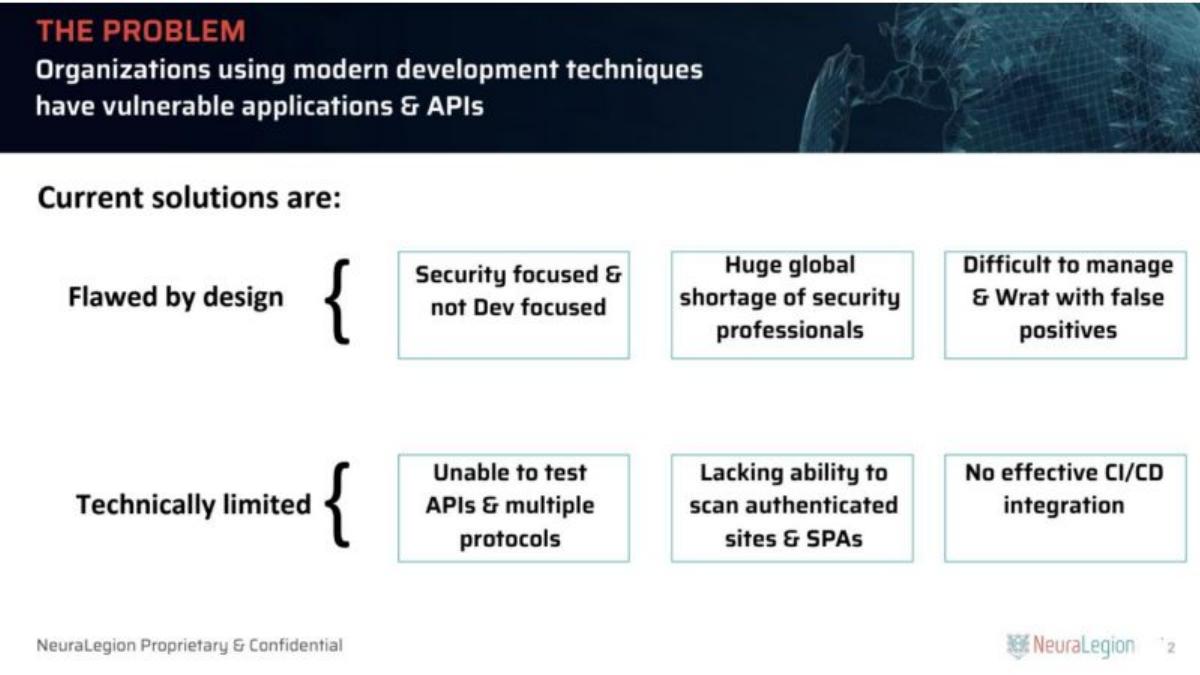
- Current solutions are critiqued for being 'flawed by design' due to a focus on security professionals rather than developers (Slide 3).
- The founding team includes a CEO with five academic degrees and a President who previously scaled a company to $50M in ARR (Slide 8).
- The product, NeXPloit, is highlighted for its ability to detect business logic vulnerabilities, illustrated by a 'Bitcoin Heist' case study (Slide 10).
- The company maintains a global footprint with offices in Israel, Bosnia, London, and San Francisco (Slide 8).
- Technical limitations of competitors are explicitly listed, including an inability to scan authenticated sites and SPAs (Slide 3).
The Strategic Narrative: Bridging the Dev-Sec Divide
NeuraLegion’s pitch deck is a focused argument for the modernization of Application Security (AppSec). In an era where software is deployed multiple times a day, the traditional model of 'stopping' for a security audit is obsolete. This deck identifies that friction and proposes a solution that integrates security directly into the developer's workflow. By raising $4.7M in 2020, the company validated the thesis that Dynamic Application Security Testing (DAST) needed an AI-driven, developer-first makeover.
Slides 1-2: The Vision and the Gap
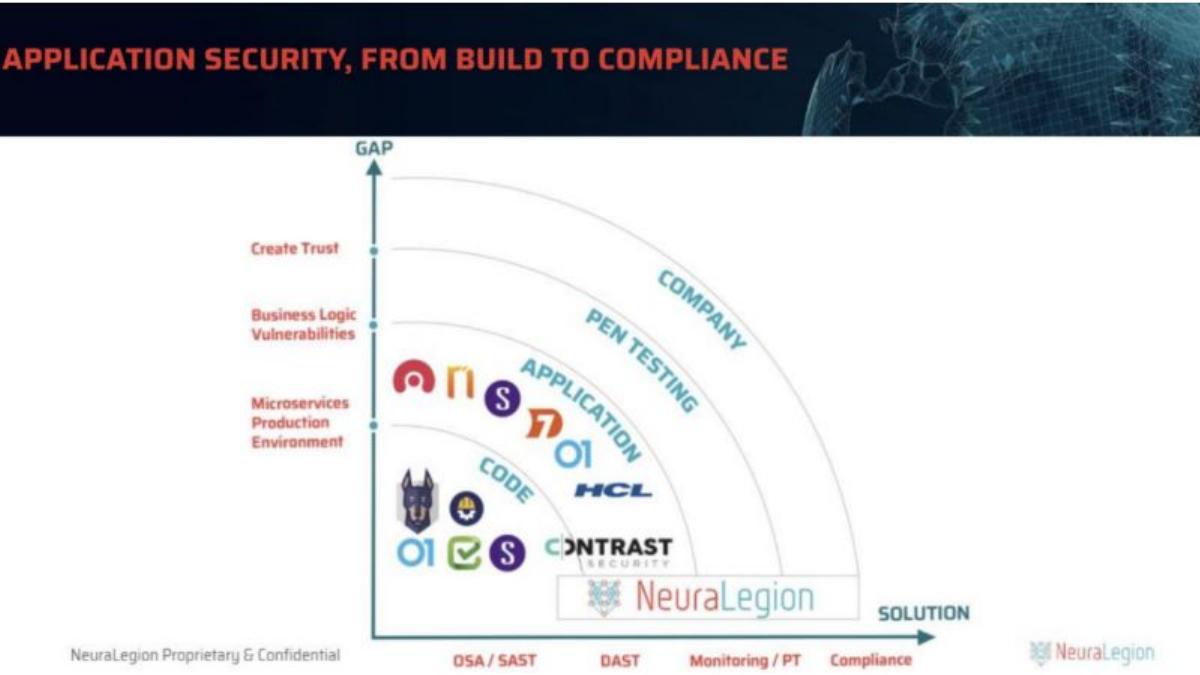
The deck opens with a clear value proposition on Slide 1: "Application Security Compliance on Every Build." This immediately signals that the product is intended for continuous integration environments. Slide 2 introduces a visual representation of the 'Gap' in the market. It maps various security categories—Code, Application, Pen Testing, and Company—against the types of vulnerabilities they address. NeuraLegion positions itself at the bottom of the 'Solution' axis, suggesting it provides the foundational layer that connects these disparate security efforts into a cohesive compliance framework.
Slide 3: Defining the Problem
The problem slide is structured into two categories: 'Flawed by design' and 'Technically limited.' NeuraLegion argues that current solutions are built for security professionals, not developers, which exacerbates the "huge global shortage of security professionals." Technically, they point out that legacy tools cannot handle modern architectures like microservices, APIs, and Single Page Applications (SPAs). This slide is effective because it doesn't just say 'security is hard'; it lists specific technical failures of the status quo that developers face daily.
Slide 4: Macro Trends and Tailwinds
To create a sense of urgency, Slide 4 identifies 2020 as the "inflection year" where more than 50% of development organizations adopt CI/CD. This 'Why Now?' slide is crucial for Seed-stage companies. It suggests that the market is moving away from manual pen-testing and Static Analysis (SAST) because they are too slow and complex for the modern 'need for speed.' By aligning their growth with the growth of CI/CD, NeuraLegion makes their success seem inevitable as the industry matures.
Slide 5: Market Sizing
NeuraLegion claims an "Application Security Market > $20BN." They break this down using data from Forester and Markets & Markets. The segments include an $11B AppSec market, a $9.5B Developer-Driven AppSec market, and a $5B App Pen Test market. While these circles overlap, the slide serves to prove that the company is playing in a massive, well-funded sandbox. It also defines the four pillars of the industry: SAST, DAST, IAST, and OSA, setting the stage for their competitive comparison.
Slide 6: Competitive Landscape
The AppSec Market Landscape slide is a classic 2x2 matrix. NeuraLegion places itself in the top-right quadrant, defined by "Support Modern Dev Practices" and a "Span From build to Compliance." They explicitly call out competitors like Micro Focus and Synopsys for having 'Low Quality DAST' or lacking IAST/DAST capabilities entirely. A key differentiator noted in the bottom right is that "None of the above have Business Logic detection or QAA integration capabilities," which NeuraLegion claims to possess.
Slides 7-8: The Product and The Team
Slide 7 is a placeholder for a "Dev First Video" featuring their product, NeXPloit. While the video isn't playable in a static deck, the icons suggest speed, automation, and simplicity. Slide 8 introduces the team, which is perhaps the strongest part of the deck. The founders have a mix of academic rigor (5 degrees for the CEO) and commercial success (President managed $300M M&A). With 24 employees, including 14 experts in Security, ML, and Dev, the company demonstrates it has the technical 'heft' to build an AI-powered platform.
Slides 9-11: Closing and Case Study
The deck concludes with a 'Thank You' slide (Slide 9) and a supplemental slide (Slide 10) regarding "Detecting Business Logic Vulnerabilities." This slide references 'The Ultimate Bitcoin Heist,' a vulnerability discovered by NeXPloit. This is a high-stakes example that proves the tool's efficacy in a real-world, high-value scenario. Slide 11 is a standard promotional slide for the platform hosting the deck.
What NeuraLegion Does Well
Technical Specificity: Unlike many 'AI' decks that remain vague, NeuraLegion lists specific technical hurdles (authenticated sites, SPAs, multiple protocols) that their product overcomes. This builds trust with technical investors.
Market Timing: By anchoring their pitch to the 2020 CI/CD inflection point, they transform their product from a 'nice-to-have' into a 'must-have' for any modern engineering org.
Team Credibility: The team slide is excellent. It highlights not just titles, but specific outcomes like ARR growth and M&A exits, which reduces the perceived risk for Seed investors.
What is Missing from the Deck
The Ask: There is no slide indicating how much money is being raised or what the milestones for the next 18 months are. While we know from catalogue facts that they raised $4.7M, a pitch deck should ideally state the target and the plan for that capital.
Unit Economics and Traction: The deck is heavy on 'The Problem' and 'The Market' but light on 'The Progress.' There are no mentions of current revenue, number of pilots, or specific logos of early adopters. This suggests the round was raised primarily on the strength of the team and the technical vision.
Financial Projections: There is no roadmap for how the company reaches its share of the $20BN market. Investors usually want to see a 3-5 year high-level projection of growth.
Founder's Playbook: What to Copy
The 'Gap' Visualization: Slide 2 is a great way to show where a startup fits in a complex ecosystem. If you are entering a crowded market, use a similar 'Gap' chart to show what the current stack is missing.
The Inflection Point: Always include a 'Why Now?' slide. NeuraLegion’s use of the 50% CI/CD adoption metric (Slide 4) is a perfect example of using a macro trend to justify a micro-solution.
Specific Competitor Critiques: Don't just put logos on a map. Use Slide 6’s approach of adding specific 'tags' (e.g., "Don't have IAST") to explain exactly why the incumbents are failing. This forces the investor to agree with your technical assessment of the competition.
Frequently asked questions
- What is the core problem NeuraLegion is solving?
- NeuraLegion addresses the disconnect between modern software development and legacy security testing. According to Slide 3, existing tools are 'security focused' rather than 'dev focused,' leading to a high volume of false positives and an inability to integrate effectively into CI/CD pipelines. They specifically target the technical limitations of old tools, such as the inability to test APIs, multiple protocols, and Single Page Applications (SPAs).
- How does NeuraLegion differentiate itself from competitors?
- The company uses a 2x2 matrix on Slide 6 to position itself in the top-right quadrant. Unlike competitors like Snyk, Checkmarx, or Veracode, NeuraLegion claims to be the only provider that both supports modern developer practices and spans the entire lifecycle from build to compliance. They also claim a unique capability in detecting business logic vulnerabilities, which legacy DAST and SAST tools often miss.
- What market trends are driving their growth?
- Slide 4 identifies three primary tailwinds: the mass adoption of CI/CD practices in 2020, a global shortage of security professionals, and the increasing cost and complexity of manual pen-testing. These factors create a demand for automated, developer-friendly security tools that can operate at the speed of modern deployment cycles.
- What are the credentials of the founding team?
- The team on Slide 8 is highly credentialed. CEO Shoham Cohen has 20 years of experience and five academic degrees. President Gadi Bashvitz has a history of scaling companies to $50M ARR and managing $300M M&A exits. CTO Bar Hofesh is a globally recognized security expert, and Chief Scientist Art Linkov holds a PhD with extensive experience in ML and AI algorithms.
- What is missing from this pitch deck?
- The deck is notably missing several standard venture components. There is no slide detailing the specific 'Ask' (amount of capital being raised and its allocation), no financial projections or historical revenue, and no detailed customer case studies beyond a brief mention of a 'Bitcoin Heist' vulnerability discovery. It functions more as a high-level strategic overview than a comprehensive business plan.