DivvyCloud’s Series B deck is a concise, 13-slide presentation that prioritizes social proof and operational scale over complex technical diagrams. By Slide 3, the company establishes massive credibility, listing 12 Fortune 500 customers and a 173k ACV, while noting they had only lost one enterprise customer in six years. The narrative focuses on the 'Business transformation problem'—the idea that cloud scale has outpaced human capacity to manage security. The deck effectively positions DivvyCloud not just as a visibility tool, but as an autonomous 'guard rail' system. While it lacks detailed…
Key takeaways
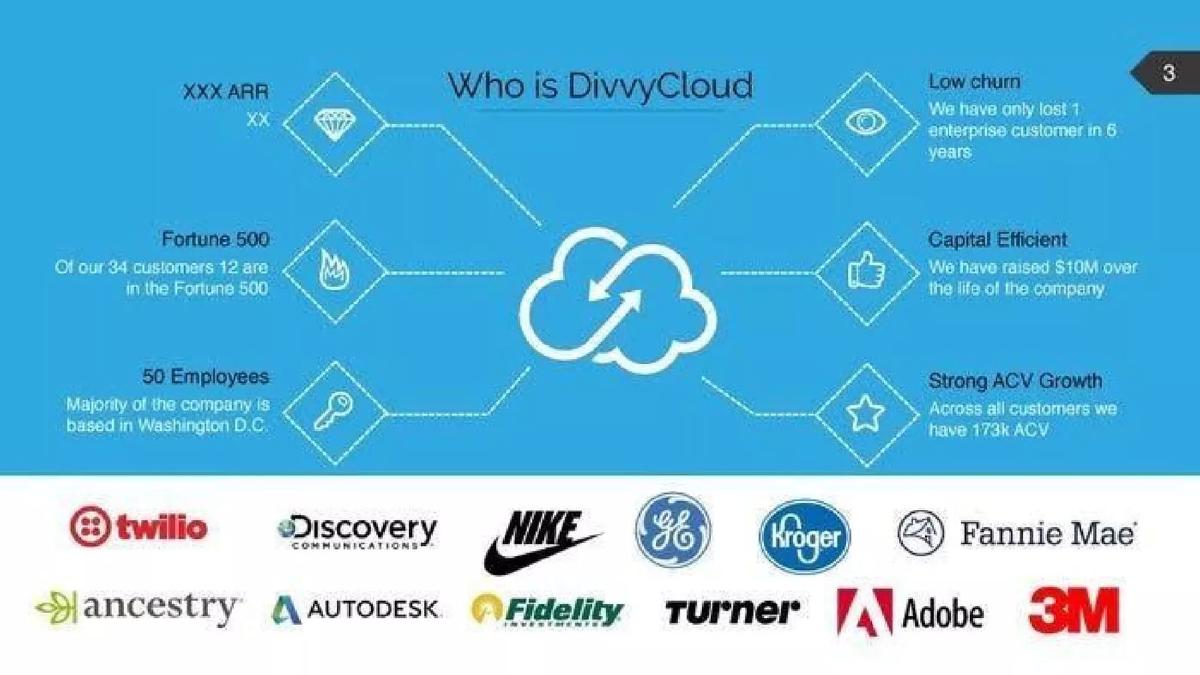
- The deck highlights a high-value customer base, noting that 12 of their 34 customers are in the Fortune 500 (Slide 3).
- DivvyCloud demonstrates extreme retention, stating they lost only one enterprise customer in six years (Slide 3).
- The company reports a strong Average Contract Value (ACV) of $173k across all customers (Slide 3).
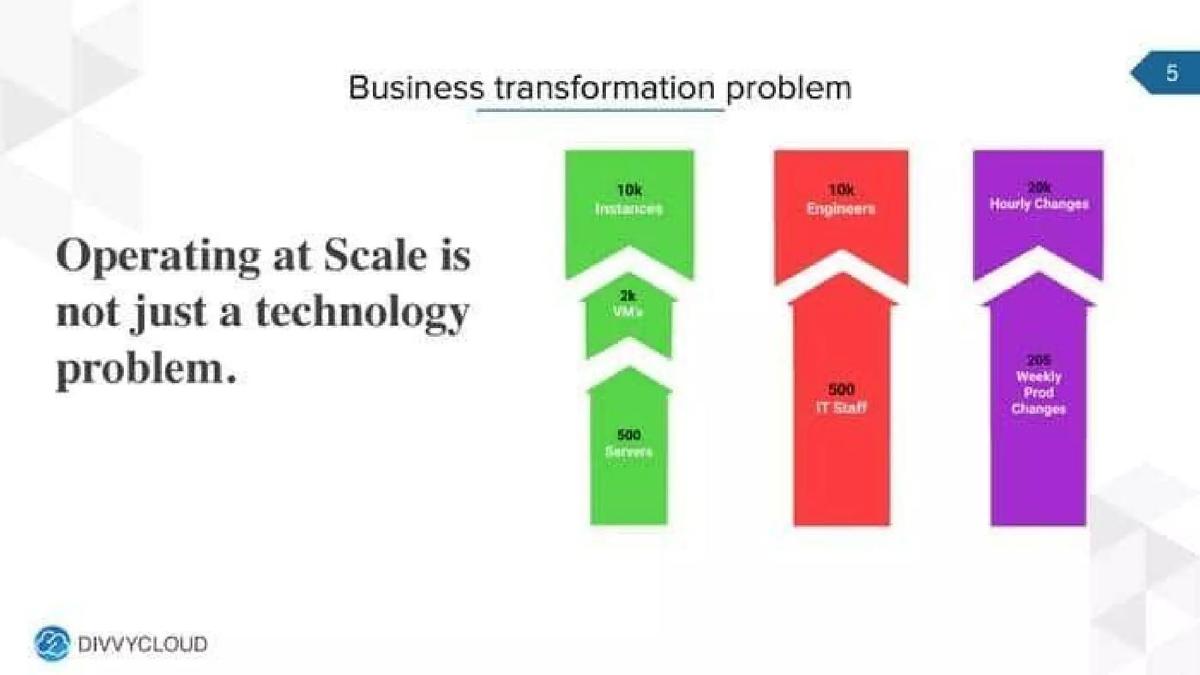
- The 'Problem' is framed as a scale issue where 10k instances and 20k hourly changes outstrip human IT staff capacity (Slide 5).
- The product is positioned as 'Automated Guard Rails' that autonomously enforce security and compliance (Slide 7).
- The technical workflow is simplified into a four-step cycle: Harvest, Unify, Analysis, and Action (Slide 8).
- The deck explicitly targets a $20M raise to fund Enterprise Sales, Marketing, Product, and Innovation (Slide 12).
- The company emphasizes capital efficiency, having raised only $10M prior to this Series B round (Slide 3).
The DivvyCloud Series B Teardown
DivvyCloud’s Series B deck is a study in enterprise-grade momentum. At 13 slides, it is remarkably lean for a Series B, suggesting that the founders relied heavily on their existing traction and blue-chip customer list to do the heavy lifting. The deck was used to raise $20 million in 2013, a significant sum for the era, and it reflects a company that had already found its footing in the complex world of cloud security and compliance.
The Opening: Mission and Traction
Slide 1: Title Slide The deck opens with a minimalist blue slide featuring the DivvyCloud logo—two interlocking clouds with arrows indicating a continuous loop. There is no tagline or date, just the brand mark.
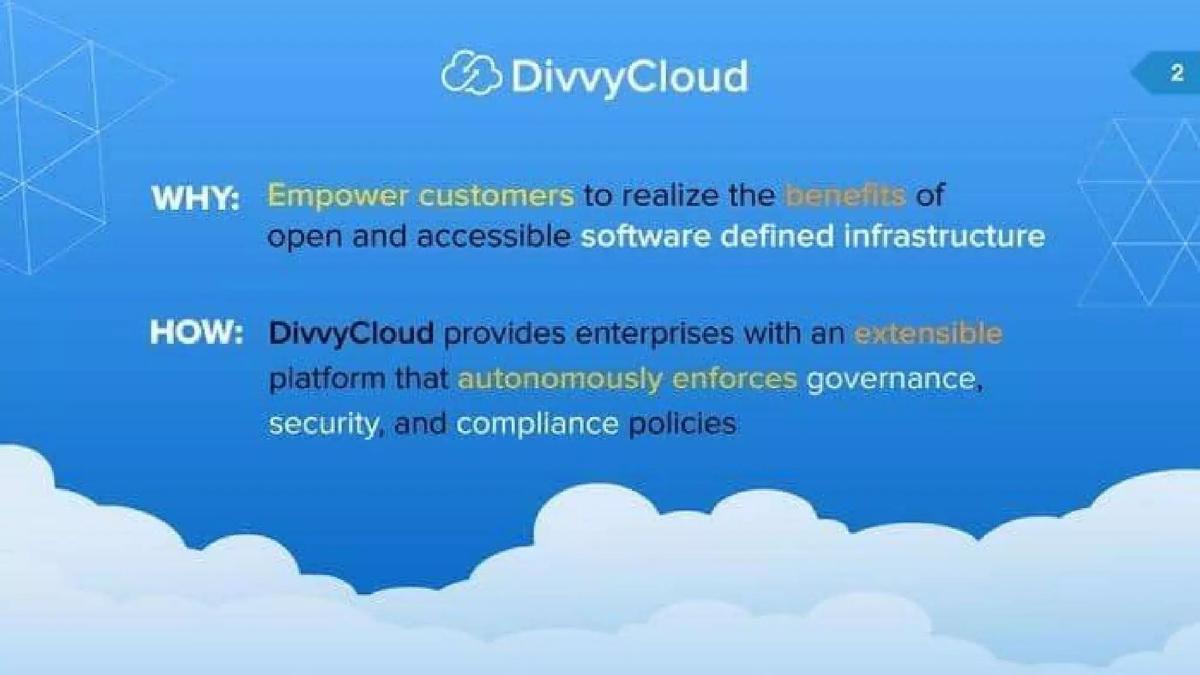
Slide 2: Why and How This slide sets the stage by defining the company’s purpose. The 'WHY' is to empower customers to realize the benefits of software-defined infrastructure. The 'HOW' introduces the core product: an extensible platform that 'autonomously enforces' policies. The use of the word 'autonomously' is critical here; it moves the conversation from simple monitoring to active remediation.
Slide 3: Who is DivvyCloud This is arguably the most important slide in the deck. It serves as a 'traction dashboard.' Key metrics include:
Fortune 500: 12 of their 34 customers are in the Fortune 500. · Low Churn: Only 1 enterprise customer lost in 6 years. · Capital Efficient: $10M raised over the life of the company. · Strong ACV Growth: $173k ACV across all customers. · 50 Employees: Based in Washington D.C.
The bottom of the slide is a 'wall of logos' including Twilio, Nike, GE, Kroger, Fannie Mae, Discovery, Autodesk, Fidelity, Turner, Adobe, and 3M. For a Series B investor, this slide answers the 'Is this real?' question immediately.
The Team and The Problem
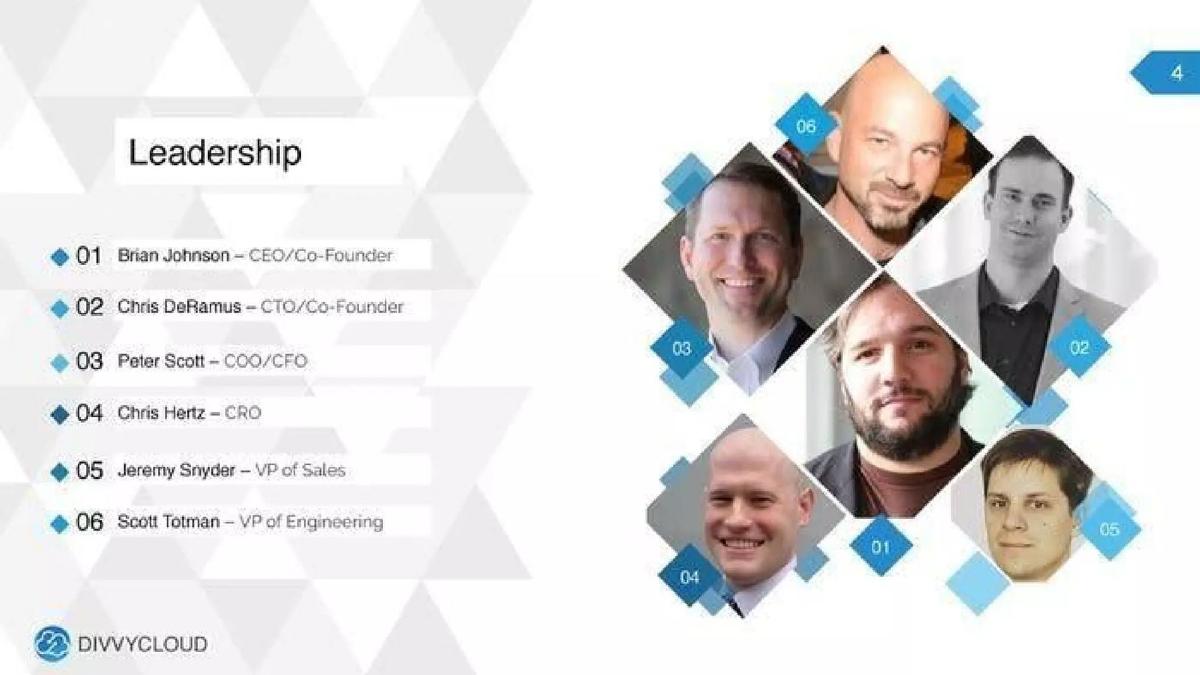
Slide 4: Leadership The leadership slide lists six key executives: Brian Johnson (CEO), Chris DeRamus (CTO), Peter Scott (COO/CFO), Chris Hertz (CRO), Jeremy Snyder (VP of Sales), and Scott Totman (VP of Engineering). Notably, the slide lacks bios or previous company logos, which is unusual for a Series B deck, though the photos are professional and numbered to match the list.
Slide 5: Business Transformation Problem This slide uses a 'scale' graphic to illustrate the gap between human capacity and cloud growth. It shows that while IT staff might remain constant at 500 people, the infrastructure they manage scales from 500 servers to 10,000 instances, and from 200 weekly changes to 20,000 hourly changes. The headline is clear: 'Operating at Scale is not just a technology problem.'
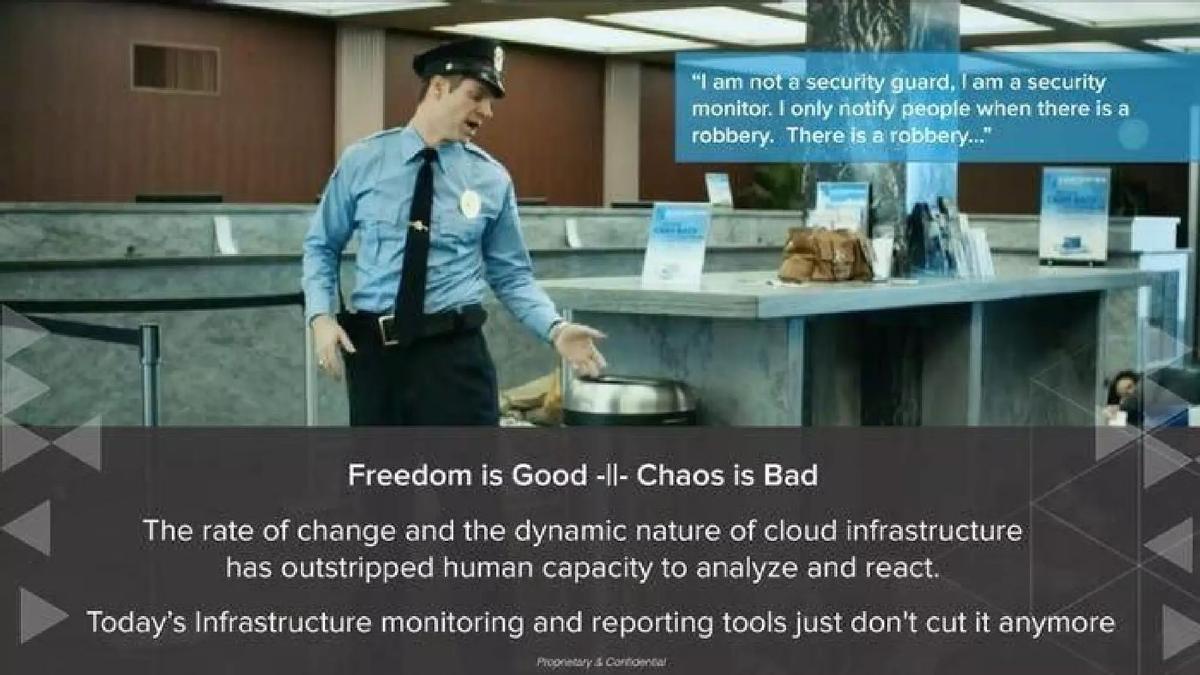
Slide 6: Freedom vs. Chaos Using a humorous image of a 'security monitor' (not a guard) from a popular commercial, the slide argues that today’s monitoring tools 'just don't cut it anymore.' It claims that the rate of change in cloud infrastructure has 'outstripped human capacity to analyze and react.'
The Solution and Product Mechanics
Slide 7: Automated Guard Rails This slide introduces the product interface via a laptop mockup. It lists three value drivers: real-time visibility, autonomous enforcement of policies, and enabling productivity through self-service infrastructure while maintaining control. This is the first time we see the 'Guard Rails' terminology, which became a signature of the DivvyCloud brand.
Slide 8: How does it work The technical process is broken down into a circular four-stage model:
Harvest: Pervasively harvest data using cloud-native API endpoints. · Unify: Convert infrastructure data into a standardized data model. · Analysis: Identify changes in cloud infrastructure. · Action: Take action to notify, record, and 'ultimately correct' non-compliant resources.
This slide introduces 'BotFactory,' the tool used to build these automated policies.
Slide 9: Use Cases The company categorizes its utility into three buckets: Governance (Single pane of glass, tag policy), Security (Network security, IAM, data protection), and Compliance (PCI-DSS, HIPAA, CIS, NIST 800-53). This demonstrates the breadth of the platform's application across different corporate departments.
Market Position and Future Growth
Slide 10: Differentiation DivvyCloud identifies three differentiators: Action (autonomous remediation), Platform (extensibility), and Deployed (containerized and flexible). The slide emphasizes that the software can be deployed behind a firewall or in cloud accounts, appealing to security-conscious enterprise buyers.
Slide 11: We are Just getting Started This is the vision slide. It outlines the roadmap toward becoming a 'Cloud Control Plane.' It mentions building a cloud-agnostic data model, a generic automation platform, and adding 'Contextual Intelligence' by incorporating data from containers and identity providers.
Slide 12: Our Raise The 'Ask' slide is explicit. They are seeking a '$20M Raise.' The funds are earmarked for:
Enterprise Sales: Growing direct and channel sales. · Marketing: Account-Based Marketing (ABM) and events. · Product: Productization of known use cases. · Innovation: Adding more data for contextual intelligence.
The graphic shows these four areas feeding into a central 'Raise' bucket, which then fuels Engineering, Sales, Product, and Marketing teams.
Slide 13: Contact Us The final slide features a team photo in front of a green wall, providing a human face to the company. It includes the office address in Arlington, VA, a phone number, and the CEO’s email address.
What Works in This Deck
The Traction Slide: Slide 3 is a masterclass in establishing Series B credibility. By listing high-ACV figures, a low churn rate, and a high percentage of Fortune 500 customers, DivvyCloud proves that they have moved past the 'experimentation' phase and are ready for a massive scale-up.
The Problem Framing: Slide 5 effectively uses numbers to show the 'human gap.' It doesn't just say 'cloud is hard'; it shows that the volume of changes (20,000 per hour) makes human oversight mathematically impossible. This creates an immediate, logical need for their 'autonomous' solution.
Clarity of the 'Action' Value Prop: Throughout the deck, DivvyCloud distinguishes itself from 'monitoring' tools. By focusing on 'remediation' and 'action,' they position themselves as a tool that reduces workload rather than just a tool that creates more alerts for an already overwhelmed IT staff.
What is Missing
Financial Depth: For a Series B deck, there is a surprising lack of financial data. While ARR is mentioned as 'XXX ARR' (likely redacted for public viewing), there are no charts showing month-over-month growth, burn rate, or detailed unit economics like LTV/CAC ratios.
Competitive Landscape: The deck assumes the investor knows the market. There is no mention of competitors like Palo Alto Networks (RedLock/Evident.io) or native cloud tools from AWS/Azure. A competitive matrix or 'Why We Win' slide would have strengthened the differentiation claims.
Detailed Team Bios: Slide 4 shows faces and titles but provides no context on why this specific team is qualified to solve this problem. In a Series B, investors are looking for 'founder-market fit' and evidence of a seasoned management layer.
What a Founder Should Copy
The 'Traction First' Approach: If you have impressive logos and metrics, put them up front. DivvyCloud doesn't wait until Slide 10 to show off; they put their best foot forward on Slide 3.
The Use of 'Guard Rails' as a Metaphor: Using the term 'Guard Rails' (Slide 7) is a brilliant way to describe a complex technical product. It is a concept that every executive understands: it allows for speed while preventing a catastrophe. Founders should look for similar metaphors that simplify their value proposition.
Specific Use of Funds: Slide 12 is very specific about where the $20M will go. It doesn't just say 'growth'; it specifies ABM marketing, channel sales, and productization of use cases. This shows a high level of operational maturity and planning.
Conclusion DivvyCloud’s deck is efficient and results-oriented. It bypasses much of the 'visionary' fluff often found in earlier-stage decks and focuses on the cold, hard reality of enterprise success. For a Series B, where the goal is to prove that the 'machine' works and just needs more fuel, this deck delivers exactly what is needed.
Frequently asked questions
- What is the core value proposition of DivvyCloud according to the deck?
- DivvyCloud positions itself as an 'extensible platform that autonomously enforces governance, security, and compliance policies.' Unlike traditional monitoring tools that simply notify users of problems, DivvyCloud emphasizes 'automated remediation,' which allows the system to fix policy violations in real-time without human intervention.
- How does DivvyCloud prove market validation in this deck?
- Market validation is primarily shown on Slide 3 through a 'Who is DivvyCloud' summary. They list 34 total customers, with a significant 35% (12) belonging to the Fortune 500. High-profile logos like Nike, Twilio, GE, and Adobe are displayed, alongside a high ACV of $173k and a near-zero churn rate.
- What specific problem does the deck address?
- The deck addresses the 'Business transformation problem,' specifically that cloud infrastructure moves too fast for human teams. Slide 5 uses a graphic to show that while IT staff might stay at 500 people, the number of instances can jump to 10,000 and hourly changes to 20,000, creating a gap that only automation can fill.
- What are the intended uses for the $20M Series B funds?
- Slide 12 outlines four main pillars for the $20M raise: Enterprise Sales (growing direct and channel sales), Marketing (increasing awareness through ABM and events), Product (focusing on productization of known use cases), and Innovation (adding data to enable contextual intelligence).
- Does the deck provide a detailed competitive analysis?
- No. The deck completely omits a competitive landscape or matrix. Instead, it focuses on 'Differentiation' (Slide 10), highlighting its platform-first approach, containerized deployment, and automated remediation as the factors that set it apart from 'today's infrastructure monitoring and reporting tools.'