Cybersecurity Team Slides: 7 Real Pitch Deck Examples
How security startups show a team buyers and investors can trust: prior security exits, named security roles, years in the field.
Cybersecurity Team Slide: Show Who Has Built and Sold Security Before
Security buyers are cautious, and they buy from people they trust to understand attackers. Investors read a security startup's team slide for two things: has someone built security products before, and has someone sold them to large companies. This guide compares seven real team slides from decks tagged cybersecurity in our library, from one that names two earlier security companies its founders sold to one that lists names and titles only.
TL;DR
Name the security companies the team built or sold, and the security roles each person held. Nokod's CEO is "Former founder and CEO of SecuredTouch (acquired by Ping Identity)" and its CTO "Former founder & CTO of Imperva (acquired by Thoma Bravo)". ngrok's CTO was "VP of Architecture and interim CTO at Twilio". IriusRisk's CEO "Founded OWASP Java Project". Evervault's founder won a prize "for research in cryptography and data privacy". RackTop gives one line on its founders' NSA background, Stytch shows only past-employer logos, and DivvyCloud lists names and titles.
Cybersecurity team slides from real pitch decks
Each example shows the exact stored slide above its analysis and links to the full teardown. The clearest slides come first; weaker ones follow for contrast. Claims are as shown on the slides; comments are ours.
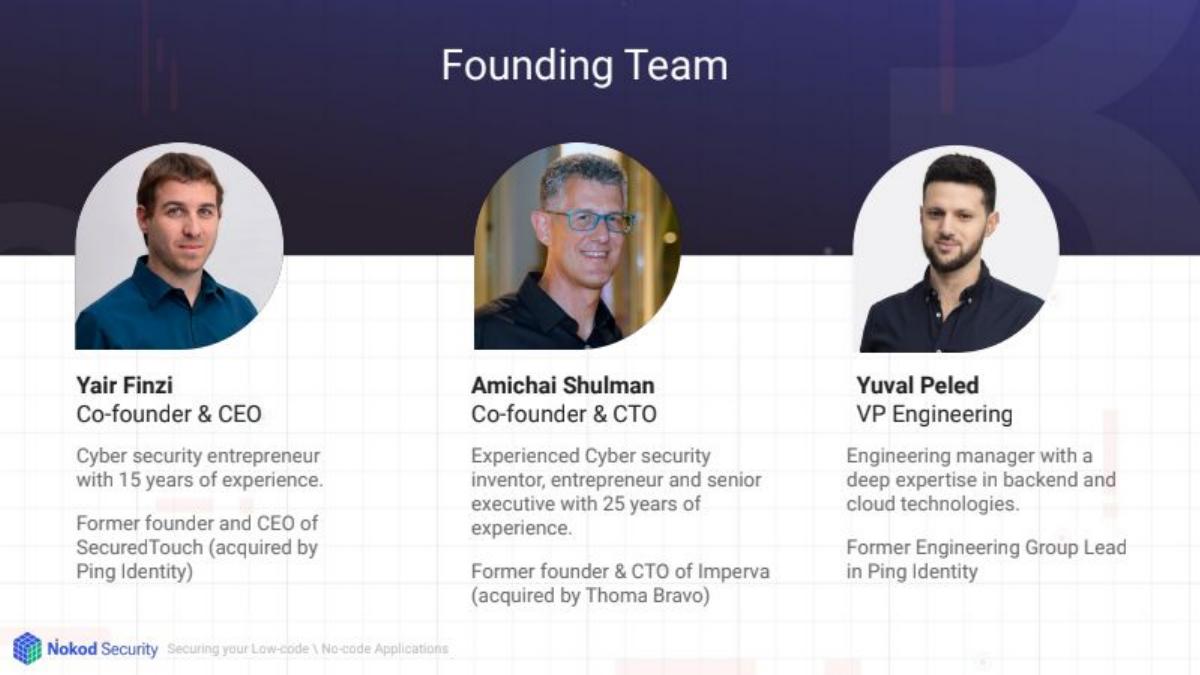
Nokod Security team slide — slide 2
Security for low-code and no-code applications. Slide titled "Founding Team".
Nokod Security deck, slide 2. Exact stored slide matched to this analysis.
Our analysis: Both founders have started security companies that were bought. That is the strongest single signal a security team slide can give, and the slide says it in two short lines each.
Evidence and limitation: Two named earlier security companies, each with its buyer, plus years in security for both founders.
What a founder can adapt: Name the earlier company and its outcome in one line per person.
Supporting analysis
What the deck claims: Yair Finzi, "Co-founder & CEO": "Cyber security entrepreneur with 15 years of experience." "Former founder and CEO of SecuredTouch (acquired by Ping Identity)". Amichai Shulman, "Co-founder & CTO": "Experienced Cyber security inventor, entrepreneur and senior executive with 25 years of experience." "Former founder & CTO of Imperva (acquired by Thoma Bravo)". Yuval Peled, "VP Engineering": "Engineering manager with a deep expertise in backend and cloud technologies." "Former Engineering Group Lead in Ping Identity".
Presentation choice: Investors and buyers both look for founders who have built and sold security products before.
When it does not fit: Burying an exit in a long bio; here it is easy to find.
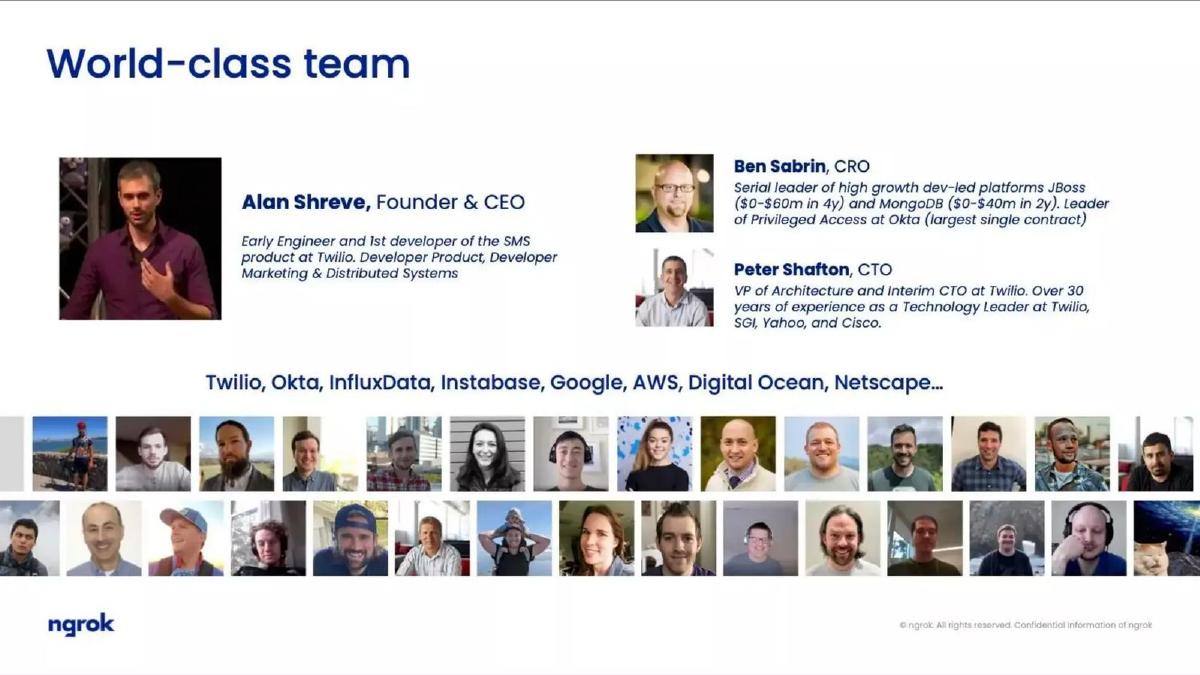
Secure network access for developers. Slide titled "World-class team".
ngrok deck, slide 6. Exact stored slide matched to this analysis.
Our analysis: The sales leader's line gives numbers for past growth and a security role at Okta, which answers whether the team can sell. The founder's line is about building developer products rather than security.
Evidence and limitation: Named products and roles, and revenue growth figures for the sales leader.
What a founder can adapt: Give each leader a figure, as the CRO line does.
Supporting analysis
What the deck claims: Alan Shreve, "Founder & CEO": "Early Engineer and 1st developer of the SMS product at Twilio." Ben Sabrin, "CRO": "Serial leader of high growth dev-led platforms JBoss ($0-$60m in 4y) and MongoDB ($0-$40m in 2y). Leader of Privileged Access at Okta (largest single contract)". Peter Shafton, "CTO": "VP of Architecture and interim CTO at Twilio. Over 30 years of experience as a Technology Leader at Twilio, SGI, Yahoo, and Cisco." A strip of staff photos under "Twilio, Okta, InfluxData, Instabase, Google, AWS, Digital Ocean, Netscape..."
Presentation choice: Security companies that sell to developers need both; revenue figures make the selling side checkable.
When it does not fit: A wall of staff photos that adds nothing an investor can check.
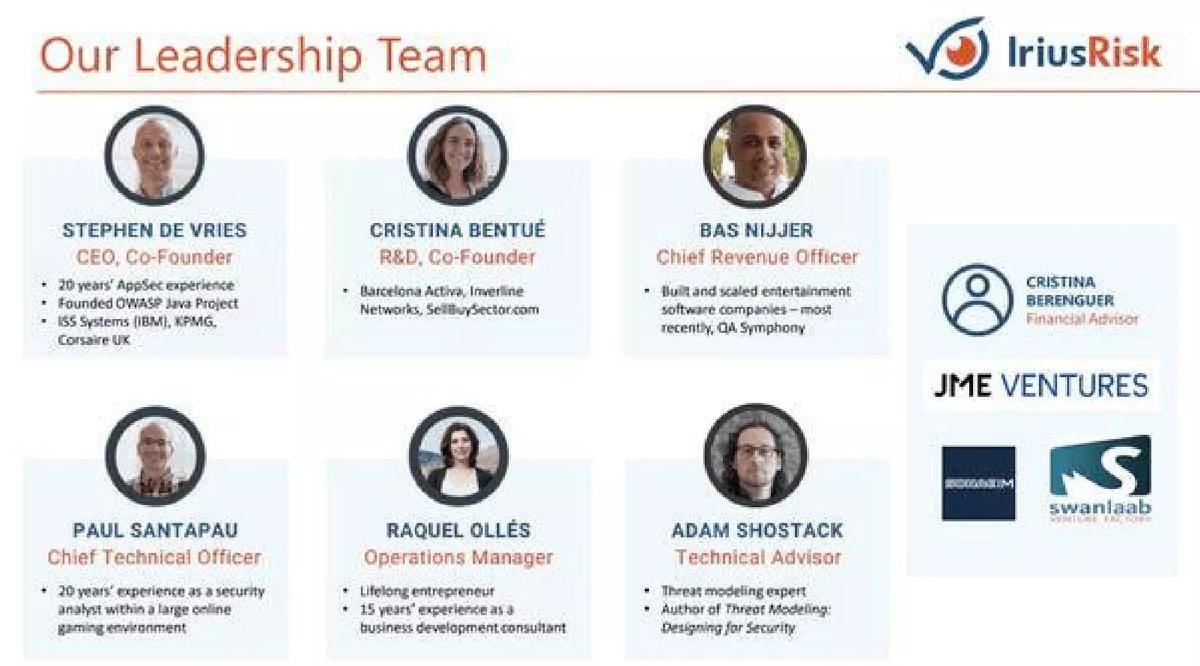
IriusRisk deck, slide 2. Exact stored slide matched to this analysis.
Our analysis: The CEO and CTO have long security careers, and the advisor is a recognised name in threat modeling. The advisor is placed in the same grid as the team, so a quick reader may count him as staff.
Evidence and limitation: Years in application security, a named open-source security project, and an advisor who wrote a book on the product's subject.
What a founder can adapt: Keep the specific security credits; move the advisor into a separate row.
Supporting analysis
What the deck claims: Stephen de Vries, "CEO, Co-Founder": "20 years' AppSec experience", "Founded OWASP Java Project", "ISS Systems (IBM), KPMG, Corsaire UK". Cristina Bentué, "R&D, Co-Founder": "Barcelona Activa, Inverline Networks, SellBuySector.com". Paul Santapau, "Chief Technical Officer": "20 years' experience as a security analyst within a large online gaming environment". Bas Nijjer, "Chief Revenue Officer". Raquel Ollés, "Operations Manager". Adam Shostack, "Technical Advisor": "Threat modeling expert", "Author of Threat Modeling: Designing for Security". Side panel: a financial advisor and investor logos.
Presentation choice: Open-source projects and books are public, so investors can check them.
When it does not fit: Mixing advisors and investor logos into the team grid.
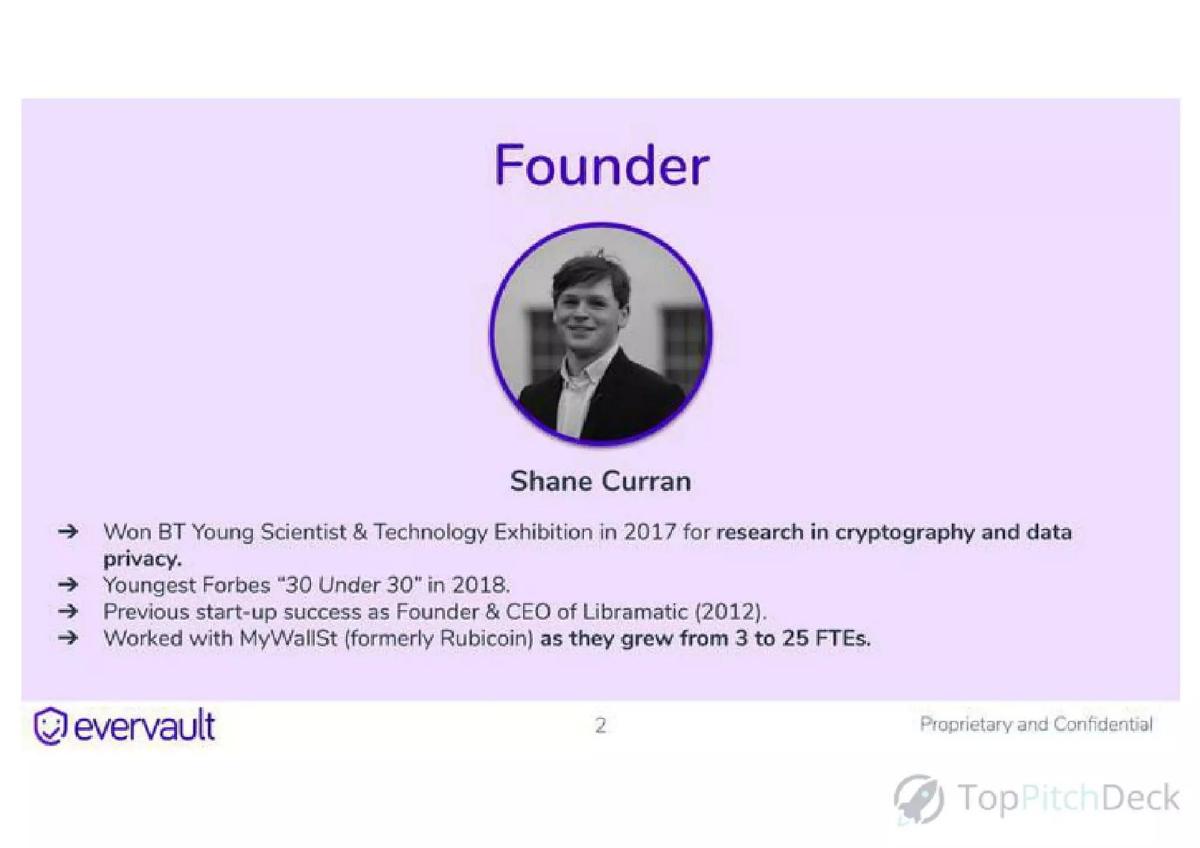
Encryption tools for developers. Slide titled "Founder".
Evervault deck, slide 2. Exact stored slide matched to this analysis.
Our analysis: For an early encryption company with one founder, the cryptography award ties him to the product. There is no one yet shown for selling or running the business.
Evidence and limitation: A named award for cryptography research, an earlier company and a growth figure.
What a founder can adapt: Add the first hires or the roles you plan to fill.
Supporting analysis
What the deck claims: Shane Curran: "Won BT Young Scientist & Technology Exhibition in 2017 for research in cryptography and data privacy." "Youngest Forbes "30 Under 30" in 2018." "Previous start-up success as Founder & CEO of Libramatic (2012)." "Worked with MyWallSt (formerly Rubicoin) as they grew from 3 to 25 FTEs."
Presentation choice: A single founder slide works when every line supports the product; investors will still ask who else is coming.
When it does not fit: "Start-up success" without saying what the success was.
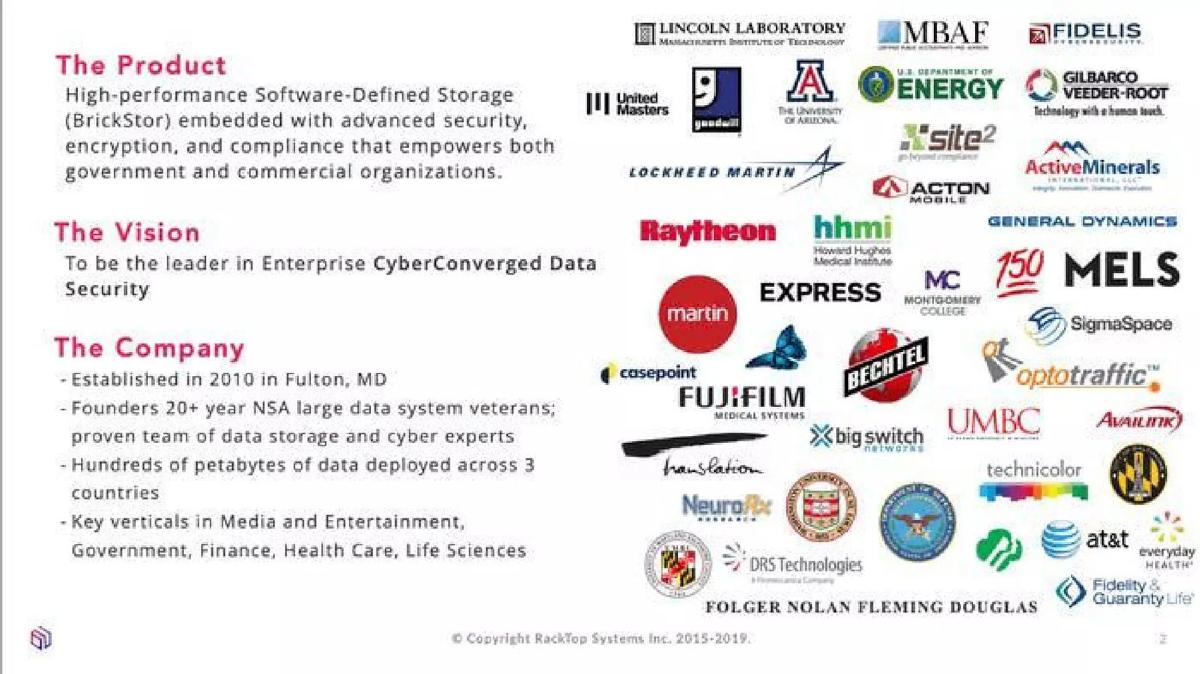
Secure data storage for government and business. Company overview slide with product, vision and company sections.
RackTop Systems deck, slide 3. Exact stored slide matched to this analysis.
Our analysis: An NSA background matters for government buyers, but the slide gives it one line inside a company overview, so an investor can't tell who the founders are or what they did.
Evidence and limitation: One line on the founders' NSA background; no names or roles.
What a founder can adapt: Give the founders their own slide, with names and the systems they ran.
Supporting analysis
What the deck claims: "Established in 2010 in Fulton, MD". "Founders 20+ year NSA large data system veterans; proven team of data storage and cyber experts." "Hundreds of petabytes of data deployed across 3 countries". Customer logos include Lockheed Martin, Raytheon, General Dynamics and the U.S. Department of Energy.
Presentation choice: A strong background in a single line is easy to miss.
When it does not fit: Team claims inside a company overview.
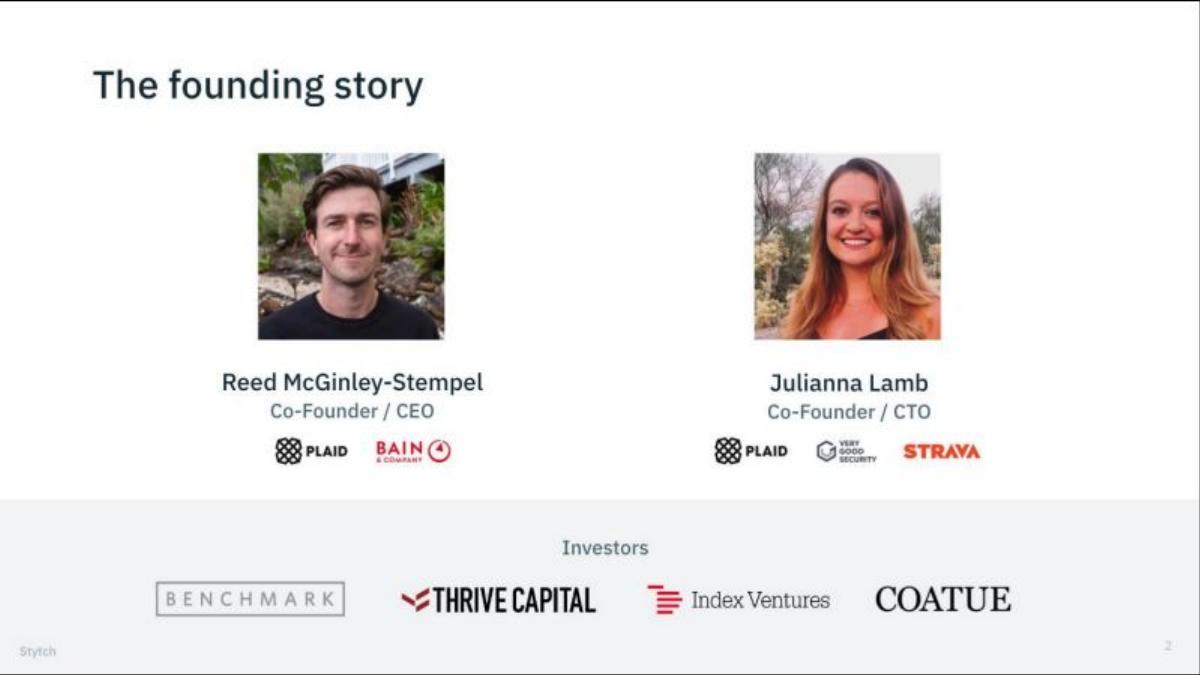
Authentication for developers. Slide titled "The founding story".
Stytch deck, slide 2. Exact stored slide matched to this analysis.
Our analysis: The logos, including a security company, suggest relevant experience, but the slide doesn't say what either founder did there. The title promises a story the slide doesn't tell.
Evidence and limitation: Names, roles and past-employer logos; no roles or results at those employers.
What a founder can adapt: Add one line per founder on what they built at each employer.
Supporting analysis
What the deck claims: Reed McGinley-Stempel, "Co-Founder / CEO", with Plaid and Bain & Company logos. Julianna Lamb, "Co-Founder / CTO", with Plaid, Very Good Security and Strava logos. "Investors": Benchmark, Thrive Capital, Index Ventures, Coatue.
Presentation choice: Logos alone leave investors to guess the role.
When it does not fit: A "founding story" slide with no story.
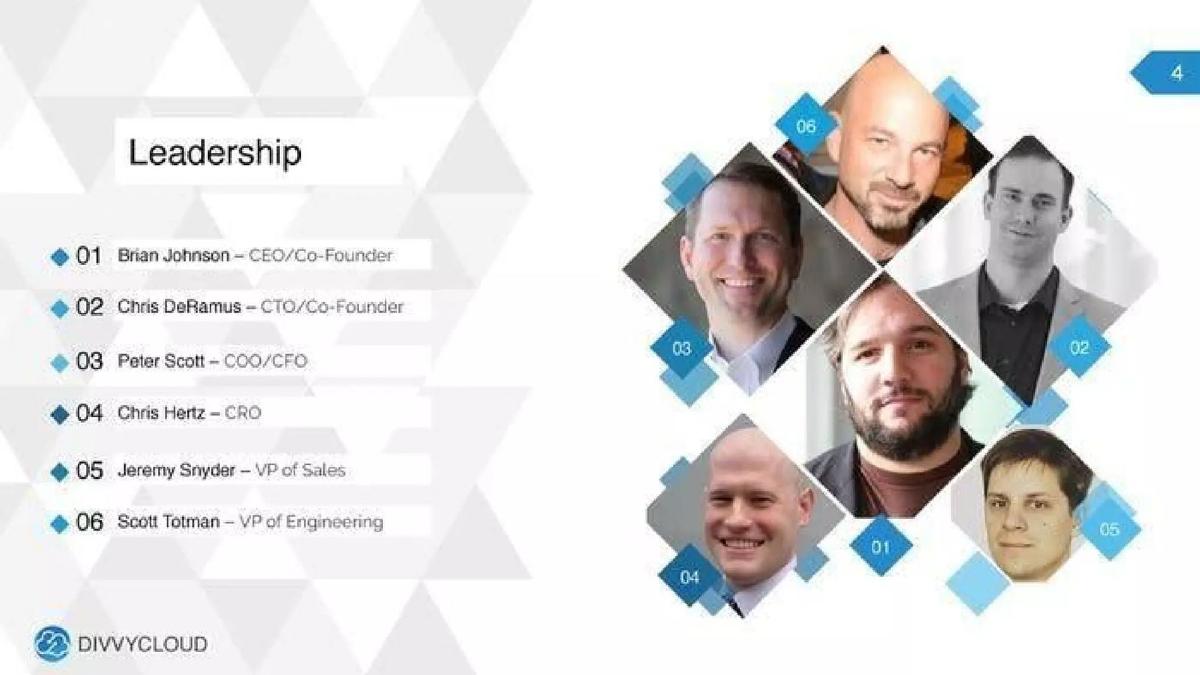
Cloud security and compliance software. Slide titled "Leadership".
DivvyCloud deck, slide 4. Exact stored slide matched to this analysis.
Our analysis: The slide shows a full leadership team, but nothing about security or sales experience. The numbered photos take up half the slide.
Evidence and limitation: Names and titles only.
What a founder can adapt: Add one past role and one result per person.
Supporting analysis
What the deck claims: "01 Brian Johnson – CEO/Co-Founder", "02 Chris DeRamus – CTO/Co-Founder", "03 Peter Scott – COO/CFO", "04 Chris Hertz – CRO", "05 Jeremy Snyder – VP of Sales", "06 Scott Totman – VP of Engineering". Numbered photos.
Presentation choice: Names and titles don't tell an investor why this team can win.
When it does not fit: Spending the space on photos instead of backgrounds.
Whether an investor can see earlier security companies, security depth, selling experience and something checkable.
Example
Business
Earlier security company
Security depth
Checkable facts
Nokod Security
Low-code app security
Yes (two, with buyers)
Years in security
Companies, buyers
ngrok
Secure network access
Security role at Okta
Not stated
Products, revenue figures
IriusRisk
Threat modeling
Not stated
OWASP project, AppSec years
Project, employers, book
Evervault
Encryption for developers
Not security
Cryptography award
Award, company
RackTop Systems
Secure storage
Not stated
NSA (one line)
None per person
Stytch
Authentication
Logo only
Not stated
Logos only
DivvyCloud
Cloud security
Not shown
Not shown
Names, titles
Key Takeaways
Name earlier security companies the team founded, and what happened to them.
Show security depth: research, open-source projects or security roles.
Show who has sold to large companies or government.
Give each person one result, not only years of experience.
Keep advisors and investors apart from the team.
Build your cybersecurity team slide
Show who has built security products, who understands attackers, and who can sell to security teams.
Earlier companies. Which security companies has anyone founded or helped build, and what happened to them?
Security depth. What research, open-source projects, certifications or security roles can each person point to?
Selling. Who has sold to security teams, large companies or government, and at what scale?
Result. What exit, revenue figure or product launch can each person name?
Advisors. Which advisors fill gaps, and are they shown apart from the team?
Copyable framework: Headline: [what the team has built or sold in security]. [Name], CEO: [earlier company], [outcome]. [Name], CTO: [security system or research], [result]. [Name], Sales: [buyers sold to], [revenue figure].
Illustrative example 1 — written by us
Before: Brian Johnson – CEO/Co-Founder
After: Brian Johnson, CEO/Co-Founder: [past role] at [company], [result such as customers or revenue].
What improved: Our illustrative rewrite; the bracketed details are placeholders, not DivvyCloud's facts. It adds a checkable background to a name and title.
What this guide adds
The general team slide guide covers any company. Security adds a trust test: buyers hand over access to their systems, so investors look for people who have already built security products, done security research or sold to security teams.
Our library's cybersecurity tag covers application security, authentication, encryption, secure storage, cloud security and network access tools. We note each company's business in the examples.
How we read each slide
We quote the text on the stored slide images. We have not checked any employer, acquisition, award, revenue or experience claim.
Common mistakes
Names and titles only. Add one past role and one result per person.
Logos without roles. Say what each person did at each employer.
Team claims hidden in an overview. Give the team its own slide with names.
No one who sells. Show who has sold to security buyers.
Advisors in the team grid. Put advisors and investors in a separate row.
Diagnostic checklist
Earlier security companies and their outcomes.
Security depth: research, projects or roles.
Selling experience with named buyers or figures.
One result per person.
Advisors and investors shown apart.
Frequently asked questions
What should a cybersecurity startup's team slide show?
Who has built or sold security products before, and what happened. Nokod's slide names two earlier security companies its founders started and who bought them.
Are past-employer logos enough?
No. Stytch shows logos including a security company, but without saying what the founders did there an investor can't judge the experience.
Can advisors supply the security credibility?
They help, but show them apart. IriusRisk's advisor wrote a book on threat modeling, yet he sits in the same grid as the staff.
How we chose these examples
Corpus: published pitch deck teardowns on StartupFundraising.com. Founder-uploaded private decks are excluded.
Selection (2026-09-27): we searched extracted slide text in decks tagged cybersecurity for team, founders or management together with CEO, CTO, founder or former. About 28 slides matched; we reviewed the unused ones with stored images as images.
Kept seven. Left out: Nokod's second deck p2 (the same slide), IFG Technology p4 (names and analyst titles only, similar to DivvyCloud), and slides whose text matched but showed disclaimers, market, product or press content (KnowBe4, Q2, CalypsoAI, Nodal, FleetDM, RingCaptcha, AlfredCamera, LoQR). Tromzo p13, iSecureCyber p8 and CrowdSec p8 have no stored image. No uploads were requested.
Review: stored slide text and images were checked on 2026-09-27 and matched to company, deck and slide number (editorial model review). No person has yet completed an editorial review of this page.
Claims are as shown on the slides; we have not verified them. We make no claim that any slide caused a fundraising outcome.