Ngrok’s 17-slide Series A deck is defined by overwhelming proof of product-market fit. Raising $50M in 2022, the company highlighted a massive user base of 5.4 million accounts and 30,000 paying customers, achieved with a $0 CAC and no formal marketing. The narrative shifts from a simple 'localhost' tunneling tool to a comprehensive 'production readiness' platform offering global scale, authentication, and observability. By showcasing organic recommendations from giants like Microsoft and Google, Ngrok proved it had already become the industry standard before seeking institutional capital. Th…
Key takeaways
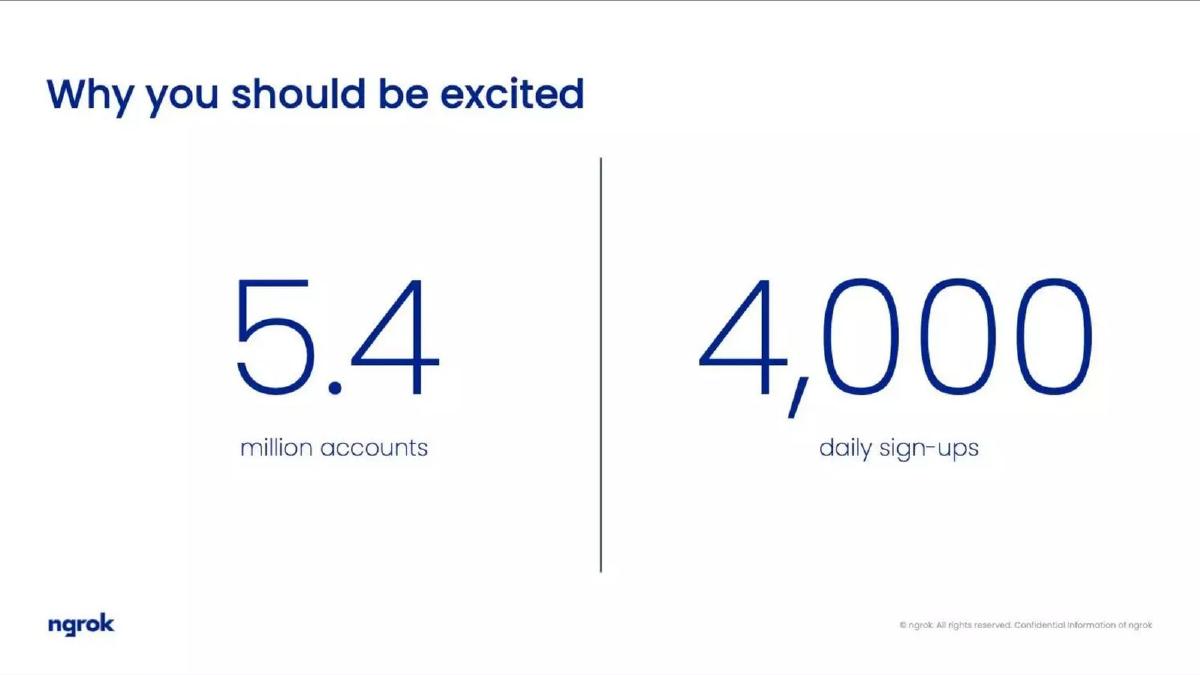
- The company leads with massive traction, citing 5.4 million accounts and 4,000 daily sign-ups on slide 3.
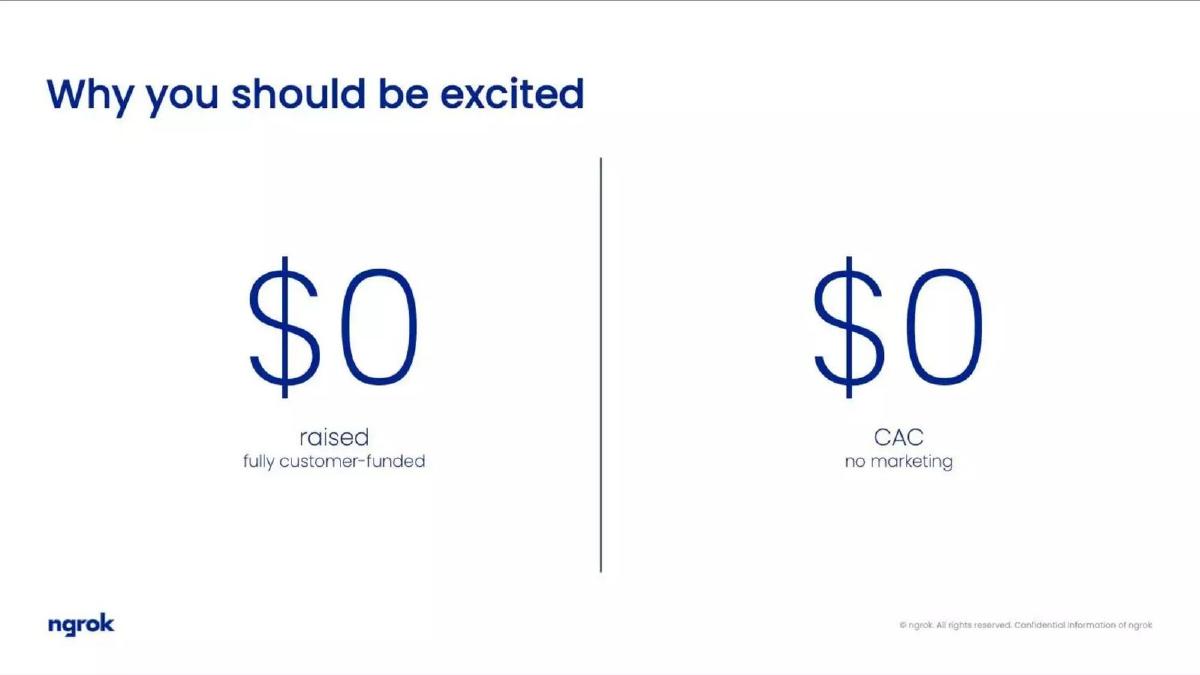
- Ngrok highlights an extremely efficient business model with $0 raised previously and $0 spent on marketing (CAC) on slide 5.
- The deck identifies a $73B Total Addressable Market (TAM) as the primary target for the $50M raise on slide 7.
- Technical friction is visualized as firewalls and NAT blocking access to localhost on slide 9.
- The product evolution is shown moving from simple tunneling to 'Production readiness in one line' including load balancing and authn/authz on slide 13.
- Social proof is a core pillar, with slide 14 displaying logos of 100s of organic recommendations including Stripe, Slack, and Meta.
- The 'Moat' is defined by speed to value, with 18,032 accounts starting a tunnel within 60 seconds of creation in April 2022 (slide 15).
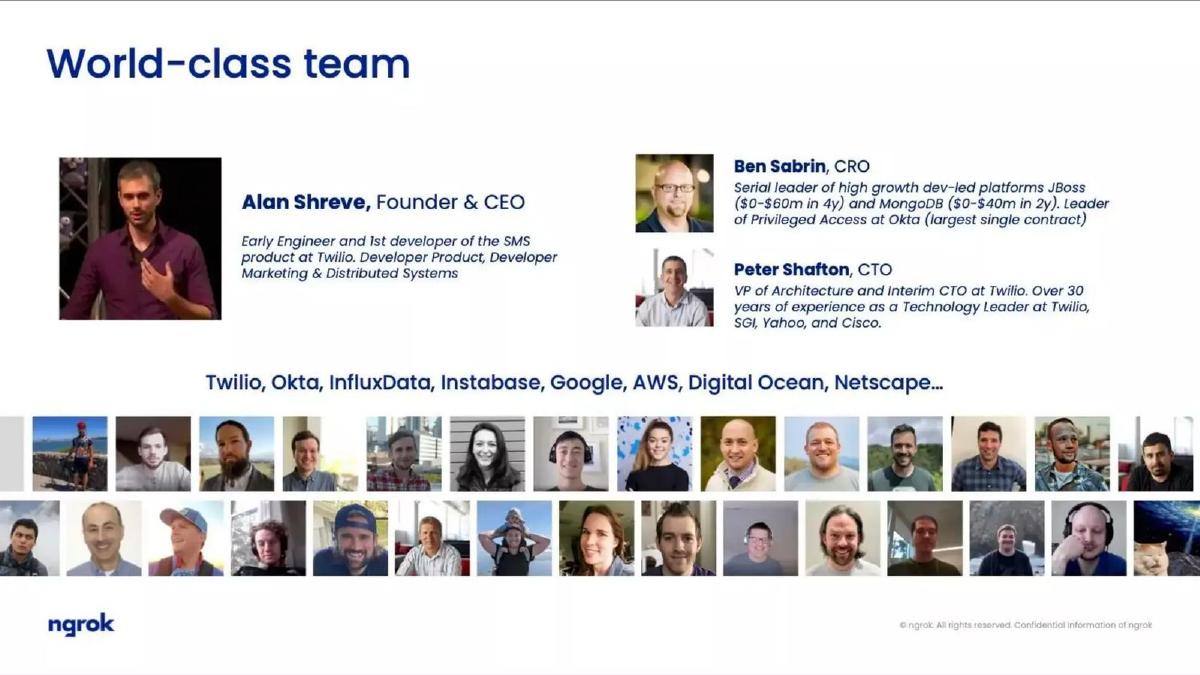
- The team slide (slide 6) emphasizes deep infrastructure experience from Twilio, Okta, and MongoDB.
The Power of Bottom-Up Adoption
The Ngrok Series A pitch deck is a rare example of a company that waited until it had achieved massive, undeniable scale before seeking venture capital. While many startups raise on a promise, Ngrok raised on a reality: 5.4 million accounts and a $0 customer acquisition cost. This teardown examines how they framed that success to secure a $50M round.
Slides 1-2: The Vision
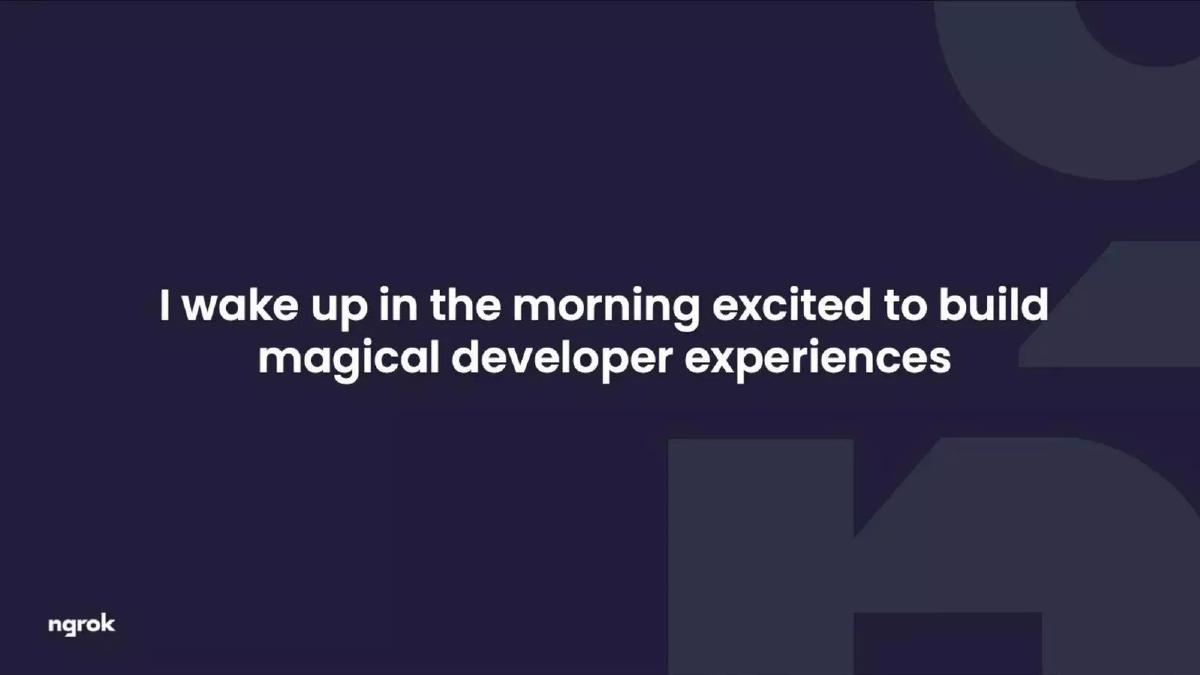
The deck opens with a minimalist title slide featuring the ngrok logo. Slide 2 sets a personal, mission-driven tone with the statement: "I wake up in the morning excited to build magical developer experiences." This establishes the company's identity as a developer-first organization, which is critical for the bottom-up SaaS model they employ.
Slides 3-5: Why You Should Be Excited
Ngrok skips the traditional problem/solution opening and goes straight to traction. This is a high-confidence move. Slide 3 displays two massive numbers: 5.4 million accounts and 4,000 daily sign-ups . By leading with these, Ngrok immediately answers the question of product-market fit.
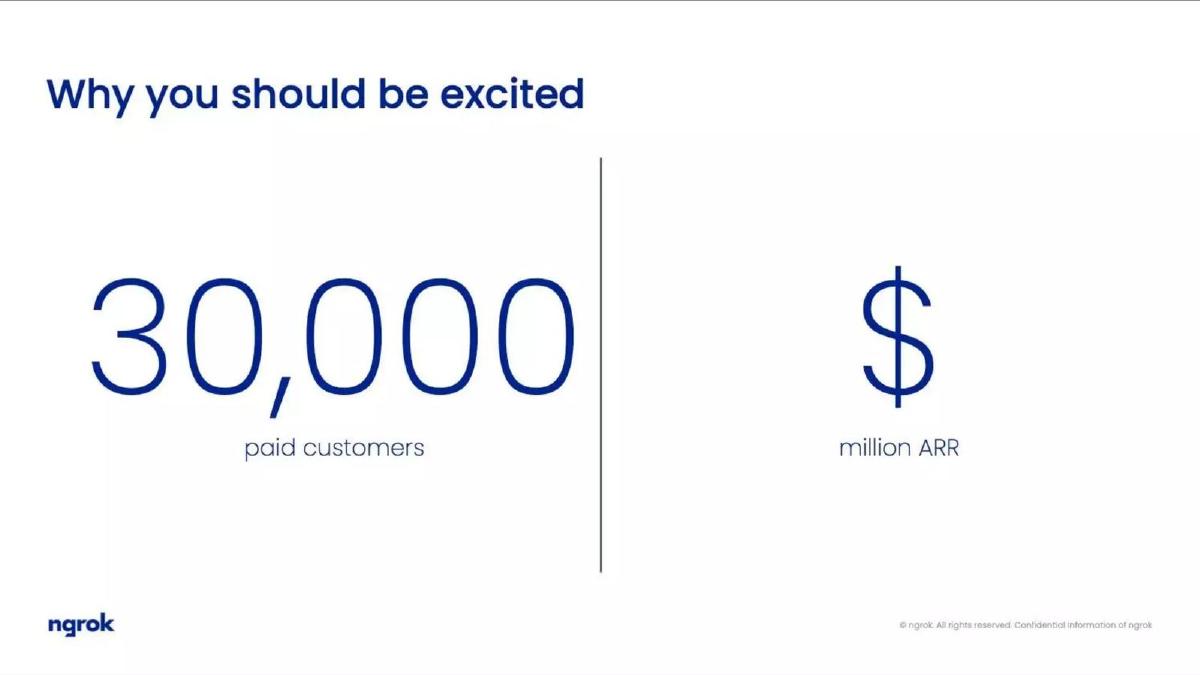
Slide 4 continues the momentum, citing 30,000 paid customers . Notably, the actual ARR figure is redacted in this version of the deck (represented by a large '$' sign), but the scale of the customer base implies a significant revenue engine. Slide 5 is perhaps the most impressive for an investor: $0 raised (fully customer-funded) and $0 CAC (no marketing). This demonstrates an incredibly efficient growth engine that relies entirely on word-of-mouth and product utility.
Slide 6: World-Class Team
The team slide highlights deep expertise in developer platforms. Alan Shreve (Founder & CEO) is noted as an early engineer at Twilio. Ben Sabrin (CRO) is credited with scaling JBoss and MongoDB, while Peter Shafton (CTO) brings experience from Twilio and Yahoo. The slide also lists a pedigree of former employers for the broader team, including Google, AWS, and Netscape, signaling that the company has the technical talent to handle its massive scale.
Slide 7: The Ask and the TAM
Slide 7 is a transition slide that explicitly states the goal: "We're raising $50m to chase a $73b TAM." This is one of the few places where the deck uses a standard venture pitch trope, but it is backed by the preceding evidence of traction. It signals that the company is ready to move from a bootstrapped utility to a venture-scale platform.
Slides 8-13: Product and Evolution
Slide 8 introduces the product section. Slide 9 visualizes the problem: web services are blocked by Firewalls, NAT, and Unreliable Networks , preventing access to localhost . Slide 10 provides the solution: "We get systems online in one line" using the command ngrok http 80 .
The deck then expands the scope. Slide 11 shows that Ngrok isn't just for localhost; it connects Apps, B2B Networks, Hybrid IT, and IoT Devices . Slide 12 and 13 represent the core of the Series A thesis: moving from a development tool to a production platform. Slide 13, titled "Production readiness in one line," lists enterprise features like Global Scale, Load Balancing, Authentication, Authorization, Encryption, and Observability . This is the pivot from a free tool to a high-value enterprise SaaS platform.
Slide 14: Social Proof as the De-Facto Standard
This is arguably the strongest slide in the deck. It features logos from Slack, Stripe, Microsoft, Google, Meta, and Zoom , among others. The text claims "100s of organic recommendations." The right side of the slide shows a screenshot of Microsoft documentation explicitly instructing users to use Ngrok. This proves that Ngrok has become part of the infrastructure of the internet's most important companies without spending a dime on sales.
Slide 15: The Moat
Ngrok defines its competitive advantage through three metrics. First, Time To Value : in April 2022, 18,032 accounts started a tunnel within 60 seconds of creation. Second, the sheer volume of 5 million developers . Third, the ISV ecosystem , with over 600,000 independent references and inclusion in the docs of Google, Microsoft, and GitHub. This suggests that any competitor would have to displace Ngrok from thousands of pages of existing technical documentation.
Slides 16-17: Conclusion
Slide 16 reinforces the slogan "Online in One Line" against a backdrop of various use cases like Database Access and File Share. Slide 17 is a standard closing slide. Notably, the deck does not include a roadmap, a detailed budget for the $50M, or financial projections. The omission suggests that the traction was so overwhelming that the round was likely pre-empted or driven by the strength of the existing business rather than a speculative future plan.
What Makes This Deck Work
1. Leading with Traction: By putting the 5.4 million users on slide 3, Ngrok removes all doubt about whether people want the product. For a Series A, this level of adoption is nearly unheard of, making the rest of the pitch a formality about how to monetize that volume.
2. Efficiency Metrics: The $0 CAC and $0 raised are the ultimate indicators of a healthy business. It tells investors that every dollar they inject will be used for expansion, not for fixing a leaky bucket or buying expensive ads.
3. Visualizing the Pivot: The transition from a simple "localhost" tool (Slide 10) to a "Production readiness" platform (Slide 13) is handled through clear, consistent diagrams. It helps investors understand how a free developer tool becomes a multi-billion dollar enterprise company.
What Is Missing
1. Financial Projections: There is no mention of future revenue targets or burn rates. While the ARR was likely shared in the data room, its absence from the deck keeps the focus on the "magic" of the developer experience and the scale of the user base.
2. Use of Funds: Aside from the mention of chasing a $73B TAM, the deck doesn't specify if the $50M is for hiring, international expansion, or R&D. This is common in highly competitive rounds where the company's momentum is the primary selling point.
3. Competitive Landscape: The deck assumes Ngrok has already won. There is no slide comparing them to traditional VPNs, reverse proxies, or emerging competitors. They rely on the "de-facto standard" claim to dismiss the need for a comparison.
Founder's Takeaway
If you have a bottom-up developer tool, copy Ngrok's approach to social proof. Don't just list logos of companies that use you; show screenshots of their documentation recommending you. That is a much higher bar of validation. Furthermore, if your metrics are your strongest asset, don't bury them on slide 12. Put them on slide 3 and let the investors spend the rest of the meeting trying to keep up with your growth.
Frequently asked questions
- How much did Ngrok raise and at what stage?
- Ngrok raised $50M in a Series A round in 2022. According to the deck and catalogue facts, the company was previously fully customer-funded, meaning this was their first major institutional round despite having millions of users.
- What is Ngrok's primary value proposition in this deck?
- The core value proposition is 'Online in One Line.' The deck illustrates how Ngrok bypasses complex networking obstacles like firewalls and NAT to make local services accessible to the internet instantly and securely.
- Who are the key team members mentioned?
- The deck features Founder & CEO Alan Shreve (early Twilio engineer), CRO Ben Sabrin (formerly JBoss and MongoDB), and CTO Peter Shafton (formerly Twilio and Yahoo). The team slide emphasizes a history of building developer-led platforms.
- How does Ngrok demonstrate market dominance?
- Ngrok uses 'organic recommendations' as its primary proof of dominance. Slide 14 shows that major tech companies like Microsoft, GitHub, and Okta include Ngrok in their official documentation as the recommended way to test integrations.
- What is the 'Moat' according to the pitch?
- The moat consists of three pillars: extreme Time To Value (tunnels live in under 60 seconds), a massive base of 5 million developers, and deep integration into the documentation of over 100 major Independent Software Vendors (ISVs).