Stripe positions itself as 'the new standard in online payments' with a strong developer-first approach. The core problem identified is payments rooted in code, not finance, emphasizing technical solutions. Mission is grand: 'increase the GDP of the internet,' aiming for broad economic impact. Key differentiators include a 'complete toolkit,' 'always improving' platform, and 'global scale.' Highlights a robust ecosystem with partners, developer tools, and simplification of financial complexity. The deck implies a comprehensive product suite (Radar, Sigma, Billing, Atlas) without detailing eac…
Key takeaways
- Stripe positions itself as 'the new standard in online payments' with a strong developer-first approach.
- The core problem identified is payments rooted in code, not finance, emphasizing technical solutions.
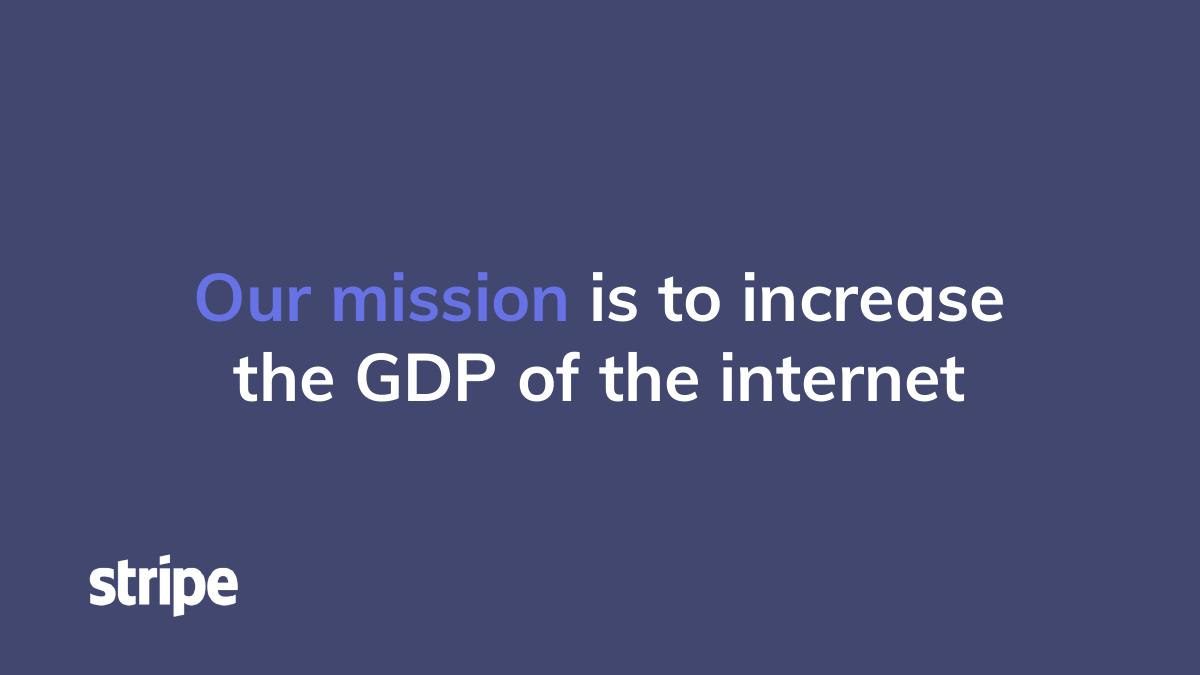
- Mission is grand: 'increase the GDP of the internet,' aiming for broad economic impact.
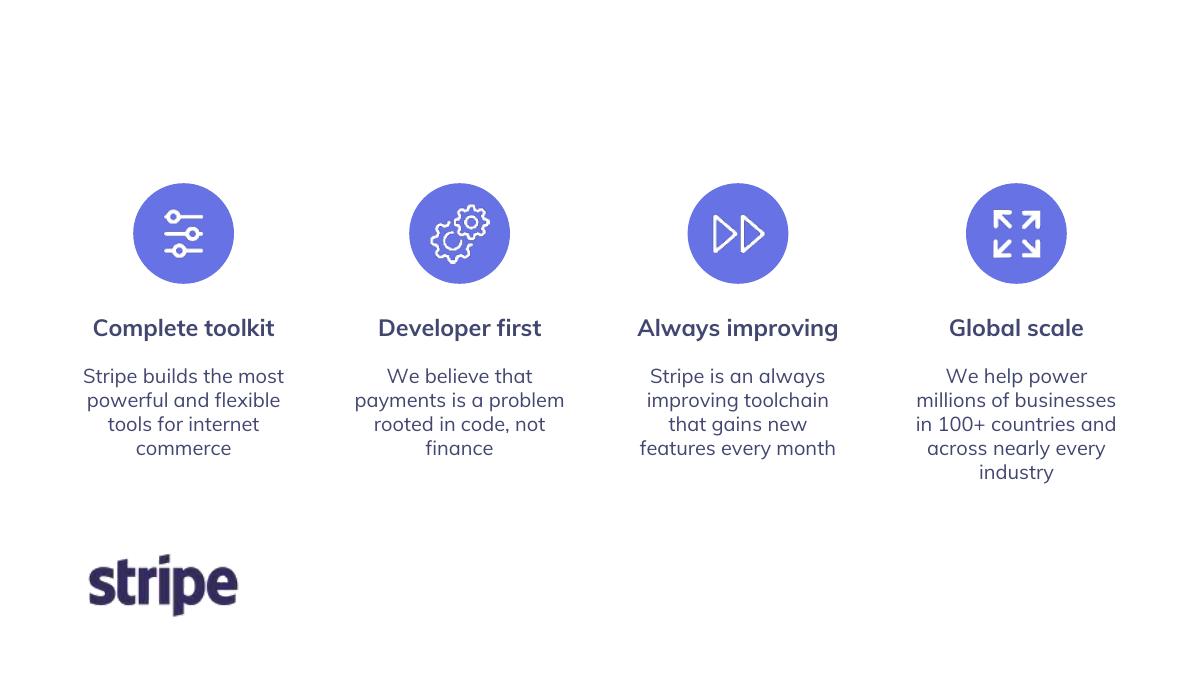
- Key differentiators include a 'complete toolkit,' 'always improving' platform, and 'global scale.'
- Highlights a robust ecosystem with partners, developer tools, and simplification of financial complexity.
- The deck implies a comprehensive product suite (Radar, Sigma, Billing, Atlas) without detailing each.
- Strong emphasis on growth, partnerships, and an experienced leadership team.
Executive Summary: The Internet's Payment OS
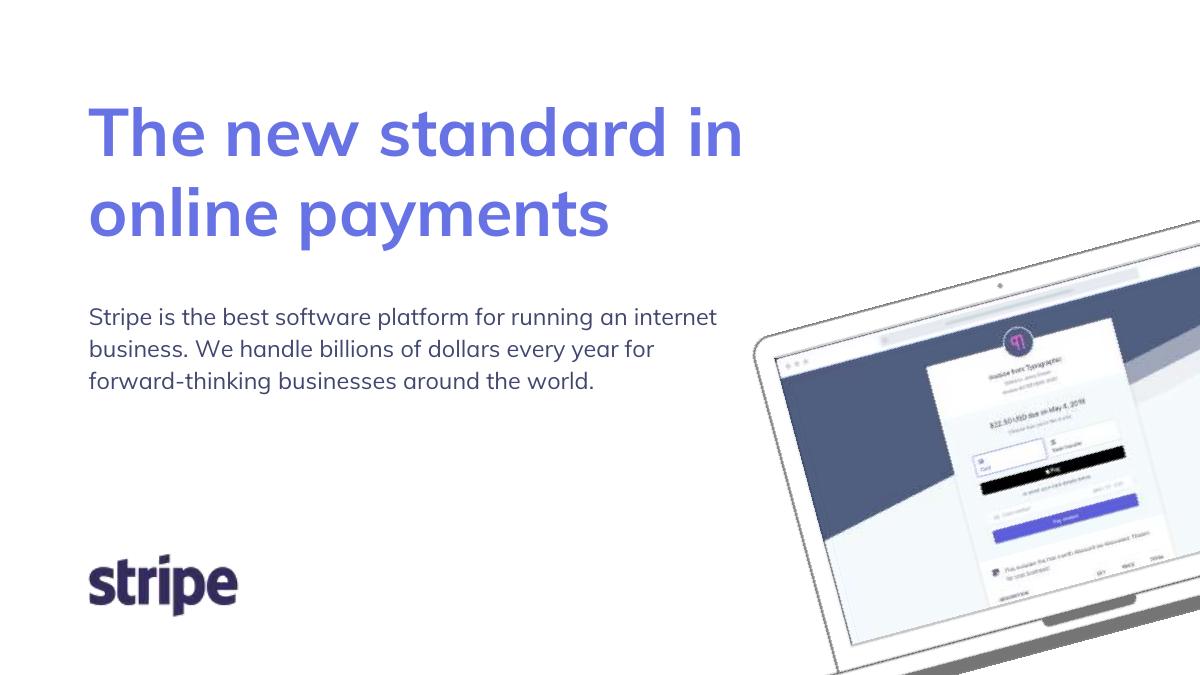
This early pitch deck for Stripe positions the company not just as a payment processor, but as 'the new standard in online payments' and 'the best software platform for running an internet business.' The vision articulated is ambitious: to 'increase the GDP of the internet.' This grand mission immediately elevates Stripe beyond a mere transactional service provider to a foundational infrastructure player. The deck emphasizes a 'developer first' philosophy, stating 'payments is a problem rooted in code, not finance,' which clearly differentiates it from traditional financial institutions and even other payment gateways of its time. The language used is confident and forward-looking, speaking of 'billions of dollars' handled and a global reach across '100+ countries.' While sparse on detailed metrics, the qualitative claims establish Stripe as a significant and innovative player.
Problem & Solution: Payments as a Code Problem
The core problem Stripe implicitly addresses is the complexity and friction of online payments for businesses, particularly for developers. By stating 'payments is a problem rooted in code, not finance,' the company asserts that traditional financial systems are ill-equipped to handle the demands of internet commerce. The solution is presented as a 'complete toolkit' of 'powerful and flexible tools' that are 'always improving.' The deck suggests Stripe builds 'the new payments stack,' listing products like Radar, Sigma, Billing, and Atlas. While these are presented as a collective, the deck doesn't delve into the specifics of what each product does, leaving the audience to infer their functions as components of a comprehensive payment ecosystem. The overarching solution is to remove 'financial complexity,' allowing businesses to focus on growth rather than navigating payment networks, regulations, and banks.
Market Opportunity & Competitive Advantage: Igniting Internet GDP
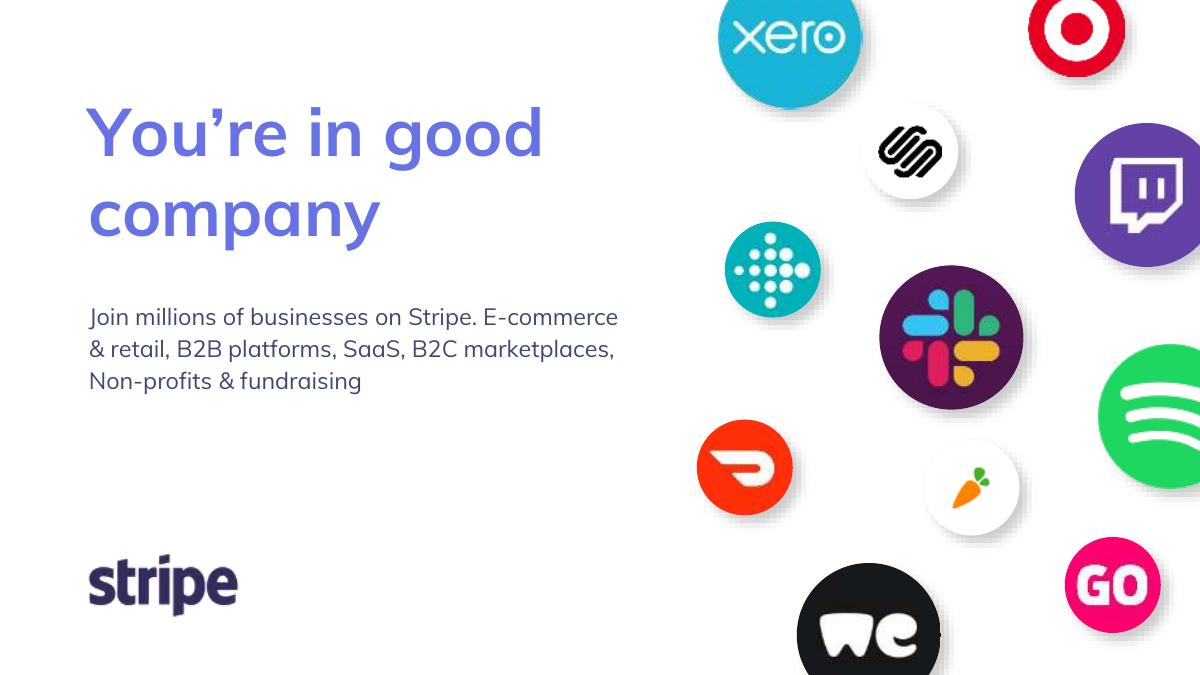
Stripe's ambition to 'increase the GDP of the internet' speaks to an enormous market opportunity. It frames itself as critical infrastructure for the global internet economy. The deck highlights the diverse range of businesses already using Stripe, including e-commerce & retail, B2B platforms, SaaS, B2C marketplaces, and non-profits. This broad adoption demonstrates the versatility and horizontal applicability of their platform. Competitive advantages are primarily rooted in its 'developer first' approach, offering 'industry-leading documentation' and support for the developer community. This focus on developers, who are often the gatekeepers for adopting new technologies within companies, is a strategic differentiator. Furthermore, the explicit statement about working with 'financial institutions, regulators, payment networks, banks, and consumer wallets' implies that Stripe abstracts away significant operational overhead for its users, another key advantage in a complex industry.
Product & Technology: The New Payments Stack
The deck showcases a 'complete toolkit' and 'the new payments stack' composed of products like Radar, Sigma, Billing, and Atlas. However, it completely omits any detailed explanation or screenshots of these products. This is a significant gap in a typical pitch deck, as investors would want to understand the features and functionalities that underpin these claims. The emphasis is on 'solutions rooted in code and design,' highlighting advanced developer tooling and a 'thriving partner ecosystem.' The phrase 'world’s fastest-advancing developer platform' reinforces Stripe's commitment to continuous innovation. The omission of granular product details might be acceptable in an early-stage pitch where the vision and strategic direction are paramount, but for later stages, more specifics would be expected. The deck also mentions 'industry-leading support for the developer community' and a 'thriving partner ecosystem,' which are critical components of a platform play.
Business Model & Traction: Billions and Millions
While the deck doesn't explicitly detail a business model (e.g., transaction fees, subscription fees), it implicitly suggests a transaction-based model given its core offering. The traction is communicated qualitatively rather than quantitatively, stating Stripe handles 'billions of dollars every year' and has 'millions of businesses' on its platform across '100+ countries.' This demonstrates significant scale and adoption for an early-stage company. The mention of operating since 2011 provides a historical context for its growth. The deck also touches upon a 'global company' structure with '2,000+ employees' and '14 global offices,' which speaks to operational maturity and capacity to scale. However, specific revenue numbers, growth rates, customer acquisition costs, or unit economics are entirely absent. This level of detail would be crucial for a thorough financial assessment.
Team & Ask: Visionary Leadership and Collaboration
The team slide features key executives: Claire Hughes Johnson (COO), Patrick Collison (Co-founder & CEO), John Collison (Co-founder & President), and Billy Alvarado (CBO). This highlights a strong, experienced leadership team. The inclusion of co-founders in prominent roles reinforces a stable and visionary leadership. The 'Ask' section is quite broad and focuses on partnership and collaboration: 'Let’s grow the internet economy together.' It invites partners to 'build technology and software that bring more businesses online' and offers a program to 'accelerate and amplify their impact.' The final slide explicitly asks to 'Get in touch' for 'general queries, including partnership opportunities.' There is no explicit ask for funding or a specific investment amount. This suggests the deck might serve multiple purposes – attracting investors, partners, and customers – or is an early version where the funding ask might have been conveyed verbally. The emphasis on collaboration indicates a strategic approach to ecosystem building.
Gaps & Opportunities
This pitch deck effectively communicates a compelling vision and strategic direction. However, several critical gaps exist:
Financials: No revenue, profit, or loss figures are provided. Key financial metrics such as burn rate, customer acquisition cost, or lifetime value are absent. · Detailed Product Information: The 'new payments stack' is mentioned, but individual product functionalities (Radar, Sigma, Billing, Atlas) are not elaborated upon. There are no screenshots or use cases provided. · Market Sizing: While the 'GDP of the internet' is a grand vision, specific TAM, SAM, and SOM figures are not presented. · Competition: No direct competitors are mentioned or analyzed, nor is Stripe's specific advantage over them articulated beyond its developer-first approach. · Go-to-Market Strategy: Beyond attracting developers and partners, the specifics of how Stripe acquires and retains customers are not detailed. · Exit Strategy: For investors, a potential exit strategy or long-term financial outlook is not discussed. · Specific Ask: There is no clear ask for a specific investment amount or terms, which is fundamental for a fundraising pitch.
Despite these gaps, the deck's strength lies in its clear vision, compelling problem framing, and emphasis on a developer-centric approach which was, and still is, a strong differentiator in the payments space. For an early-stage pitch, establishing this visionary foundation and problem-solution fit can be highly effective.
Frequently asked questions
- What is Stripe's core mission?
- Stripe's core mission is to 'increase the GDP of the internet,' aiming to be foundational infrastructure for online commerce.
- How does Stripe differentiate itself?
- Stripe differentiates itself primarily through its 'developer first' approach, viewing payments as a 'problem rooted in code, not finance,' and offering powerful, flexible tools with industry-leading documentation and a strong developer community.
- What products are mentioned in Stripe's 'new payments stack'?
- The deck mentions Radar, Sigma, Billing, and Atlas as components of Stripe's 'new payments stack,' though their specific functionalities are not detailed.
- Does the deck provide financial specifics or a funding ask?
- No, the deck does not provide specific financial figures, revenue, or an explicit funding ask. It focuses on qualitative traction (billions of dollars, millions of businesses) and an open invitation for partnerships.
- Who is on Stripe's leadership team according to the deck?
- The leadership team includes Claire Hughes Johnson (COO), Patrick Collison (Co-founder & CEO), John Collison (Co-founder & President), and Billy Alvarado (CBO).