The 2007 Mint.com seed deck is a masterclass in narrative and de-risking. By focusing on automated personal finance during a transition from desktop to web, Aaron Patzer secured $4.7M from top-tier investors. The deck succeeded by presenting a clear bottom-up market size, a win-win business model, and an all-star team that included the founder of their chief competitor as an advisor. Despite lacking product visuals, its logical clarity and focus on unit economics led to a $170M acquisition by Intuit just two years later.
Key takeaways
- Build your TAM from the bottom up by multiplying your target customer count by your specific projected revenue per user.
- Use your team slide to systematically de-risk execution by highlighting specific, relevant experience for your industry.
- Align monetization with user value so the company makes money when the users save or make money.
- Demonstrate partner-market fit as a proxy for traction if the product has not yet launched to the public.
- Explicitly map out an exit strategy with specific strategic rationales for potential acquirers to align with investor goals.
The Moment in Time: Pre-Crisis, Pre-iPhone
To understand the genius of the Mint deck, you have to transport yourself back to April 2007. The iPhone was still two months from release. The global financial crisis was a gathering storm, but not yet a full-blown hurricane. "Personal finance software" meant buying a CD-ROM of Quicken or Microsoft Money, manually installing it on your Windows desktop, and then spending hours painstakingly inputting every transaction by hand. Online banking existed, but it was a fragmented mess of siloed websites, each with its own clunky interface.
This was the world Aaron Patzer surveyed. He saw a generation of young, tech-savvy people (his target demographic of 22-35) who were comfortable online but had zero patience for manual data entry. The core insight was simple but profound: people hate managing their money, but they would do it if it were automated, effortless, and free. Mint wasn't just a better version of Quicken; it was a fundamental reconceptualization of personal finance for the web era. This deck was used to raise its foundational seed rounds, totaling approximately $4.7 million in 2007 from a who's who of angel investors and early-stage funds, including First Round Capital, Ron Conway, and Felicis Ventures.
Slide-by-Slide Walkthrough
The Vision: A World Without Spreadsheets
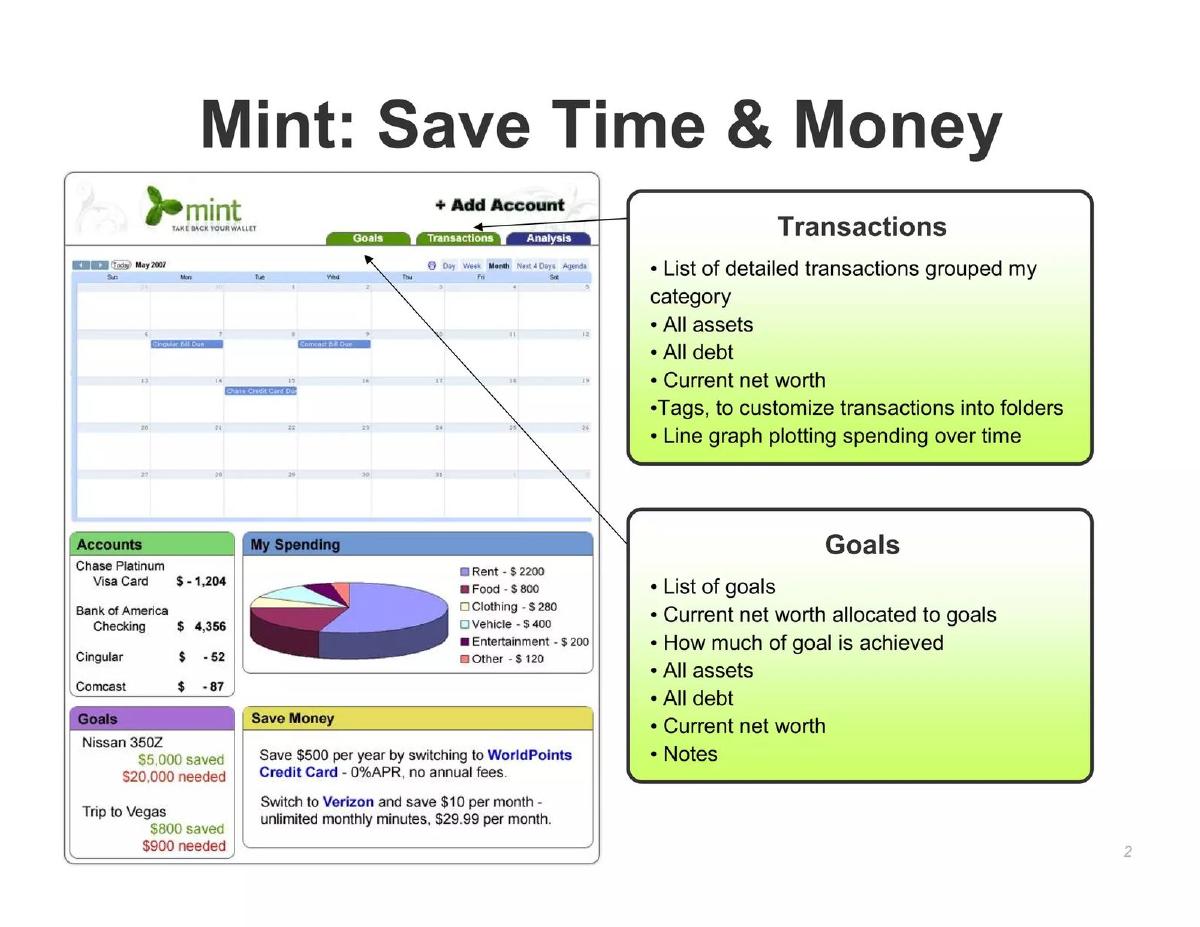
Most decks begin with a dramatic Problem slide. Mint breaks the rules. It opens with a title card and then jumps straight to Slide 2, "Mint: Save Time & Money." This isn't a problem slide; it's a vision slide. It simply states the user benefits and lists the core features: aggregated transactions, automatic categorization, net worth calculation, and goal tracking.
This is a masterclass in confident storytelling. By starting with the solution, the deck implies the problem is self-evident: managing money across multiple accounts is a time-consuming, fragmented nightmare. Instead of dwelling on the pain, Patzer presents the panacea. The tone is not "we will build..." but "this is what it is." It presents Mint as an inevitability, a solved problem from the very first slide.
The Team: All-Star Execution Risk Mitigation
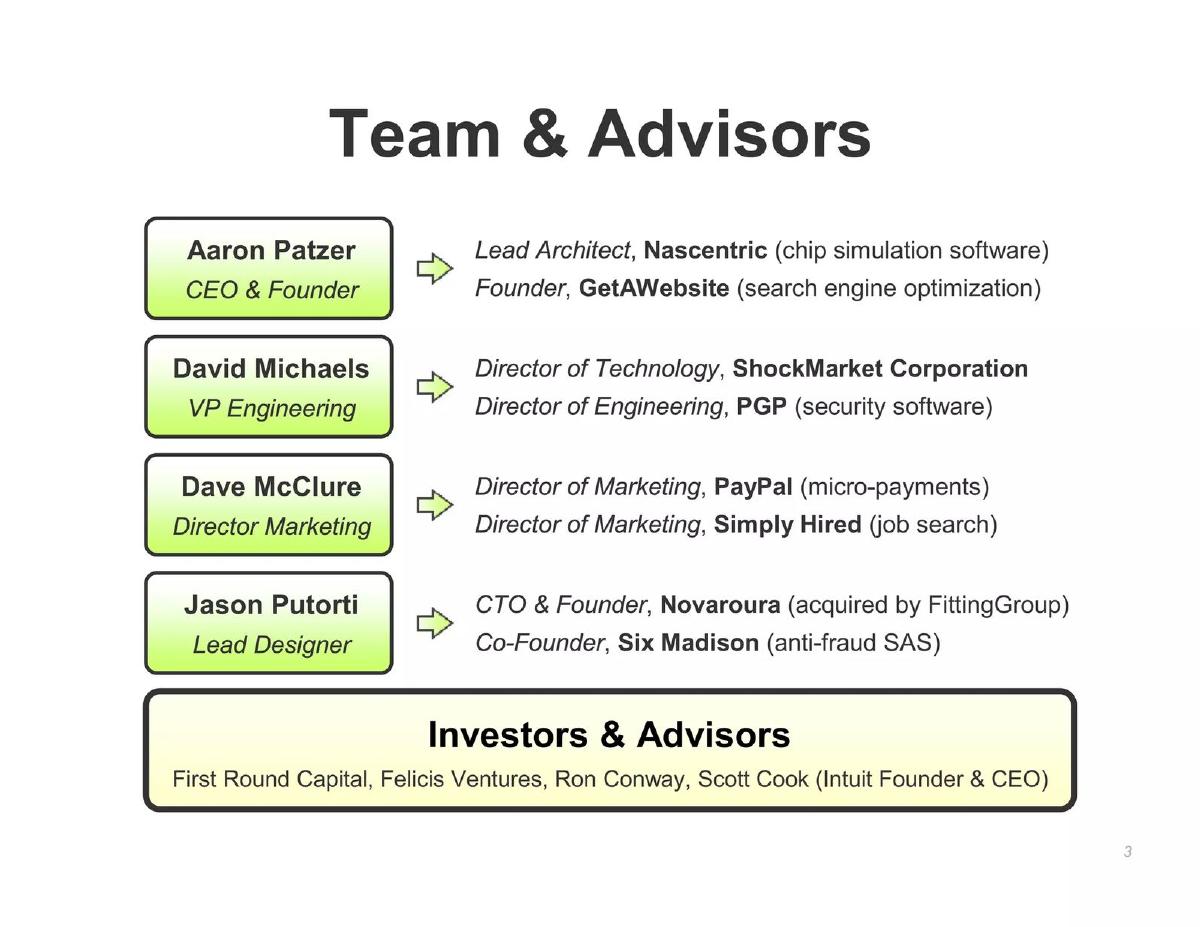
Placed strategically on Slide 3, the Team slide is an object lesson in building credibility. It's not just a list of names; it's a roster of precisely the right people for this specific challenge.
Aaron Patzer (CEO & Founder): Previous founder experience and a background in architecture for chip simulation software. This signals technical depth and entrepreneurial grit. · David Michaels (VP Engineering): Director of Engineering at PGP (Pretty Good Privacy). In a business that requires users to hand over their bank passwords, having a security veteran in a key role was a non-negotiable trust signal. · Dave McClure (Director Marketing): Director of Marketing at PayPal. Who knows more about acquiring users for a new financial product than an early PayPal marketing lead? This signaled that Mint understood growth. · Jason Putorti (Lead Designer): Founder of a company that was acquired. This shows a proven ability to create value.
The knockout blow, however, is the list of Investors & Advisors: First Round Capital, Felicis Ventures, Ron Conway, and... Scott Cook (Intuit Founder & CEO) . Getting the founder of the company you are ostensibly trying to kill to advise you is the ultimate power move. It tells investors that even the incumbent knows the future looks like Mint. This single name likely erased 90% of the execution risk in investors' minds.
Market Size: The Credible, Bottom-Up TAM
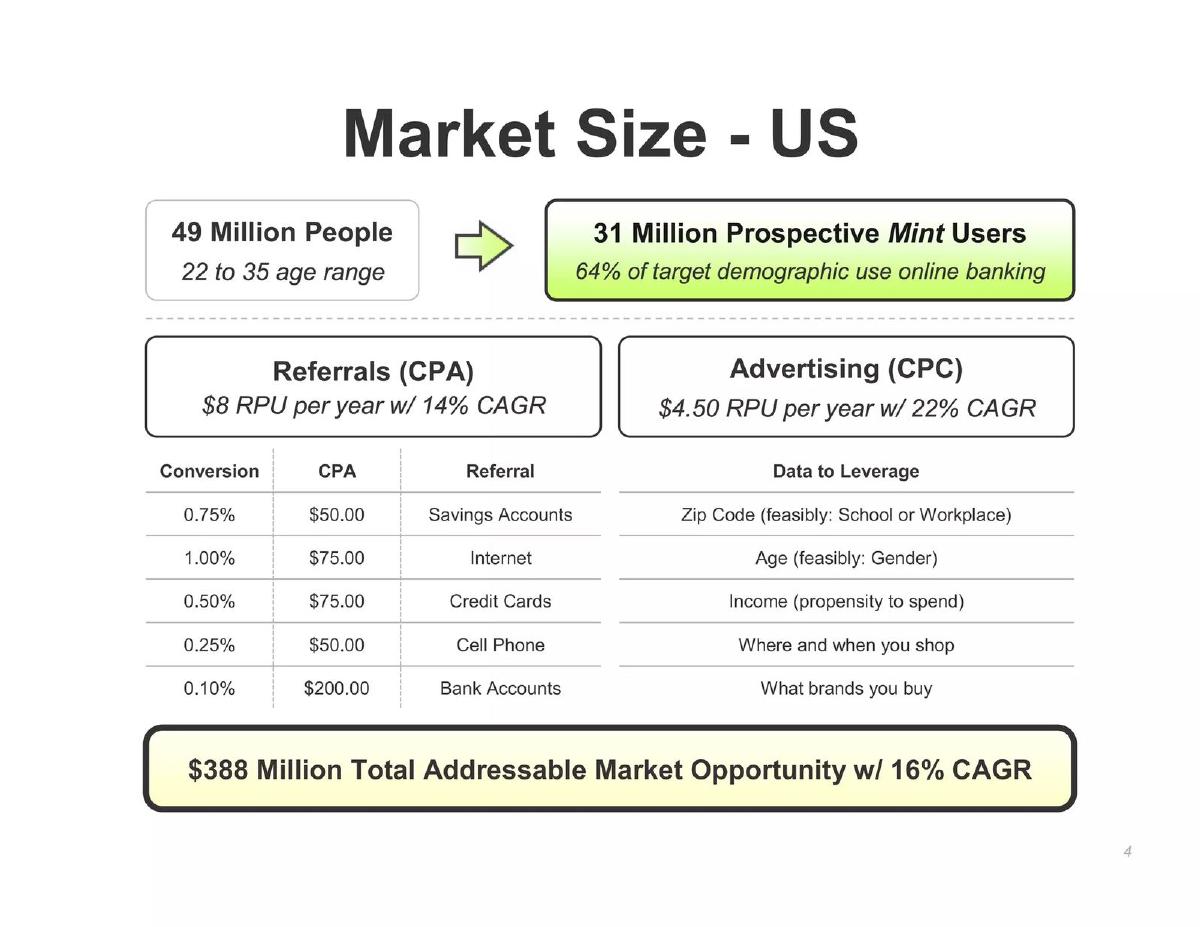
Amateur decks wave their hands and point to a multi-trillion dollar market. Professional decks, like Mint's, build their market from the ground up. On Slide 4, Mint doesn't just say "personal finance is a big market." They quantify their addressable market.
They start with a broad demographic (49M people aged 22-35 in the US), narrow it to a Serviceable Obtainable Market (31M who use online banking), and then apply their own business model to it. They project an $8 Revenue Per User (RPU) from referrals and a $4.50 RPU from advertising. The math is simple: (31M users) (~$12.50 blended RPU) leads to a Total Addressable Market of $388 Million. This is orders of magnitude more believable than a generic analyst report. It demonstrates a deep understanding of their own unit economics and links the market opportunity directly to their monetization strategy.
Business Model: Perfect Incentive Alignment
Slides 4, 7, and 9 work together to paint a crystal-clear picture of how Mint would make money. This was not a "we'll get users and figure it out later" Web 2.0 company. Monetization was baked in from day one.
Mint makes money when users make money rather than relying on creating value through added services. This tagline is the core of the entire pitch. The model is a simple flywheel:
Acquire users via viral marketing and PR. · Aggregate and analyze their financial data securely. · Use that data to provide intelligent, automated suggestions for saving money (e.g., "You could save $25/month by switching to this higher-yield savings account" or "This credit card offers better rewards for your spending patterns"). · When a user acts on a suggestion and switches providers, Mint earns a CPA (Cost Per Acquisition) referral fee from the new bank, credit card company, or cell phone provider.
This is a perfect win-win-win. The user saves money. The partner acquires a new customer at a lower CAC than traditional marketing. Mint gets paid for creating value. Slide 7, "Value to Partners," drives this home by showing concrete examples. It claims WaMu's CAC is $200, while Mint's referral fee is only $50, creating $150 of value for the partner. This made the business model feel tangible and inevitable.
Competition: Respectful Dismissal
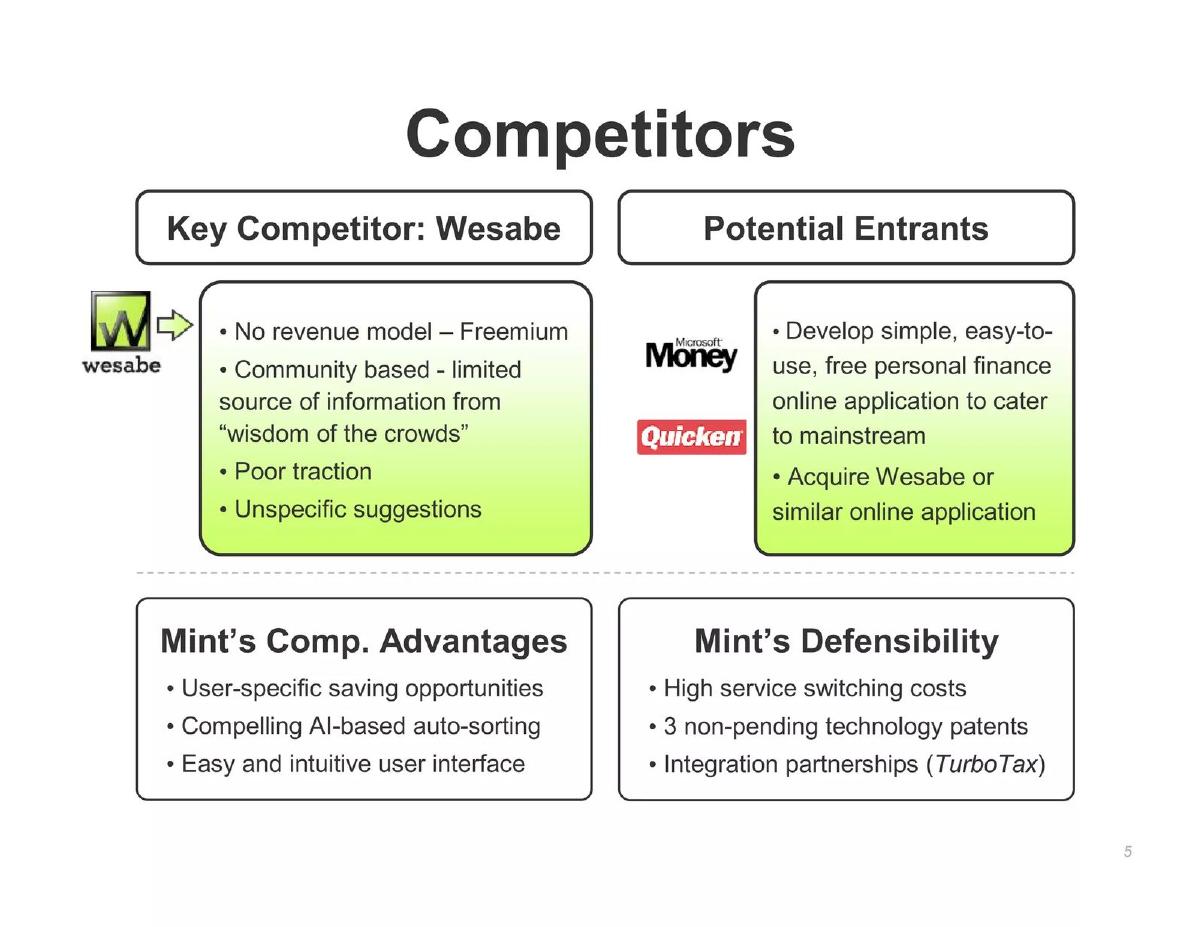
Every startup needs to answer the "what about competition?" question. Mint does it deftly on Slides 5 and 6. Slide 5 names their direct startup competitor, Wesabe, but dismisses them as having "no revenue model" and "poor traction." It also preempts the elephant-in-the-room question about large incumbents by listing them as "Potential Entrants."
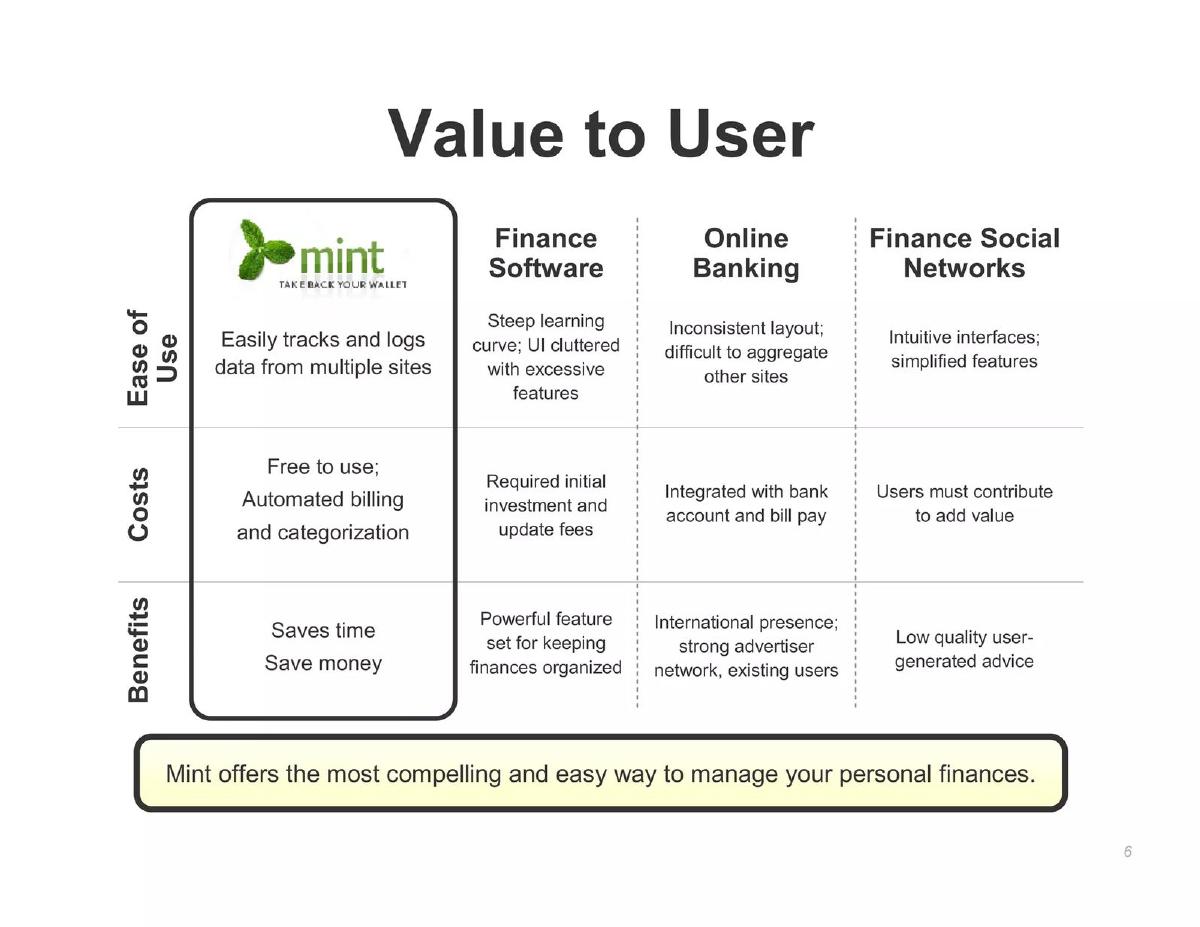
Slide 6 is a classic 2x2 matrix plotting "Ease of Use" vs. "Benefits/Cost." Mint places itself in the magic quadrant: high ease of use and high benefits (saves time/money, free). Finance Software (Quicken) is powerful but hard to use and expensive. Online Banking is easy but fragmented. Finance Social Networks (a dig at Wesabe) are intuitive but offer low-quality advice. It's a simple, devastatingly effective visual argument that frames Mint as the only logical choice.
Traction: The Art of the Pre-Launch Deck
Since this was a pre-launch deck, there were no user metrics to show. This is often a death sentence for startups. Mint cleverly substitutes business development for user traction. The "Value to Partners" slide (Slide 7) acts as a proxy for traction. By showing a clear, quantified value proposition for the companies that would ultimately pay Mint's bills, they demonstrated that the economic engine of the business was sound. It told investors, "Even if we don't have users yet, we have a compelling sales pitch for the people who will fund our growth." It proved the model worked, at least in theory, which is the best you can do before launch.
The Ask & Financials: A Path to Profitability
Slide 10 lays out the financial projections and the implicit ask. The deck models a $3M investment for a 15% stake, targeting a $17M pre-money / $20M post-money valuation. The projections are aggressive, forecasting profitability by the end of the first year (2007) with $751k in revenue and a slim $38k in EBIT. For a consumer-facing company in 2007, this was audacious. It signaled capital efficiency and a laser focus on the bottom line, a refreshing contrast to the cash-burning startups of the era. The detailed breakdown of revenue sources tied directly back to the business model, creating a cohesive and defensible financial narrative.
The Exit Strategy: Thinking Like Your Investor
Many founders are hesitant to talk about an exit, fearing it makes them seem mercenary. Patzer embraced it. Slide 11 is a grid of potential acquirers—Google, Yahoo, Microsoft, and Intuit—complete with a specific strategic rationale for each. For Intuit, the rationale was "Integration with Quicken by providing an online interface." For Google, it was an "entrance into the personal finance industry" and a source of "more targeted advertising." This showed investors two crucial things: 1) The founders understood the strategic landscape of their market. 2) The founders were aligned with their investors in seeking a massive return on capital. It was a clear signal that they were building to sell.
What Worked and Why Investors Said Yes
A Flawless Narrative: The deck told a simple, linear story: The world needs a better way to manage money; we have the team to build it; here is exactly how it will work; here is exactly how we'll make money; and here is exactly how you'll get your money back. · Systematic De-Risking: Every slide is engineered to remove a specific investor fear. The Team slide de-risked execution. The Business Model slide de-risked monetization. The Value to Partners slide de-risked the go-to-market. The Exit slide de-risked the potential for a return. · Economic Clarity: The deck was built on a foundation of solid unit economics. The concepts of RPU, CPA, and partner CAC made the entire enterprise feel less like a speculative bet and more like a predictable machine. · Unbeatable Social Proof: The team and advisor list was, for a seed-stage company, an unfair advantage. It created a powerful feeling of inevitability around the company.
What Was Weak or Missing
Product Visuals: For all its strategic brilliance, the deck contains zero screenshots, wireframes, or mockups. The product is described only as a list of features. In today's visually-driven pitch environment, this would be a major red flag. Investors want to see the product magic. · Security Deep Dive: While the VP Eng's background helped, the deck could have used a dedicated slide addressing the single biggest user adoption hurdle: trust. How exactly would Mint secure user bank credentials? A slide on their security architecture would have been a powerful addition. · Overly Aggressive Projections: Forecasting profitability in year one is a bold move. While it signals capital efficiency, it lacks credibility for a pre-launch consumer product. Investors likely discounted these numbers heavily but appreciated the underlying focus on building a real business.
Lessons for Today's Founders
Build your TAM from your business model. Don't just cite a top-down market figure. Show investors the math: (Target Customers) x (Your Actual Price) = Your Addressable Market. It's infinitely more powerful. · Your team slide is your first traction slide. Especially pre-launch, your team's specific, relevant experience is the best indicator of your ability to execute. Tailor it to crush a-priori doubts about your specific business. · Monetization isn't an afterthought; it's a core product feature. The best business models, like Mint's, are deeply integrated with the user's journey and align your success with theirs. Show how you make money from day one. · Demonstrate "partner-market fit." If you don't have users yet, show that you have a compelling value proposition for a key stakeholder in your ecosystem. This could be channel partners, data providers, or, in Mint's case, the companies paying referral fees. · Explicitly map out the exit. Show investors you're playing the same game they are. A well-researched exit slide proves you understand the strategic landscape and are focused on generating a return.
Epilogue: Promise vs. Reality
Mint's execution was as good as its pitch. The company launched at the TechCrunch40 conference in September 2007 and won the top prize, rocketing to mainstream awareness. The product delivered on the promise of effortless, automated financial aggregation. The business model worked precisely as planned, generating millions from lead-gen referrals.
The exit strategy proved to be prophetic. In November 2009, just over two years after this deck was created, Mint was acquired by Intuit for $170 million. The strategic rationale was exactly what the deck predicted: Intuit, the aging desktop giant, desperately needed an foothold in the future of free, web-based personal finance. For seed investors who backed the vision in this deck, it was a spectacular and rapid return. Mint not only achieved its mission but also became the defining company of the Web 2.0 fintech era, creating a template that countless fintech apps follow to this day.
Frequently asked questions
- Did Mint have a product when they pitched this deck?
- No, this was a quintessential pre-launch, pre-product deck. Its power came from the clarity of the vision, the credibility of the team, and the irrefutable logic of the business model, not from a demo.
- Why was the Intuit founder, Scott Cook, advising a potential competitor?
- Cook was a visionary who saw that desktop software like Quicken was a melting iceberg. By advising Mint, he got a front-row seat to the disruption of his own company and was perfectly positioned to advocate for the eventual acquisition. It was a brilliant strategic move for both parties.
- Isn't a $388M TAM too small for venture capital?
- In 2007, for a seed round, it was perfect. The key was that it was a *believable* TAM that Mint could realistically dominate. It was better to own a well-defined $388M market than to claim a tiny fraction of a trillion-dollar one. The focus was on capital-efficient growth to a significant acquisition.
- What was the single most important slide in the deck?
- While the Team slide provided the credibility, the "Value to Partners" slide (Slide 7) likely sealed the deal. For a company with no users, it offered concrete, quantitative proof that the business model was not just a theory but a compelling value proposition for the companies that would pay the bills.
- How did Mint convince users to trust them with their bank passwords?
- This was their biggest challenge. They tackled it head-on with a multi-pronged strategy: hiring a top security expert as VP of Eng, implementing bank-level security measures, using read-only access so no money could be moved, and making security a central pillar of their public relations and marketing efforts.