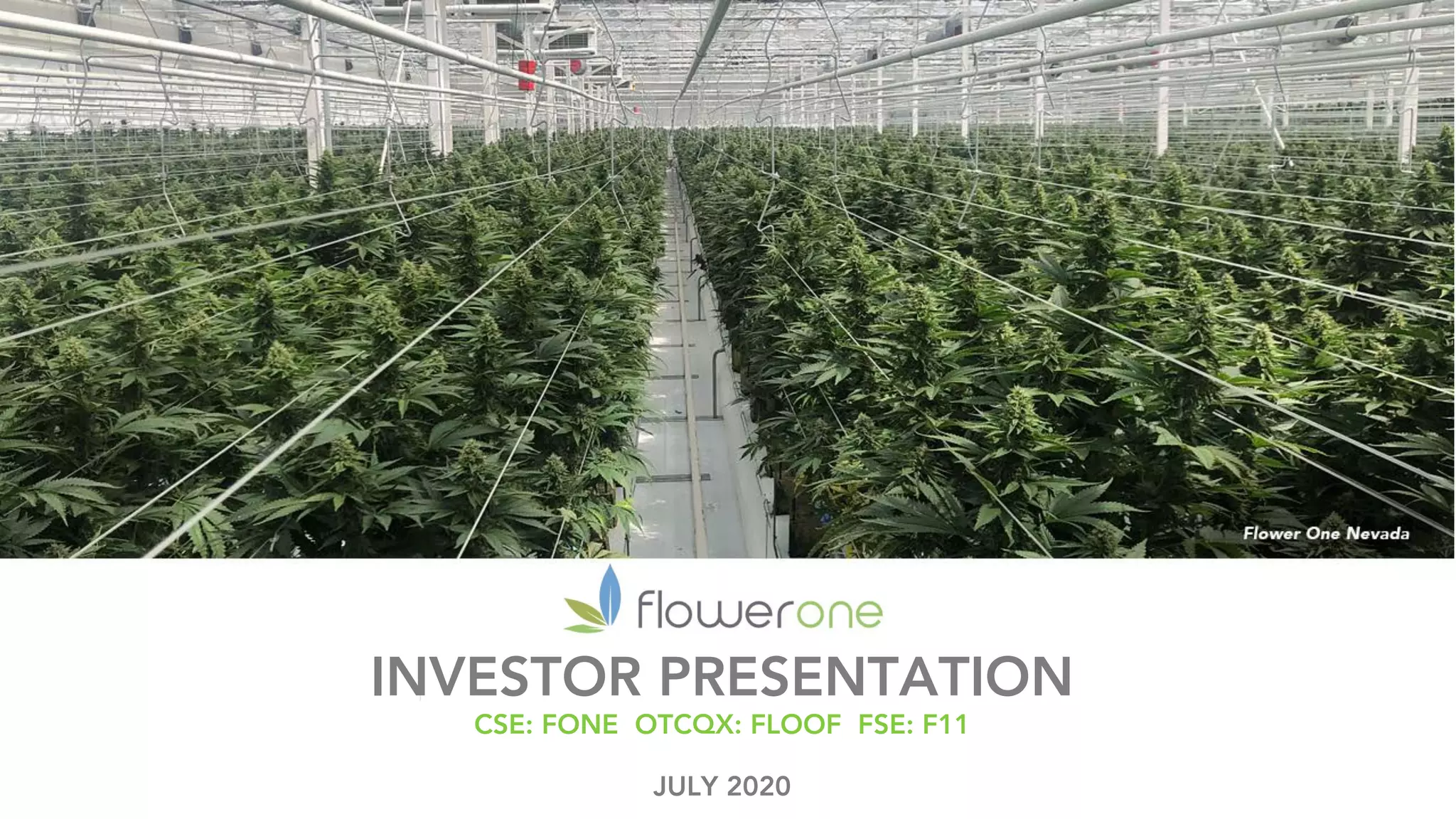
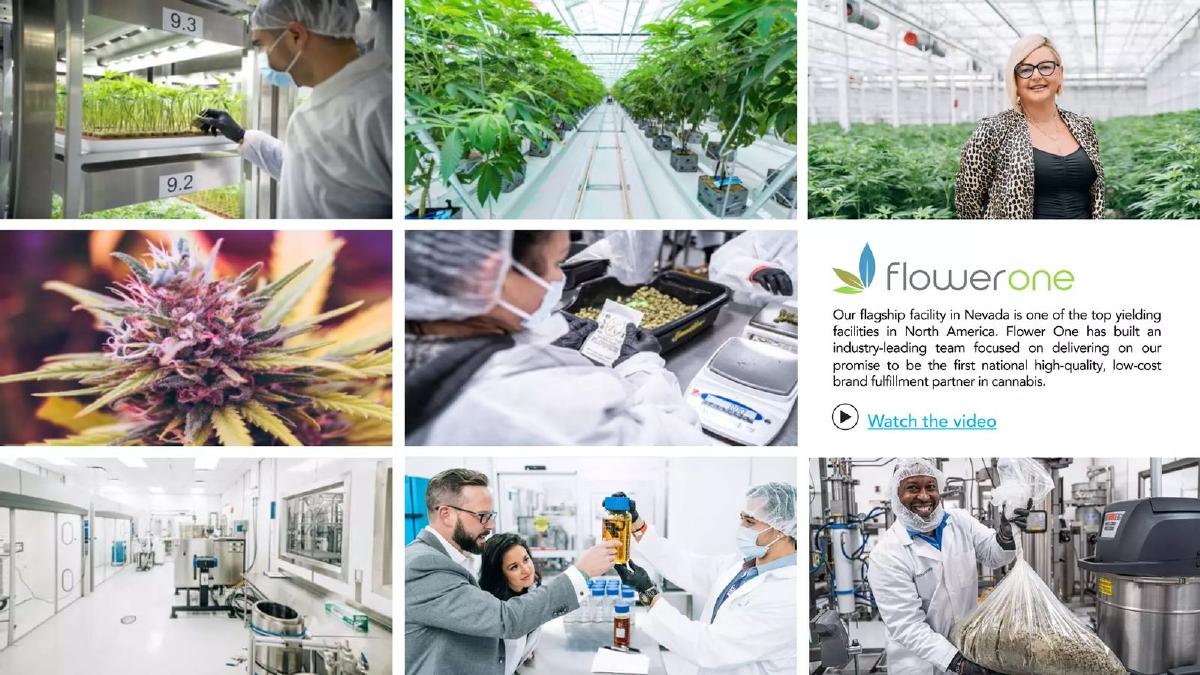
Flower One Holdings (CSE: FONE) positioned itself in July 2020 as the dominant industrial-scale cannabis producer in Nevada. The deck focuses heavily on physical infrastructure, highlighting a 400,000 square foot flagship greenhouse and a 55,000 square foot production facility. By emphasizing a 'turnkey solution' for brand partners, the company shifts the narrative from simple farming to high-tech manufacturing and distribution. The financial data shows rapid growth, with Q4 2019 revenues up 128% over the previous quarter, reaching $5.8M. However, the deck is light on specific unit economics…
Key takeaways
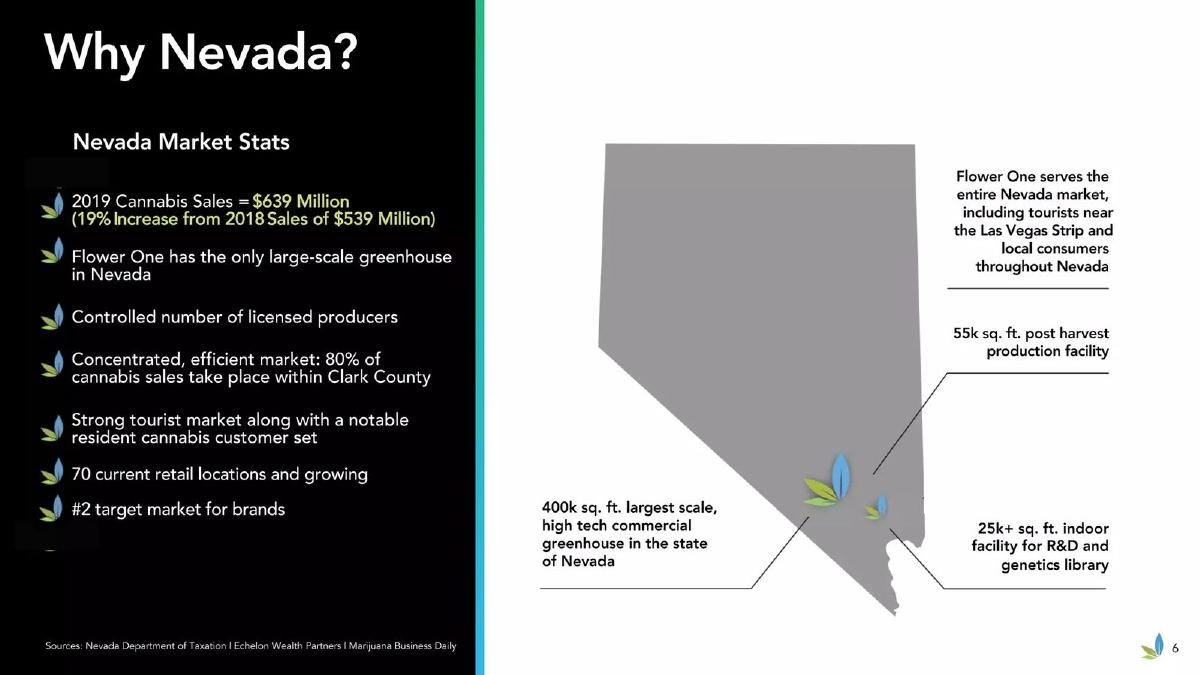
- The company operates the largest commercial cultivation and production facility in Nevada, featuring a 400,000 square foot flagship greenhouse (Slide 7).
- Flower One reports an annual production capacity of 100K-110K pounds of cannabis from its primary facility (Slide 7).
- Revenue grew significantly in late 2019, with Q4 revenues of $5.8M representing a 128% increase from Q3 2019 (Slide 19).
- The business model relies on a 'Turnkey Solution' encompassing cultivation, extraction, manufacturing, and distribution for over 16 brand partners (Slides 7, 10).
- Manufacturing capabilities include a 55,000 square foot facility producing over 100 SKUs through an exclusive partnership with the Dennis Group (Slide 13).
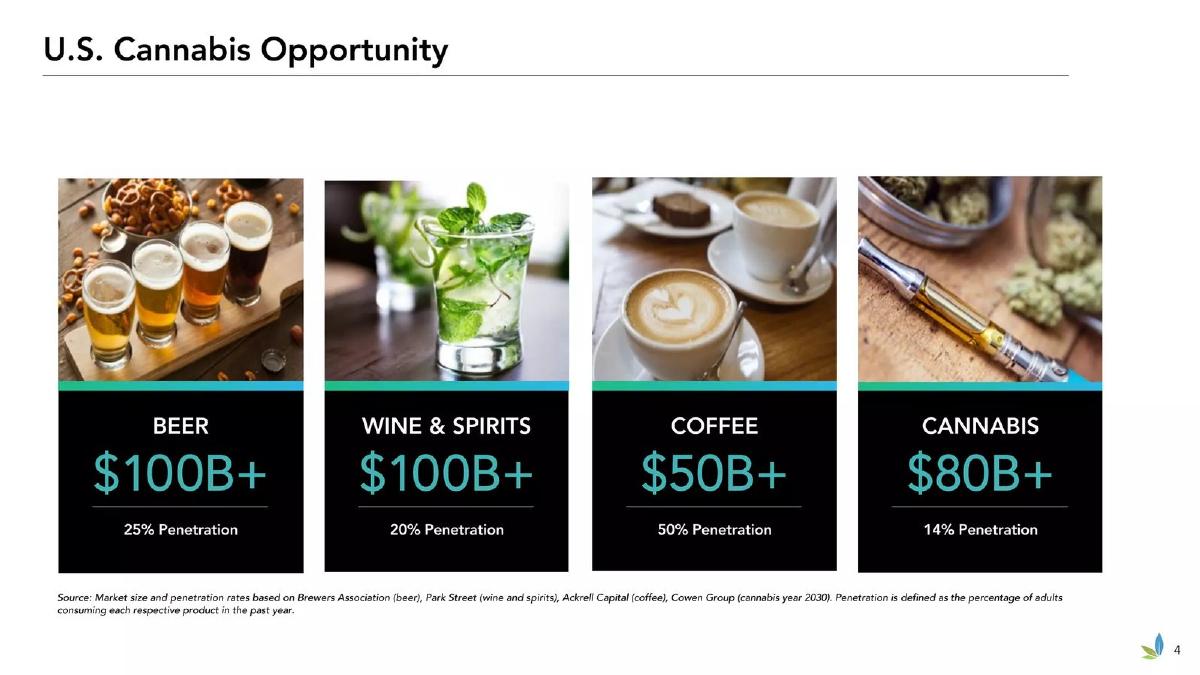
- Market sizing benchmarks cannabis against established industries, projecting an $80B+ opportunity with only 14% current penetration (Slide 4).
- The board of directors features significant experience in corporate affairs, large-scale greenhouse operations, and cross-border banking (Slide 22).
- Operational responses to COVID-19 included hiring additional cleaning staff and reconfiguring production workflows to ensure supply chain consistency (Slide 25).
Flower One Holdings: The Industrialization of Cannabis
The July 2020 investor presentation for Flower One Holdings (CSE: FONE) represents a specific era in the cannabis industry: the transition from speculative 'green rush' startups to industrial-scale agricultural and manufacturing powerhouses. The deck focuses heavily on the company's Nevada footprint, positioning them not just as a grower, but as a critical infrastructure partner for the entire state's cannabis ecosystem.
The Market Opportunity (Slide 4)
Flower One begins by contextualizing the cannabis market within the broader consumer packaged goods (CPG) landscape. Slide 4 presents a side-by-side comparison of Beer, Wine & Spirits, Coffee, and Cannabis. By showing that Cannabis has the lowest penetration rate (14%) despite a projected market size of $80B+, the company argues for massive untapped growth. This is a classic 'rising tide' argument intended to make the sector feel as stable and inevitable as the alcohol or caffeine industries.
Infrastructure as a Moat (Slide 7)
The core of the Flower One value proposition is physical scale. Slide 7 provides an aerial view of their Nevada footprint, which they claim is the 'Largest Commercial Cultivation & Production Facility in Nevada.' The numbers are significant: a 400,000 square foot flagship greenhouse, a 55,000 square foot production facility, and a 25,000 square foot indoor space for premium craft cannabis. The slide explicitly states an annual production capacity of 100K-110K pounds. For investors, this slide is meant to demonstrate a barrier to entry; building a facility of this magnitude requires capital and time that competitors may not have.
The Turnkey Business Model (Slides 10 & 13)
Flower One positions itself as more than a farmer. Slide 10 introduces the 'Turnkey Solution for Brand & Retail Partners,' listing cultivation, extraction, manufacturing, distribution, and market penetration strategy as their core service offerings. This 'Cannabis-as-a-Service' model is further detailed on Slide 13, which focuses on their Manufacturing & Production capabilities. By partnering with the Dennis Group (a firm specialized in food and beverage facilities), Flower One emphasizes that their 55,000 square foot production space is built to CPG standards, capable of churning out over 100 different SKUs. This suggests a diversified revenue stream that isn't solely dependent on the fluctuating price of raw cannabis flower.
Financial Performance and Growth (Slides 16 & 19)
The transition from construction to operations is reflected in the financial slides. Slide 19 is the most critical for growth-oriented investors. It shows a 128% revenue increase from Q3 2019 to Q4 2019 ($5.8M). More impressively, Q1 2020 revenues reached $8.8M, nearly eclipsing the total revenue for the entire previous year ($9.5M). While Q2 2020 preliminary revenues showed a dip to $3.8M, the company notes this was still ahead of their guidance of $3.25M-$3.75M. The deck uses these figures to prove that their massive infrastructure is successfully being converted into top-line growth.
Governance and Crisis Management (Slides 22 & 25)
To provide confidence in the management of these large-scale assets, Slide 22 introduces a Board of Directors with deep institutional experience. The bios highlight expertise in multi-national greenhouse operations, corporate banking, and CPG leadership. Finally, Slide 25 addresses the then-current COVID-19 pandemic. The 'Operational Response Plan' details specific steps taken to maintain the supply chain, such as shift-based social distancing and enhanced disinfection. This slide serves to reassure investors that the company's large-scale operations are resilient to external shocks.
What Works in This Deck
Visual Proof of Scale: The use of aerial photography and specific square footage callouts (Slide 7) makes the company's claims of dominance feel tangible rather than theoretical. · CPG Framing: By comparing cannabis to beer and coffee (Slide 4), the company moves the conversation away from 'drug culture' and toward 'consumer staples,' which appeals to institutional investors. · Clear Revenue Momentum: The quarter-over-quarter growth figures on Slide 19 provide a clear 'up and to the right' narrative that justifies the previous capital expenditures on infrastructure. · Strategic Partnerships: Mentioning the Dennis Group (Slide 13) adds third-party credibility to their manufacturing standards.
What Is Missing
Unit Economics: While the deck highlights total revenue, it omits the cost per gram to produce or the margins on their 'turnkey' services. In a commodity-sensitive market like cannabis, knowing the production floor is vital. · Debt and Capital Structure: Building 400,000+ square feet of high-tech greenhouse is capital intensive. The deck does not detail the company's debt load or cash runway, which are critical for a company at this stage. · Competitor Analysis: The deck claims to be the 'largest' in Nevada but does not list who the other major players are or how Flower One protects its market share against them. · Path to Profitability: The focus is entirely on revenue growth. There are no projections for when the company expects to reach EBITDA-positive status or net profitability.
Founder Takeaways
Sell the 'Factory,' Not Just the 'Product': Flower One succeeds by selling the efficiency and scale of their production process. If you are in a hardware or manufacturing space, your facility is as much a part of the pitch as your product. · Contextualize Your Market: Using familiar industries (like coffee or beer) to explain a new or misunderstood market helps investors quickly grasp the potential upside without needing a deep dive into industry-specific jargon. · Highlight Operational Resilience: The inclusion of a COVID-19 response slide (Slide 25) is a good lesson in addressing the 'elephant in the room.' Always show investors how you are navigating current macro-economic challenges. · Use Third-Party Validation: Mentioning that a top U.S. design firm built your facility (Slide 13) is a subtle way to signal quality and professional rigor without bragging.
Frequently asked questions
- What is Flower One's primary competitive advantage according to the deck?
- The primary advantage is sheer physical scale and vertical integration within the Nevada market. Slide 7 highlights their 400,000 square foot greenhouse as the largest in the state, providing a production capacity of 100,000 to 110,000 pounds annually. This industrial scale allows them to act as a 'turnkey' partner for brands that lack their own cultivation or manufacturing infrastructure.
- How does Flower One compare the cannabis market to other consumer goods?
- Slide 4 uses a comparative market analysis, placing Cannabis ($80B+ potential at 14% penetration) alongside Beer ($100B+ at 25% penetration), Wine & Spirits ($100B+ at 20% penetration), and Coffee ($50B+ at 50% penetration). This framing suggests that as cannabis penetration reaches levels seen in other beverages, the market size will expand significantly.
- What are the specific components of their production facility?
- According to Slide 13, the production facility spans 55,000 square feet and was designed in partnership with the Dennis Group, a top U.S. food and beverage design-build firm. The facility is capable of producing over 100 SKUs, offering contract manufacturing, white-label solutions, and biomass processing at scale.
- What was the company's financial trajectory leading into mid-2020?
- The company showed strong upward momentum. Slide 19 notes that 2019 full-year revenues were $9.5M, beating guidance. Q1 2020 revenues jumped to $8.8M, nearly matching the entire previous year's total in a single quarter. However, Q2 2020 preliminary revenues were lower at $3.8M, though still ahead of the company's revised guidance.
- Who leads the company's strategic and operational oversight?
- The Board of Directors, detailed on Slide 22, includes Ken Villazor (Corporate Affairs), Molly Hemmeter (former CEO of Landec Corporation), David Wesley (Greenhouse operations expert), Amit Varma (Banking and Finance), and Bern Whitney (CFO consultant). This group provides a mix of agricultural, financial, and consumer packaged goods (CPG) expertise.