Brag House is a social platform designed to bridge the gap between professional esports and the casual collegiate gaming community. The company’s 24-slide deck, used for a $5M Series A round in 2023, argues that current esports infrastructure ignores the 'casual' majority in favor of the top 1% of players. By focusing on existing university rivalries and providing a centralized hub for tournaments, commentary, and risk-free wagering, Brag House aims to capture a highly engaged demographic. The deck highlights early traction with 26 universities and a low $6.12 CAC, though it relies heavily on…
Key takeaways
- The company identifies a market gap where esports engagement is currently scattered across Instagram, Twitch, and Discord (Slide 4).
- Brag House positions itself against competitors like Barstool Sports and DraftKings by focusing exclusively on non-professional collegiate gamers (Slide 10).
- Early traction metrics from 2020 show a 30.1% paying member rate across 26 universities (Slide 13).
- The platform achieved a ranking in the top 0.8% of over 7 million Twitch channels during its beta phase (Slide 13).
- Customer Acquisition Cost (CAC) is reported at a relatively low $6.12 (Slide 13).
- The five-year vision projects scaling from 26 universities to 4,000 universities and 14.5 million members (Slide 16).
- Revenue figures in the vision slide are redacted or placeholder 'XX' values, obscuring historical and projected earnings (Slide 16).
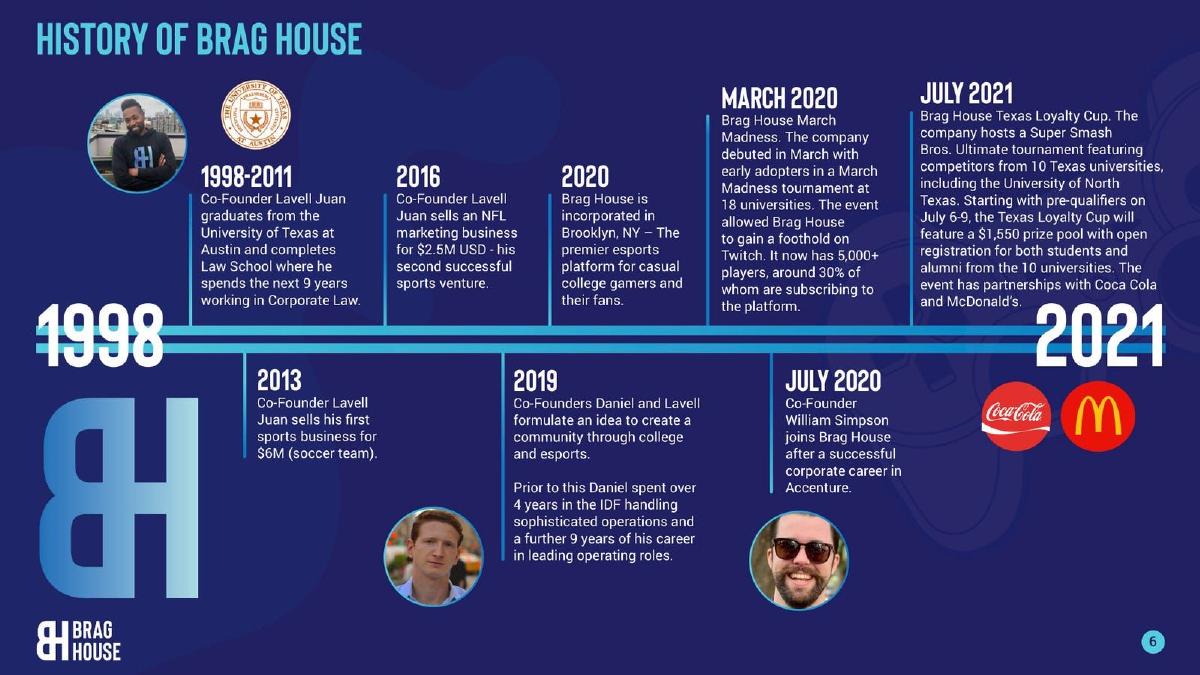
- The leadership team includes a Co-Founder with a background in the Israeli Defense Forces and operations at Darktrace (Slide 19).
Introduction and Market Positioning
Brag House entered the fundraising market with a clear thesis: the esports industry is hyper-focused on the elite 1% of players, leaving the 'casual' majority underserved. The deck, dated November 2021, served as the foundation for their 2023 Series A raise of $5M. The visual identity of the deck leans heavily into gaming aesthetics—dark blues, neon accents, and controller iconography—to signal industry alignment.
Slide 1: Title Slide
The opening slide establishes the brand as 'The Premier Esports Platform for Casual College Gamers and Their Fans.' It sets the stage for a niche focus within a massive industry, specifically targeting the collegiate demographic. The date, November 2021, indicates this deck was used for early-stage discussions leading up to their later reported funding.
Slide 2-3: The Context of Gaming
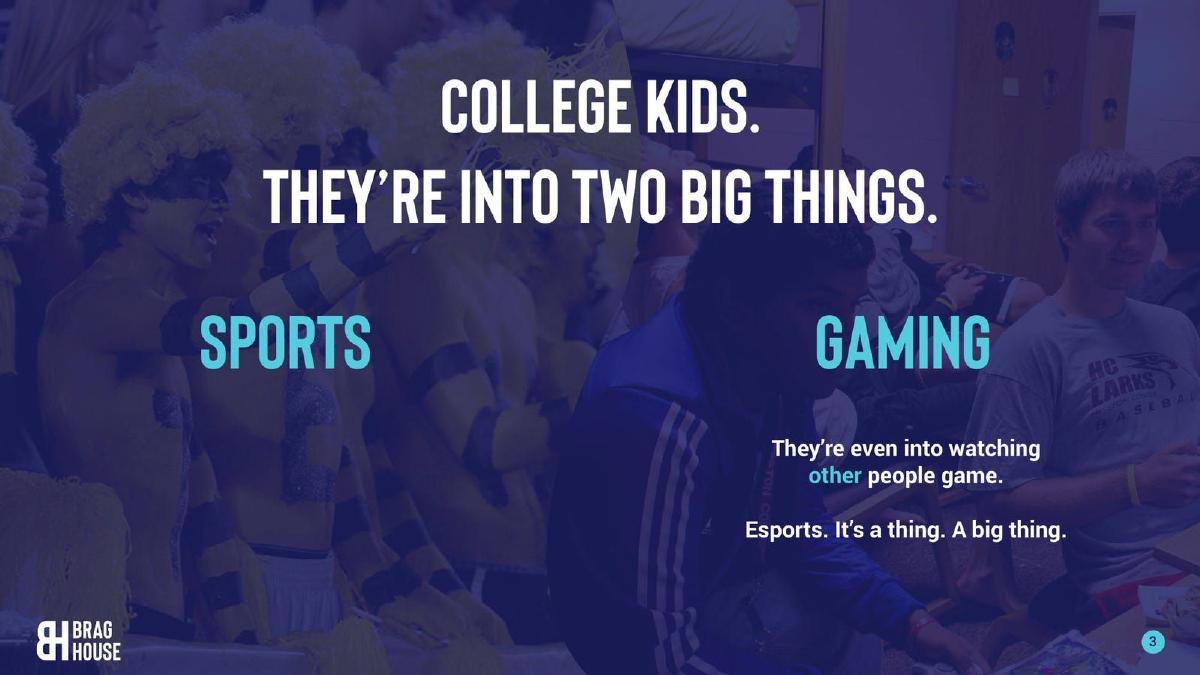
These slides (text-only in the provided summary) likely establish the scale of the gaming industry. By framing gaming as a cultural cornerstone for Gen Z, the company justifies why a dedicated collegiate platform is necessary. The narrative transition moves from 'gaming is big' to 'collegiate gaming is underserved.'
Slide 4: The Fragmentation Problem
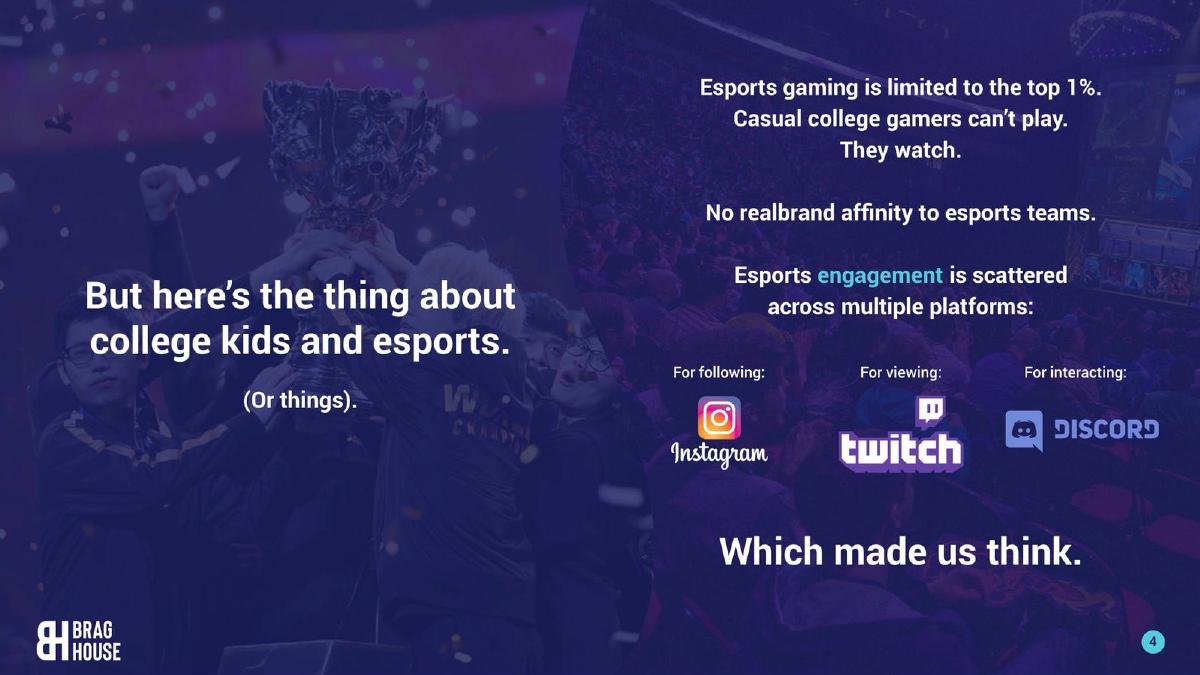
Slide 4 is a critical 'Problem' slide. It argues that collegiate esports engagement is currently 'scattered across multiple platforms.' It specifically names Instagram for following, Twitch for viewing, and Discord for interacting. By highlighting this fragmentation, Brag House positions itself as the 'all-in-one' solution that can capture the entire user journey in a single ecosystem.
Slide 5-6: Defining the Casual Gamer
These slides further refine the target audience. The deck claims that the top 1% of gamers have platforms, but the 'casuals'—the students who play for fun or social status—lack a home. This is a classic 'white space' argument, suggesting that the largest segment of the market is currently being ignored by professional-grade tournament organizers.
Slide 7: The Emotional Hook
Slide 7 uses the concept of 'college rivalries' to anchor the platform's value proposition. By showing a photo of a painted LSU fan, the deck connects the digital world of esports to the high-energy, high-affinity world of traditional college sports. The phrase 'An esports experience built around college rivalries for college fans' suggests that Brag House isn't just about the game; it's about the school pride.
Slide 8-9: The Solution
The solution slides detail the platform's features, including tournament hosting, social feeds, and prediction-based gaming. The emphasis is on 'bragging rights,' which aligns with the company name. The goal is to turn every campus into a competitive hub where students can represent their schools in a structured environment.
Slide 10: Competitive Landscape
Slide 10 is a standard competitive matrix but with specific, well-chosen axes. It compares Brag House against Barstool Sports , PlayVS , DraftKings , and Varsity Teams . Brag House claims to be the only one that hits all five criteria: Collegiate Market Focus, Centralized Platform, Full-Scale Tournament Production, Professional Commentary, and Risk-Free Wagers. Notably, it labels its gamer segment focus as 'Non-Professionals,' contrasting it with PlayVS ('Professionals') and Varsity Teams ('Elite').
Slide 11-12: Product Deep Dive
These slides likely showcase the mobile interface and the user experience. For a social platform, the 'look and feel' are vital to proving that the team can build a product that Gen Z will actually use. The focus remains on the integration of viewing and playing.
Slide 13: Traction and Metrics
Slide 13 is the most data-dense slide in the deck. It reports 2020 launch figures: 26 universities, 2,180 members, and a 30.1% paying user rate. Most impressively, it claims a $6.12 CAC and a ranking in the top 0.8% of all Twitch channels during its beta period. The slide also lists logos for several major universities, including UCLA, Ohio State, and Texas, indicating an 'active presence' at these institutions.
Slide 14-15: Revenue Model
The revenue model slides explain how the company makes money. The deck mentions a 'PaaS' (Platform as a Service) contract model for universities, alongside direct-to-consumer monetization through the 30% paying member base. This dual-revenue stream (B2B and B2C) is a strong signal for investors looking for diversified income.
Slide 16: The Five-Year Vision
Slide 16 presents a roadmap from 2020 to Year 5. The projections are aggressive: moving from 26 universities to 4,000, and from 2,180 members to 14.5 million. However, the revenue figures are listed as '$XXK' and '$XXmm,' which suggests that at the time of this deck's creation, the company was either keeping its financials confidential or was in a pre-revenue stage for certain products.
Slide 17-18: Market Opportunity
These slides likely zoom out to the total addressable market (TAM). By showing the number of college students globally and the growth of the esports market, the founders aim to prove that the 'Scale' phase of their vision is achievable.
Slide 19: The Team
Slide 19 focuses on Daniel Leibovich , Co-Founder and COO. His bio is extensive, highlighting 15 years of operations experience, including a role in the Israeli Defense Forces (IDF) where he worked on projects like the Iron Dome. This 'military-grade operations' narrative is intended to give investors confidence in the company's ability to execute complex logistics, such as nationwide tournament production.
Slide 20-21: Management and Culture
These slides likely introduce the rest of the leadership team. A common theme in these decks is balancing 'gaming expertise' with 'business maturity.' The text suggests a focus on creating a 'holistic esports community.'
Slide 22: Advisors
Slide 22 features a strong lineup of advisors, including Peter L. Fong , Freddie Adler (Antler), Davon Morgan (former NFL), and Delu Jackson (former VP at McDonald's). The inclusion of a former McDonald's and Kellogg executive (Delu Jackson) is particularly relevant for a platform that will eventually rely on brand sponsorships and consumer marketing.
Slide 23-24: The Ask and Closing
The final slides typically contain the funding ask and contact information. While the specific dollar amount isn't on these slides, the publisher reports a $5M Series A raise in 2023. The deck concludes by reinforcing the 'Brag House' brand and its mission to dominate the collegiate social gaming space.
What Works in This Deck
Clear Niche Identification: The deck does an excellent job of explaining why 'casual' gamers are a distinct and valuable segment compared to 'professional' gamers. · Low CAC: The $6.12 CAC figure on Slide 13 is a standout metric. In the crowded social media and gaming space, showing efficient user acquisition is a major plus for investors. · High Conversion: Reporting that 30.1% of members are 'paying' (Slide 13) is a strong indicator of product-market fit and willingness to pay within the collegiate demographic. · Strategic Advisors: The advisory board (Slide 22) covers the three pillars the company needs: venture capital, professional sports credibility, and big-brand marketing expertise.
What Is Missing from This Deck
Hard Revenue Data: The use of '$XXmm' on Slide 16 is a missed opportunity to show real financial growth. Even if the numbers were small, showing a trend line is usually better than placeholders. · Unit Economics: While CAC is mentioned, the Lifetime Value (LTV) of a user is not. Without LTV, the $6.12 CAC lacks context—investors don't know if the company is actually profitable on a per-user basis. · Churn/Retention Metrics: For a social platform, user retention is everything. The deck mentions '23.8% Month-to-Month growth' but doesn't disclose how many users stay on the platform after the first tournament ends. · Technical Infrastructure: There is little mention of the proprietary technology behind the platform. Given the COO's background in 'cutting-edge technology,' more detail on the platform's scalability would have been beneficial.
Founder Lessons: What to Copy
The 'Scattered Engagement' Slide: Slide 4 is a masterclass in identifying a problem. By showing the logos of Instagram, Twitch, and Discord, the founders make the 'fragmentation' problem feel tangible and urgent. · Leveraging Existing Affinities: Brag House didn't try to create new rivalries; they tapped into existing ones (LSU vs. rivals). Founders should always look for 'pre-sold' emotions they can build their product around. · The Competitive Matrix: Instead of just using 'Feature A' and 'Feature B' as axes, Brag House used 'Gamer Segment Focus' (Slide 10). This allowed them to place themselves in a quadrant all their own, rather than just claiming to be 'better' than competitors. · Operational Credibility: If you have a team member with a high-stakes background (like the IDF/Iron Dome mention on Slide 19), highlight it. It suggests a level of discipline and execution that is rare in the startup world.
Frequently asked questions
- What is the core problem Brag House aims to solve?
- According to Slide 4, the problem is twofold: esports is currently limited to the top 1% of players, leaving casual gamers as mere spectators, and fan engagement is fragmented across multiple platforms like Twitch and Discord. Brag House aims to centralize this experience around existing collegiate rivalries.
- How does Brag House differentiate itself from other gaming platforms?
- Slide 10 provides a competitive matrix showing that while competitors like PlayVS focus on professionals and DraftKings focuses on 'die-hards,' Brag House is the only platform offering full-scale tournament production and risk-free wagers specifically for the casual collegiate segment.
- What were the company's early traction metrics?
- As of the 2020 launch data on Slide 13, the company had 2,180 members across 26 universities. Notably, 30.1% of these members were paying users, and the platform maintained a month-to-month user growth rate of 23.8%.
- What is the long-term growth strategy for the platform?
- Slide 16 outlines a three-stage plan: Launch (direct to student), Growth (direct to university with 750 PaaS contracts), and Scale (expanding to alumni and media platforms). The goal is to reach 14.5 million members by Year 5.
- Who is leading the company's operations?
- Slide 19 introduces Daniel Leibovich as Co-Founder and COO. His background includes four years as a lieutenant in the IDF's Operations Branch, senior roles at startups like Darktrace, and a degree in Financial Economics from Columbia University.