BrandBoards presents a streamlined 8-slide demo day deck targeting the $9 billion global live event advertising market. The company aims to bring 'Google AdWords simplicity' to stadium digital signage, addressing the 15-35% of inventory that typically goes unsold. The deck's primary strength lies in its team slide, featuring executives with backgrounds at Anheuser-Busch, Cisco, and successful exits to Qualcomm. Despite its brevity, the deck manages to visualize a complex six-step marketplace workflow and showcase a portal mockup with real-world pricing data. With $1 million in signed advertis…
Key takeaways
- The mission is clearly defined as bringing 'Google AdWords simplicity and reach' to live event digital advertising (Slide 2).
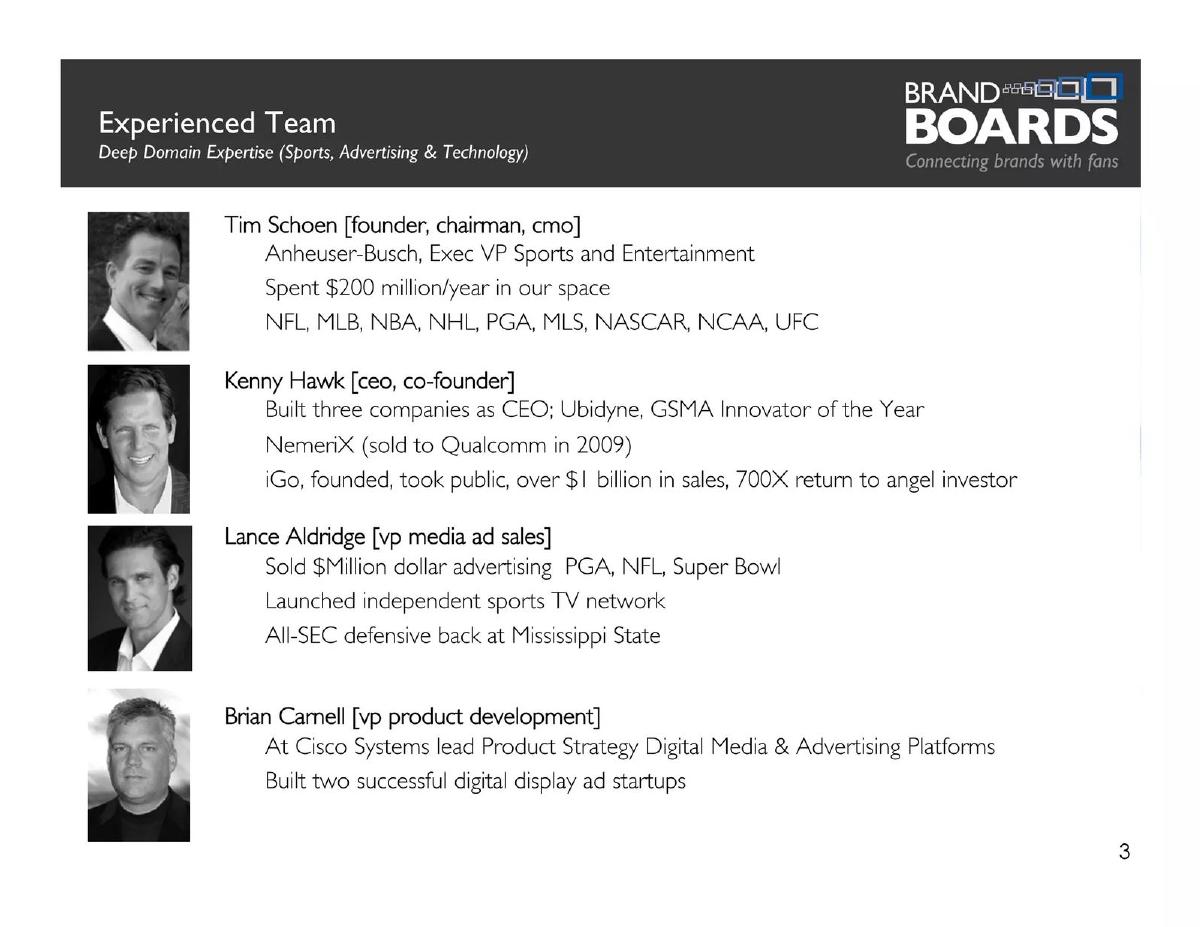
- The founding team possesses significant domain expertise, including a Chairman who managed a $200 million annual sports spend at Anheuser-Busch (Slide 3).
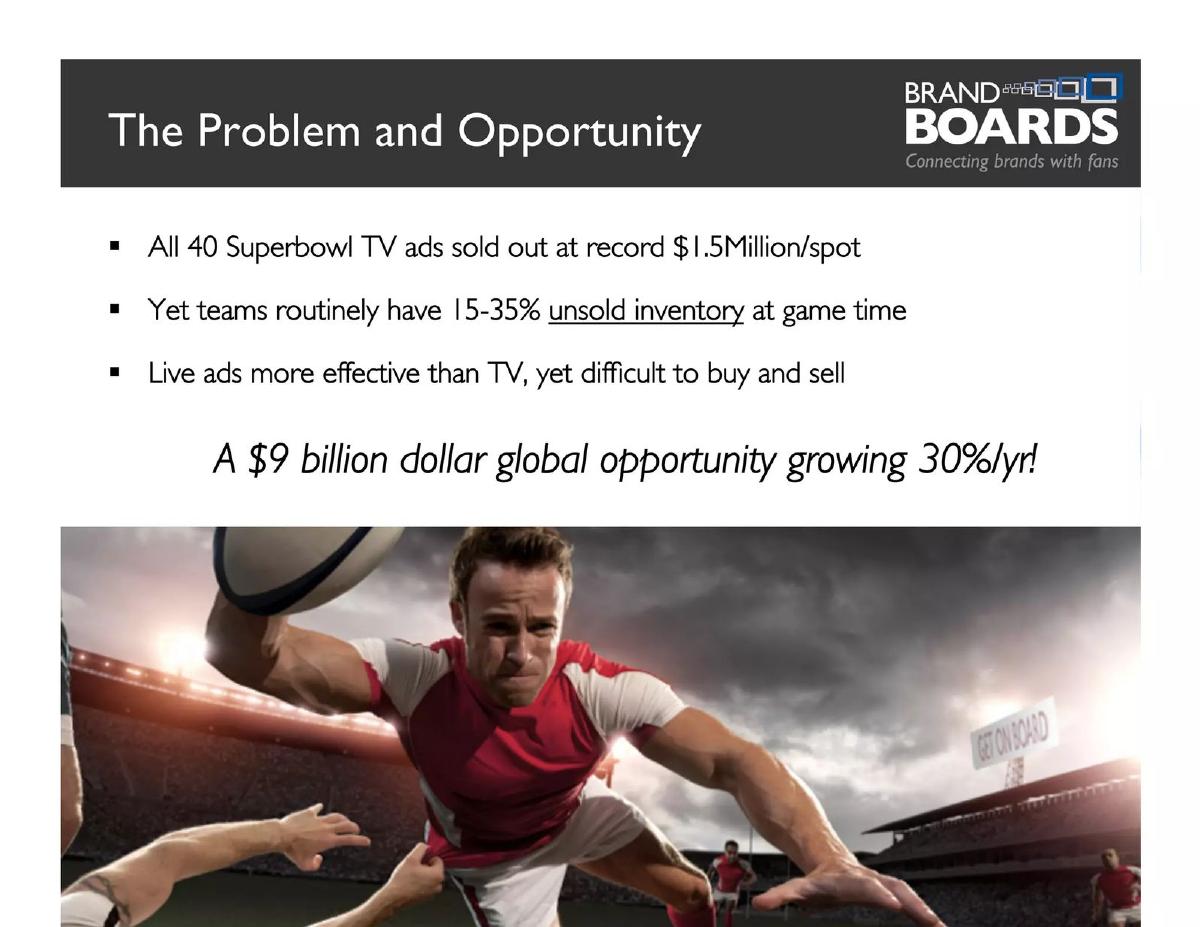
- The market opportunity is valued at $9 billion globally, growing at 30% per year, fueled by 15-35% unsold inventory at game time (Slide 4).
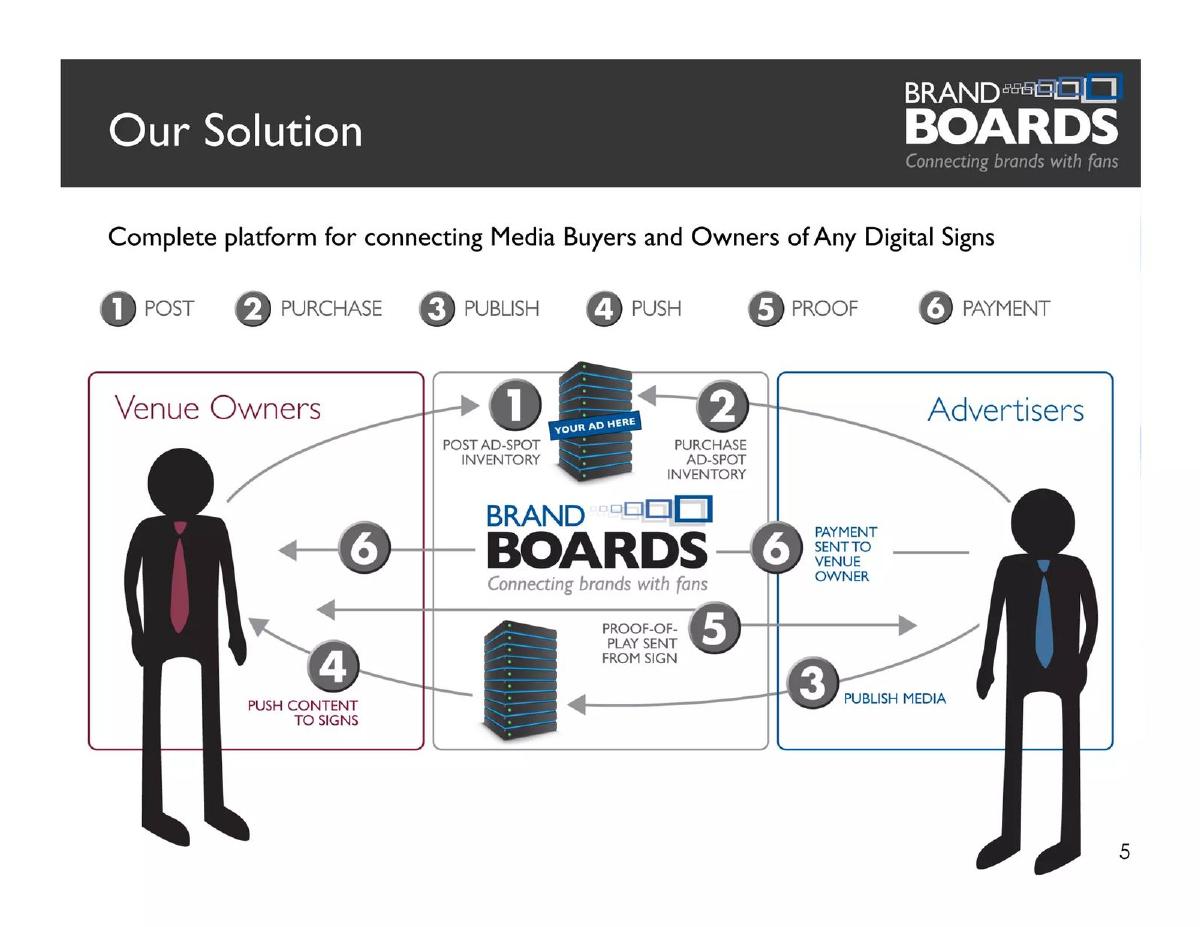
- The solution is a six-step marketplace connecting Venue Owners and Advertisers through a centralized platform (Slide 5).
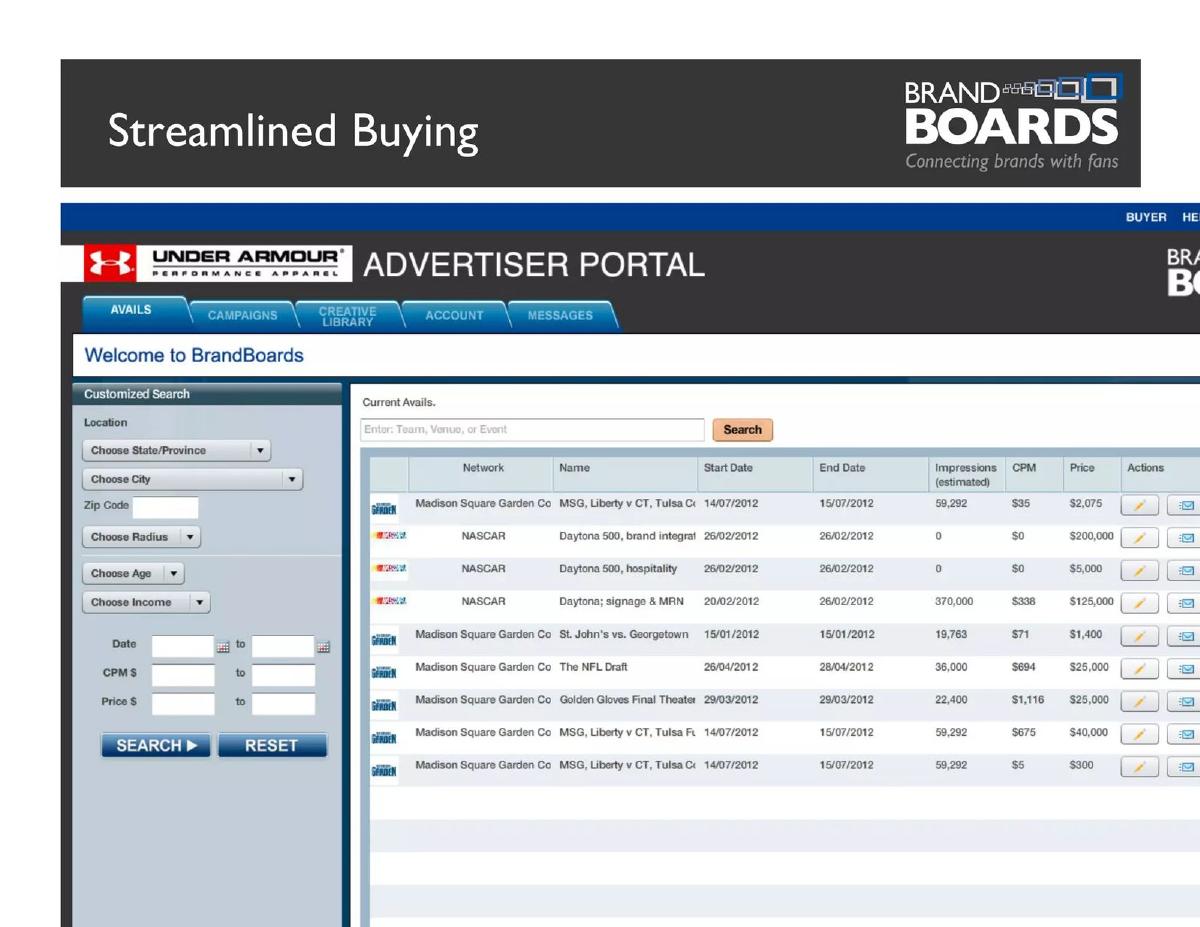
- Product maturity is demonstrated through a functional 'Advertiser Portal' mockup showing CPMs ranging from $5 to over $1,000 (Slide 6).
- Early traction is validated by $1 million in signed advertising commitments (Slide 7).
- The deck lists 12 major sports and racing logos, including the Knicks, Mavericks, and NASCAR, as being in the 'contract phase' (Slide 7).
- The investment ask is a specific $750,000, though the deck omits the intended use of funds or valuation (Slide 8).
BrandBoards: Streamlining the Stadium Ad Stack
The BrandBoards pitch deck is a concise, 8-slide presentation designed for a demo day environment. It focuses heavily on the 'Who' and the 'What,' relying on the immense professional credibility of its founders to bridge the gaps often left by short-form decks. By positioning themselves as the 'AdWords for stadiums,' they utilize a powerful mental model that investors can immediately grasp.
Slide 1: Title
The cover slide is minimalist, featuring the BrandBoards logo and the tagline 'Connecting brands with fans.' It identifies Kenny Hawk as the Co-Founder. The branding uses a blue and grey color palette that suggests a corporate, B2B focus. There is no mention of the specific round or date on this slide.
Slide 2: Mission
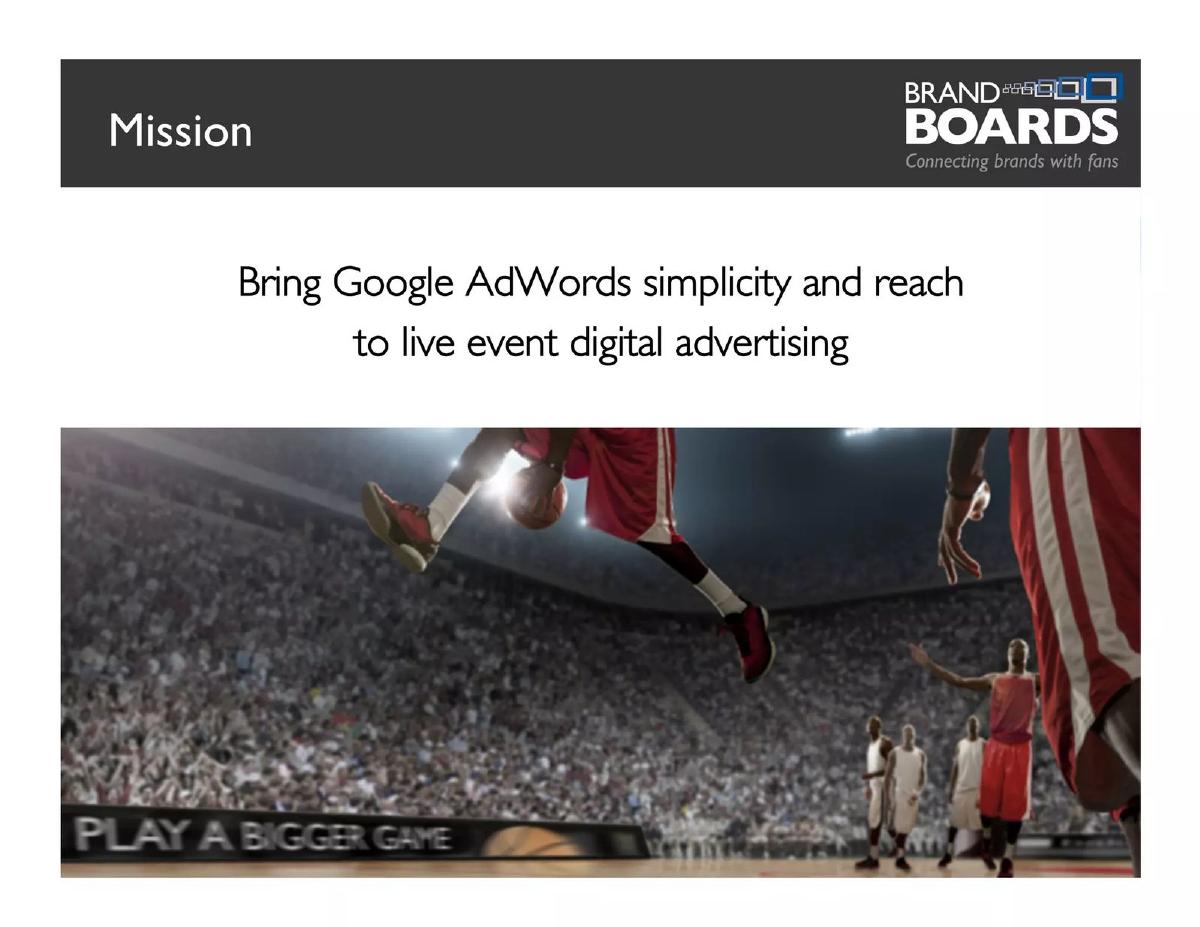
Slide 2 establishes the company's North Star: 'Bring Google AdWords simplicity and reach to live event digital advertising.' This is a classic 'X for Y' value proposition. By referencing AdWords, the company signals that it intends to build a self-service, scalable marketplace rather than a traditional manual ad agency. The background image of a basketball game reinforces the 'live event' context.
Slide 3: Experienced Team
This is arguably the strongest slide in the deck. The founders present 'Deep Domain Expertise' across sports, advertising, and technology. Tim Schoen is highlighted for his time at Anheuser-Busch, where he spent $200 million per year in the sports space across the NFL, NBA, and others. This establishes him as a 'buyer' who understands the pain points. Kenny Hawk is listed as a three-time CEO with an exit to Qualcomm and a $1 billion public company (iGo) under his belt. Lance Aldridge brings sales experience from the PGA and Super Bowl, while Brian Carnell provides technical leadership from Cisco. This team composition covers the three pillars of a marketplace: supply, demand, and platform.
Slide 4: The Problem and Opportunity
The deck quantifies the inefficiency in the current market. It notes that while Super Bowl ads sell for $1.5 million per spot, teams 'routinely have 15-35% unsold inventory at game time.' This 'perishable' inventory is the core opportunity. The slide claims a '$9 billion dollar global opportunity growing 30%/yr.' It frames the problem as a lack of liquidity: live ads are effective but 'difficult to buy and sell.'
Slide 5: Our Solution
Slide 5 uses a process diagram to explain the marketplace mechanics. It breaks the platform down into six steps: 1. Post, 2. Purchase, 3. Publish, 4. Push, 5. Proof, 6. Payment. The diagram shows BrandBoards acting as the central clearinghouse between 'Venue Owners' and 'Advertisers.' The inclusion of 'Proof-of-play' (Step 5) is a critical detail for advertisers who need verification that their digital ads actually appeared on the stadium boards.
Slide 6: Streamlined Buying
This slide provides a high-fidelity mockup of the 'Advertiser Portal.' It shows a search interface where buyers can filter by location, date, CPM, and price. The 'Current Avails' table is particularly revealing, showing real-world data points:
Madison Square Garden: St. John's vs. Georgetown, 19,763 impressions, $71 CPM, $1,400 total price. · NASCAR: Daytona signage & MRN, 370,000 impressions, $338 CPM, $125,000 total price. · Golden Gloves: $1,116 CPM for a $25,000 buy.
The presence of Under Armour branding at the top suggests a specific user persona or a potential pilot partner.
Slide 7: Accelerating Traction
Traction is presented through two lenses: hard dollars and brand partnerships. The slide states they have 'Signed first $1 Million in advertising commitments.' Below this, it lists logos for the Houston Texans, Dallas Cowboys, St. Louis Cardinals, Golden State Warriors, Oakland A's, Cleveland Cavaliers, New York Knicks, Kansas City Royals, Dallas Mavericks, New York Mets, NASCAR, and Orlando Magic. These are noted as being in the 'Contract phase,' which suggests these are active leads or pending partnerships rather than fully integrated customers.
Slide 8: Investment Opportunity
The final slide is the ask. BrandBoards is 'Raising $750K.' The slide provides a direct email for Kenny Hawk. It is a very standard, no-frills closing slide for a demo day presentation.
What Works in the BrandBoards Deck
1. The Team-Market Fit: The founders aren't just technologists; they are industry veterans. Having a Chairman who previously controlled a $200M budget in the exact sector they are disrupting is a massive validator. Investors are more likely to trust that this team can navigate the complex, relationship-driven world of sports leagues.
2. Clear Marketplace Mechanics: Slide 5 does an excellent job of demystifying how the software interacts with physical hardware. By showing the 'Push' and 'Proof' steps, they address the technical hurdles of digital out-of-home (DOOH) advertising early in the pitch.
3. Concrete Pricing Data: Including a portal mockup with specific CPMs and impression counts (Slide 6) makes the business feel real. It moves the conversation from theoretical 'billions of dollars' to specific $1,400 and $125,000 transactions.
What is Missing from the BrandBoards Deck
1. Business Model/Take Rate: While we see the transaction prices, the deck never explicitly states how BrandBoards makes money. Do they take a percentage of the transaction? Is there a SaaS fee for venue owners? The 'Payment' step is shown, but the revenue split is omitted.
2. Use of Funds: A $750,000 ask is relatively small for a company targeting a $9 billion market. The deck does not explain if this capital is for engineering, sales, or geographic expansion. Without a roadmap, the ask feels slightly disconnected from the scale of the opportunity.
3. Competition: The deck implies they are the first to bring 'AdWords simplicity' to this space, but it ignores existing players in the DOOH or sports marketing agency world. A slide addressing why existing ticketing or stadium management software hasn't already solved this would have been beneficial.
Founder's Playbook: What to Copy
The 'Mental Model' Strategy: If you are building a marketplace, find the most successful version of that marketplace in another industry (like AdWords) and use it as your mission statement. It reduces the cognitive load for the investor.
Quantify the 'Waste': BrandBoards didn't just say 'stadium ads are hard to buy.' They cited a specific percentage (15-35%) of inventory that goes to waste. If your startup solves an efficiency problem, you must quantify the current level of inefficiency.
Show, Don't Just Tell, the Product: Even if your platform is in beta, a mockup that includes realistic data (like the CPMs on Slide 6) is far more persuasive than a list of features. It shows you have thought through the unit economics of your own marketplace.
Focus on the 'Contract Phase': If you don't have 50 paying customers yet, listing high-profile logos that are in the 'contract phase' is a legitimate way to show momentum, provided you are honest about the status of those relationships as this deck is.
Frequently asked questions
- What is the core problem BrandBoards is solving?
- According to Slide 4, while high-profile events like the Super Bowl sell out, typical sports teams routinely have 15-35% of their digital signage inventory go unsold by game time. The deck argues that live ads are more effective than TV but remain difficult to buy and sell due to fragmented, manual processes.
- How does the BrandBoards marketplace actually function?
- Slide 5 illustrates a six-step circular workflow. Venue owners post inventory to the BrandBoards server (1), advertisers purchase that inventory (2) and publish their media (3). The platform then pushes content to the signs (4), sends proof-of-play back to the advertiser (5), and facilitates payment to the venue owner (6).
- What kind of pricing and inventory is shown in the platform?
- Slide 6 shows a mockup of the Advertiser Portal featuring inventory from Madison Square Garden and NASCAR. CPMs (Cost Per Mille) vary wildly based on the event, from a low of $5 for certain MSG events to $694 for the NFL Draft and $1,116 for the Golden Gloves Final Theater.
- Who are the key people behind the company?
- The team (Slide 3) is exceptionally high-pedigree. It includes Tim Schoen (former Exec VP at Anheuser-Busch), Kenny Hawk (CEO with a previous exit to Qualcomm and a public company founding), Lance Aldridge (VP Media with Super Bowl sales experience), and Brian Carnell (former Product Strategy lead at Cisco).
- What is the current stage of the business based on the deck?
- The company is in the early revenue/traction stage. Slide 7 notes they have signed their first $1 million in advertising commitments and are in the 'contract phase' with major teams across the NFL, NBA, MLB, and NHL, as well as NASCAR.