Brandvee is a content promotion platform designed to combat the decline of organic social reach, which the deck claims dropped from 4.2% to roughly 2% between late 2013 and early 2014. The company uses predictive analytics and a chatbot named Maya to notify marketers when specific content should be promoted. The deck outlines a clear historical timeline, including a £50k investment from Collider and a subsequent £100k follow-on. Seeking a further £100k in equity, the presentation emphasizes 'no friction' and 'high lock-in' as its primary competitive advantages. While the deck provides strong…
Key takeaways
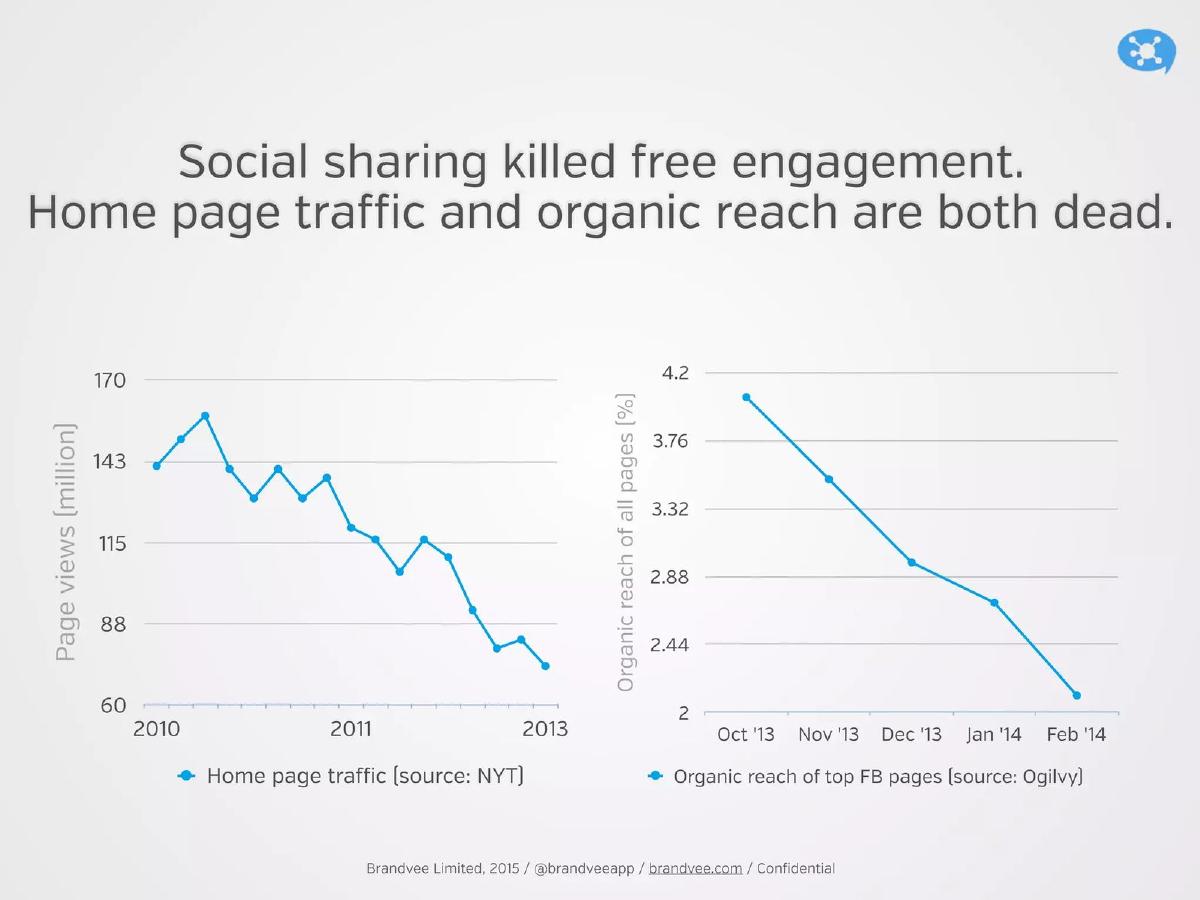
- The deck identifies a significant decline in organic reach for top Facebook pages, falling from 4.2% in Oct '13 to approximately 2.1% in Feb '14 (Slide 2).
- Brandvee positions itself against 'In-house solutions' like those at BuzzFeed and NYT, which are proprietary and not shared with the market (Slide 4).
- The product workflow centers on 'Maya,' a chatbot that sends messages to users when content is ready for promotion (Slide 5).
- The company claims its chatbot-driven approach results in twice as much sharing as competitors (Slide 6).
- Financial history includes a £50k investment and a £100k follow-on from Collider in late 2014 and early 2015 (Slide 7).
- The company projected reaching break-even status in Q1 2016, coinciding with a projected ARR spike toward £250k (Slide 7).
- The current funding ask is exactly £100,000 in equity (Slide 8).
- The deck lacks a dedicated team slide, mentioning only Co-founder & CEO David Szabo (Slide 8).
Slide-by-Slide Teardown
Slide 1: Title Slide
The cover slide introduces Brandvee Limited and its CEO, David Szabo. The tagline 'Turn content into an epidemic' establishes the company's focus on virality. The footer indicates the deck is from 2015 and is marked as confidential. The visual branding is clean, utilizing a blue speech-bubble logo with a network node icon, reinforcing the social/communication aspect of the product.
Slide 2: The Problem - Declining Reach
This slide uses data to validate the market need. It presents two line graphs. The first, citing The New York Times as a source, shows home page traffic declining from a peak of 160 million page views in 2010 to under 80 million by 2013. The second graph, citing Ogilvy, shows the organic reach of top Facebook pages dropping from 4.2% in October 2013 to just above 2% in February 2014. The headline 'Social sharing killed free engagement' is a bold, provocative statement designed to create urgency.
Slide 3: The Market Pain Point
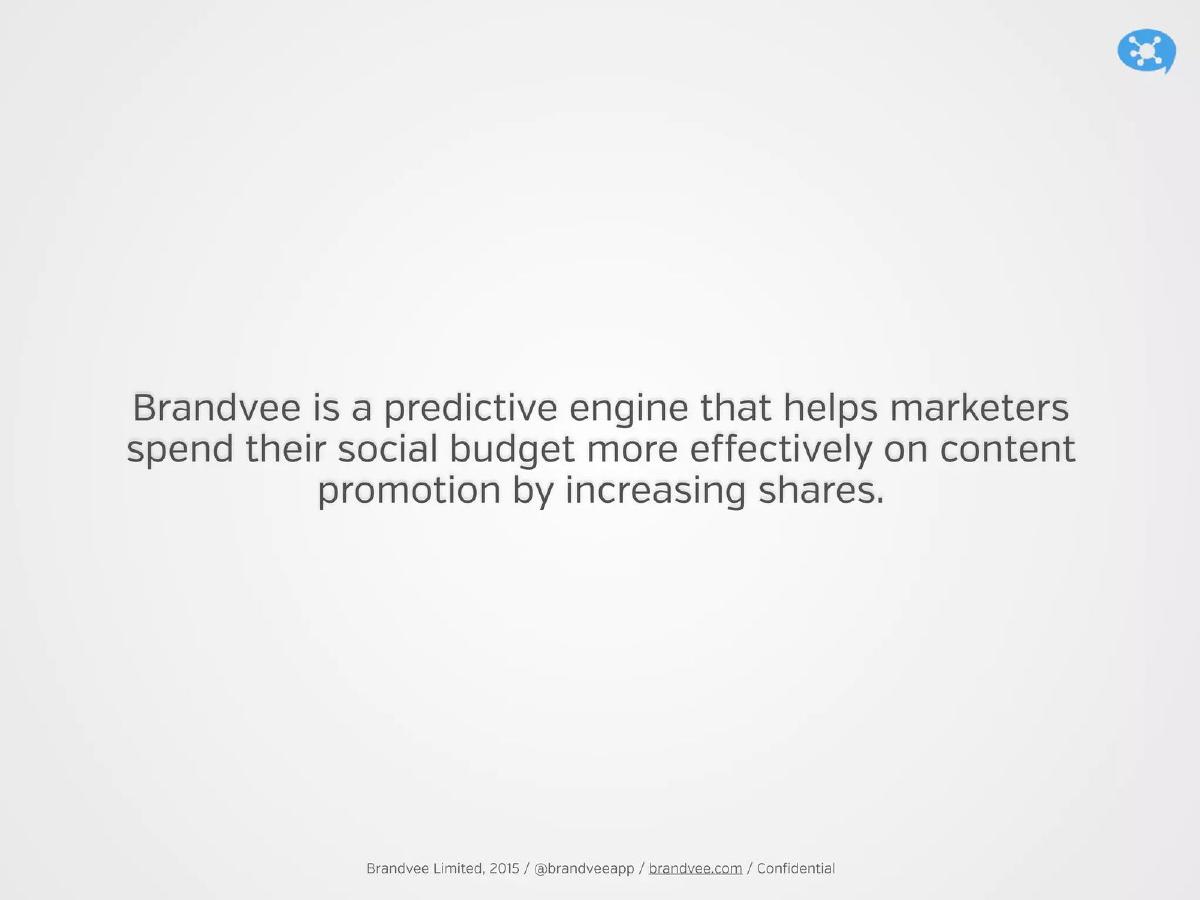
Slide 3 is a simple transition slide stating, 'Content promotion is a nightmare for today's marketers...' This serves to bridge the data-heavy problem slide with the competitive landscape and solution slides. It focuses on the emotional frustration of the target customer (marketers).
Slide 4: Competitive Landscape
Brandvee categorizes the current market into three 'improper' solutions. In-house solutions (BuzzFeed, NYT) are criticized for being proprietary and unavailable to others. Web analytics tools (Google Analytics, Chartbeat) are described as unable to track 'generations of sharers.' Promotion networks (Taboola, RadiumOne) are framed as underserved segments that optimize for clicks rather than social sharing, failing to prove viral effects. This positioning suggests a gap in the market for a tool that focuses specifically on viral tracking and social sharing optimization.
Slide 5: The Solution - Predictive Analytics
The solution is presented as a three-step process. The core differentiator is 'Maya,' a chatbot that proactively notifies users when content should be promoted. This moves the user away from passive dashboard monitoring to active, triggered responses. The slide includes three small screenshots of the interface, showing a chat window, a viral velocity graph, and a 'viral activity' heat map. The claim is that these reports act as 'extraordinary sales tools' by proving influence.
Slide 6: Unfair Advantages
Brandvee lists three 'unfair advantages.' First is Proprietary technology , claiming to redefine sharing using data science and mathematics. Second is No friction & high lock-in , asserting that chatbots are replacing dashboards and that their 'intel' drives twice as much sharing as competitors. Third is Integration & automation , stating a goal to build an 'automated content promotion machine' that allows clients to benchmark networks based on viral effect. The mention of 'higher lock-in' is a specific nod to investor interests in customer retention.
Slide 7: Milestones & Financials
This slide provides a detailed historical and projected timeline from Q4 2014 to Q3 2016. It tracks two metrics: 'Cash in bank' (gray area) and 'ARR' (blue line). Key milestones include a £50k investment from Collider (Q1 2015), a £100k follow-on from Collider (Q2 2015), and the end of beta tests in Q3 2015. The chart projects a significant ARR ramp-up starting in Q1 2016, aiming for over £438k by Q3 2016, with a break-even point in early 2016. It also notes a £100k bridge round in Q4 2015.
Slide 8: The Ask
The final slide clearly states the funding goal: 'We’re raising £100,000 in equity.' It provides direct contact information for David Szabo, including his email and phone number. It also points to a dedicated investor URL. This slide functions as a clear call to action, though it lacks details on the valuation or the specific use of funds beyond the 'hire dev & sales' note on the previous slide.
What Brandvee Does Well
Data-Driven Problem Definition: The use of specific, sourced charts on Slide 2 is excellent. By citing the New York Times and Ogilvy, the founders ground their 'nightmare' scenario in verifiable industry trends. This makes the problem feel objective rather than anecdotal.
Product Differentiation: The focus on a chatbot (Maya) as the primary interface was quite forward-thinking for 2015. By framing the chatbot as a way to reduce 'friction' and replace 'dashboards,' Brandvee identifies a specific user experience pain point that many SaaS companies overlook.
Clear Financial History: Slide 7 is a very transparent look at the company's capitalization and runway. Showing previous investment amounts and the specific quarters they were received builds credibility and shows a track record of successfully raising capital and hitting milestones.
What is Missing from the Deck
Team Slide: The most glaring omission is a dedicated team slide. While David Szabo is mentioned as CEO, there is no information about his background, technical co-founders, or the data scientists responsible for the 'proprietary tech' mentioned on Slide 6. Investors at the seed stage invest in people as much as ideas.
Market Size (TAM/SAM/SOM): The deck explains why the problem exists but does not quantify how many marketers or publishers would pay for the solution. There is no mention of the total addressable market size, which makes it difficult for an investor to judge the potential scale of the exit.
Business Model Details: While Slide 7 mentions ARR, the deck never explains the pricing structure. Is it a flat monthly fee, a percentage of ad spend, or based on the number of articles tracked? Without understanding the unit economics, the ARR projections feel speculative.
Founder Takeaways
Use 'Bridge' Slides Wisely: Slide 3 is a simple text-on-white transition. While it breaks up the deck, it is a missed opportunity to add a customer quote or a powerful image that illustrates the 'nightmare' of content promotion. If you use a transition slide, make sure it adds emotional or narrative weight.
Quantify the 'Unfair' Advantage: Brandvee claims their intel drives 'twice as much sharing as our competitors.' This is a powerful claim, but the deck doesn't explain how that was measured or provide a case study to back it up. If you make a bold performance claim, ensure the evidence is nearby.
Visualizing the Future: The ARR chart on Slide 7 is a good example of how to combine historical reality with future projections. By showing the 'Cash in bank' alongside the revenue growth, the founders demonstrate an understanding of runway management, which is a key concern for seed investors.
Frequently asked questions
- What specific problem is Brandvee trying to solve?
- Brandvee is addressing the 'death' of organic reach and home page traffic. According to Slide 2, home page traffic (sourced from NYT) saw a steady decline from 2010 to 2013, while Facebook's organic reach for top pages plummeted by half in just five months. The company argues that content promotion has become a 'nightmare' because existing web analytics tools cannot track generations of sharers or prove the viral effect of traffic.
- How does the Brandvee product actually work?
- The product operates in three steps as shown on Slide 5. First, a chatbot named Maya sends a message to the user indicating when a piece of content should be promoted based on predictive analytics. Second, the user can access additional insights via an online platform. Third, the system generates performance reports that serve as sales tools by proving the virality and influence of the content.
- Who does Brandvee consider to be its competition?
- Slide 4 categorizes competition into three groups: In-house solutions (BuzzFeed and The New York Times), Web analytics tools (Google Analytics and Chartbeat), and Promotion networks (Taboola and RadiumOne). Brandvee claims these competitors either don't share their tools, can't track viral generations, or optimize for clicks rather than social sharing.
- What are the financial milestones and projections mentioned?
- Slide 7 shows a timeline where beta tests ended and sales started in Q3 2015. The company secured a £100k bridge round and its first enterprise client in Q4 2015. Projections for 2016 included breaking even in Q1, hiring development and sales staff in Q2, and reaching an Annual Recurring Revenue (ARR) of over £438k by Q3 2016.
- What is the investment ask and who is the lead contact?
- The company is seeking £100,000 in equity, as stated on Slide 8. The primary contact listed is David Szabo, identified as the Co-founder and CEO. The slide provides his Twitter handle (@szabodav), email address, and a UK-based mobile phone number, directing further inquiries to a specific investor URL on the company website.