Vise AI’s 2019 seed deck is a textbook example of how to frame a B2B solution for a legacy industry. By identifying a specific 'Holy Grail'—the intersection of time, money, and customization—the founders positioned their AI-driven platform as the inevitable evolution of wealth management. The deck successfully raised $3.5M by highlighting that 87% of advisors struggle with growth due to time constraints and that 71% of clients are disappointed with their current advice. While the deck is light on specific product screenshots and traction metrics, it compensates with a high-pedigree team slide…
Key takeaways
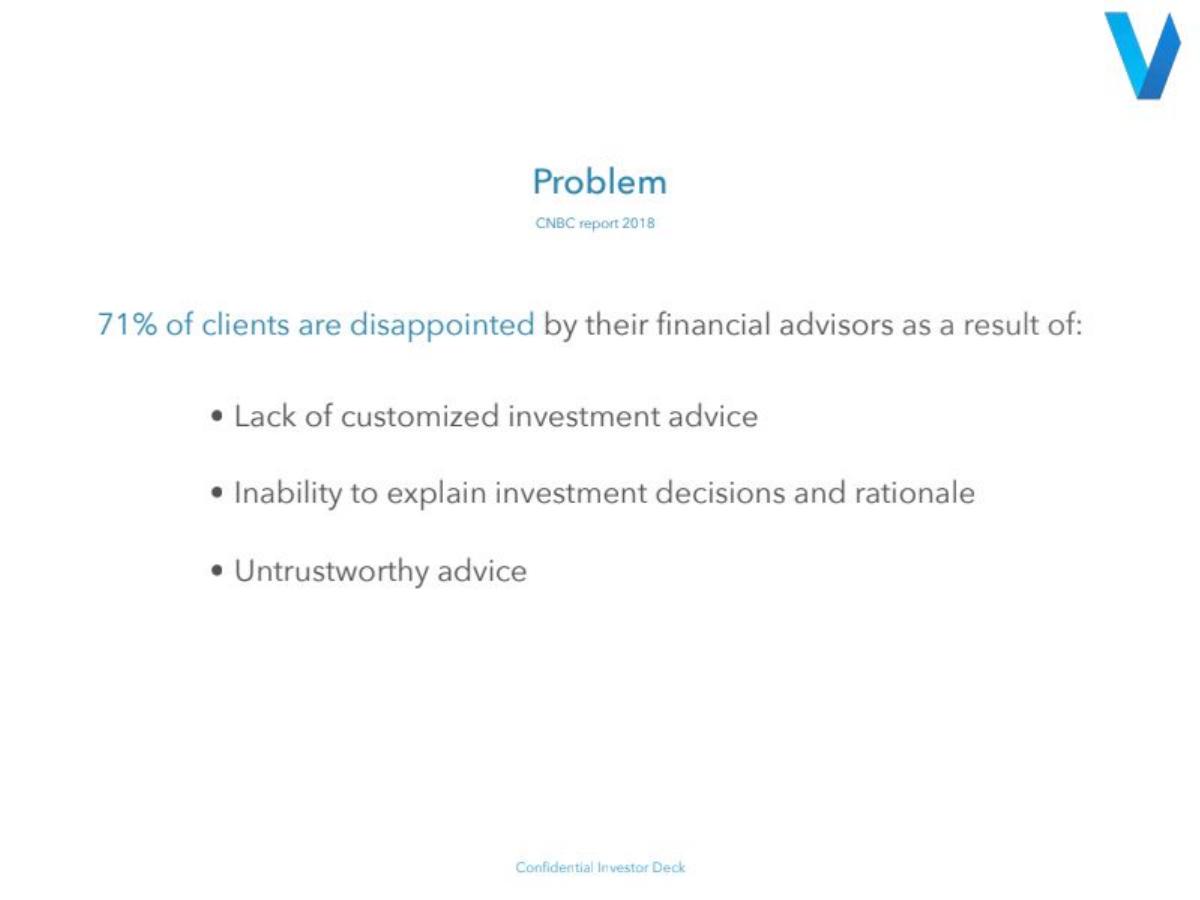
- The deck identifies that 71% of clients are disappointed by financial advisors due to lack of customization and inability to explain decisions (Slide 2).
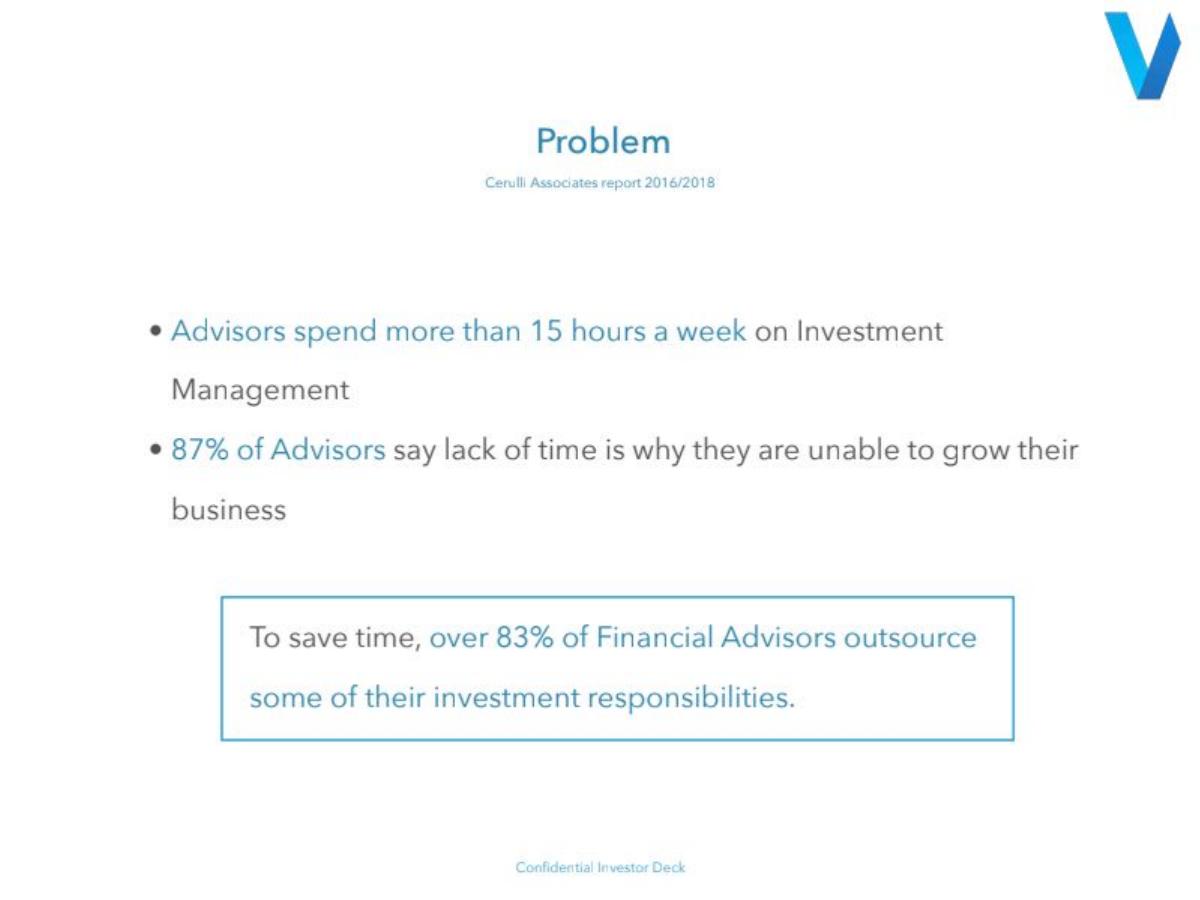
- Advisors spend over 15 hours a week on investment management, which 87% cite as the reason they cannot grow their business (Slide 3).
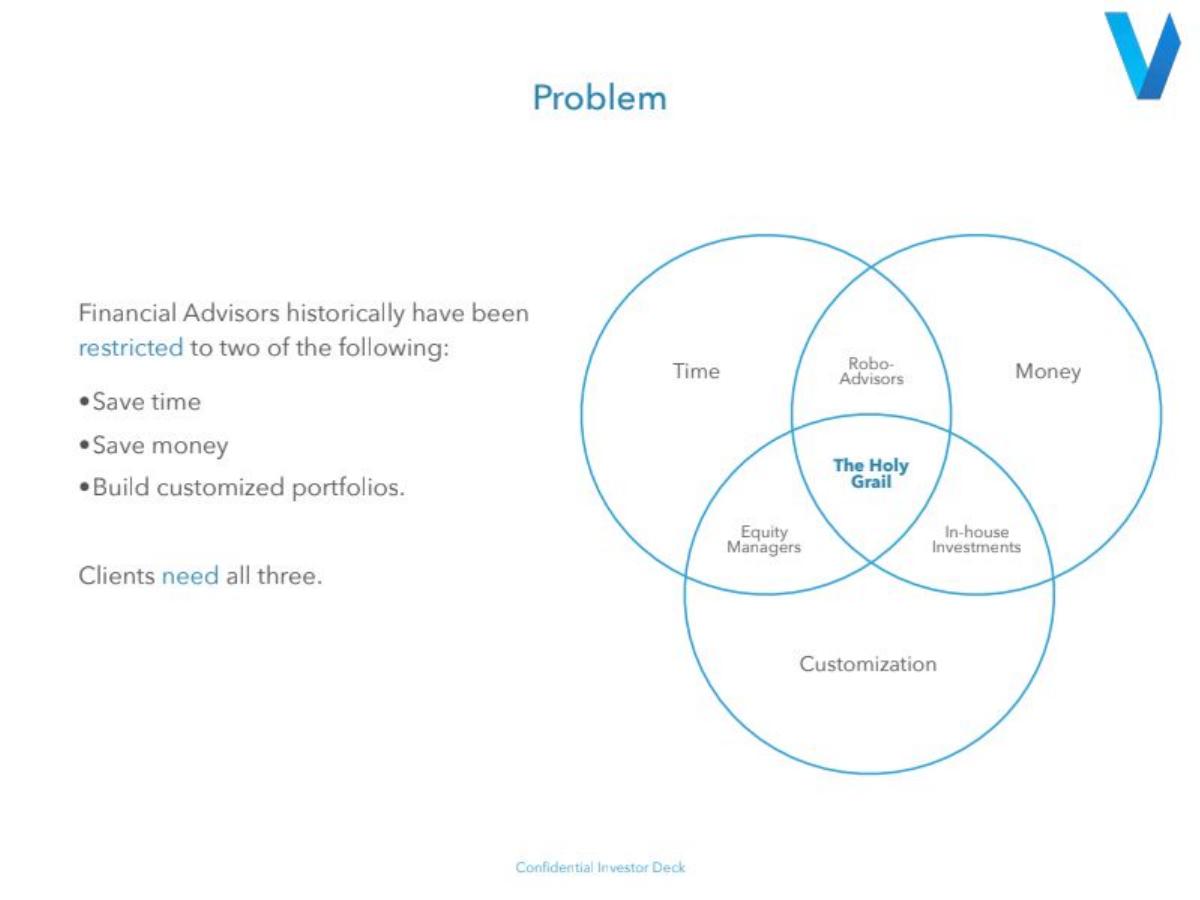
- Vise AI positions itself as the 'Holy Grail' by simultaneously solving for time, money, and customization (Slide 4).
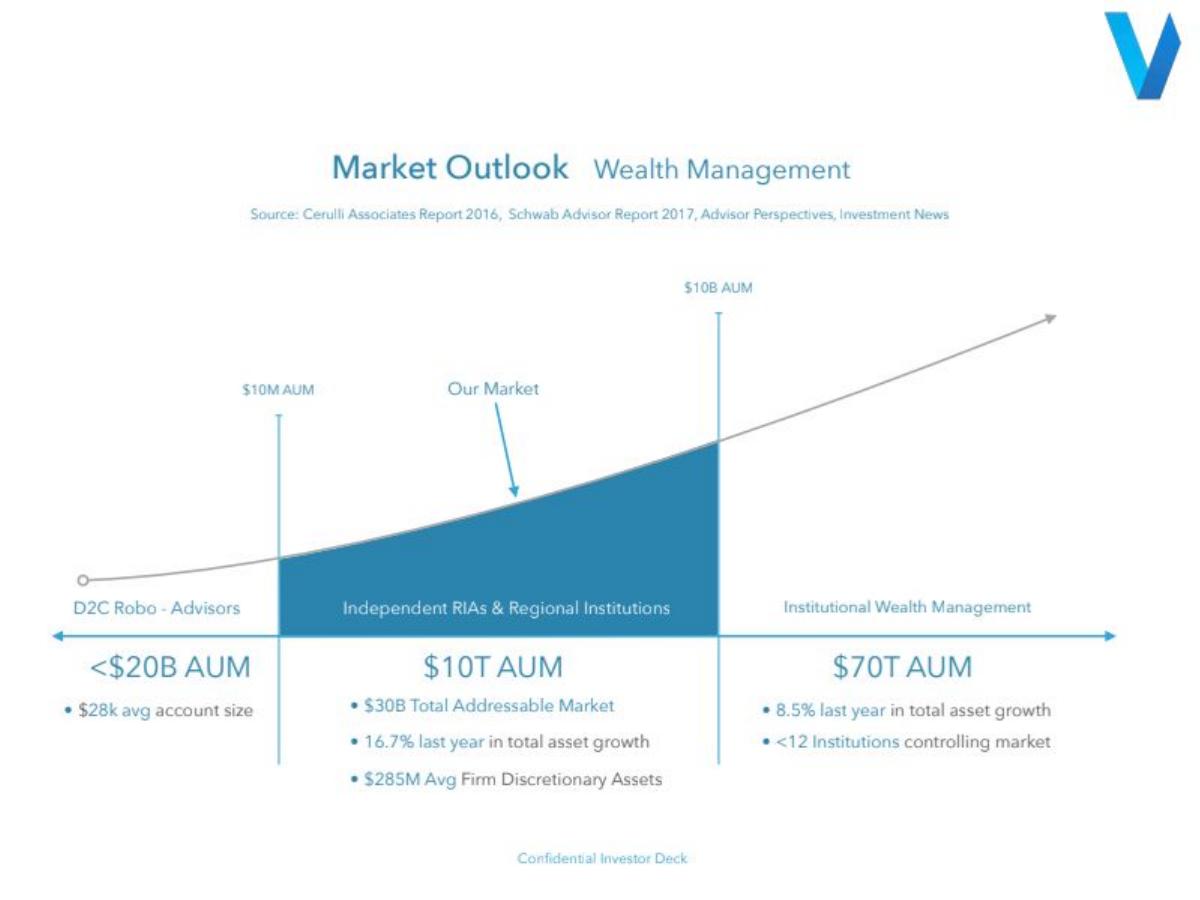
- The market outlook segments the industry into D2C Robo-Advisors (<$20B AUM), Independent RIAs ($10T AUM), and Institutional Wealth Management ($70T AUM) (Slide 6).
- Vise targets the $10T Independent RIA market, noting a $30B Total Addressable Market within that segment (Slide 6).
- The business model proposes a flat 0.25% AUM fee, significantly undercutting the 0.90% industry standard for manager, TAMP, and clearing fees (Slide 8).
- The technology utilizes Recurrent Neural Networks to identify correlations in alternative data and NLP to read thousands of SEC filings in seconds (Slide 9).
- The team slide emphasizes high academic and professional pedigree, including a Lead Data Scientist who was a former MD at IBM and a Scientific Advisor from Goldman Sachs (Slide 10).
The Vise AI Seed Deck: A Strategic Breakdown
Vise AI entered the market in 2019 with a clear mission: to bring institutional-grade AI to the independent financial advisor. The wealth management industry is notoriously slow to adopt new technology, and this deck reflects a deep understanding of the psychological and operational barriers facing Registered Investment Advisors (RIAs). By focusing on 'time' as the primary pain point for the advisor and 'customization' as the primary pain point for the client, Vise created a compelling narrative that resonated with top-tier investors like Sequoia Capital and Founders Fund.
Slide 1: Title Slide
The deck opens with a minimalist title slide featuring the Vise AI logo and the tagline: Empowering Financial Advisors to Make Better Investment Decisions . It establishes a professional, fintech-forward aesthetic immediately. The footer notes this as a 'Confidential Investor Deck.'
Slide 2: The Client Problem
Vise begins by addressing the end-consumer's dissatisfaction. Citing a 2018 CNBC report, the slide states that 71% of clients are disappointed by their financial advisors. The three bullet points identify the root causes: lack of customized advice, inability to explain decisions, and untrustworthy advice. This sets the stage for a solution that prioritizes transparency and personalization.
Slide 3: The Advisor Problem
The narrative shifts from the client to the service provider. Citing Cerulli Associates, Vise notes that Advisors spend more than 15 hours a week on investment management. Crucially, it highlights that 87% of Advisors say lack of time prevents them from growing their business. The slide concludes that 83% of advisors already outsource some responsibilities, proving there is an existing market for third-party management tools.
Slide 4: The Holy Grail
This slide uses a Venn diagram to visualize the competitive landscape. It argues that advisors have historically been restricted to choosing only two of three benefits: Time, Money, and Customization . Existing solutions like Robo-Advisors (Time/Money) or In-house Investments (Money/Customization) fall short. Vise positions itself at the center of the diagram, labeled The Holy Grail , promising all three simultaneously.
Slide 5: The Solution
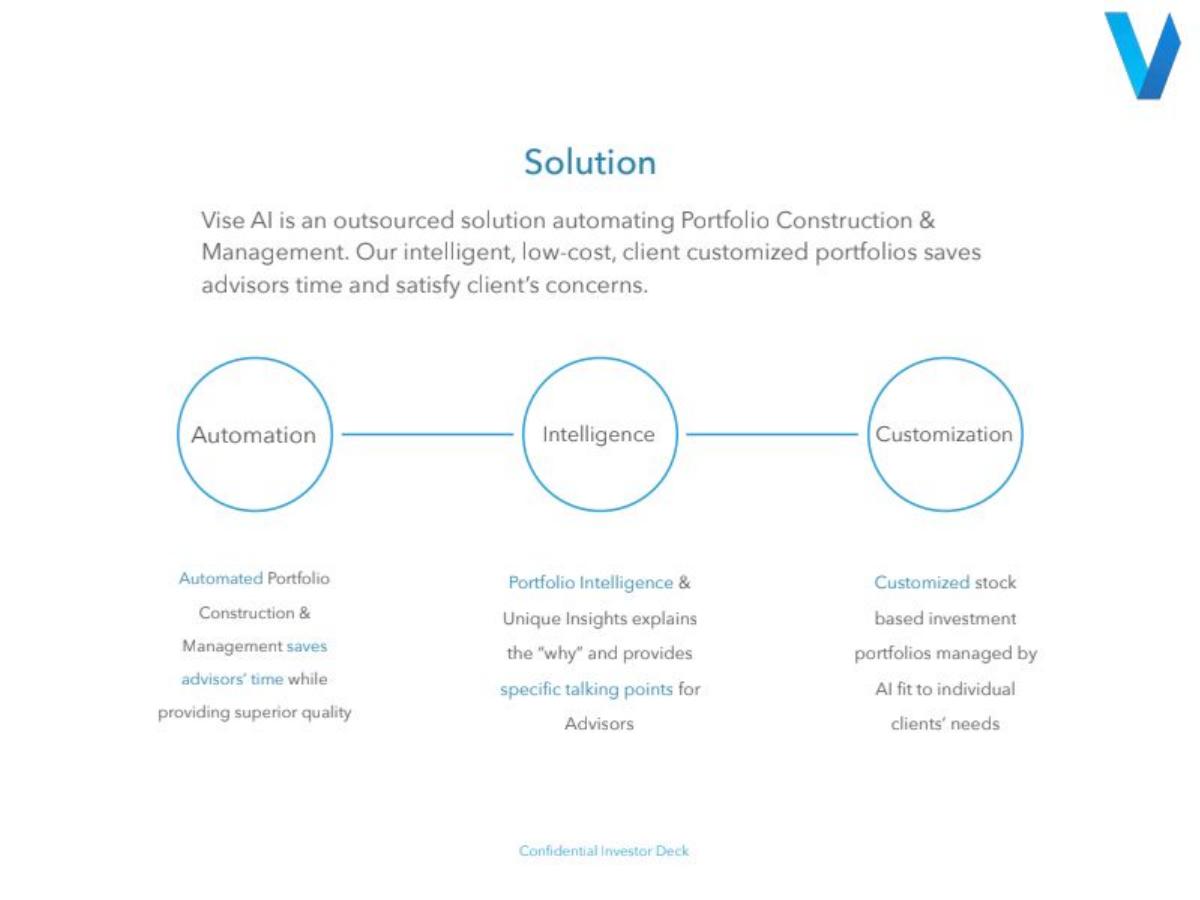
The solution slide defines Vise AI as an outsourced solution automating Portfolio Construction & Management . It breaks the value proposition into three pillars: Automation (saving time), Intelligence (providing the 'why' and specific talking points), and Customization (AI-fit portfolios for individual needs). This is the first mention of using AI to generate 'talking points,' a critical feature for advisors who need to justify their fees to clients.
Slide 6: Market Outlook - Wealth Management
This is a sophisticated market segmentation slide. It divides the wealth management universe into three tiers based on AUM. The first is D2C Robo-Advisors ( Independent RIAs & Regional Institutions , representing $10T AUM and a $30B Total Addressable Market . This shows investors that the company is focused on a massive, yet reachable, segment.
Slide 7: Market Outlook - Tech Adoption
Vise addresses the 'tech-phobic' reputation of financial advisors. It provides three data points to argue the tide is turning: 77%+ of RIAs cite automation as their biggest need, 61%+ still spend 40% of their time on manual tasks, and 78%+ of clients choose advisors based on their use of technology. This slide serves to de-risk the 'market adoption' concern for investors.
Slide 8: Business Model
The business model is presented as a direct comparison. The 'Industry Standard' is shown as a stack of fees totaling 0.90% (0.75% Manager, 0.10% TAMP, 0.05% Clearing). Vise proposes an all-inclusive fee of 0.25% . By combining trading costs and margin into a single, lower fee, Vise positions itself as both a technological and economic upgrade for the advisor.
Slide 9: Technology
This slide provides the technical 'meat' of the deck. It lists four components: 1. Machine Learning for Portfolio Construction (using Recurrent Neural Networks), 2. Portfolio Intelligence (using NLP to read SEC filings), 3. Active Portfolio Management (smart-tax based rebalancing), and 4. Design & Interface (integration into existing trading platforms). This slide is designed to prove that the 'AI' in the company name is backed by sophisticated engineering rather than just marketing.
Slide 10: Team
The team slide is a high-signal asset for a seed round. It features the co-founders, Samir Vasavada and Runik Mehrotra, but emphasizes the supporting cast. The roster includes Dr. Marc Ettlinger (ex-Google AI), Dr. Joshua Woodruff (ex-Morgan Stanley MD), and Dr. Joerg Osterrieder (ex-Goldman Sachs). The inclusion of advisors from Future Advisor and EQIS adds further industry credibility. The headline 'Ph.D Level Engineering Team' reinforces the technical moat.
Slide 11: Closing Slide
The deck concludes with a repeat of the logo and tagline. Notably, there is no 'Ask' slide in this version of the deck, which is common in leaked or public versions of successful seed decks.
What Works in the Vise AI Deck
Specific Market Targeting: By explicitly excluding the D2C and massive Institutional segments on Slide 6, Vise showed investors they had a 'wedge' strategy. They weren't trying to boil the ocean; they were going after the $10T RIA market that was underserved by modern tech.
Economic Disruption: Slide 8 is perhaps the most powerful slide in the deck. It doesn't just say they are cheaper; it shows the specific legacy fees (TAMP, Clearing, Manager) that they are eliminating. This makes the 0.25% fee feel like an inevitable market correction rather than just a discount.
Pedigree as a Proxy for Progress: At the seed stage, product-market fit is rarely proven. Vise used the academic and professional backgrounds of their team (Slide 10) to convince investors that they were capable of building the complex AI described on Slide 9.
What is Missing from the Vise AI Deck
Product Screenshots: The deck is entirely conceptual. While Slide 9 mentions a 'beautiful' interface, there are no actual visuals of the platform. Investors are left to take the founders' word on the user experience.
Traction or Pilot Data: There is no mention of current AUM, signed LOIs, or pilot programs with specific RIAs. This suggests the $3.5M raise was based almost entirely on the team, the market opportunity, and the technical vision.
The 'Ask': As noted, the deck lacks a slide detailing how much capital is being raised and how it will be spent. While this information is often shared in person, its absence in the deck makes it less of a standalone document.
Founder Lessons from Vise AI
Focus on the 'Why': Vise didn't just say they built a portfolio tool. They said they built a tool that gives advisors 'talking points' to explain the 'why' to clients. Understanding the emotional labor of your customer (the advisor having to justify their fee) is a key insight that founders should emulate.
Use Industry-Standard Language: The deck uses terms like 'RIA,' 'TAMP,' 'AUM,' and 'SEC filings' correctly and strategically. This signals to investors that the founders aren't just 'tech guys' playing in finance, but that they deeply understand the regulatory and operational landscape of wealth management.
Quantify the Inefficiency: Don't just say your customers are busy. Say they spend '15 hours a week' on a specific task. Quantifying the pain point makes the ROI of your solution much easier for an investor to calculate.
Frequently asked questions
- What was the primary problem Vise AI aimed to solve?
- According to slides 2 and 3, the problem is two-fold: clients are unhappy with the lack of transparency and customization in their portfolios, while advisors are bogged down by administrative tasks. Specifically, 87% of advisors claim they lack the time to grow their business because they spend over 15 hours a week on manual investment management.
- How does Vise AI's pricing compare to the industry standard?
- Slide 8 shows that Vise AI charges an all-inclusive fee of 0.25% of Assets Under Management (AUM). This is contrasted against an 'Industry Standard' stack that totals 0.90%, consisting of a 0.75% Manager Fee, a 0.10% TAMP Fee, and a 0.05% Clearing Fee.
- Which specific market segment is Vise AI targeting?
- Slide 6 identifies 'Independent RIAs & Regional Institutions' as the primary target. This segment represents $10T in AUM with a $30B Total Addressable Market. The deck explicitly avoids the D2C Robo-Advisor space and the massive $70T Institutional Wealth Management space for its initial focus.
- What technical capabilities does the deck highlight?
- Slide 9 outlines four pillars: Machine Learning for portfolio construction using Recurrent Neural Networks, Portfolio Intelligence using NLP to analyze SEC filings and analyst reports, Active Portfolio Management for smart-tax rebalancing, and a modern Design & Interface for firm-specific customization.
- Who were the key team members listed in the seed deck?
- The team (Slide 10) was led by co-founders Samir Vasavada and Runik Mehrotra. Key technical hires included Dr. Marc Ettlinger (ex-Google AI) and Dr. Joshua Woodruff (ex-Morgan Stanley MD). Advisors included Scott Winters (CEO of Financial Gravity) and Jon Xu (Co-founder of Future Advisor).