The VirtuOz deck from 2007 represents a transitional moment in AI history, moving from basic automated scripts to 'Personal Intelligent Assistants.' The company targeted large enterprise accounts like eBay and AOL, utilizing a 'pay per dialog' business model ranging from 0.22 € to 0.58 € per interaction. While the visual design reflects the era's 3D avatar trends, the underlying strategy was forward-thinking, proposing a 'Meta VirtuOz' layer that integrated with mobile devices, instant messengers, and SMS. However, the deck is notably light on technical architecture and team credentials, focu…
Key takeaways
- VirtuOz defined its product as a 'Personal Intelligent Assistant' that learns habits and provides services 24/7 (Slide 3).
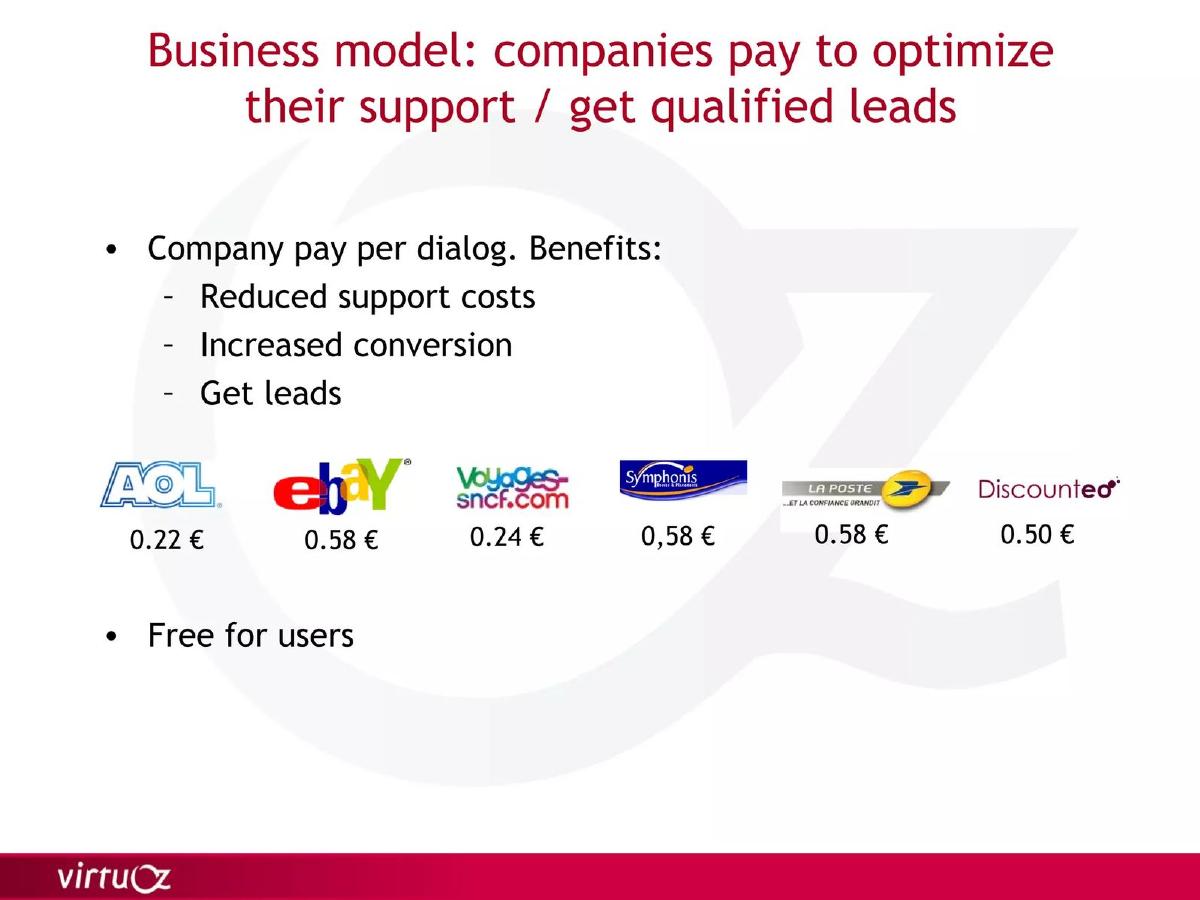
- The business model was strictly B2B, charging companies per dialogue while remaining free for end-users (Slide 5).
- Exact pricing figures for early clients included 0.22 € for AOL, 0.58 € for eBay, and 0.24 € for Voyages-sncf.com (Slide 5).
- The platform aimed to integrate with external APIs and interfaces, including Citysearch, Outlook, and American Airlines AAdvantage (Slide 4).
- The strategy involved three pillars: Corporate Agents for large accounts, Social Agents with creation tools, and a central 'Meta VirtuOz' hub (Slide 6).
- The deck identifies the 'old way' of trip planning as complex and time-consuming, requiring multiple browser tabs and manual coordination (Slide 2).
- The product was designed to be cross-platform, supporting website, instant messenger, SMS, and voice (Slide 3).
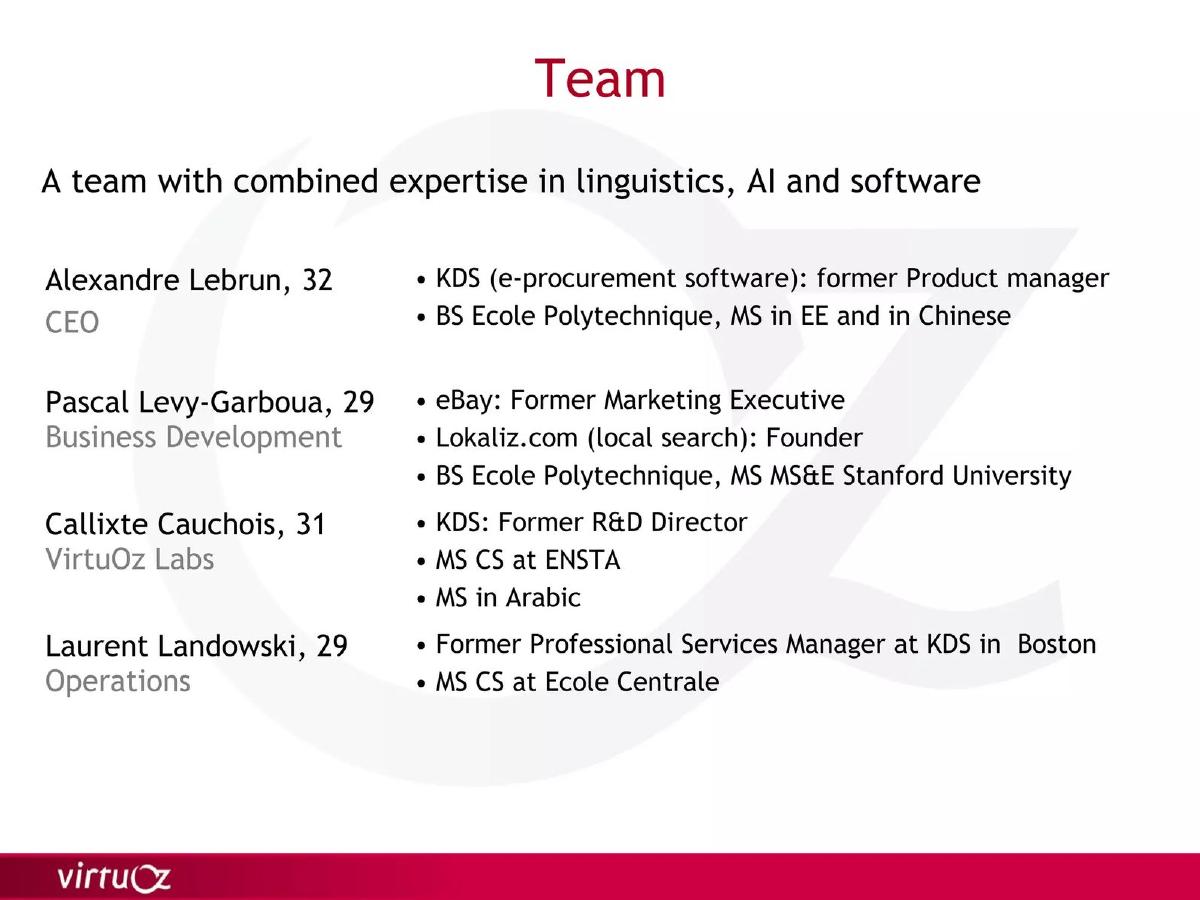
- The deck omits a team slide, financial projections, and a specific fundraising 'ask' in the provided slides.
VirtuOz: The 2007 Vision for Conversational Middleware
The VirtuOz pitch deck from 2007 is a historical artifact that captures the first major wave of commercial chatbots. Long before the current era of Generative AI, companies like VirtuOz were attempting to solve the 'fragmentation problem' of the early web using 3D avatars and natural language processing (NLP). The deck focuses heavily on the transition from manual web navigation to automated assistance, emphasizing a business model built on transactional efficiency.
Slide 1: Title and Brand Identity
The cover slide introduces VirtuOz with the subtitle 'Personal Intelligent Assistants.' The visual centerpiece is a 3D-rendered female avatar in professional attire. In 2007, these 'skeuomorphic' avatars were the industry standard for representing AI, intended to make the technology feel more approachable and human-like. The branding is clean, utilizing a red and white color palette that persists throughout the deck.
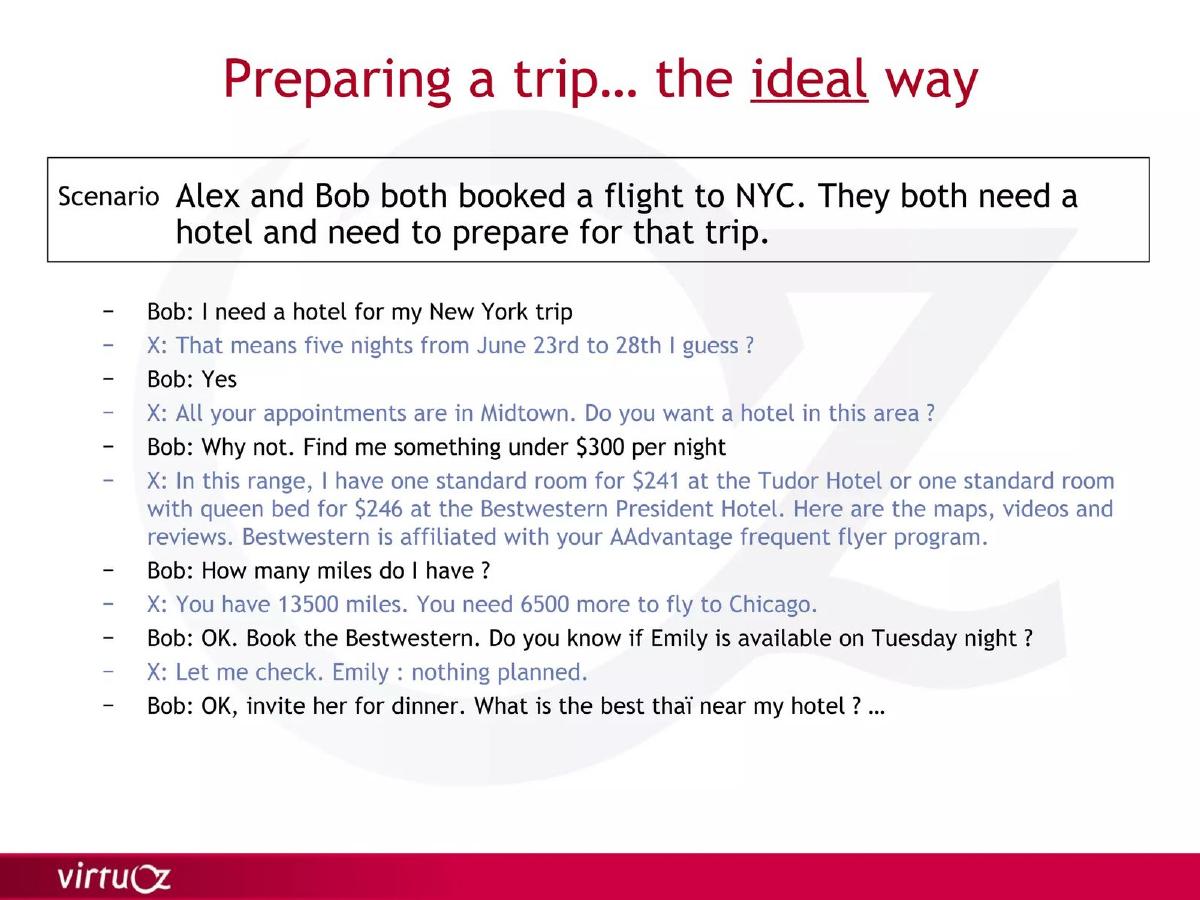
Slide 2: The Problem - 'Preparing a trip... the old way'
Slide 2 sets the stage by illustrating the friction in the 2007 digital experience. It presents a scenario: 'Alex and Bob both booked a flight to NYC. They both need a hotel and need to prepare for that trip.' The slide features a chaotic web of screenshots including Microsoft Outlook, Google Maps, Hotels.com, Citysearch, American Airlines (AAdvantage), and an instant messenger. The conclusion at the bottom is clear: the process is 'Complex and time-consuming.' This is a classic 'status quo' slide, highlighting the cognitive load required for users to coordinate data across multiple siloed platforms.
Slide 3: Defining the Personal Intelligent Assistant
This slide attempts to define the product category. VirtuOz breaks down their name into three components: Personal (knows the user, profile, and habits), Intelligent (performs understanding, reasoning, and learns), and Assistant (provides services 24/7). The slide lists the delivery channels: 'website, instant messenger, SMS, voice.' Screenshots show the avatar on a web page, a French-language chat interface discussing plasma vs. LCD TVs, and a mobile device (a Windows Mobile-style PDA) running a chat session. This slide establishes the ambition of the product—not just a FAQ bot, but a cross-platform companion.
Slide 4: Technical Feasibility and Integration
Slide 4 asks, 'Is it possible?' and uses a visual metaphor to explain their approach. On the left, a traditional 'robot' icon is marked 'NO,' suggesting that a standalone, isolated bot is the wrong path. On the right, the VirtuOz avatar is shown as a central hub connected to various services: AAdvantage account, Hotel booking, Citysearch API, IM interface to friends, and Outlook interface. The slide lists three technical pillars: NL-based (Natural Language), User-generated , and Transactional . This indicates that VirtuOz viewed itself as a middleware layer that could read and write to third-party APIs to complete tasks for the user.
Slide 5: The Business Model - Pay Per Dialog
This is the most data-rich slide in the deck. It explicitly states the business model: 'companies pay to optimize their support / get qualified leads.' The benefits listed are reduced support costs, increased conversion, and lead generation. Crucially, the slide lists exact per-dialogue pricing for six major brands:
AOL: 0.22 € · eBay: 0.58 € · Voyages-sncf.com: 0.24 € · Symphonis: 0.58 € · La Poste: 0.58 € · Discounted: 0.50 €
The slide also notes that the service is 'Free for users.' This performance-based pricing model was a hallmark of early SaaS, attempting to prove ROI by charging only when the bot was actually engaged.
Slide 6: Strategy and Ecosystem
The final slide in this set outlines the broader 'Strategy.' It depicts three overlapping circles: Corporate Agents (targeting large accounts and SOHO for ad/sales/support), Social Agents (featuring 'KH Creation tools' and a historical portrait, likely suggesting a legacy or personality-driven bot), and Meta VirtuOz . The center of the diagram shows a silhouette of a professional surrounded by mobile devices, instant messengers, voice phones, and desktop widgets (including a MySpace logo). This slide suggests that VirtuOz intended to move beyond simple B2B support into a broader consumer ecosystem where users could create their own agents.
What Works in This Deck
Clear Value Proposition: The transition from Slide 2 (the problem) to Slide 4 (the solution) is logical. It identifies a specific pain point—multi-tab browsing—and offers a unified interface as the solution.
Transparent Pricing: Including exact Euro figures for specific clients like eBay and AOL is a bold move that provides immediate clarity on the company's revenue mechanics. It shows that the product is not just a concept but is actively being monetized by major enterprises.
Multi-Channel Vision: In 2007, the mobile web was in its infancy. By including SMS, voice, and early mobile devices in their strategy, VirtuOz demonstrated a forward-thinking approach to where consumer attention was heading.
What is Missing
The Team: There is no slide in the provided set that introduces the founders or the engineering team. In AI startups, the technical pedigree of the team is often the most important factor for investors.
Market Size (TAM): While the deck lists impressive clients, it does not quantify the total addressable market for automated support or lead generation.
The 'Ask': There is no mention of how much money the company is looking to raise, the valuation they are seeking, or what milestones the funding will help them achieve.
Unit Economics: While we see the 'revenue' per dialogue, there is no information on the 'cost' per dialogue. Investors would need to know the margins on these 0.22 € to 0.58 € transactions to determine if the business is scalable.
Founder Takeaways
Use Scenarios to Explain Complexity: Slide 2's 'Alex and Bob' scenario is an excellent way to ground a complex technical product in a relatable human experience. Modern founders should use similar story-based problem slides.
Validate with Real Logos: The inclusion of eBay, AOL, and La Poste immediately builds credibility. If you have pilots or early customers, showing their logos alongside the specific value you provide them (or what they pay) is highly effective.
Define Your Category: Slide 3 does a great job of breaking down a buzzword ('Personal Intelligent Assistant') into functional requirements. This prevents the investor from projecting their own (potentially incorrect) definitions onto your product.
Frequently asked questions
- What was the primary value proposition of VirtuOz in 2007?
- VirtuOz focused on two primary outcomes for enterprise clients: reducing support costs and increasing lead conversion. By using 'Intelligent Assistants' to handle customer inquiries, they aimed to replace manual, time-consuming web searches and support tickets with a natural language interface that could perform reasoning and combine multiple knowledge sources.
- How did VirtuOz monetize its chatbot technology?
- The company utilized a 'pay per dialog' model. Slide 5 shows specific rates for their early adopters, such as 0.58 € for eBay and La Poste, and 0.22 € for AOL. This performance-based pricing was designed to align the cost of the software with the volume of customer interactions it successfully handled.
- What platforms did VirtuOz support?
- According to Slide 3, the assistant was intended to be available 24/7 across multiple channels: websites, instant messengers (like Windows Live Messenger, shown in screenshots), SMS, and voice. Slide 6 further illustrates integrations with mobile devices, desktop apps, and widgets like MySpace.
- How did VirtuOz differentiate its AI from simple bots?
- Slide 4 uses a 'NO/YES' comparison to distinguish their tech. They rejected the idea of a standalone, disconnected robot. Instead, they proposed a 'Natural Language-based' system that provided 'seamless access' to transactional data and user-generated content, effectively acting as a middleware layer between the user and various web APIs.
- What is missing from this pitch deck?
- The provided slides lack several critical components of a standard venture pitch: there is no team slide detailing founder expertise, no competitive landscape analysis, no financial roadmap or burn rate data, and no slide outlining the specific amount of capital being raised or the intended use of funds.